
A semiconductor packaging line is being relocated. The tools are eleven years old, fully functional, and worth a fraction of what the current generation costs. The receiving site is in Vietnam, one of the few places actively building semiconductor capacity from the ground up while the rest of the industry competes for finished AI hardware. On paper this is the easiest kind of deal: proven equipment, a buyer who wants it, a government that has publicly committed to the industry. Then the compliance questions arrive, and one of them is not the sort anyone prepares for. The age of the tools turns out to be answerable. So does their condition. The question nobody has an answer to is whether the country the equipment is leaving has ever published a list that includes it.
Since 1 January 2026, used production lines, equipment, machinery and tools entering Vietnam for semiconductor work or digital technology research have been governed by Circular No. 30/2025/TT-BKHCN. The headline change is a liberalisation: the permitted age doubled from ten years to twenty. The conditions attached to it are the difficulty. One of them turns on a list published by the exporting country, not by Vietnam, and an importer cannot answer it from Vietnamese law or from its own records.
Circular 30 in short:
- What it is: Circular No. 30/2025/TT-BKHCN, issued by Vietnam’s Ministry of Science and Technology on 14 November 2025, in force from 1 January 2026.
- What it covers: used technology lines, equipment, machinery and tools imported for semiconductor manufacturing, packaging and testing, or for training, research and development in digital technology.
- What it does not cover: used machinery for general industrial purposes, which remains under Decision 18/2019/QD-TTg and its ten year ceiling.
- The headline change: the age limit for qualifying individual tools doubled from ten years to twenty.
- The procedural change: no advance import licence. Importers self-assess and file a written commitment with customs.
- The hardest condition: the equipment must not appear on the exporting country’s list of outdated, poor quality or environmentally polluting equipment.
- The penalty: where equipment admitted for research or training is found in production use, the reported remedy is re-export of the shipment.
Most coverage of this circular has framed it as Vietnam tightening the rules. That reading is backwards, and getting it backwards leads to the wrong commercial decision.
Why Vietnam Wants Used Equipment in the First Place
Semiconductor capacity is not built by buying the newest tools. Leading-edge lithography is priced beyond the reach of a new entrant, and much of the work that makes an industry viable, assembly, packaging, testing, and the training of the engineers who will run it, is done on equipment that is one or two generations behind. Every country that has established a semiconductor sector has done so partly by acquiring the previous generation’s tools from someone upgrading, which is why relocation and production shifts between countries generate as much equipment movement as new build does.
Vietnam is at exactly that stage. It has established assembly, packaging and testing operations, is working to add fabrication capability, and the state has been explicit about wanting the ecosystem to develop quickly. A ten-year age ceiling on imported equipment, the general rule for used machinery under Decision 18/2019/QD-TTg, is an obstacle to that ambition rather than a protection of it. Much of the useful inventory on the global secondary market is older than ten years and entirely serviceable.
Circular 30 is the response. It sits under the Digital Industry Law, which also took effect on 1 January 2026, and it was issued by the Ministry of Science and Technology on 14 November 2025. The intent is to admit capable older equipment while keeping out what the drafters describe as outdated, inefficient or polluting technology. Whether a given machine falls on one side of that line or the other is the entire question.
Importing Used Equipment into Vietnam: What the Circular Actually Covers
Before anything else, scope. This matters because commentary on Circular 30 has circulated well beyond its actual reach, including advice aimed at buyers of general industrial plant who are not affected by it at all.
The circular applies to used technology lines, equipment, machinery and tools imported for two defined purposes:
- Training, research and development of digital technology products and services.
- Direct service of projects manufacturing, packaging or testing semiconductor chip products.
That is the boundary, and it is narrower than much of what has been written about it. Used equipment imported into Vietnam for general manufacturing, for a warehouse, or for a factory with no semiconductor or digital technology purpose is not governed by this instrument. It continues to sit under Decision 18/2019/QD-TTg, the wider regime for second-hand machinery, where the ten year ceiling still applies.
This matters because the misreading is already circulating. There is published advice telling buyers of general industrial plant, including air compressors, that Circular 30 has changed their position. It has not. Those goods were never in scope, and acting on that advice can push a buyer towards new equipment on the strength of a rule that does not reach them.
The Three Conditions That Apply to Everything in Scope
Whichever of the two purposes applies, three conditions run across both.
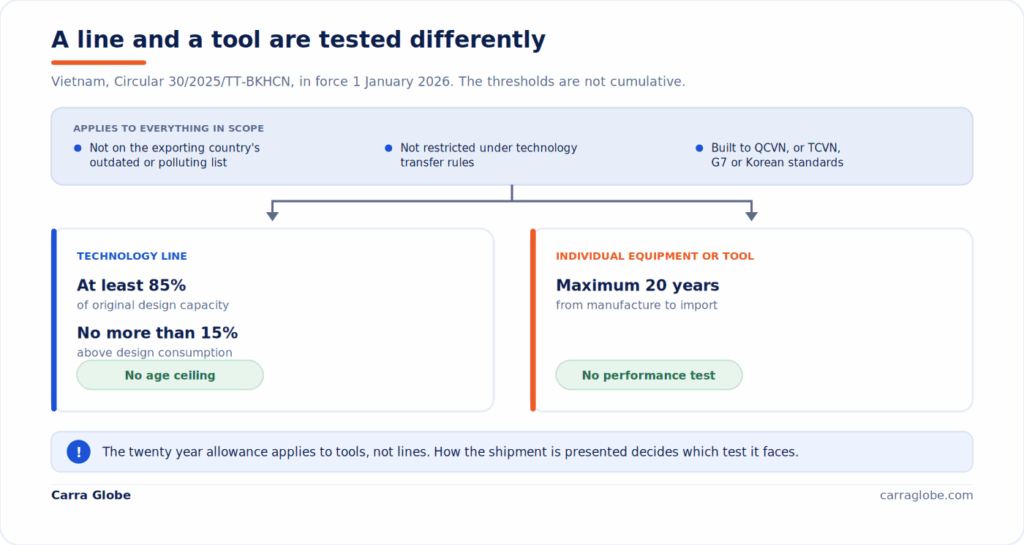
- The equipment must not appear on the list of outdated, poor quality or environmentally polluting equipment published by the exporting country.
- It must not be prohibited or restricted under technology transfer regulations.
- It must be manufactured in compliance with Vietnam’s national technical regulations on safety, energy efficiency and environmental protection, the QCVN. Where no QCVN applies, Vietnamese national standards known as TCVN will do, and so will the standards of a G7 country or South Korea.
The second and third are familiar in shape. Technology transfer restrictions are something an exporter’s compliance function is already built to check, and it is the same discipline that governs export control classification on any high-technology shipment. National technical regulations are a destination-market conformity question, and while the specifics differ, the exercise is one that any experienced importer recognises. Correct classification of the equipment underpins both.
The first condition is different in kind, and it deserves its own section.
The Condition That Points at Somebody Else’s Government
Read the first condition again. Vietnamese admissibility depends on whether the exporting country has published a list identifying that equipment as outdated, poor quality or environmentally polluting.
You may be wondering how anyone is supposed to answer that. It is a fair question, and it is the reason this condition matters more than the numbers do. The importer is being asked to prove a negative about a foreign administrative act. Not Vietnamese law, which can be researched. Not the equipment’s own specification, which can be measured. The published position of whichever jurisdiction the tools happen to be leaving.
Several consequences follow, and none of them is obvious from a purchase order.
- The answer changes with the route. The same tool sourced from two different countries can produce two different answers, because the two exporting states may take different views, or one may publish such a list and the other may not.
- Most sellers have never checked. A company disposing of surplus equipment is not in the habit of researching whether its own government classifies that equipment as obsolete. The question has never come up, because it has no bearing on the sale until the destination is Vietnam.
- It cannot be cured after arrival. If the equipment is listed, it is listed. There is no rectification, no supplementary filing, and no version of the transaction that fixes it once the machine is at the port.
- How you evidence it is not spelled out. The circular sets the condition. What it does not do, at least in the guidance published so far, is state what an importer must produce to demonstrate the absence of a listing. That gap is the practical difficulty, and until it is settled the safe assumption is that you will be asked to show your working.
This is a familiar pattern in a different disguise. When we looked at importing network security equipment, the difficulty was that the required licence belonged to a party the buyer could not become. Here the difficulty is that the required fact belongs to a government the buyer has no relationship with. In both cases, the constraint sits outside the importer’s reach, which is precisely why it has to be settled before anything ships rather than after.
Moving used or relocated equipment into Vietnam? The admissibility question turns on the origin country’s published position and on measurable performance thresholds, both of which have to be settled before the tools are crated. Carra Globe acts as importer of record in Vietnam and provides IOR services across 175+ countries, and works the entry position alongside the equipment specification rather than after it.
The Numbers Depend on Whether You Are Importing a Line or a Tool
Here the circular makes a distinction that is easy to read past and that changes which tests you actually face. It treats a technology line and an individual piece of equipment as different things, and applies different thresholds to each. They are not cumulative.
- A technology line must retain at least 85% of its original design production or performance capacity, and its consumption of energy and raw materials must not exceed the design benchmark by more than 15%. No age ceiling is specified for a line.
- Individual equipment, machinery and tools must be no more than 20 years old, calculated from the year of manufacture to the year of importation. The capacity and consumption thresholds do not apply.
Read that carefully, because it inverts the assumption most buyers arrive with. The twenty year allowance, which is the headline liberalisation, attaches to individual tools rather than to complete lines. A line is judged on how well it still performs, not on when it was built, so an older line that has been well maintained can qualify while a newer one that has degraded may not. Conversely, a tool inside the age limit faces no performance test at all.
That makes the presentation of the shipment a substantive decision rather than a paperwork one. Whether a group of machines is imported as a line or as a set of individual tools determines which rulebook applies to it, and the two rulebooks ask genuinely different questions. It is the same lesson as correct classification generally: how the goods are described decides which law reaches them.
Our view is that the line and tool distinction is the most commonly misread part of this circular, and the one most likely to produce an expensive surprise. The age test is arithmetic and can be answered from the nameplate. The performance tests cannot. Remaining capacity and consumption are claims about a specific installation in its current condition, which means they require assessment rather than assertion, and the assessment has to be credible to a Vietnamese authority.
If you take one operational point from this article, take this one. That has a scheduling consequence worth planning around. Equipment that has been running in a production environment for a decade does not automatically hold 85% of its design capacity, and the honest answer may only emerge from inspection. Establishing the position while the tools are still installed and running at the origin site is considerably easier than doing it after they have been decommissioned, crated and shipped, in the same way that data centre equipment programmes settle compliance at specification rather than at the port. Once the line is disassembled, the evidence is harder to produce and the commercial exposure is already committed.
The Same Machine, Two Different Rulebooks
Here the circular does something genuinely useful, and it is the provision most likely to be missed.
Equipment imported specifically for training, research and development is exempted from certain criteria, including the age limit, the remaining performance requirement and the energy consumption threshold. The stated purpose is to support scientific research and the training of engineers, which Vietnam needs at least as much as it needs production capacity.
So the same physical machine can face two different sets of requirements depending on the declared purpose of the import. A twenty-five year old tool that would fail the age test for a production line may be admissible for a university programme or a corporate R&D facility. The three baseline conditions still apply in both cases, but the numerical thresholds do not.
Two cautions follow from that. The declared purpose becomes a material fact about the import rather than a description of intent, which means it needs to be accurate and supportable. And a change of use after entry is not a neutral event, because the basis on which the goods were admitted no longer matches what they are doing. This is the same principle that makes the distinction between a paper IOR and an operational IOR more than academic: someone has to be able to stand behind the declaration when the question is asked later.
What Applies to What
| Requirement | Technology line for semiconductor work | Individual equipment or tool for semiconductor work | Anything for training, research and development |
|---|---|---|---|
| Not on the exporting country’s outdated or polluting list | Applies | Applies | Applies |
| Not restricted under technology transfer rules | Applies | Applies | Applies |
| Built to Vietnamese safety, energy and environmental regulations, or TCVN, G7 or Korean standards | Applies | Applies | Applies |
| At least 85% of design capacity | Applies | Not applicable | May be exempt |
| Consumption no more than 15% above design | Applies | Not applicable | May be exempt |
| Age limit of 20 years | Not applicable | Applies | May be exempt |
The top three rows apply to everything in scope, and two of the three are answered outside Vietnam. The bottom three shift depending on what you are importing and why, which is why the shape of the shipment has to be settled before the tests are run.
Nobody Checks This Before You Ship
There is one more change, and for an importer it is the most consequential thing in the circular.
The administrative procedure has been streamlined, and the change is easier to see side by side.
- Before: apply for an import licence, submit the equipment for assessment, and wait for a decision before shipping.
- Now: assess your own equipment against the criteria, take responsibility for that assessment, and file a written commitment with the customs authority.
There is no longer a government body confirming, in advance, that a particular machine qualifies.
That is faster, and it is genuinely welcome on a programme where a fab tool is sitting in a crate waiting on a decision. It also removes something valuable that pre-approval quietly provided: an answer before the money was spent. Under a licensing regime, a refusal is disappointing but survivable, because it arrives before the line is decommissioned. Under self-assessment, the equivalent moment arrives later and costs more.
The consequence for getting it wrong is correspondingly firm. Where equipment admitted under the research and training route is found to be in mass production use, the reported outcome is re-export of the shipment together with administrative penalties. Not a fine and a correction. The equipment leaves.
Read that alongside the exporting country condition and the shape of the risk becomes clear. Vietnam removed the checkpoint that would have caught the problem early. It kept a condition that is genuinely hard to verify. And it attached a remedy that undoes the entire transaction. The circular is more permissive and less forgiving at the same time, and those two things are not in tension. They are the same design decision.
What to Establish Before the Equipment Is Decommissioned
- Fix the origin country before you price the deal. Because the first condition turns on the exporting state’s published position, the source of the equipment is a compliance variable rather than a logistics detail. Two identical tools in two countries are not equally importable, and the cheaper one is not necessarily the one that arrives.
- Ask the seller a question they will not expect. Whether their jurisdiction publishes a list of outdated, poor quality or environmentally polluting equipment, and whether this class of tool appears on it. Most sellers will not know. That is information you need before signing, not a reason to assume the answer is favourable.
- Assess capacity and consumption while the line is still running. The 85% and 115% thresholds are measurable, and they are far easier to evidence in situ than from a crate. Build the assessment into the decommissioning plan rather than the import plan.
- Declare the purpose accurately, and understand what it buys you. Training and R&D imports are exempted from the numerical thresholds. That is a real advantage where it genuinely applies, and a serious exposure where it does not.
- Confirm who is filing and what they can support. Entry documentation for used equipment carries claims about age, performance and origin classification that may be examined after clearance. Our guide to the importer of record role sets out where that responsibility sits.
None of this makes the shipment harder than it needs to be. It moves the difficulty to the point in the programme where it is cheap to solve. A tool that fails a threshold while it is still bolted to the floor is a procurement decision. The same tool failing at Hai Phong is a customs problem with a decommissioned production line attached to it.
Frequently Asked Questions
Can I import used semiconductor equipment into Vietnam in 2026?
Yes. Individual tools must be no more than 20 years old. A complete technology line is tested on performance instead, needing at least 85% of design capacity, and both must satisfy the circular’s baseline conditions.
The age ceiling for tools was previously ten years, so the position is more permissive than it was, not less.
Does Circular 30 apply to all used machinery entering Vietnam?
No. It applies to used technology lines, equipment, machinery and tools imported for semiconductor manufacturing, packaging and testing, or for training, research and development of digital technology products and services.
Used equipment for general industrial purposes falls outside it and sits under Vietnam’s wider second-hand machinery regime. Some commentary has overstated the scope.
What is the list published by the exporting country?
It refers to any list issued by the country the equipment is leaving that identifies that equipment as outdated, poor quality or environmentally polluting. Where such a listing exists, the equipment is not admissible to Vietnam under the circular.
Because it depends on the origin jurisdiction rather than on Vietnam, the answer can differ for identical machines sourced from different countries.
Is used equipment for research treated differently from production equipment?
Yes. Equipment imported for training, research and development is exempted from certain criteria including the age limit, remaining performance efficiency and energy consumption thresholds, though the baseline conditions still apply.
The declared purpose therefore becomes a material fact about the entry rather than a description of intent.
Is Circular 30 a restriction or a liberalisation?
A liberalisation in substance. It doubles the permitted age for qualifying equipment, exempts research and training imports from the numerical thresholds, and removes the requirement to obtain an import licence in advance.
What it does not do is remove the conditions. It moves the point at which they are tested.
Do I need an import licence for used equipment in Vietnam?
Not under Circular 30 for equipment in its scope. Businesses assess their own equipment against the criteria and submit a written commitment to the customs authority rather than applying for prior approval.
The trade-off is that nobody confirms the position before the equipment ships, and the reported remedy for a wrong assessment is re-export.
The instinct when a new instrument appears is to read it as a barrier, and most commentary on Circular 30 has done exactly that. It is better understood as a door Vietnam deliberately widened, because a country cannot build a semiconductor industry on newly manufactured tools alone. What sits behind that door is a set of conditions that reward preparation and punish assumption, and the sharpest of them is not about the equipment at all. It is about what somebody else’s government has already written down. Worth asking in the week the deal is negotiated, not the week the crates reach Hai Phong.
Disclaimer: This article is for informational purposes only and does not constitute legal, customs or engineering advice. The requirements described are set out in Circular No. 30/2025/TT-BKHCN and related Vietnamese law, and are subject to change, interpretation and to guidance issued after publication. Always confirm the current position for your specific equipment, purpose and origin market with the relevant Vietnamese authority or qualified counsel before committing to a purchase or shipment.