
A power of attorney for customs is the document that lets a broker or agent transact customs business in your name. Almost every import that clears through a third party rests on one, and most importers sign it without reading it, on the assumption that handing over the authority also hands over the risk. It does not. The power of attorney moves who may act. It rarely moves who is liable, and in one common arrangement it moves the liability the opposite way from what people expect.
Call it the authority-liability gap: a power of attorney for customs grants the authority to act, but liability follows the representation basis, not the power itself. Everything below is a consequence of that one distinction.
In brief:
- A customs power of attorney authorises an agent to act, not to assume your obligations. In most cases the importer remains responsible for the accuracy of the declaration.
- It can be limited or general. A limited power covers a defined scope; a general power grants broad authority, which is convenient and worth understanding before granting.
- The choice of representation basis decides liability. In the EU and UK, direct and indirect representation carry very different consequences, and picking the wrong one has cost agents real money.
- A non-resident principal cannot simply appoint anyone. Most regimes require the agent to be locally established and, in the US, authorised to accept legal service.
- It is not filed with the authority in every country, but it must be valid, held and produceable, and it expires or lapses in ways that catch people out.
This page sits alongside our guides on the EORI number, which is the customs identity, and on the difference between an importer of record and a customs broker. The power of attorney is the instrument that connects them: it is how the identity gets used by someone acting on your behalf.
What a Power of Attorney for Customs Actually Does
A power of attorney, in customs terms, is a grant of authority from a principal, meaning the importer or exporter, to an agent, meaning the broker or forwarder, allowing that agent to carry out customs formalities in the principal’s name. Without it, a broker has no standing to file a declaration for you.
It comes in two scopes. A limited power of attorney authorises the agent to handle a specified part of the customs business, a particular shipment, a particular type of transaction, or a defined period. A general power of attorney grants broad authority to transact all of the principal’s customs business without that limitation. The general form is more convenient for an ongoing relationship, which is why most brokers ask for it, but the breadth is worth understanding rather than signing past.
What the document does not do is transfer the underlying legal responsibility for the import. That responsibility follows a different set of rules, and understanding those rules is the whole point of reading the power of attorney rather than initialling it.
The United States: Form 5291 and Who Stays Responsible
In the US the framework sits in the customs regulations at 19 CFR Part 141, Subpart C. A few points from it matter more than the rest.
The standard instrument is CBP Form 5291, though the regulation is explicit that a power of attorney does not have to be on that form. It can be a general power with unlimited authority or a limited power, provided it is as explicit in its terms and executed in the same manner as the form. So a broker’s own document is valid if it carries the right language.
The broker is required to obtain a valid power of attorney before transacting customs business in your name, but is not required to file it with CBP. Instead the broker retains it with their records and must produce it on request. The absence of a filing step is exactly why importers underestimate the document: nothing visible happens when it is signed, so it feels like paperwork rather than a legal grant.
Duration depends on the entity. A power of attorney issued by a partnership is limited to a maximum of two years from execution. Any other power of attorney may be granted for an unlimited period. A partnership that signed one three years ago and assumes it is still live may find it has lapsed.
Two further rules bite specifically on foreign importers. A power of attorney executed by a non-resident principal is not accepted unless the agent it designates is a resident and is authorised to accept service of process against that non-resident. And a resident corporation does not even need a power of attorney when the person signing is known to CBP to be the president, vice president, treasurer or secretary. The system is built around the idea that someone locally accountable stands behind the declaration.
Not sure whether you should be the importer of record or simply grant authority to one? The two are different decisions with different liabilities, and the power of attorney is where they meet. Carra Globe acts as importer of record across 175+ countries, taking on the customs standing rather than only the filing, so the responsibility rests with an entity equipped to carry it.
The EU and UK: Direct Versus Indirect Representation
In the EU and the UK the power of attorney question is inseparable from a choice that has no direct equivalent in the US, and getting it wrong is where importers and agents have actually lost money. The basis is Article 18 of the Union Customs Code, mirrored in UK law after Brexit.
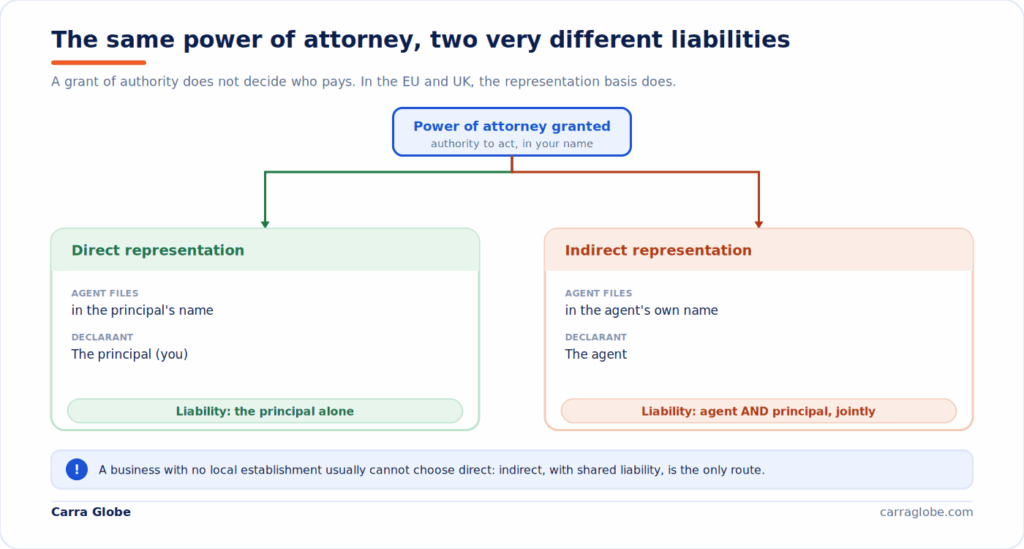
There are two modes of representation, and the difference is not cosmetic.
- Direct representation. The agent lodges the declaration in the name of and on behalf of the principal. The principal is the declarant and carries responsibility for the declaration. The agent is acting as a conduit.
- Indirect representation. The agent lodges the declaration in their own name but on behalf of the principal. The agent becomes the declarant and is jointly and severally liable for the customs debt alongside the principal.
This is where the counterintuitive part lives. A business established outside the country of import usually cannot act as declarant itself. It must appoint an indirect representative, and that representative takes on joint liability for the customs debt.
Non-EU businesses importing into the EU generally require an indirect representative for exactly this reason, and the same applies to non-UK businesses importing into Great Britain. Direct representation is not available to a principal who has no standing to be the declarant.
The liability split has been refined by the courts. In the EU, the Court of Justice held in case C-714/20 that an indirect representative is jointly and severally liable for customs duty, but not automatically for import VAT unless national law expressly says so. That distinction between the duty position and the VAT position is precisely the kind of detail that decides who pays when something goes wrong.
US and EU/UK Rules at a Glance
| United States | EU and UK | |
|---|---|---|
| Framework | 19 CFR Part 141, Subpart C | Article 18, Union Customs Code (mirrored in UK law) |
| Standard document | CBP Form 5291, or an equivalent with the same wording | A written authorisation stating the representation basis |
| Who is the declarant | The importer of record | Direct: the principal. Indirect: the agent |
| Who carries the customs debt | Importer of record, generally, even when a broker files | Direct: the principal. Indirect: agent and principal jointly |
| Non-established importer | Must appoint a resident agent authorised to accept legal service | Generally must use indirect representation |
| Filed with the authority | No, but the broker must retain and produce it | Held by the parties; authorisation evidenced on request |
| Duration | Unlimited, except a partnership grant is capped at two years | Until revoked or the underlying authority changes |
The Trap: When Direct Representation Silently Becomes Indirect
The most expensive mistake in this area is not choosing indirect representation. It is intending direct representation and being treated as indirect because the paperwork or the conduct did not support the direct claim.
Under HMRC’s approach, an agent who cannot produce written authority confirming direct representation, or who steps outside the principal’s specific instructions, risks being regarded as acting on their own behalf, which makes them the declarant and liable for the debt. Where the authorisation does not confirm the type of representation, the agent can be treated as an indirect representative by default. Even something as ordinary as the agent choosing an HS code the importer failed to supply can undermine a direct-representation claim, because the agent has then exercised judgement rather than following instructions to the letter.
This is not theoretical. In a 2024 UK First-tier Tribunal case, a customs clearance agent was assessed jointly with the importer for unpaid duty and import VAT of over thirty-six thousand pounds on a shipment where relief had been incorrectly claimed. The agent was treated as the declarant because it had declared itself the importer’s indirect agent, and its later argument that the parties had agreed direct representation failed for want of evidence.
The lesson is not that indirect representation is dangerous in itself. It is that the representation basis is a documented legal position, not a label, and it is enforced on the documents rather than on intentions.
Authority Is Not the Same as Liability
Pulling the jurisdictions together, one principle holds across all of them, and it is the single most useful thing to take from this page.
Granting a power of attorney gives an agent the authority to act. It does not, by itself, determine who bears the customs debt if a declaration is wrong. In the US, the importer of record generally remains responsible for the accuracy of the entry even though a broker filed it.
The UK position is the same in substance. An agent acting in direct representation leaves the importer responsible, and an agent filing through CDS still leaves the importer legally responsible for the accuracy of the information even though the agent submits it. The authority to file and the liability for what is filed are two separate things, and the power of attorney governs the first, not the second.
Where the two genuinely move together is indirect representation, and that is the arrangement a non-established business most often has to use. So the businesses most likely to assume the paperwork protects them, foreign importers with no local entity, are frequently the ones for whom it does the opposite: it either leaves them fully liable or forces them into a structure where an agent shares that liability and prices it accordingly.
The stakes are highest exactly where the goods are valuable and the rules are dense. Consider a vendor shipping a consignment of servers into the US on delivered-duty-paid terms, having signed the broker’s general power of attorney to keep the clearance moving. The entry misclassifies the hardware, or applies a duty treatment the goods do not qualify for.
The broker filed it, but the vendor is the importer of record, and the responsibility for the accuracy of that entry sits with the importer of record. The power of attorney authorised the filing. It did not absorb the error, and on a rack of data centre equipment the gap between the duty paid and the duty owed is not a rounding point. High-value technology shipments, often carrying export-control sensitivities of their own, are precisely where signing the mandate without settling the liability becomes expensive.
Reduced to its decisions, the liability picture is short enough to hold in your head:
- US importer: the importer of record stays liable, even though the broker files under the power of attorney.
- EU or UK, direct representation: the principal is the declarant and carries the liability.
- EU or UK, indirect representation: the agent and the principal are jointly and severally liable.
- Non-established importer: usually must use indirect representation, so liability is shared with the agent.
- US partnership: the power of attorney lapses after two years unless renewed.
This is why the power of attorney should be read as the point where the choice of Incoterms, the identity on the declaration, and the allocation of liability all resolve. Signed carelessly, it is the moment a business accepts a position it did not understand. Read properly, it is where the structure of the whole import is confirmed.aration.
Practical Points Before You Sign One
- Confirm the scope. Establish whether you are granting a limited or a general power, and whether the breadth matches the relationship you actually want.
- Confirm the representation basis in writing. In the EU and UK, make sure the document states direct or indirect representation explicitly, because silence tends to default against you.
- Check who carries the liability under that basis, and confirm the duty and VAT positions separately rather than assuming they move together.
- Check the duration. Remember the US partnership two-year cap, and diary any renewal so a lapsed power does not surface at the border.
- Confirm the agent’s standing. A non-resident principal needs a locally established agent, and in the US one authorised to accept service of process.
- Keep a copy and know where it is. In the US the broker holds it rather than filing it, so make sure your own records reflect what you granted and to whom.
The US statutory rules are published in full at the eCFR, 19 CFR Part 141 Subpart C, and the UK position on who is liable is set out in the GOV.UK guidance on customs debt liability.
Frequently Asked Questions
Does a customs power of attorney make my broker liable for errors?
Usually not. A power of attorney authorises the broker to act, but the importer of record generally stays responsible for the declaration’s accuracy. Liability follows the representation basis, not the power of attorney.
The main exception is indirect representation in the EU and UK, where the agent shares the customs debt.
What is the difference between a limited and general power of attorney?
Scope. A limited power covers a defined scope, such as one shipment or transaction type. A general power grants broad authority over all of the principal’s customs business.
Most brokers request a general power for an ongoing relationship, which is convenient but worth reading before granting.
Do I have to use CBP Form 5291?
No. Form 5291 is the standard, but the US regulation allows a different document if it is as explicit and executed the same way. A broker’s own document is valid with the right language.
The form simply removes any doubt about wording and format.
What is the difference between direct and indirect representation?
Who becomes the declarant. In direct representation the agent files in the principal’s name, so the principal is the declarant. In indirect representation the agent files in its own name and shares the debt.
A business with no establishment in the country of import usually must use indirect representation.
Does a customs power of attorney expire?
It can. In the US a partnership’s power of attorney is capped at two years, while others may be unlimited. It can also be revoked in writing, and a change in partners can end it.
Treat the duration as something to diary rather than assume, especially for partnerships.
Can I revoke a customs power of attorney?
Yes, at any time. In the US it is revoked by written notice given to and received by CBP. Elsewhere, written notice to the agent and the authority as required.
Revoking promptly matters when you change broker, so the former agent no longer holds live authority to act.
Can a foreign company grant a customs power of attorney?
Yes, but with conditions. A non-resident principal must generally appoint a locally established agent, and in the US that agent must be authorised to accept service of process against the principal.
The rules are built to ensure a locally accountable party stands behind every declaration.