
An EORI number is the identifier customs authorities use to know who is moving goods across a border. Without one on the declaration, a shipment does not clear. It is the most basic piece of customs identity a business can hold, and also one of the most widely misunderstood, because since Brexit a single company can need three separate EORI numbers to run one supply chain.
In brief:
- An EORI number identifies an economic operator to customs. It appears on every import and export declaration and links a shipment to a specific business.
- An EORI is not a VAT number. They are often related in format but serve different purposes and cannot be used interchangeably.
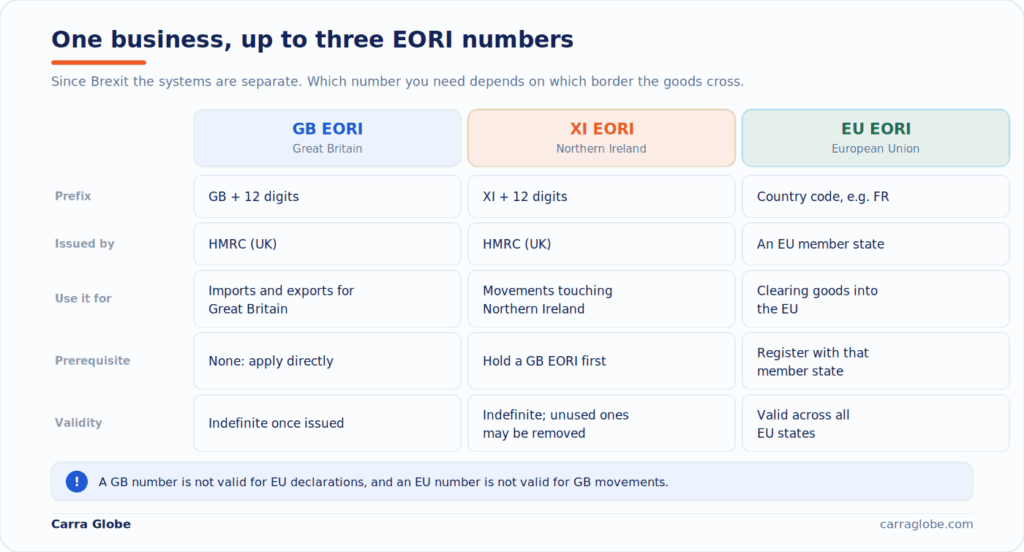
- Since Brexit there are three families: GB for Great Britain, XI for Northern Ireland movements, and an EU EORI issued by a member state for clearing into the EU.
- A business not established in the country of import can still hold one, and often must in order to act as importer or exporter of record.
- Applying is free and usually fast, but using the wrong one, or none, holds goods at the border and runs up storage charges.
What an EORI Number Actually Is
EORI stands for Economic Operators Registration and Identification. It is a unique reference assigned to a business that moves goods internationally, and customs systems use it to match a declaration to a known trader with a known record. Every commercial import or export needs one on the paperwork.
The format is a country prefix followed by a numeric string. A Great Britain number takes the form GB followed by twelve digits, for example GB123456789000. For a VAT-registered business, the first nine of those digits match the VAT registration number, with three zeros appended. A business that is not VAT registered receives a unique number issued by the customs authority instead. EU member states issue their own numbers with their own country prefixes, and once issued an EU EORI is valid across all member states.
The reference is durable. Once assigned, it does not need to be renewed transaction by transaction, and it stays valid however many shipments follow. It is closer to a permanent registration than to a per-consignment permit.
An EORI Is Not a VAT Number
This is the confusion worth clearing first, because the two are so often mentioned together that people assume one implies the other.
A VAT number exists for tax: it identifies a business to the tax authority and governs what it charges and reclaims. An EORI number exists for customs: it identifies a business at the border and governs security and tracking. The GB EORI often embeds the VAT number in its digits, which is exactly why the two get conflated, but they are not interchangeable and one cannot be substituted for the other on a declaration. A business can be VAT registered and still need to apply separately for its EORI, and a business can hold an EORI without being VAT registered at all.
The practical failure this causes is a trader quoting a VAT number where the customs system expects an EORI, and the shipment stalling because the field does not validate.
The Post-Brexit Split: GB, XI and EU
Before 2021 a single EU EORI covered movements across the whole bloc, including the UK. Brexit broke that into separate systems, and this is where one business ends up needing more than one number.
- GB EORI. Required to move goods into or out of Great Britain, meaning England, Scotland and Wales. Since 1 January 2021 only a GB-prefixed number is accepted for these movements. A UK business that once relied on an EU EORI now needs a GB one.
- XI EORI. The Windsor Framework governs Northern Ireland’s trade position, and that is what makes an XI number necessary for movements touching Northern Ireland, such as bringing goods in from outside the UK or moving them between Northern Ireland and the EU. You must already hold a GB EORI before you can apply for an XI number.
- EU EORI. Required to act as declarant when clearing goods into the EU. It is issued by the customs authority of an EU member state, and a UK GB EORI is not valid for EU import declarations. Once you have an EU number from one member state, it works across all of them.
The result is that a business importing into Great Britain, moving some stock through Northern Ireland, and holding inventory in an EU warehouse can genuinely need all three. This is not duplication for its own sake. Each number answers a different customs territory, and the declaration in each territory validates only against the number that belongs to it.
One further change now bites at the EU edge. The Import Control System 2, the EU’s advance security filing regime, became mandatory across all transport modes on 3 February 2026, completing a rollout that had already brought road and rail into scope the previous September. A valid EU or XI EORI is part of what a carrier needs to file the required Entry Summary Declaration before goods enter the customs territory.
A few member states that took a road derogation, including Croatia, Latvia, Poland, Romania and Slovakia, have a further deadline in mid-2026, and for movements from Great Britain to Northern Ireland the full ICS2 dataset replaced the legacy system from 1 January 2026. The direction is the same everywhere: a number that was easy to put off obtaining has become hard to trade without.
Who Needs an EORI Number
The requirement is broad. Any business moving goods commercially across the relevant borders needs one, and several roles trigger it beyond the obvious importer.
- Businesses importing or exporting goods commercially into or out of Great Britain, the EU, or across the Northern Ireland boundary.
- Overseas businesses that need to make customs declarations, for example when acting as importer of record in a territory where they are not established.
- Businesses holding inventory in a foreign warehouse, including fulfilment centres, because stock stored abroad and sold locally is treated as an import.
- Freight forwarders and customs brokers making declarations on behalf of clients.
- Anyone registering for a customs export licence, which requires an EORI as a prerequisite.
The main exemption is the private individual bringing in personal goods within allowance, which is not commercial movement. Almost everything done for business purposes needs the number.
Selling into a market where you have no legal entity? The EORI question is usually the first sign that you need someone established locally to act on your behalf. Carra Globe acts as importer of record and exporter of record across 175+ countries, holding the customs standing so your goods clear against a compliant entity rather than stalling at the border.
Talk to Carra Globe about importing without a local entity →
How a Non-Established Business Gets an EORI
A non-established importer is a business making customs declarations in a territory where it has no registered legal presence. This is the situation that matters most for anyone selling into a country where they have no local company, and it has a clear answer that surprises people: you do not always need a local entity, but you do need a route.
A non-UK business can obtain a GB EORI. It applies through the same government route as a UK business, but without a UK tax reference, supplying its home-country company registration details instead. The equivalent applies in reverse for a UK business needing an EU number, which registers with the customs authority of the member state concerned.
The complication is that holding the number is not always enough on its own. A business not established in the territory of import frequently also needs a locally established party, a customs agent, fiscal representative or importer of record, to make the declaration or to carry the import liabilities the law places on an established entity. For a company selling DDP into a market, this is the crux: it may be quoting delivered-duty-paid terms while lacking the standing to be the declarant, and the gap has to be filled by an entity that has it.
A concrete case makes the gap clear. A US technology company agrees to ship a rack of servers into Germany on delivered-duty-paid terms, having obtained an EORI so the customs fields can be completed. The hardware reaches the border and stops. The company has the identity, but as a business with no German establishment it does not have the standing to be the declarant of record, and the delivered-duty-paid promise it made to its customer requires exactly that. The servers sit, accruing storage, while an established entity is arranged to carry the import. The number was never the missing piece. The standing was.
Put plainly, the EORI is the identity, and the established entity is the standing. A cross-border programme usually needs both, and discovering that at the border rather than in planning is what turns a clearance into a delay. This is the same distinction that separates a customs broker from an importer of record, and it is worth settling before the first shipment moves.
How to Apply, Step by Step
For a GB number the process is run by HM Revenue and Customs and is free. It is deliberately quick, though it can slow down if the authority runs manual checks.
- Check whether you already have one. A VAT-registered UK business, or a subsidiary of a group that already registered, may already hold a number. It can be checked on the government’s EORI checker before you apply for a duplicate.
- Gather your details. A UK business needs its tax reference, business start date and activity code. A non-established business supplies its home-country registration details instead.
- Apply online through the official route. The application is submitted to the customs authority and takes only a few minutes to complete.
- Tick the XI box if Northern Ireland is in scope. If there is any chance of trading with or through Northern Ireland, requesting the XI number at the same time avoids a separate application and the delay that follows.
- Receive the number. A GB EORI is often issued immediately, or within around five working days if checks are triggered.
- Register the EU number separately if you clear into the EU. That is a distinct application with a member state’s authority, not part of the GB process.
Apply before the first shipment rather than alongside it. An EORI obtained after goods are already in transit does not help a consignment that has reached a border without one.
Where an EORI Sits in the Wider Import Picture
The number is necessary, but it is only the identity layer. It does not by itself determine what duty is owed, who is liable for it, or whether the goods meet the destination’s product rules. Those are separate questions, and the EORI simply attaches a name to the declaration where they are answered.
It connects directly to several other decisions. The choice of DDP or DAP terms determines which party is the importer and therefore whose EORI is used. The landed cost of a shipment depends on duties and taxes assessed against that importer. And where a business lacks its own standing in the destination, the EORI question folds into the larger one of how to import into the EU or into the UK without a local entity at all.
Treated as the first item on a customs checklist rather than the whole of it, the EORI is straightforward. The mistakes come from assuming it is either more than it is, a substitute for local standing, or less than it is, an optional formality.
The official application and eligibility guidance is published by GOV.UK, and an existing number can be verified using the GOV.UK EORI checker.
Frequently Asked Questions
Is an EORI number the same as a VAT number?
No. A VAT number is for tax; an EORI number is for customs. A GB EORI often contains the VAT number in its digits, which causes the confusion, but the two are not interchangeable.
You can hold one without the other, and being VAT registered does not mean an EORI has been issued automatically.
Can a non-UK company get a GB EORI number?
Yes. A business not established in the UK applies through the same government route, giving home-country registration details instead of a UK tax reference. It often must, to act as importer of record.
Holding the number may still need to be paired with a locally established party to make declarations.
Do I need both a GB and an EU EORI number?
If you move goods into Great Britain and also clear into the EU, yes. A GB number is not valid for EU import declarations, and an EU number is not valid for GB movements.
Many businesses trading both ways hold a GB EORI plus an EU one issued by a member state.
When do I need an XI EORI number?
When your goods movement touches Northern Ireland, such as importing into Northern Ireland from outside the UK or moving goods between Northern Ireland and the EU under the Windsor Framework.
You must hold a GB EORI first before an XI number can be issued.
How long does it take to get an EORI number?
A GB EORI is often issued immediately after an online application, or within around five working days if the authority runs manual checks. EU member-state numbers vary by country.
Apply before your first shipment, because a number obtained mid-transit does not release goods already held at a border.
Does an EORI number expire?
No. Once issued it remains valid indefinitely unless cancelled, and it does not need to be renewed for each shipment. The same number covers all your import and export activity.
Note that customs authorities may remove numbers that were issued but never used, such as unused XI numbers.
Do sole traders need an EORI number?
Yes, if they move goods commercially across the relevant border. The requirement follows the activity, not the legal form, so sole traders, partnerships and limited companies are all covered.
The business structure does not change whether a number is needed, only the registration details supplied on the application.
Can I use an EORI number for personal imports?
No. An EORI number is for commercial movement of goods. A private individual bringing in personal goods within allowance does not need one and should not be using a business number for it.
The line is the purpose of the movement: commercial needs a number, genuinely personal within allowance does not.
What happens if I ship without an EORI number?
The goods are held at the border. Customs cannot clear a commercial shipment without an EORI on the declaration, so the consignment stops until the number is supplied, and storage charges accrue meanwhile.
Because a number obtained mid-transit does not release goods already held, the fix is slower than getting one in advance.