
Ask a room of supply chain leaders about building supply chain resilience in 2026 and you will hear the same word: volatility. In the Thomson Reuters Global Trade Report, 72% of trade professionals named US tariff volatility the single most impactful regulatory change of the year, up from 41% the year before, and the share ranking supply chain management as their top strategic priority nearly doubled. The response has been near universal: diversify suppliers, add regional hubs, hold more inventory, move from just-in-time to just-in-case. Every consultancy has published a version of the same advice.
It is good advice, and it is incomplete. Almost every resilience playbook published this year stops at sourcing and inventory, and skips the step where the plan actually succeeds or fails: getting the goods legally across the border, into the destination country, and onto your dock.
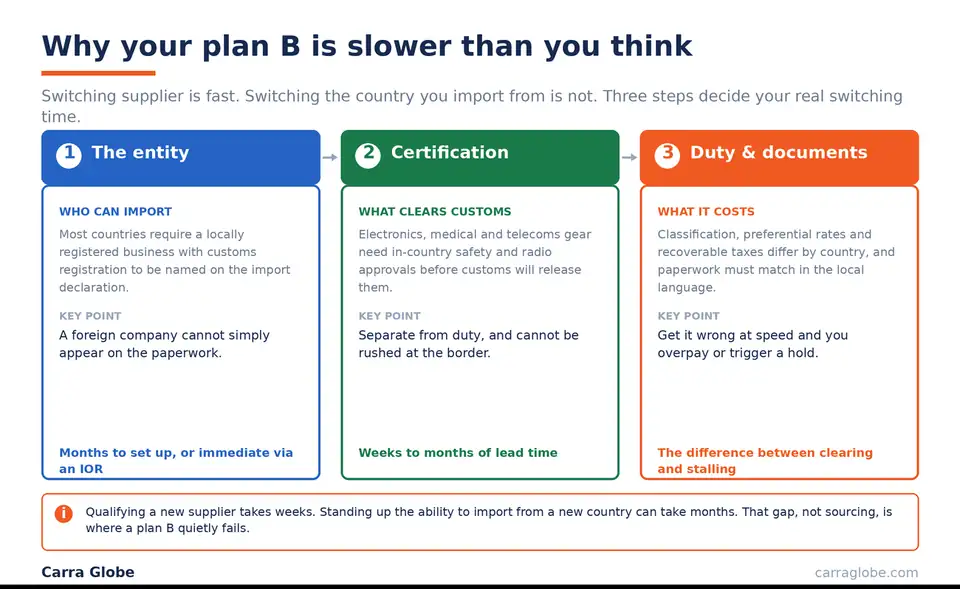
You can qualify a second supplier in a new country in a matter of weeks. Standing up the ability to legally import from that country, with the right entity, customs registration, product certifications, and duty treatment, is where the timeline quietly stretches to months. This guide is about the part of supply chain resilience that the industry conversation is skipping, and why in 2026 compliance execution, not sourcing, is the real bottleneck.
Supply Chain Resilience 2026: At a Glance
- The definition changed: resilience is no longer measured by how rarely your supply chain breaks, but by how fast your plan B becomes the operating plan when it does.
- The industry is half right: dual sourcing, regional hubs, and inventory buffers are necessary, but they only move the risk to the border, where a different problem waits.
- Compliance is the hidden lead time: a new supplier can be qualified in weeks, but importing from a new country legally, with entity, registration, certification, and duty treatment in place, can take far longer.
- Trade moved from back office to boardroom: across the industry, trade and compliance teams shifted from cost centres to strategic partners in network decisions during 2026.
- The real test: find the point in your network where switching takes longer than the disruption it is meant to solve. That gap is your true exposure.
What Actually Broke in 2026
The disruptions of 2026 were not weather or a blocked canal. They were policy, arriving faster than networks could adapt. In February, the Supreme Court struck down the IEEPA tariff regime, and within hours a 10% global surcharge went up under Section 122 of the Trade Act of 1974. That surcharge ran its full 150-day statutory life and expired on 24 July 2026, replaced the same day by a new Section 301 forced-labour action carrying 10% or 12.5% duties on the products of roughly 60 economies.
Alongside it, the US de minimis exemption that had let sub-800-dollar parcels enter duty-free was suspended for all countries, and the USMCA agreement governing North American trade was thrown into a review that could reshape rules of origin.
The policy shocks did not arrive in isolation either: geopolitical events like the Strait of Hormuz closure risk hit freight and routing at the same time, compounding the pressure.
The pattern that matters is not any single measure but the speed and unpredictability of the sequence. A landed cost model built in January was wrong by March, wrong again in a different way by late July, and is written on sand for anything beyond the next court ruling. Companies that had built their supply chains for lowest landed cost in stable conditions discovered that the conditions were the assumption doing all the work. When the conditions moved, the optimisation moved from asset to liability overnight.
The Resilience Everyone Bought, and the Gap It Left
To their credit, most large shippers were better prepared than expected, because the investments made after 2020 in visibility, supplier-risk monitoring, and scenario planning gave them a head start. The industry response to 2026 has been consistent and sensible. Around two-thirds of trade professionals report changing sourcing patterns, over half are renegotiating supplier contracts, and roughly half are pursuing nearshoring or moving production closer to home. The common thread is optionality: more than one supplier, more than one lane, more than one region in play, so that when tariffs shift again there is somewhere else to go.
Here is what that response quietly assumes. It assumes that having an alternative supplier is the same as being able to use one. It is not. The moment your plan B supplier sits in a different country from your plan A supplier, you have not just changed a purchase order, you have changed your entire import position: a different customs regime, a different duty and tax treatment, different product certification and marking requirements, and, in many countries, a requirement for a locally registered entity to even appear on the import declaration.
Optionality on the sourcing side creates a compliance obligation on the import side, and that second obligation is the one with the long lead time. A supply chain that has diversified its suppliers but not its ability to import is only half resilient. It has moved the single point of failure from the factory to the border.
The Switching-Time Test: A Framework for Real Resilience
The most useful definition of resilience in circulation this year is also the most demanding: a supply chain is resilient not when it rarely breaks, but when plan B can become the operating plan faster than the disruption lasts. We call the practical version of this the switching-time test, and it reframes the whole exercise.
For every alternative in your network, a second supplier, a second lane, a second region, ask one question: how long would it actually take to switch to it and be delivering at volume? Then compare that to how long the disruption you are protecting against would realistically last. Wherever switching takes longer than the disruption, the alternative is not protection. It is a line item that makes the plan look safer than it is.
Run that test honestly and the compliance bottleneck appears immediately. Requalifying a supplier might take four to six weeks. Renegotiating freight might take days. But activating the legal ability to import commercial volumes into a new country, obtaining or transferring the entity and customs registration, securing the product certifications that customs will demand at the border, confirming the duty and tax treatment, and getting the documentation right in the local language, is frequently the longest pole in the tent.
If that step takes three months and the tariff event you are dodging is already in force, your plan B does not arrive until the crisis is over. The alternative existed on paper and failed in practice, for reasons that had nothing to do with sourcing and everything to do with import execution.
Where the Switching Time Actually Hides
The compliance lead time is not one obstacle but several, and each one is invisible until you hit it. These are the four that most often turn a fast sourcing switch into a slow import:
- The entity requirement. Many countries require a locally registered business, with customs registration and a local tax number, to be named as the importer on the declaration. A foreign company cannot simply appear on the paperwork. Establishing your own entity takes months; an importer of record gives you compliant access without one.
- Product certification. Electronics, medical devices, telecoms, and industrial equipment usually need in-country safety and radio certifications before customs will release them. These are separate from duty, cannot be rushed at the border, and often require local testing or a local applicant.
- Duty and tax treatment. The correct classification, the available preferential rates, and the recoverable taxes all differ by country, as the WTO’s tariff data across more than 150 economies makes plain. Getting them wrong at speed either overpays or triggers a hold, and the cost of a misclassification compounds on every shipment until it is found.
- Documentation and language. The commercial invoice, certificates of origin, and import declaration must match exactly and, in many markets, be prepared in the local language. A mismatch is one of the most common causes of a customs hold, and holds do not care that you were in a hurry.
| Compliance step | Typical lead time | Can it be rushed? |
|---|---|---|
| Qualify a new supplier | Weeks | Yes, relatively |
| Renegotiate freight and lanes | Days | Yes |
| Local entity and customs registration | Months (or immediate via an IOR) | No, unless using an importer of record |
| Product certification (safety, radio) | Weeks to months | No, requires in-country testing or a local applicant |
| Duty and tax treatment confirmation | Days to weeks | Partly, if classification is verified early |
| Documentation in local language | Days | Yes, but errors cause holds |
The pattern is clear: the sourcing side of a switch moves in days and weeks, while the import side moves in weeks and months. That asymmetry is the whole reason a plan B can look ready on paper and still arrive too late.
Do you know your real switching time into your top three backup markets? Carra Globe can map the compliance lead time for every country in your contingency plan, so your plan B is something you can actually activate, not just a name on a slide.
From Cost Centre to Boardroom: Why Compliance Moved Up the Org Chart
The most telling structural change of 2026 is not a tariff. It is that trade and compliance teams stopped being treated as a back-office cost and started being invited into network decisions. When tariff volatility became the top-cited risk in the business, the people who understand customs regimes, rules of origin, and import execution became strategic, because they were the only ones who could answer the question that now decides margins: if we move this, what does it actually cost and how fast can we do it legally?
Enterprises that used to optimise purely for lowest landed cost are now optimising for survivability at an acceptable cost, and that calculation cannot be made without the compliance function in the room.
For a mid-sized importer without a large in-house trade team, this is the practical challenge: the strategic capability that large enterprises built internally still has to come from somewhere. This is the role a specialist import partner plays that a freight forwarder does not. A freight forwarder moves the box; the importer of record is the party legally responsible for the entry, the classification, the certifications, and the duty, and is therefore the party that can tell you whether your plan B is real. Resilience is not only a sourcing strategy. It is an execution capability, and execution is where it is won or lost.
Building a Supply Chain That Passes the Test
Turning the switching-time test into an actual plan is a manageable exercise. It does not require rebuilding your network. It requires knowing where the network is weakest and closing those specific gaps before you need them.
Use this quick self-assessment on each backup country in your plan. Score each row, and any “no” is a gap to close before a disruption forces the issue:
| Self-assessment question | Ready | Gap |
|---|---|---|
| Can a legal importer be named on the declaration in this country today? | Yes | No, entity or IOR needed |
| Are the required product certifications already held or in progress? | Yes | No, certification lead time applies |
| Is the duty and tax treatment for our products confirmed? | Yes | No, classification unverified |
| Do we know the landed cost for this route within a usable range? | Yes | No, cost unknown |
| Could we be importing at volume within our disruption window? | Yes | No, switching time too long |
- Map your contingency countries, not just your contingency suppliers. For every backup supplier, write down the country it imports from and treat that country as the unit of planning. The supplier is easy; the country is where the lead time lives.
- Measure the compliance lead time for each one. For each contingency country, establish what it actually takes to import your products: entity and registration, certifications, duty treatment, documentation. This number is your real switching time.
- Pre-position the slow steps. The entity registration and product certifications are the long poles, and they can often be arranged in advance so the capability is ready before the disruption, not started after it. Pre-positioned import access is the difference between a plan B that activates in days and one that activates in months.
- Model landed cost across scenarios, not as a fixed number. Because the tariff picture now moves within a single quarter, build your landed cost as a range across your plausible sourcing routes, and recalculate whenever the rules change rather than annually.
- Consolidate execution under a partner that can operate across your whole map. A resilience plan that spans several countries needs an import capability that spans the same countries. A single partner operating across all of them removes the per-country scramble each time you switch.
Frequently Asked Questions
What is supply chain resilience in 2026?
Supply chain resilience is the ability to switch to plan B faster than the disruption lasts.
In 2026 this is measured not by how rarely your network breaks, but by activation speed. With tariff volatility the dominant disruption, resilience depends on changing sourcing and import routes faster than new restrictions can hurt you.
How do you measure supply chain resilience?
Measure it by switching time: how long it actually takes to move to your plan B and be delivering at volume, compared to how long the disruption you are protecting against would last.
If switching takes longer than the disruption, the alternative is not real protection. Resilience is high when your activation speed beats the length of the disruptions you realistically face.
What is switching time in a supply chain?
Switching time is how long it takes to activate an alternative, a second supplier, lane, or country, and be operating at volume, including the compliance steps needed to import from it legally.
It is the honest measure of an alternative, because it counts the slow import steps, entity, certification, and duty treatment, that a simple sourcing plan leaves out.
Why is compliance the bottleneck in supply chain resilience?
Because a backup supplier can be qualified in weeks, but legally importing from a new country, with the right entity, certifications, and duty treatment, can take months, which is often longer than the disruption itself.
Most resilience plans focus on sourcing and stop at the border. The import execution step is where the real switching time hides, and it is the step that decides whether a plan B is usable.
Is dual sourcing enough to make a supply chain resilient?
No. Dual sourcing creates an alternative supplier, but if that supplier is in a country you cannot yet import from at speed, the alternative exists on paper and fails in practice.
Dual sourcing is necessary but not sufficient. It must be paired with the ability to import from each backup country, or the single point of failure simply moves from the factory to the border.
How do tariffs affect supply chain resilience?
Tariffs are now the dominant disruption, so resilience increasingly means being able to reroute sourcing and imports faster than a new tariff can erode your margin.
Because tariff measures can appear and expire within a single quarter, a fixed supply chain optimised for one tariff picture becomes a liability when the picture changes. Resilience is the ability to switch before the cost lands.
How long does it take to start importing into a new country?
It varies widely by country and product, but the slow steps, entity and customs registration and product certification, commonly take months rather than weeks and cannot be rushed at the border.
Using an importer of record that already holds the registration and manages certification compresses this dramatically, which is why pre-positioning import access is central to a workable contingency plan.
How did tariff volatility change supply chain strategy in 2026?
It shifted the goal from lowest landed cost to survivability at an acceptable cost, and moved trade and compliance teams from back-office cost centres to strategic partners in network decisions.
With 72% of trade professionals naming tariff volatility the year’s most impactful change, companies now judge supply chains by how well they run in messy conditions, not how cheaply they run in ideal ones.
What is the difference between a freight forwarder and an importer of record for resilience?
A freight forwarder moves your goods; an importer of record is legally responsible for the customs entry, classification, certifications, and duty in the destination country.
For resilience, the distinction matters because the importer of record is the party that can actually tell you whether you can import into a backup country, and how fast, not just how the goods will travel.
How Carra Globe Helps
Resilience is only as good as your ability to execute it when the moment comes. That execution, importing legally, quickly, and correctly across many countries, is exactly what Carra Globe does.
We act as your importer of record across 175+ countries, holding the local entity and customs registration, securing product certifications, classifying goods correctly, and managing duty and tax treatment, so that any country in your contingency plan is one you can actually import into at speed.
For the strategic layer, our global trade compliance team maps the switching time across your network and pre-positions the slow steps before you need them, and our Delivered Duty Paid service gives you a single guaranteed landed cost per route so you can compare sourcing scenarios on a like-for-like basis. The result is a supply chain whose plan B is real, tested, and ready to become the operating plan the day you need it.
Disclaimer: this guide is educational and does not constitute legal, customs, or tax advice. Trade rules, tariff measures, and country import requirements change frequently and vary by product. Always confirm the current treatment for your specific goods and markets with the relevant customs authority or a qualified trade compliance advisor before making supply chain decisions.