
Taiwan sits at the centre of the global technology supply chain, and for most IT hardware its import duty is already 0%. Yet businesses importing servers, networking equipment, and components into Taipei, Hsinchu, and Kaohsiung still overpay, usually because a product that should qualify for zero duty is misclassified, or because the compliance gate is treated as an afterthought.
The reason companies fail to reduce import duty Taiwan is rarely a high tariff. Taiwan’s duty-reduction levers are different from most markets: with a limited free trade agreement network for diplomatic reasons, the saving comes from the WTO Information Technology Agreement, correct classification under the 11-digit CCC code, and the bonded and science-park regimes, not from an FTA claim.
This guide covers how Taiwan’s duty and tax structure actually works, every verified legal method to reduce your bill, the de minimis and classification rules that catch importers out, and the compliance requirements that sit alongside duty management. It is educational reference material; the commercial options are kept separate and clearly marked.
Reduce Import Duty Taiwan: At a Glance
- Most IT hardware is already 0%: servers, networking, semiconductors, and computing equipment enter Taiwan duty-free under the WTO ITA, regardless of origin. The saving is in not overpaying through misclassification.
- The average duty is low: Taiwan’s applied MFN rate averages around 6% and roughly a third of all tariff lines are duty-free, so most technology imports fall at or near zero.
- Classification is the main lever: Taiwan uses an 11-digit CCC code with three tariff columns, and the correct classification decides whether a shipment enters at 0% or a dutiable rate.
- Business tax is 5% on CIF plus duty: recoverable as input tax by a registered Taiwan business, plus a small Trade Promotion Service Fee of about 0.04%.
- Certification is a separate gate: BSMI and, for wireless, NCC approval are mandatory for most electronics and must be presented before the goods can clear.
How Taiwan’s Import Duty Structure Actually Works
Taiwan assesses duty on the CIF value (cost, insurance, and freight to the Taiwanese port of entry) using the transaction value method, classified under the 11-digit CCC code, which extends the international HS code with additional national digits. Duty rates range from 0% to 30%, but the average applied MFN rate is around 6%, and according to WTO data roughly 31% of all tariff lines are duty-free. For technology, the effective rate is usually far lower still, because most IT hardware is covered by the WTO Information Technology Agreement and enters at 0%.
The tariff schedule has three rate columns: Column 1 applies to WTO members and reciprocal-treatment countries, Column 2 covers specific goods from least-developed and FTA-partner countries, and Column 3 applies to others.
| CCC rate column | Applies to | Typical use for importers |
|---|---|---|
| Column 1 | WTO members and countries granted reciprocal treatment | The column most commercial importers fall under |
| Column 2 | Specific goods from least-developed and certain partner countries | Preferential rates where a qualifying origin applies |
| Column 3 | Countries outside the above | The general (non-preferential) rate |
On top of duty, Taiwan applies a 5% business tax (its value added tax) on the CIF value plus duty, and a Trade Promotion Service Fee of approximately 0.04% on the customs value. The business tax is the equivalent of VAT elsewhere: the receiver or buyer pays it via customs on import, and a registered Taiwan business can recover it as input tax. A party without a Taiwanese business registration cannot recover it, so it becomes a cost.
What CCC classification is, and why it decides your rate
CCC stands for the Standard Classification of Commodities of the Republic of China. It takes the international 6-digit HS code and extends it to 11 digits with national subdivisions.
That extension is where duty outcomes are decided: two products that share the same international heading can sit in different CCC subheadings carrying different duty rates and different certification requirements. Because most IT hardware is duty-free only if it falls within a WTO ITA-covered CCC line, the classification is not a formality but the single technical decision that determines whether a shipment enters at 0% or at a dutiable rate. Getting it right at the 11-digit level, and being able to defend it if Taiwan Customs queries the entry, is the foundation every other duty-reduction method rests on.
The WTO ITA: Taiwan’s Biggest Duty-Reduction Lever
Because Taiwan’s diplomatic position means it has few of the bilateral free trade agreements that drive duty reduction in markets like Korea or the UAE, the WTO Information Technology Agreement does most of the heavy lifting for technology importers. Taiwan is a signatory to the ITA and its 2015 expansion, which together eliminate duty on a broad range of technology products.
The ITA covers computers, servers, semiconductors and semiconductor manufacturing equipment, networking and telecom apparatus, and scientific instruments, and goods within its scope enter Taiwan at 0% duty regardless of origin.
The critical qualifier is that ITA coverage is assessed at the CCC line level, not by general product category. A product that a buyer thinks of as “IT hardware” may sit on a CCC line inside ITA scope, at 0%, or just outside it, at a dutiable rate. We call this the CCC line verification method: confirming ITA coverage line by line across your product range is the single most effective way to make sure you are paying the zero rate you are entitled to, and to catch any lines that have been dutiable by mistake.
Taiwan Duty and Tax at a Glance: The Numbers That Drive Landed Cost
| Element | Rate / Rule | Basis |
|---|---|---|
| Customs duty (range) | 0% to 30%, average ~6% | CIF value, 11-digit CCC code |
| Customs duty (most IT hardware) | 0% under WTO ITA | Assessed at CCC line level |
| Business tax (VAT) | 5% | CIF plus duty; recoverable if registered |
| Trade Promotion Service Fee | ~0.04% | On customs value |
| De minimis | TWD 2,000 | Below this, duty and tax exempt |
| Above de minimis | Whole value taxable | Not just the excess over the threshold |
| Commodity tax (certain goods) | 8% to 30% | Specific categories only |
Want these numbers run for your products? We can audit your CCC classifications against WTO ITA coverage and show which of your goods qualify for 0% duty. Get a free Taiwan duty audit.
The Verified Methods to Reduce Import Duty into Taiwan
These are legal duty-reduction methods, claiming the zero rates and reliefs Taiwanese customs law provides for, not avoidance. Each depends on correct documentation and defensible classification.
- Claim the WTO ITA zero rate, verified line by line. Most servers, networking, storage, semiconductors, and computing hardware enter Taiwan at 0% under the ITA. The task is to confirm each product’s CCC line falls within ITA coverage, so the zero rate actually applies and nothing is bumped into a dutiable category by a loose classification. This is the largest lever for technology importers.
- Audit your 11-digit CCC classification. Because Taiwan extends the code to 11 digits with three rate columns, a product classified under a broader or incorrect line can attract a materially higher rate than the accurate classification. A classification review across your product range frequently surfaces lines that have overpaid, and those overpayments may be recoverable.
- Use bonded facilities, science parks, and free trade zones. Taiwan operates bonded warehouses, science-based industrial parks such as Hsinchu, and free trade zones that allow duty and business tax to be suspended while goods remain under bond, and avoided entirely on goods that are re-exported. For manufacturing, processing, and regional distribution, this converts an immediate duty cost into a deferred or eliminated one.
- Structure customs valuation correctly. Duty and business tax are assessed on CIF transaction value, so ensuring the declared value reflects only the correct dutiable elements, and that the import declaration matches the commercial invoice exactly, keeps the base from being inflated and avoids reassessment. Discrepancies between the declaration and the invoice trigger holds. This is correct structuring, not undervaluation, which carries penalties.
- Watch the de minimis rule on low-value shipments. Imports with a customs value at or below TWD 2,000 are exempt from duty and business tax. Above that threshold, the entire value becomes taxable, not just the excess, so structuring and consolidating low-value consignments correctly matters for parcel-heavy import programmes.
- Register for business tax and recover the 5%. The 5% business tax is recoverable as input tax by a registered Taiwan business. Ensuring the import structure names a registered entity as the receiver turns the business tax from a sunk cost into a recoverable item.
Importer of Record · 175+ countries
Importing IT or high-value hardware? We can be your Importer of Record.
Carra Globe acts as your Importer of Record so you can ship into markets where you have no local entity. We carry the legal liability, handle certifications and duties, and give you one itemised quote:
Have a shipment in mind? Send us your lane and goods, we will confirm and quote.
Get a compliance quote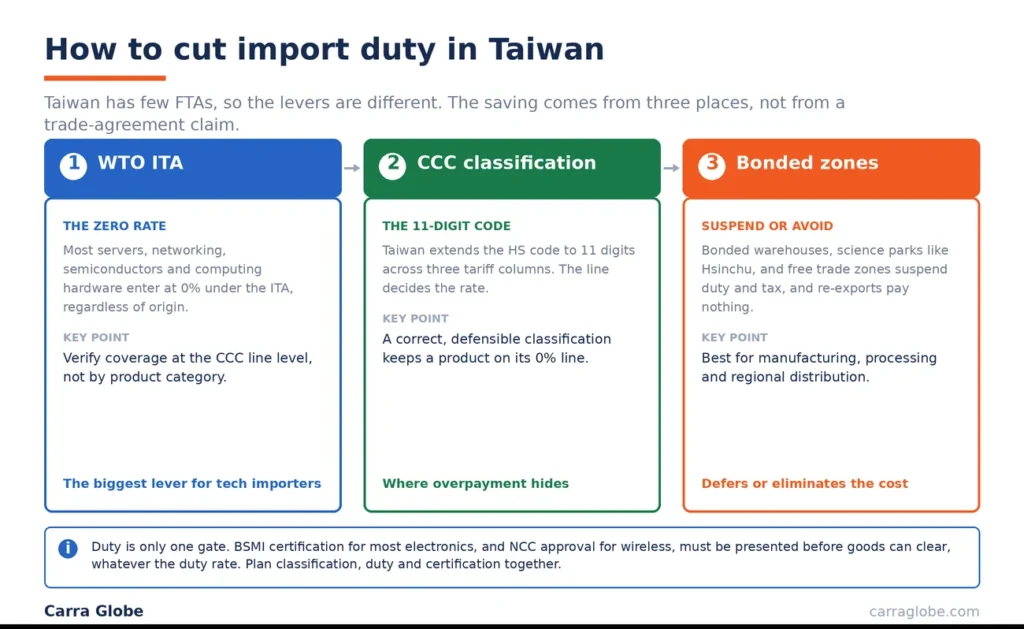
Not sure whether every one of your products is on a zero-rated ITA line? Carra Globe can audit your CCC classifications against WTO ITA coverage across your full product range, and identify where you are overpaying or exposed.
The Compliance Layer That Sits Alongside Duty
Reducing duty is only half the picture in Taiwan, because certification is a separate gate that duty savings cannot open. BSMI certification, from the Bureau of Standards, Metrology and Inspection, is mandatory for most finished electrical and electronic products, including servers, power supplies, displays, and networking equipment, and the BSMI certificate must be presented to customs before the goods can be imported. For wireless and telecom equipment, the National Communications Commission (NCC) regulates controlled radio-frequency devices, and any product with WiFi, Bluetooth, cellular, or RFID functions must be tested by an NCC-endorsed body and carry the NCC mark before it can enter the market.
This is where an importer of record matters beyond simply paying duty. Commercial import into Taiwan requires a Taiwan-registered entity with customs registration and a Unified Business Number, and clearance documentation should be prepared in Traditional Chinese where possible, as English-only submissions routinely cause delays. A foreign company without that registration cannot appear as the importer on the declaration.
The entity that files the declaration, holds or coordinates the BSMI and NCC certifications, matches the paperwork exactly, and is registered to recover the business tax is doing the work that makes the duty saving real. Getting that structure wrong means overpaying duty, losing the business tax recovery, or facing a certification hold, sometimes all three.
Frequently Asked Questions
How much is import duty in Taiwan in 2026?
Taiwan import duty ranges from 0% to 30%, averaging around 6%.
Most IT hardware enters at 0% under the WTO ITA, and roughly a third of all tariff lines are duty-free. A 5% business tax applies on CIF value plus duty. The exact rate depends on the 11-digit CCC classification, so the same product can be duty-free or dutiable depending on its line.
Is IT hardware duty-free in Taiwan?
Most is. Servers, networking equipment, semiconductors, and computing hardware covered by the WTO ITA enter Taiwan at 0% duty, regardless of origin. A 5% business tax still applies on the CIF value plus any duty.
The important qualifier is that ITA coverage is assessed at the CCC line level, not by product category. Some lines sit outside ITA scope, so classification must be verified product by product.
What is the de minimis value for Taiwan customs?
The de minimis is a customs value of TWD 2,000, below which imports are exempt from duty and business tax. Above the threshold, the entire value becomes taxable, not just the portion above it.
This matters for parcel-heavy and e-commerce importers. For commercial pallet shipments of IT hardware, the de minimis is not in play, full duty and tax rules apply regardless of value.
How can I reduce or lower my import duty into Taiwan legally?
By claiming the WTO ITA zero rate on qualifying IT hardware, classifying correctly under the right 11-digit CCC line, using bonded or science-park facilities, and registering for business tax to recover the 5%.
Unlike markets with broad FTA networks, Taiwan’s levers are the ITA, classification, and bonded regimes rather than FTA claims. Undervaluation or misdeclaration is illegal and carries penalties.
Can I import into Taiwan without a local company?
Not directly, but you do not need to set up your own company.
Commercial import requires a Taiwan-registered entity with customs registration and a Unified Business Number. A foreign company without one cannot be named as importer on the declaration, so it uses an importer of record that holds the registration on its behalf.
An importer of record gives you compliant access, including BSMI and NCC certification handling and business tax recovery, without establishing your own Taiwanese entity.
What is the difference between a CCC code and an HS code?
The CCC code is Taiwan’s national extension of the international HS code. It takes the shared 6-digit HS heading and adds national digits to reach 11 digits in total.
Every country shares the first 6 HS digits; Taiwan’s additional digits create the specific line that sets the duty rate and certification requirements. Two goods with the same 6-digit HS heading can sit on different CCC lines with different outcomes.
Does certification affect whether my goods clear customs in Taiwan?
Yes. BSMI certification is mandatory for most electronics and must be presented before import, and wireless products need NCC approval. Non-certified goods cannot clear customs at all.
Certification is a separate gate from duty. Both BSMI and NCC require in-market testing and documentation, so certification and customs filing are usually managed together through one importer of record.
How Carra Globe Helps
For companies importing servers, networking hardware, semiconductors, and other IT infrastructure into Taiwan, the duty saving and the compliance requirement are two halves of the same job.
Carra Globe acts as your importer of record in Taiwan, holding the Unified Business Number and customs registration, filing declarations in Traditional Chinese, verifying CCC classification against WTO ITA coverage, securing BSMI and NCC certification, and managing business tax recovery, across 175+ countries.
Our guide to calculating landed cost shows how duty, business tax, and fees combine into your true cost per shipment, and because misclassification is the leading cause of overpayment and delay, our breakdown of the cost of incorrect HS codes is worth reading before your next entry. For semiconductor and data centre moves specifically, see our guides to importer of record for semiconductor manufacturing equipment and IT hardware and data centre trade compliance. To see how these methods apply to your corridors, speak to our trade compliance team.
Official primary sources: the Customs Administration, Ministry of Finance (tariff schedule and clearance), and the Bureau of Standards, Metrology and Inspection (BSMI certification).