
Nobody tells you this at the start, so we will. Your first shipment into a new country will probably not go smoothly. Not because your team is careless, and not because you picked a difficult market. Because a first entry is a genuinely different exercise from every entry that follows it, and most import plans are built as though it is the same.
The second shipment into that market is often easier. By the tenth, the lane may be routine. The first one carries every registration, every unknown, and every decision that later shipments can inherit, provided the product, importer, route, and rules have not materially changed. That is worth knowing before you promise a delivery date.
This guide is written from the freight and customs side, from watching first entries into many markets. It covers what actually makes entry one harder, what tends to go wrong, and a way to map a shipment before it moves rather than discovering the gaps at a border.
Quick answer
| Question | Short answer |
|---|---|
| Why is the first shipment harder? | It carries one-time registrations, unknown lead times, and the precedents every later shipment inherits |
| What causes most first-entry delays? | Something that needed doing weeks earlier, not something that happened at the border |
| What cannot be rushed? | Registrations and approvals. Money and urgency do not compress an administrative queue |
| When does it get easier? | Usually by the second or third shipment, once the registrations exist and the classification is settled |
| What is the single biggest lever? | Mapping the shipment before it books, not after it lands |
Why entry one is a different exercise
The difference is not simply difficulty. Four recurring features make a first shipment unlike the ones that follow, and none of them is visible on a freight quote.
Many registrations are front-loaded. Many markets require the importing party to hold a customs registration, and some also require a tax or sector-specific registration before goods can be cleared. These tend to be queues rather than transactions: some resolve within a week, some run to several weeks, and a few stretch further where a product approval sits behind them. They are usually obtained before the first entry and reused afterwards, though renewals, updates, reporting, and product-specific additions can still apply.
You set precedents without meaning to. The classification you establish on entry one often becomes the classification you keep using. So does the way you describe the goods and the way you build the value. If any of that is wrong, you have not made one mistake, you have made a template. Correcting it later is harder than getting it right once, because you are now explaining a change rather than making a choice.
Nobody in the chain has done it before either. Your supplier has not shipped to that destination, your forwarder may not have cleared that commodity there, and your customer does not know what their side needs. On a mature lane, everyone has a habit. On a first entry, everyone is improvising politely.
The unknowns are unevenly distributed. Some countries clear standard commercial cargo quickly. Others may subject unfamiliar products, first-time importers, or shipments with incomplete documentation to additional review or inspection. Some require a product approval that can take weeks and, depending on the product and jurisdiction, may need a locally registered party or representative in place first. You cannot feel that difference from the outside, which is why our IOR by country pages set out what each market actually requires rather than describing importing in general terms.
| First shipment | Later shipments |
|---|---|
| Importer registration may need establishing | Registration already exists |
| Classification needs confirming | Established classification can often be reused |
| Product approvals need identifying | Existing approvals may already cover the product |
| The document process is being built | Documents become a repeatable template |
| Lead times are less predictable | Lane history improves planning |
| Roles may still be unclear | Importer, broker, and consignee roles are settled |
Which reframes what entry one is for. The objective is not simply to clear one shipment. It is to build a repeatable import lane for the shipments that follow.
What usually goes wrong on a first shipment
These are patterns rather than country rules. They repeat across very different markets, which is what makes them worth planning around.
- The registration was started too late. Somebody assumed it could run in parallel with the freight. Often it cannot, because the declaration may require a customs, tax, importer or product-registration identifier that the process has not produced yet.
- The goods description is written for a colleague, not a customs officer. Internal product names, model codes, and marketing language tell an officer nothing, and vague descriptions invite exactly the scrutiny you are trying to avoid.
- The classification was guessed. One line copied from a similar product, or taken from the export side without checking the import side, and the duty rate, the certification requirement, or both, come out wrong.
- A certification exists but not in the right form. Many markets accept only their own approval, or a specific test report, or a local representative holding it. A perfectly valid certificate from elsewhere is not automatically portable.
- The paperwork does not agree with itself. Invoice, packing list, transport document and declaration each say a slightly different thing about quantity, value, weight, or description. Any mismatch is a reason to look closer.
- Nobody confirmed who the legal importer would be. The commercial terms were agreed, the freight was booked, and the question of which registered entity actually files the entry was left until the goods existed.
Notice what is not on that list: bad luck at the border. Many first-entry problems are created weeks earlier, in a decision that looked administrative at the time. Our guides to resolving and preventing customs holds and how long customs clearance takes cover what happens once a shipment is already stopped.
Not every first shipment has the same starting problem
It helps to stop thinking of markets as simply easy or difficult, and instead ask what is most likely to gate this entry, for this product, with this importer. Three patterns recur. A given shipment can meet more than one, and the answer moves with the product and the importer as much as with the destination.
- Document-led. The main task is getting the commercial and customs documentation complete, consistent, and acceptable for entry. This is common for standard commercial cargo where the importing party is already properly registered and no product-specific approval applies.
- Registration-led. The first hurdle is establishing the importer and completing the registrations needed to make a declaration at all. That matters most where a customs, tax, or importer registration has to exist before the shipment can be cleared, and those registrations run on their own timetable.
- Approval-led. The product itself creates the longest lead time. A type approval, conformity requirement, telecoms permission, or safety authorisation becomes the gating item. The shipment may arrive before the approval exists, but it may not be releasable or lawfully usable.
Which pattern you are in is market and product specific, which is exactly why it pays to check the destination rather than generalise about it. Our market pages set out what each one requires: United States, Germany, Netherlands, United Kingdom, Ireland, India, China, Singapore, Malaysia, Saudi Arabia, Israel, Brazil, and Mexico, with the full set on our IOR by country index.
Map the shipment before you book it
This is the part that changes outcomes. Mapping is not a checklist you tick at the end; it is a set of questions answered in order, where each answer narrows the next. Work through the six below before the freight is booked, and the first entry is more likely to behave like a later shipment.
1. Map the goods
Write down exactly what is moving, in the words a stranger would need: what it is, what it does, what it is made of, and what it is for. Then settle the classification properly rather than by resemblance, because that code drives the duty rate, the paperwork, and often whether a licence or approval applies at all. Our HS Code Finder is a starting point for the customs heading.
Then confirm the customs procedure before assuming a normal import for free circulation. Permanent import, temporary admission, repair, exhibition, transit, bonded movement, inward processing, and returned goods are different routes, and the choice changes the documents, any guarantee, the duty treatment, the permitted use, and whether the goods can be sold after arrival. The names and conditions vary by country: in the EU, for example, these sit as special procedures under the Union Customs Code.
2. Map the roles
Decide who is legally the importer, who is the consignee, who acts as customs declarant or representative, who pays the duty and tax, who owns the goods on arrival, who handles post-clearance obligations, and who the customer expects to deal with. These are separate questions and they do not automatically resolve to the same party. If you have no registered entity in the destination, this is the question to answer first, not last, because everything else depends on it. Our page on importing without a local legal entity sets out the routes.
3. Map the country
Now, and only now, look at the destination. What registrations does the importing party need, what approvals does this specific product need, and does either have to exist before the goods leave rather than before they arrive? This is where general knowledge stops being useful and market detail starts. Whether you are shipping to a fast, document-driven market or one with a mandatory product-approval step, the requirement list is different, and our importer of record services cover 175+ countries on exactly this basis.
4. Map the documents
List every document the entry will need, then check that they agree with one another and with the goods actually in the box. Completeness and consistency matter more than volume here: a complete, coherent document set works better than a thick, contradictory one. Check too whether the destination expects translations, original certificates, notarisation or legalisation, pre-arrival filings, product-registration evidence, or documents held by a local representative. Our guide to delivery documentation for imports covers the standard set, and the customs compliance checklist covers the wider pre-shipment sweep.
5. Map the lead times, including the ones you cannot compress
Separate the timeline into things you control and things you queue for. Freight, packing and booking are yours to accelerate. Registrations, approvals and licences are not: they take what they take, and paying more does not move an administrative queue. Build the plan backwards from the slowest queue, not forwards from the ship date, and do not commit to a delivery date that assumes every queue behaves.
6. Map the money
Work out the full landed position, not the freight quote: duty, import tax, clearance and handling, any certification cost, and who is contractually carrying each one. If the terms are delivered duty paid, confirm in writing exactly what “duty paid” includes, because unclear treatment of taxes, duties, or destination charges is one of the easiest ways for a DDP promise to break down.
Agree in advance who carries the costs that appear when a first entry does not release on schedule: storage, demurrage, detention, examination, bond or guarantee, disbursement, inspection, translation, and exchange-rate movement. And remember that Incoterms allocate commercial cost and risk between buyer and seller. They do not override local rules on who may act as importer, who may recover import tax, or who must hold a product licence.
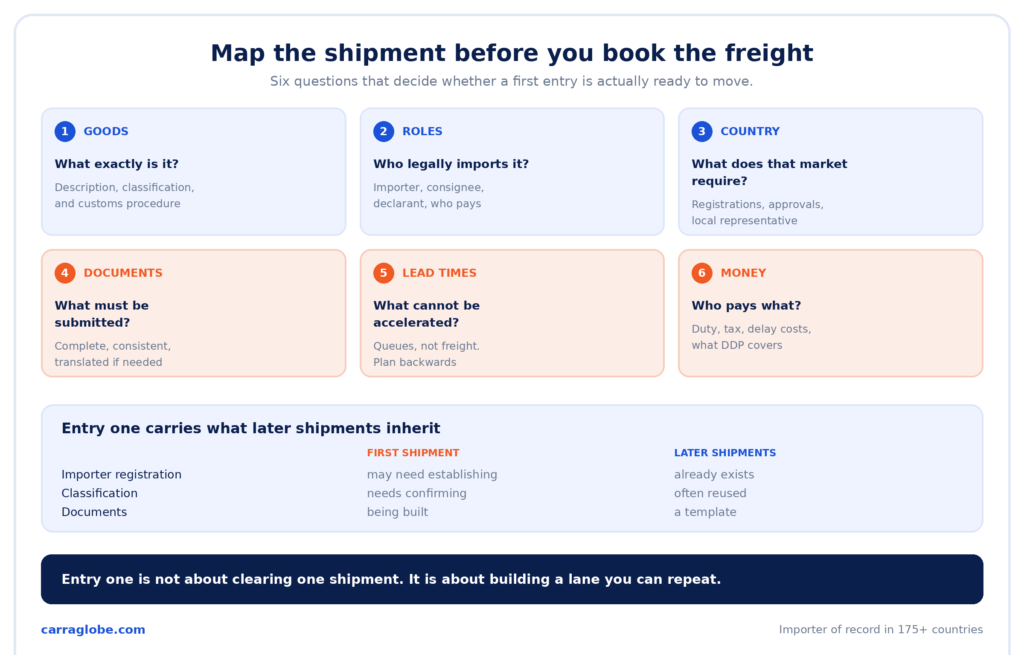
GOODS → ROLES → COUNTRY → DOCUMENTS → LEAD TIMES → MONEY. Do not start with freight. Start with the six questions that determine whether the shipment is actually ready to move.
Where each decision actually falls
Laid against a timeline, the pattern becomes obvious. Clearance sits near the end of the process, but most of the decisions that determine how it goes are taken before the cargo is collected.
| Stage | What to confirm | What it depends on |
|---|---|---|
| Before quoting | Product, destination, who the importer will be | Product classification |
| Before booking | Registrations, approvals, the importer role | Country requirements |
| Before dispatch | Documents, customs value, classification | The customs entry |
| Before arrival | Broker, importer, permits | Clearance |
| At arrival | Entry filing, any inspection, duty and tax | Customs release |
| After clearance | Records, classification, reusable templates | Every later shipment |
First shipment into a new country: pre-shipment checklist
Not everything here applies to every product or market, but each item is worth a deliberate yes or no before freight is booked.
- Product description (HS Code) written in plain, specific terms
- Customs classification confirmed rather than assumed
- Importer, consignee, and customs declarant identified
- Importer-of-record eligibility and authority confirmed for this product and destination
- That party’s customs registration confirmed
- Tax registration checked, where it applies
- Product approvals or certifications checked
- Import licence requirement checked
- Broker or clearance agent appointed
- Customs procedure confirmed: free circulation, temporary admission, repair, transit, bonded movement, or another special procedure
- Product condition confirmed: new, used, returned, repaired, sample, or demonstration equipment
- Dangerous-goods and restricted-goods status checked
- Any pre-arrival safety, security, or carrier filing checked
- Local representative appointed where required
- Commercial invoice and packing list reviewed against each other
- Country of origin established on a defensible basis
- Customs value basis established
- Duty and import tax estimated
- Incoterm agreed, and DDP responsibilities confirmed in writing where used
- Transport documents checked for consistency
- Destination-specific requirements for these goods confirmed
- Registration and approval lead times built into the schedule
- Storage, demurrage, detention, examination, and guarantee costs allocated
- Post-clearance obligations identified: record retention, reporting, product registration, warranty, and recall
Planning a first shipment into a market you have not used before? Tell us the goods, the origin, and the destination, and we will tell you what has to happen before it moves. Ask us to map your first entry →
What “smoothly” actually looks like
Worth resetting the expectation, because “smooth” is not the same as “fast” and it is definitely not the same as “nothing happened”.
A first entry that goes well usually still involves a question from the authorities, a document you did not expect to need, and a day or two you had not planned for. What makes it smooth is that none of those becomes a stop, because the importing party was registered, the classification held up, and the paperwork agreed with itself. The shipment moves through friction rather than into a wall.
By the second shipment, many of the one-time registrations, classification decisions and document templates may already be in place. By the third, the lane is often boring, which is exactly what you want a supply chain to be. The work you do before entry one is what buys that.
How Carra Globe helps
We handle first entries regularly, which means the common failure points are familiar before a shipment moves. On a new market we help on three fronts:
- Providing the importer-of-record structure where permitted. Where you have no suitable local entity, we can provide importer of record support across 175+ countries in markets where the role is legally available.
- Front-loading the queue. Identifying which registrations and approvals your product needs in that market, and starting them at the point they need starting rather than when the freight is ready.
- Getting entry one right so entry two is easy. Classification, valuation basis, and document set built to be reused rather than corrected.
What we will not do is promise that a first shipment is routine. Requirements vary by product, country and role, and we confirm the position for your specific case rather than assuming it.
Importer of Record · 175+ countries
Shipping into a new market? Get entry one right and the rest of the lane looks after itself.
Carra Globe acts as your importer of record where you have no local entity, starts the registrations that gate a first entry, and builds the classification and document set your later shipments will reuse. Explore how we help:
Free tools: HS Code Finder|Volumetric Weight Calculator|Pallet Calculator
Planning a first shipment into a new market? Tell us the goods, the origin, and the destination, and we will tell you what has to happen before it moves.
Map your first entryFrequently asked questions
Why is my first shipment into a new country delayed?
Usually because something needed doing before the goods moved: a registration, an approval, or a classification decision. Many first-entry delays are not created at the border; they are revealed there. The fix usually sits earlier in the timeline than the delay appears.Do I need to register before importing into a new country?
In many markets the importing party needs a customs registration, and sometimes a tax or sector registration too. The specific requirements depend on the country and the product. Registrations are queues rather than transactions, so start them before the freight rather than alongside it.Can I import into a country where I have no legal entity?
Often yes, but not simply by appointing any registered party. Some markets require local establishment, tax registration, product licences, ownership or control of the goods, or an importer able to accept post-import liability. Confirm the permitted structure for the specific product and destination before booking freight, because the registered importer is what many other steps depend on.What should I check before shipping to a country for the first time?
The importer and its registrations, the product classification, any licence or approval, the documents, the customs value, and the duty and tax position for those specific goods and that destination. Do it before booking freight, because some of those can take weeks to put in place.Is the consignee the same as the importer?
Not necessarily. The consignee is named to receive the goods, while the importer, declarant, or customs representative may carry responsibility for the entry, duties, documentation, and post-import obligations. Confirm the roles before shipping rather than assuming the transport document settles the customs position.Can goods clear customs but still not be legal to sell?
Yes. Customs release does not necessarily complete product registration, safety certification, environmental compliance, labelling, tax, or sector-specific approval requirements. Map the requirements for customs release and the separate requirements for lawful sale or use as two different questions.Does a first shipment need a different customs classification?
No. A first shipment gets no special classification, but the decision deserves care because later entries often reuse it. Classification can differ by customs territory, product configuration, and tariff rules, so do not copy an export code or another country’s code without checking it.How far ahead should I start planning a first shipment?
Work backwards from the slowest queue, not forwards from the ship date. Where a product approval or a new registration is involved, that queue can be measured in weeks rather than days. Freight is the part you can compress. Administrative lead time is not.Is the second shipment into a new country easier?
Often, and noticeably. The infrastructure created for entry one, the registrations, the classification decision and the document set, can usually be reused rather than rebuilt. A later shipment can still raise something new, a different product, a changed rule, or a new importer, but the groundwork rarely has to be repeated.Disclaimer: This guide is for informational purposes only and does not constitute legal, customs, or trade advice. Import requirements, registrations, approvals and lead times vary by country, product, and the role each party takes, and they change. Always confirm the current requirements for your specific goods and destination with the relevant customs authority, a licensed broker, or qualified counsel before shipping.