
The cluster is decommissioned. The buyer is agreed, the racks are ready to come out, and the shipment cannot lawfully leave the country. Not because anything was done wrong, but because two questions were never asked: is this hardware still controlled, and is your company even eligible to act as the exporter?
Both answers surprise people, and they are what makes exporting retired AI hardware different from an ordinary outbound shipment. Advanced accelerators can remain controlled goods after they leave the rack, and in several jurisdictions the company that owns them may not be permitted to act as the exporter. Retirement changes an asset’s value, not its legal status. Redeployment, refurbishment, and resale are all better commercial outcomes than disposal, and most of them cross a border.
We have seen exactly this. A European data centre was decommissioning a fleet of high-end AI servers, with the GPUs destined for reuse in another country rather than disposal. The hardware was paid for, fully depreciated, and physically ready to leave the racks. The shipment still could not move, because the export classification, the destination screening, and the legal exporter had not been established for the redeployment.
The machines had reached the end of their life in one data centre. They had not reached the end of their regulatory life.
This guide covers exporting retired AI hardware from the freight and customs side, where these shipments actually stall: what still applies to used equipment, who can lawfully make the declaration, and what to establish before anything is uninstalled. The inbound leg, which most teams already handle well, is covered in our guide to the importer of record for AI servers and GPU clusters.
Last updated: 21 August 2026. Checked against the EU Dual-Use Regulation, the Union Customs Code, the US Foreign Trade Regulations, and current BIS guidance.
Quick Answer
| Question | Short answer (verify for your fleet and route) |
|---|---|
| Do export controls still apply to used GPUs? | Generally yes. Controls can depend on the item’s specification, origin, destination, end user, and end use, not merely its age or book value |
| Are retired accelerators controlled items? | They may be. Illustrative US classifications include ECCN 3A090 and 4A090 and related .z entries, with separate EU and other national lists |
| Can the owner always be the exporter? | No. For ordinary EU exports the Article 1(19) exporter generally must be established in the Union customs territory. Different rules can apply to re-export of non-Union goods |
| US position | The USPPI is determined under the Foreign Trade Regulations. EEI may be filed by the USPPI or an authorised US agent, and routed exports carry separate FPPI, USPPI, and agent responsibilities |
| Does a forwarder take the role? | Not automatically. Arranging transport is not the same as holding the exporter role |
| When to resolve it | Before uninstall. Classification and eligibility drive the plan, not the other way round |
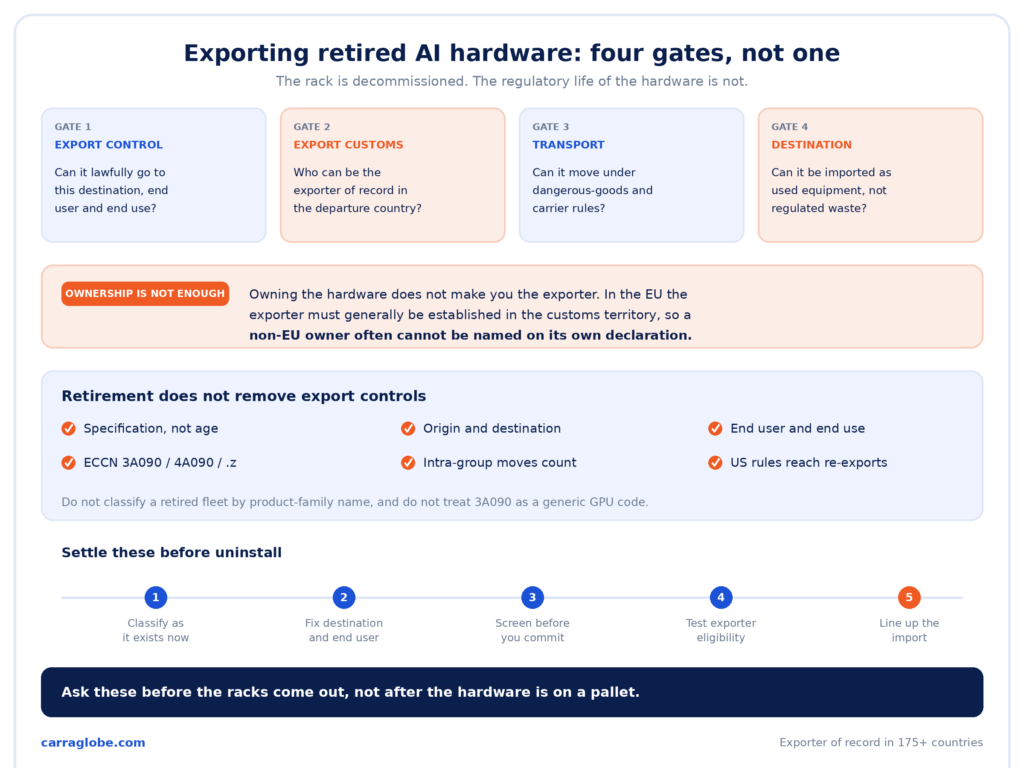
Four separate gates, four separate questions
Most confusion in a decommissioning project comes from collapsing four distinct questions into one. Keep them apart.
| Gate | The question it answers |
|---|---|
| Export control | Can this item lawfully go to this destination, this end user, and this end use? |
| Export customs | Who can be the exporter of record, legally, in the country of departure? |
| Transport | Can it physically move under dangerous-goods and carrier rules, given embedded batteries and packing requirements? |
| Receiving-market compliance | Can the destination import it as used equipment, and is it reusable equipment rather than regulated waste? |
Used does not mean uncontrolled: the US position
Export controls on used GPUs attach to specification, origin, destination, end user, and end use, not to age or book value. Second-hand status, a written-down book value, and an internal transfer between your own sites do not remove a licensing requirement, and licence requirements reach well beyond China and Macau. This is one of the costliest misunderstandings in a decommissioning project.
Advanced accelerators and the systems containing them may be controlled under ECCN 3A090, ECCN 4A090, related .z classifications, or another EAR classification, depending on the part number, specification, configuration, and rules in force. Do not classify a retired fleet by product-family name, and do not treat 3A090 as a generic code for every GPU. A previous classification does not settle current status either, because rules change and specifications matter.
Two details catch decommissioning specifically. Related .z paragraphs can bring systems, computers, and assemblies incorporating controlled advanced-computing technology within scope, so a retired server may carry a system-level classification alongside the chip-level one. Check that against the actual configuration, not the accelerator alone. And ECCN 3A090 controls certain high-bandwidth memory under 3A090.c, subject to the applicable parameters, which matters if memory is separated for resale. Subparagraphs are not treated identically in licence exceptions.
Destination matters as much as the item. BIS has maintained controls touching advanced-computing items across certain Country Group D:1, D:4, and D:5 destinations, though the enforcement position is not uniform across those groups. The instruction is simpler than the rule: do not work from a remembered country list. Check the current requirement against your ECCN or .z paragraph, the item, destination, end user, and end use.
A separate analysis attaches to the counterparty, not just the destination. BIS guidance of 31 May 2026 addressed licence requirements for covered advanced-computing items involving entities headquartered in, or with an ultimate parent headquartered in, Country Group D:5 destinations or Macau, including where the receiving entity sits elsewhere. A follow-up FAQ of 17 June 2026 confirmed this reaches 3A090, 4A090, and related .z items, not only the “.a” entries.
Three points follow. Non-enforcement of the January 2025 AI Diffusion Rule did not suspend the separate pre-existing requirements, so for a resale the question is not only where the buyer sits but who owns the buyer. Commentary notes the control operates on a strict-liability basis, so screening alone is not a defence. And BIS guidance and FAQs are implementation guidance, read alongside the EAR text, ECCN notes, and licence exceptions rather than in place of them.
US controls also reach outside the United States. US-origin accelerators, and sometimes foreign-made items, can remain subject to the EAR when re-exported from the EU, the Middle East, or Asia. Jurisdiction can turn on US origin, controlled US-origin content or technology, and the de minimis or foreign direct product rules, so foreign-made means neither automatically controlled nor automatically clear. Our guides to export controls on data centre hardware and ITAR and EAR compliance go deeper.
An export classification is not a customs code
These get conflated constantly. A customs classification, the HS or CN code, serves tariff and statistical purposes. An export-control classification such as an ECCN sits under export-control rules, and other countries maintain their own lists. A retired accelerator carries both, and neither substitutes for the other. Determine both before shipment; our HS Code Finder covers the customs heading, a separate exercise from the export-control determination.
Worth saying plainly. An intra-group transfer can still be an export or re-export when it takes hardware outside the relevant customs territory, or when an export-control rule otherwise applies. Note the distinction inside Europe: moving a rack from Germany to the Netherlands stays within the EU customs territory and is not an EU export, while moving it from either country to a third country is. No sale and no change of ownership removes licensing, screening, or end-use obligations.
Export controls are not only a US question
The EU runs its own dual-use regime under Regulation (EU) 2021/821, with Annex I updated in November 2025. Some Member States add national controls, so the analysis can differ by departure country.
The EU list sits in Annex I to Regulation (EU) 2021/821 and is refreshed regularly. Commission Delegated Regulation (EU) 2025/2003, in force from 15 November 2025, added or revised controls across semiconductor, quantum, and advanced-computing items. Check the Annex I entry against the exact hardware and configuration, not a general product description, and recheck any fleet classified against an older version.
There can be a second layer. Article 9 allows Member States to impose national licence requirements on certain unlisted items on public security or human rights grounds, and the Commission publishes those lists. The 2025 update introduced EU-wide controls that replaced or narrowed some earlier national measures, but the answer can still differ by departure Member State, particularly where an item falls outside Annex I or a catch-all applies. Check the EU list, any national list, the catch-all rules, and that country’s licensing procedure.
Beyond the EU, similar in shape and different in detail. The United Kingdom runs its own framework: Great Britain applies an assimilated dual-use regime with its own control list, while Northern Ireland remains subject to EU dual-use controls in the circumstances set out in the Withdrawal Agreement, so the 2025 EU changes applied there directly. The GB list was amended in December 2025, so check it rather than automatically applying the EU one.
Licensing shortcuts differ too: the EU has General Export Authorisations, the UK operates Open General Export Licences, and jurisdictions across Asia and the Middle East maintain their own lists and catch-all provisions. Assume each departure country has its own answer.
Owning the hardware does not make you the exporter
Ownership answers “whose equipment is this?” Exporter status answers “who is legally responsible for taking it out?” They are not necessarily the same party.
Under EU customs rules the exporter is generally a person established in the customs territory who has the power to determine that the goods leave, or, failing that, a person established in the Union who is party to the contract under which they are taken out. Both limbs require EU establishment; which applies depends on the transaction and customs circumstances, so check the current consolidated Article 1(19) against the facts, alongside the Commission guidance on the definition of exporter.
Establishment is specific: for a company it generally means a registered office, central headquarters, or permanent establishment inside the customs territory. A colocation contract is not establishment, nor is a local systems integrator. An EORI number identifies an economic operator but does not by itself establish that operator in the customs territory or make it eligible to act as exporter.
So an operator not established in the EU, retiring a cluster from a Dutch or German facility, generally cannot act as exporter under the ordinary definition simply because it owns the hardware. Identify an EU-established party that can: a qualifying group entity, the buyer, a reseller, or another contractual party. Where legally permitted a customs representative may act in indirect representation, in its own name and with the associated liability. Representation and exporter status are distinct, so confirm the representative’s authority before filing.
One carve-out matters here. For certain re-export declarations involving non-Union goods, covered by Article 270(1) of the Union Customs Code, the customs role can differ, because the Article 1(19) definition is not necessarily applied in the same way. That must be assessed against the customs status and procedure actually used; it is not a general rule that anyone may act as exporter for non-Union goods.
It can apply where hardware remains non-Union goods under temporary storage, customs warehousing, a free zone, or another special procedure, and does not automatically apply to goods already in free circulation. Map this customs role separately from ownership, sale terms, EU dual-use licensing, and US re-export exposure.
Roles and jurisdictions that should never be merged by default
| Role or jurisdiction | What it actually means |
|---|---|
| Owner | Holds title. Confers no automatic right to declare the goods |
| Exporter or declarant | The party named on the declaration, subject to the departure country’s eligibility rules |
| Customs representative | Acts for another party, directly or indirectly. Representation is not exporter status |
| Licence responsibility | The party responsible for determining or obtaining any required export licence |
| EU | Exporter under Article 1(19): is the party established in the Union customs territory and otherwise eligible? |
| United States | USPPI and authorised EEI filer: who is the US Principal Party in Interest, and who may file? |
| United Kingdom | Exporter or declarant: which regime applies, Great Britain’s assimilated list or the EU rules in Northern Ireland? |
| US-origin goods abroad | Re-exporter and other EAR parties: does the EAR still reach this movement? |
The United States works differently
Why the wording matters here. “Exporter of record” is a commercial term for the party managing an outbound shipment. The legally relevant role differs by jurisdiction: EU customs law defines an “exporter”, the US Foreign Trade Regulations use the US Principal Party in Interest, and export-control law can assign licensing responsibility to a different party again. This guide uses the relevant legal term for each jurisdiction rather than treating the three as interchangeable.
The United States works on a different test entirely: not establishment, but the party identified as the US Principal Party in Interest under the Foreign Trade Regulations at 15 CFR Part 30. Often that is the US person receiving the primary benefit, but the answer depends on the facts and applicable definitions, including special cases involving foreign entities and previously imported goods. It is not whoever owns the equipment or books the freight, and it is a role determination, not a statement that the USPPI files.
Electronic Export Information is filed through the Automated Export System by the USPPI, its authorised US agent, or, in a routed export, the agent authorised by the foreign party. Filing is generally required where the Foreign Trade Regulations trigger it, including shipments over the applicable value threshold per classification line and shipments requiring a licence regardless of value, subject to the exemptions in force.
Where the foreign principal party in interest controls the movement, the transaction may be a routed export under 15 CFR 30.3. The FPPI authorises a US agent to file the EEI, and the regulations split data and record-keeping duties between the USPPI and that agent, which parties cannot reassign through an Incoterm or freight instruction. Routing changes filing authority, not who is the USPPI, and the EAR can assign exporter or licence-applicant responsibility differently again.
Important: exporter of record, USPPI, and EEI filer are not interchangeable terms, and the party carrying licence responsibility may be different again. An authorised agent can file in AES without becoming the USPPI. Where a foreign entity is the USPPI and a filing is required, that filing is made through an authorised US agent rather than by the foreign entity directly.
Stripped of the acronyms, the US position comes to this: someone has to be identified as the USPPI on the facts, someone has to be authorised to file, and someone carries the licence decision. They are frequently three different parties, and an authorisation such as a power of attorney for customs is normally required for an agent to act. Map them before the shipment is booked, not after.
Eight issues that catch decommissioning projects
Projects stall on classification drift, used-goods valuation, serial-level records, data sanitisation timing, physical handling, embedded batteries, the used-versus-waste question, and nobody owning the export role.
- Classification drift. The fleet was classified on import years ago. Configurations changed, cards were swapped, and the export classification no longer matches the records.
- Valuation of used goods. Book value, secondary market value, and intra-group transfer price all differ, and the method depends on the applicable valuation rules. Do not substitute book value for customs value because the fleet is depreciated; export-control value thresholds and customs valuation are separate concepts.
- Serial-level records. Accelerators are tracked individually. Manifests built for pallets rather than units create reconciliation problems at the border.
- Data sanitisation and custody. Decide before uninstall whether media is removed, wiped, cryptographically erased, or destroyed, and keep certificates, serials, and custody records aligned with the manifest. Capture export-control evidence first: once a unit is wiped or stripped, model, configuration, firmware, and serial relationships can be lost, and classification becomes harder to defend.
- Physical logistics. High-density racks, liquid cooling loops, and heavy chassis make removal a specialist job.
- Embedded batteries and dangerous goods. UPS units, battery-backed controllers, and ancillary hardware can bring lithium batteries into scope, separately from export controls. Confirm battery type, state of charge, packing, carrier restrictions, and transport rules before the equipment reaches the dock.
- Used equipment or waste. Hardware shipped for documented reuse, resale, repair, or refurbishment is treated differently from equipment destined for disposal. Incomplete, non-functional, or disposal-bound goods can pull in separate waste-shipment and environmental rules.
- Nobody owns the export. Facilities runs the uninstall, procurement runs the resale, and the export declaration belongs to neither until someone asks.
Two points need expanding. Decommissioned does not automatically mean waste, and it does not automatically mean reusable equipment either: condition, intended use, documentation, and the circumstances of shipment all matter, and authorities may treat a consignment as waste where evidence of intended reuse is missing.
And not every outbound movement is a permanent export. Equipment sent temporarily for testing, repair, refurbishment, demonstration, or return may fall under different customs procedures or reliefs, such as temporary export, outward processing, or returned-goods arrangements, though those do not automatically remove export-control, sanctions, transport, or destination-country requirements. See our guides to exporting equipment for repair and IOR and EOR for returned goods.
What the exporter of record actually carries
The exporter carries declaration accuracy, the licence position, screening of parties and end use, documentation, record retention, and contact with authorities. A forwarder arranging transport does not absorb this by default.
| Responsibility | What it means for a retired fleet |
|---|---|
| Declaration accuracy | Correct classification, value, quantity, origin, and destination for used equipment |
| Licensing position | Establishing whether the accelerators need a licence for that destination, and holding the evidence |
| Sanctions, end use, and diversion review | Screening the buyer, consignee, end user, intermediaries, and destination. Obtain and retain end-user, final-location, and intended-use information, and investigate unusual routing or incomplete counterparties |
| US re-export analysis | For US-origin or otherwise EAR-controlled hardware, assessing re-export and in-country transfer restrictions separately from local customs rules |
| Documentation | Invoice, serial-level packing list, transport documents, and any permits aligned |
| Waste-status assessment | Documenting functional condition, completeness, and intended reuse, with evidence the shipment is not disposal-bound waste |
| Records | Retaining export records for the period the jurisdiction requires |
Two traps sit inside that table. For used hardware, do not infer customs origin from the location of the data centre, the owner, or the country the equipment is leaving: origin follows the applicable customs origin rules, and a server that spent four years in Frankfurt does not thereby become of EU origin. And a freight forwarder arranging the move does not absorb the exporter role by default, however much of the paperwork it files.
How to approach exporting retired AI hardware
The order matters more than any individual step, because each answer constrains the next. Work through these for decommissioned data centre equipment before uninstall, not after the hardware is on a pallet.
- Classify the fleet as it exists now, in every departure country. Work from current configurations, not original import records, and classify against the rules applicable to the transaction and jurisdiction, not only the local list: EAR-controlled goods can carry US obligations alongside local controls.
- Fix the destination, end user, and ownership early. Licensing turns on where the hardware goes and who receives it, including the counterparty’s headquarters and ultimate parent.
- Screen before you commit. Run sanctions, restricted-party, end-use, and diversion screening on the buyer, consignee, end user, and intermediaries before signing, then settle the licence position.
- Check the customs status of the goods. Free circulation or a special procedure changes the options, including whether a re-export route is open.
- Test who can be the exporter. In the EU, ask whether any group company is established in the customs territory. In the US, work out the USPPI on the facts.
- Settle valuation and serial records. Agree the basis for value on used equipment and build the manifest at unit level.
- Line up the import at the far end. Confirm the importer of record for data centre equipment and clearance route in parallel, and check the destination can receive it as used equipment.
Treat licensing as a schedule risk, not just a compliance one. A licence determination or application can move the resale timetable, the storage plan, and the dismantling sequence, so avoid committing to removal or delivery dates before classification, end use, and the licence position are settled. In the decommissioning described at the start of this guide, none of the three open questions was difficult on its own. They were simply asked after the hardware was ready to move rather than before.
Planning a cluster retirement or a cross-border redeployment? Carra Globe helps map the exporter, declarant, authorised-agent, and importer roles, and provides exporter of record and importer of record support across 175+ countries where the jurisdiction, transaction structure, and compliance requirements permit. The legal role is confirmed separately for each shipment. Talk to us before the racks come out →
How Carra Globe helps
We move high-value and regulated hardware for technology, data centre, medical, aerospace, and telecoms clients, and the export leg is usually the one nobody planned for. On a decommissioning we help on three fronts:
- Role mapping. Establishing who can lawfully be the exporter or declarant in the departure country, and how the USPPI, authorised-agent, and importer roles line up around it.
- The declaration itself. Classification, valuation of used equipment, serial-level documentation, and the customs entry, alongside the dangerous-goods paperwork an accelerator fleet with embedded batteries needs.
- Both ends of the move. Pairing the export with the importer of record and clearance at the destination, so a consignment is not stranded mid-route.
One boundary worth stating plainly: acting as exporter of record does not automatically transfer licence responsibility, manufacturer obligations, or an export-control determination. Those roles are confirmed separately for each shipment, and where a specialist assessment is needed we say so rather than absorb it.
Exporter of Record · 175+ countries
Retiring a cluster? Settle the exporter question before the racks come out.
Carra Globe helps map the exporter, declarant, authorised-agent and importer roles, handles the declaration and classification, and flags licensing questions before the hardware moves. Explore how we help:
Free tools: HS Code Finder|Volumetric Weight Calculator|Pallet Calculator
Planning a decommissioning or cross-border redeployment? Tell us the departure country, destination and equipment list, and we will map the path.
Talk to us before the racks come outFrequently Asked Questions
Do export controls apply to used and decommissioned GPUs?
Generally yes. Controls follow the item’s technical specification, origin, destination, end user, and end use, not its age, condition, or written-down value. Retirement does not declassify a controlled item. Advanced accelerators can fall within classifications such as ECCN 3A090 or 4A090 and related .z paragraphs, subject to the applicable thresholds and current rules.
Can I export decommissioned hardware from a country where I have no entity?
Not necessarily. In the EU, ordinary export rules generally require the exporter to be established in the Union customs territory, and owning the equipment or holding an EORI number does not create that capacity. Other jurisdictions apply different tests. Exporting equipment without a local entity is workable, but the structure depends on the departure country’s rules, which is the question to settle before uninstall.
Can I move retired GPU servers between EU countries without an export declaration?
Movement between EU Member States is not an export from the EU customs territory, so no EU export declaration arises on that basis. VAT, intra-EU reporting, customs-procedure, record-keeping, and export-control obligations can still require review. Once the equipment leaves the EU customs territory, the ordinary export rules apply in full. Do not treat the wider European region as equivalent: the United Kingdom, Switzerland, Norway, Turkey, and other non-EU destinations need their own analysis.
Do US export controls apply if the GPU leaves from Europe?
They can. US-origin accelerators, and in some circumstances foreign-made items, can remain subject to the US Export Administration Regulations when re-exported from another country. An EU customs-compliant export declaration does not replace a separate US re-export and licence assessment.
What is ECCN 3A090?
It is the US export classification for advanced computing integrated circuits, with subparagraphs covering the most capable data centre parts, less advanced but still controlled parts, and certain high-bandwidth memory. Related .z paragraphs extend control to computers and assemblies incorporating those circuits. It is not a generic code for every GPU: whether a specific accelerator falls within it depends on its parameters and the rules in force.
Does decommissioned AI hardware count as e-waste?
Not automatically. Functional equipment intended for documented reuse, resale, repair, or refurbishment can move as used equipment, but non-functional or disposal-bound goods may be treated as waste. Classify condition and intended use before shipping, because waste shipments can trigger separate environmental and destination-country controls.
When should export planning start in a decommissioning project?
Before uninstall. Classification, destination, and exporter eligibility shape the plan, and discovering a licence requirement after the racks are stripped is the expensive order to do it in. Data sanitisation and serial-level manifests also need deciding while the equipment is still in place.
Sources and verification
- EU customs: Commission Delegated Regulation (EU) 2015/2446, Article 1(19) on the exporter definition, and the Union Customs Code, Article 5(31) on establishment and Article 270(1) on re-export.
- EU export controls: Regulation (EU) 2021/821, Annex I as amended by Delegated Regulation (EU) 2025/2003 (in force 15 November 2025), Article 9 national controls, and the Commission page on exporting dual-use items. The UK and other jurisdictions operate separate regimes.
- US: Foreign Trade Regulations, 15 CFR Part 30, with the Census Bureau FTR FAQs; BIS guidance of 31 May 2026 and its FAQ of 17 June 2026.
- Verify before shipping. EAR classifications and licence requirements changed repeatedly during 2025 and 2026. Confirm the current position for your exact item, destination, end user, and end use, and note that separate waste-shipment and environmental rules can apply to non-functional or disposal-bound equipment.
Disclaimer: This guide is for informational purposes only and does not constitute legal, customs, or export-control advice, and Carra Globe does not provide export-licensing determinations as a substitute for qualified advice. Eligibility to act as exporter, classification, licensing, and valuation vary by country, item, destination, and the facts of each transaction, and the rules change. References to classifications, country groups, licensing requirements, customs roles, and thresholds are illustrative and are not a determination that any particular item or transaction is authorised. Always confirm the current position with the relevant customs or export-control authority, or with qualified counsel, before exporting.