
Six access points. One box, fifty by fifty by forty-five centimetres, twelve point eight kilos. Total value under three thousand dollars. Going by courier from Denmark to Brazil.
Almost nobody asks whether they need an importer of record for a small shipment like that, because it does not feel like the kind of shipment that would need one. It fits on a desk. It costs less than a laptop refresh. It is going by DHL, and DHL will handle it.
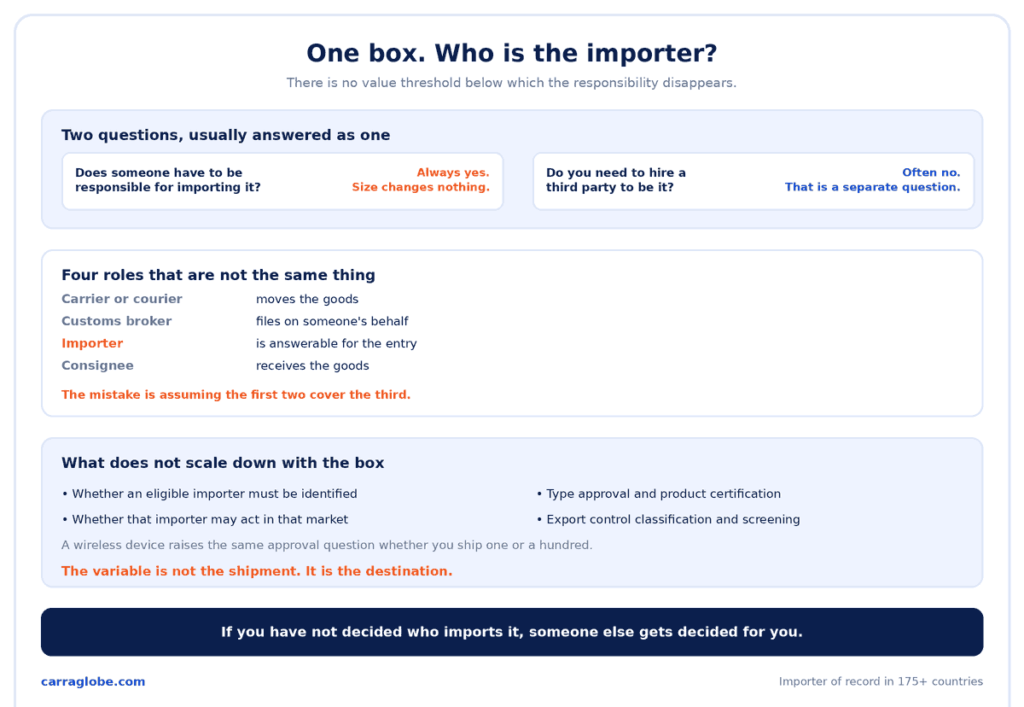
Here is the thing that reframes it. There are two questions inside “do I need an importer of record”, and they get answered as one.
The first is whether somebody has to be responsible for importing the box. That answer does not change with size. Every commercial import needs an identifiable party answerable for the customs entry, and there is no universal value threshold at which that responsibility disappears.
The second is whether you need to hire a third party to be it. That answer changes constantly, and quite often it is no.
Conflating the two is what causes the trouble. A company decides it does not need an IOR service, which may well be right, and treats that as settling who the importer is, which it does not. The responsibility still lands somewhere. If you have not decided where, it tends to land on whoever is receiving the goods.
Carra Globe acts as importer of record, so we have a commercial interest in this. What follows is written to be useful whether or not you ever speak to us, including the parts where the answer is that you do not need us.
Do I need an importer of record for a small shipment?
You need to establish who is legally responsible for importing the box. Whether you need a third-party IOR service is a separate question, and often the answer to that one is no.
The responsibility exists because a customs authority needs somebody answerable for the entry: the declared value, the classification, the duties, the record-keeping afterwards. None of that becomes optional because the consignment is one box.
Terminology varies. Different customs systems use importer, declarant, customs representative or person liable for the customs debt, and the precise role is defined nationally. Our guide to what an importer of record does covers the concept in more detail. What travels across all of them is that somebody has to be identifiable.
On a courier shipment, it often lands on your customer
Small consignments are where this goes wrong most often, because a courier booking asks for a delivery address rather than an import structure. Where the seller has not arranged another eligible importer, the consignee is often the party the carrier and the customs process look to. For a technology shipment that usually means your customer, sometimes a specific employee of your customer, occasionally a data centre operator who has never heard of you.
They then hold the compliance position. The declared value is theirs to justify, the classification is theirs to defend, the duties are theirs to pay or dispute, and the record sits against their name with that customs authority.
Which is a commercial problem before it is a compliance one. Your customer opens a duty invoice they were not expecting, or gets a query from customs about goods they did not import, on a deal where you told them delivery was handled. The shipment may well clear. The relationship takes the damage.
Couriers formalise this in their own way. Where a sender wants clearance handled by a party other than the receiver, the carrier may require the nominated party to have the appropriate import account, authorisation or customs arrangement in place before shipment.
The process varies by carrier and destination. What does not vary is the timing: it is arranged before the parcel moves, not once it is at the border.
Importer and consignee are distinct roles in law, and our guide to importer of record versus consignee covers that comparison in full. What matters here is narrower: on a small courier consignment, the choice is frequently never made at all.
Part of the confusion is that four different parties touch the same shipment, and people use their names interchangeably.
Four roles that are not the same thing
Carrier or courier moves the goods.
Customs broker or representative files on someone’s behalf.
Importer is answerable to the authority for the entry.
Consignee receives the goods.
One party can hold several of these, and the combinations differ by country and transaction. The mistake is assuming the first two cover the third.
Why small does not mean simple
The instinct that a small shipment is a simple shipment is reasonable and mostly wrong, because the things that complicate an import do not scale with value or weight.
| What scales with size | What does not |
|---|---|
| Freight cost | Whether an eligible importer must be identified |
| Duty and tax payable | Whether the importer is eligible to act in that market |
| Handling and storage | Type approval and product certification |
| Insurance value | Export control classification and screening |
| Pallet and container planning | Documentation and record-keeping obligations |
Read the right-hand column again. The compliance question does not disappear because the shipment contains one unit, though the exact obligation and any thresholds can still depend on the product, quantity, destination and transaction. A wireless device raises the same telecom approval question whether you ship one or a hundred. A market that requires a locally established importer requires one for a single box.
Which produces an uncomfortable ratio: the smaller the shipment, the higher the compliance overhead as a proportion of its value. A one-box order can carry much of the same regulatory workload as a project many times its size.
The same box, four destinations
An illustration using the shipment above: six wireless access points, one box, under three thousand dollars. Nothing about the goods changes. Everything about the answer does. It is deliberately simplified, and the real requirements still depend on the product model, its classification and the importer structure.
| Destination | What the box runs into |
|---|---|
| Netherlands | Straightforward if an EU-established party is named. EORI and the VAT position are the questions, not eligibility |
| Brazil | The importer needs the required Brazilian customs registration and Siscomex habilitation. A foreign seller without that structure generally cannot act as the importer through the ordinary import process |
| India | Wireless equipment can trigger WPC and DoT requirements, while certain IT and electronic products separately fall under BIS compulsory registration |
| Thailand | Radio equipment can require NBTC approval, while other equipment can trigger separate TISI requirements. See our guide to NBTC and TISI |
Same twelve point eight kilos in every row. The variable is not the shipment, it is the destination, and no amount of making the box smaller changes that.
Our IOR by country index sets out the position market by market, including Brazil and India.
One market, stated plainly
South Africa is a useful example because the rule is written down rather than inferred. SARS states that any foreign importer wishing to import goods into South Africa must register as an importer and nominate a registered agent located in South Africa, and that the nominated agent assumes full liability for the acts of the foreign principal in dealings with Customs. Until an approved agent is nominated, the application is suspended.
Nothing in that turns on consignment size. One box and forty pallets meet the same requirement, which is the whole argument of this article in a single national rule. Worth noting the counterpoint too: SARS says foreign entities clearing cargo for international transit through South Africa are not required to register, so genuine transit and importing are different questions.
What about de minimis?
Reasonable question, and the honest answer is that it helps less than people hope.
De minimis thresholds relieve duty or simplify declarations on low-value consignments in many markets, and they are worth checking. But they generally address the customs duty or declaration question rather than eliminating every other regulatory obligation. A relief from duty is not a relief from type approval, from import licensing, from export control screening, or from the requirement that somebody eligible be identified as importer.
Thresholds have also been moving. Our note on EU de minimis changes and the importer of record covers where that has been heading, and it is worth confirming the current position for your destination rather than working from what was true two years ago.
Not sure whether your one-box shipment needs a structure or just a good courier? Tell us the destination, what is in the box and who receives it, and we will tell you which. Ask us →
Importer of Record · 175+ countries
One box or one pallet, somebody has to be the importer. Decide who before it ships.
Most of our work is single boxes and small consignments rather than containers. Tell us the destination, what is in the box and who receives it, and we will tell you whether it needs a structure or just a courier. If your customer can import and is happy to, we will say so.
- Importer of Record services
- What an importer of record does
- Importer of record vs consignee
- What an importer of record costs
- IOR by country
- How to compare DDP quotes
Free tools HS Code Finder Volumetric Weight Calculator Pallet Calculator
Shipping one box somewhere unfamiliar? Send the destination, the equipment and who receives it. We will tell you who should be named as importer, and whether that needs to be us.
Check one shipmentWhen you genuinely do not need a third party
Not every small shipment needs a third-party IOR. Worth saying plainly, because an article like this can otherwise read as though every parcel needs a service attached to it.
- Your customer is willing and able to import. They have the registration, they know they are the importer, and they have agreed to it. That is a perfectly good structure. Confirm it rather than assume it.
- You have your own entity in the destination. Then you are the importer and the question is administrative rather than structural.
- The goods are unregulated and the market is open. Some destinations and some products genuinely are straightforward, and a courier plus a clear commercial invoice does the job.
The failure mode is not choosing one of these. It is assuming one applies without checking, and finding out at the border which one actually did.
The proportionality question
Worth naming the thought that sits behind all of this. On a three thousand dollar shipment, an import structure can look disproportionate. Sometimes it is, which is why the section above exists.
But compare it against the alternative rather than against the goods. A held consignment costs storage per day, a redelivery, and the time of whoever chases it. A misdeclared value can cost a correction and a mark on someone’s compliance record. A customer landed with an unexpected duty bill costs goodwill you priced into the deal.
The question is not whether the structure costs less than the box. It is whether it costs less than the version of this that goes wrong, and on repeat shipments into the same market it usually settles quickly. Our page on what an importer of record costs sets out how it is priced.
Five questions before you ship one box
- Who will be identified as the importer on the customs entry? A company name, not “the courier handles it”.
- Do they know, and have they agreed? Naming your customer without telling them is where relationships break.
- Are they eligible to act as importer in that country? Some markets restrict this regardless of consignment size.
- Does the product need an approval that has nothing to do with value? Wireless, mains-powered and encryption-capable equipment are the usual triggers. Our HS Code Finder is a starting point for classification.
- Who pays the duty and tax, and does the invoice reflect that? A surprise duty bill on a small shipment is disproportionately annoying to the person who receives it.
How Carra Globe helps
Most of our work is single boxes and small consignments rather than containers. Six access points to Brazil, a switch to India, thirty laptops between two European sites. That is the normal shape of a technology shipment, and it is what the service is built around.
- Acting as importer of record across 175+ countries, including for courier consignments, so your customer is not named on an entry they did not agree to.
- Telling you when you do not need us. If your customer can import and is happy to, that is usually cheaper and simpler, and we will say so.
- Flagging the approvals that do not scale, so a wireless device does not sit at a border while somebody discovers it needed a certificate.
Our case study on a server import into India shows what the structure looks like when it is set up properly, and our page on what an importer of record costs covers how it is priced.
Shipping one box somewhere unfamiliar? Send the destination, the equipment and who receives it, and we will tell you whether it needs a structure or just a courier.
Frequently asked questions
Is there a minimum value for needing an importer of record?
No universal one. Every commercial import needs a party answerable for the entry, and value affects duty and declaration format rather than whether that responsibility exists.
What a low value can change is how simple the declaration is, which is a different question from who is answerable for it.
Does the consignee automatically become the importer of record?
Often, but not automatically. Where the seller has not arranged another eligible importer, the consignee may be the party expected to handle the import, which on a technology shipment usually means your customer.
The two roles are distinct, and the same party holding both should be a decision rather than a default.
Can DHL or UPS be my importer of record?
Do not assume the courier is your importer of record. Couriers commonly act as carriers, brokers or customs representatives and may advance duties, but the legal importer is a separate question.
Confirm explicitly who will be named on the customs entry before the shipment moves. Our note on freight forwarder versus importer of record covers why the distinction matters.
Does de minimis mean I can skip the importer of record?
No. De minimis thresholds generally relieve duty or simplify declarations. They do not remove product approvals, licensing, export control screening or the need for an eligible importer.
Thresholds also change, so confirm the current position for your destination rather than the one you remember.
Can I use DDP for a single-box shipment?
Yes, but DDP does not by itself create an eligible importer. If the seller cannot lawfully act as importer in that destination, the term describes something that cannot happen.
Our guide to comparing DDP quotes covers the questions worth asking before accepting one.
Does low value mean customs will not inspect my shipment?
No. Low-value treatment can simplify duty or declaration requirements, but customs can still require accurate classification, documentation and any applicable regulatory approvals.
Small consignments are also cheap to hold, which does not make them any faster to release once they are held.
Is a single box too small for an IOR service?
No. Single boxes and small consignments are the normal shape of technology shipments, and the compliance requirements are the same as for larger ones.
If anything the case is stronger, because the overhead falls on a smaller value and mistakes are proportionally more expensive.
What happens if my customer refuses to be the importer?
The shipment stops until somebody eligible is named. That usually means your own entity where you have one, or an appointed third party who holds standing in that market.
Better to establish this before shipping, since resolving it with goods already at a border costs storage as well as time.
Sources and verification
- South Africa: SARS guidance for importers, which requires foreign importers to register and to nominate a South African registered agent who assumes full liability, and which treats international transit differently.
- Terminology is national. The role described here as importer of record is defined differently across customs systems, which variously use importer, declarant, customs representative or person liable for the customs debt. The concept travels; the wording does not.
- Importer eligibility is national. Whether a foreign party may act as importer, and on what conditions, is set by each destination country and changes. Brazil, for example, works through customs registration and Siscomex habilitation.
- De minimis thresholds are national and have been moving. Check the current threshold and what relief it actually provides, since duty relief and regulatory relief are not the same thing.
- Carrier arrangements vary. Where clearance is to be handled by a party other than the receiver, carriers set their own account and authorisation requirements in advance of shipment.
Disclaimer: This guide is for informational purposes only and does not constitute legal or customs advice. Importer eligibility, de minimis thresholds, product approval requirements and carrier procedures vary by destination country and change over time, and the correct treatment depends on the facts of the specific shipment. This article reflects publicly available information as at 2 September 2026. Always confirm the position for your goods and destination with a qualified adviser or the relevant customs authority before shipping.