
A rack of switches is sitting at a bonded warehouse in its third week. Nobody eligible was named as importer, the entry cannot be filed, and storage is accruing daily.
The goods are insured, under the broadest standard cover available. And none of it helps, because nothing has happened to the goods.
That gap is the subject of this piece. For high-value IT shipments, cargo insurance is often worth considering. But it protects against a narrower set of things than people assume, and the difference matters most on exactly the shipments where it feels like everything is covered.
Does my Incoterm include insurance?
Almost certainly not. Only two of the eleven Incoterms rules require insurance at all: CIF and CIP. Under every other rule, including DDP, insurance is a commercial decision rather than an obligation.
That surprises people quoting DDP, because DDP is the term that sounds most comprehensive. The seller clears the goods, pays the duties and delivers to the door. It is easy to read that as “everything handled”.
DDP places the risk on the seller until delivery. It does not require the seller to insure the goods. A DDP quote can legitimately provide no cargo insurance unless insurance has been separately agreed, and the Incoterm itself gives the buyer no right to assume cover is in place. If it matters to you, it goes in the contract.
Where insurance is required, the level differs. CIF calls for minimum cover under Institute Cargo Clauses (C). CIP was changed under Incoterms 2020 to require Clause (A), reflecting the ICC’s view that CIP is commonly used for manufactured and containerised multimodal shipments where broader cover is appropriate.
Both call for at least 110% of the contract value, with cover arranged so that it entitles the buyer, or another party with an insurable interest in the goods, to claim directly from the insurer.
Our guide to comparing DDP quotes lists insurance among the things to confirm in writing, and DDP versus DAP covers where the risk actually sits under each.
What the three sets of clauses actually do
Cargo policies are usually written against the Institute Cargo Clauses, which come in three levels.
| Clause | Cover | Typical use |
|---|---|---|
| Clause (A) | The broadest standard cover, subject to listed exclusions | The realistic default for high-value IT hardware |
| Clause (B) | Specified risks only, including events such as fire, stranding or grounding, collision, and certain water-related losses | Middle ground, less common for electronics |
| Clause (C) | Specified risks, narrower still. The minimum standard cover | Commodity and bulk cargo |
For servers, switches and laptops, Clause (A) is the sensible starting point. Clauses (B) and (C) cover specified risks rather than the broader structure of (A), so if the loss does not result from a covered peril the claim may not respond, subject to the wording and exclusions.
The practical consequence for electronics is worth stating. Under the narrower tiers, theft or pilferage is not automatically covered and may require additional wording or cover, which is why (C) rarely suits high-value hardware whatever the premium saving.
Quick rule for IT hardware. Clause (A) as the baseline, war and strikes bought separately if the route warrants it, and the duration clause read properly if any storage is likely.
The exclusion that catches technology shipments
Here is the part worth understanding properly, because it is where the opening scenario comes from.
Clause (A) is often described commercially as “all risks”. It is not. It is the broadest of the standard Institute Cargo Clauses, and it is subject to specific exclusions that include wilful misconduct, ordinary leakage and wear, inherent vice, war, strikes, insufficiency of packing, insolvency of the carrier, and delay.
War and strikes are a slightly different case. They sit outside Clause (A) but are commonly covered by buying the separate Institute War and Strikes clauses, so their absence from the base cover is a gap you can close rather than one you have to accept.
Two other exclusions are worth pausing on for IT hardware.
The packing exclusion bites where packing was carried out by the assured or their employees and was insufficient to withstand the ordinary incidents of the transit. That is a live question for equipment crated in-house. It is also one reason professional third-party packing is often the safer route for high-value hardware, since the exclusion is drafted around packing done by the assured.
Insolvency of the carrier or other parties can also be excluded under the standard clause wording, which matters in a freight market that has seen operators fail.
Loss caused by delay is excluded even under Clause (A), and even where the delay was itself triggered by a covered peril. So a shipment held at the border because the import structure was wrong does not, by itself, create an insured cargo loss. Storage costs, a missed deployment date and the commercial consequences of the hold would generally fall outside standard cargo cover.
Physical damage occurring while the goods are held is a separate question, and may still be claimable subject to the policy.
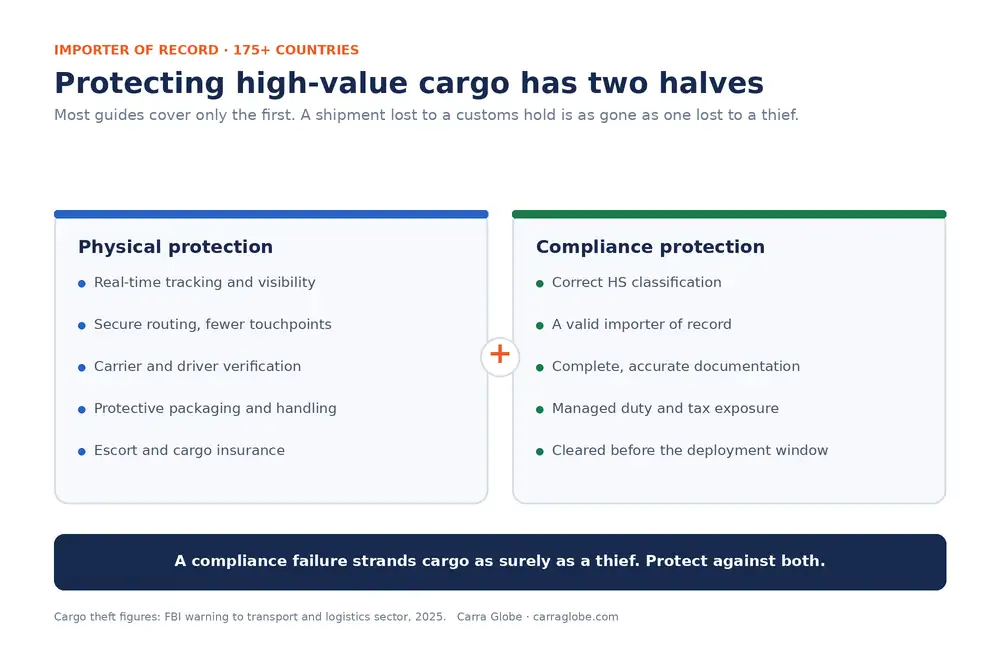
This is the distinction that matters commercially. Insurance answers the question what if something happens to the goods. It does not answer what if the goods cannot lawfully enter. Those are different failures with different remedies, and one of them is not an insurance problem at all.
Which is worth saying plainly given what we sell. Appointing an importer of record does not protect your goods in transit. Insuring your goods does not get them released. They cover different failures, and buying one because you have the other is how companies end up exposed on the side they did not think about.
Which failure does what
| What goes wrong | Cargo insurance | Import structure |
|---|---|---|
| Equipment damaged in transit | Yes, subject to policy | No |
| Theft during insured transit | Potentially, subject to policy and circumstances | No |
| Shipment held, no eligible importer named | No | Yes, by preventing it |
| Storage accruing during a hold | Generally no, delay is excluded | Yes, by preventing it |
| Missing product approval | No | Yes, by flagging it before shipment |
| Deployment date missed | Generally no | Yes, by preventing the cause |
The important point is that several of the most commercially expensive shipment failures are not physical-loss events at all.
The transit clock most people never read
There is a second problem with the held shipment, and it is worse than the delay exclusion.
Under the standard Institute Cargo Clauses (A) duration wording, cover does not simply run until the goods arrive.
The transit clause attaches when the goods first move at origin and continues during the ordinary course of transit. It then terminates on the earliest of three things: delivery to the final warehouse at destination, the assured electing to store the goods outside the ordinary course of transit, or the expiry of 60 days after completion of discharge from the vessel at the final port.
That 60-day provision is a standard backstop in the clause wording. The standard Clause (A) transit cover may terminate at that point, unless the policy provides otherwise or continuation or storage cover has been arranged, even if the goods have not reached the destination warehouse. So a consignment stuck in a customs impasse does not only lose the ability to claim for the delay. Past that point the standard transit cover may have ended, unless a storage extension or continuation was arranged in advance.
Which changes the opening scenario. Those switches in their third week are not only exposed on the delay point. They are on a clock, and if the impasse runs long enough the standard transit cover may end while they are still sitting there.
One point specific to air freight, which is how most IT hardware moves. The 60-day provision is written around discharge from an oversea vessel, so air shipments are commonly handled under equivalent air cargo wordings with their own duration terms, often shorter. If your equipment flies, check the duration clause in the actual policy rather than assuming the sea wording applies.
These are the standard clause provisions and individual policies vary. Many open cover and project policies already build in storage extensions or different duration wordings, so check what yours actually says rather than assuming warehouse-to-warehouse means what it sounds like.
Who can actually claim
A question that gets overlooked until there is a claim, and one that a third-party import structure makes worth checking.
Under CIF and CIP, the insurance is arranged so that the buyer, or another person having an insurable interest in the goods, can claim from the insurer. Broadly, that means someone who stands to suffer financially if the goods are lost or damaged. Outside those Incoterm requirements, the policy wording controls who is insured and who may claim.
An importer of record is answerable to the customs authority for the entry. That is not the same as owning the goods, and on many arrangements the importer of record never takes title at all. Our note on importer of record versus consignee covers why the roles separate. So naming it on the entry does not automatically give it a claimable interest, and it should not be assumed to be the party the policy responds to.
Worth establishing three things before shipping: who holds title at each stage, who the policy is issued in favour of, and who would actually make the claim.
Importer of Record · 175+ countries
Insurance covers what happens to the goods. We cover what stops them.
Carra Globe is not an insurance underwriter or broker and does not sell cover as a product. Where a shipment needs it we work through our network to arrange it, and lead time varies, so raise it early. What we do consistently is the exposure your policy excludes: goods that cannot lawfully enter, sitting somewhere accruing storage while somebody eligible is found. Where your customer can import themselves, we will say so.
- Importer of Record services
- Customs holds on IT shipments
- How to compare DDP quotes
- DDP vs DAP explained
- How to calculate landed cost
- Packaging standards for IT hardware
Free tools HS Code Finder Volumetric Weight Calculator Pallet Calculator
Shipping equipment somewhere unfamiliar? Send the destination, the equipment and who receives it. We will tell you whether the import side is settled, and where it is not.
Check the import sideInsured value and customs value are not the same number
They are related, they are often close, and they are calculated for different purposes.
Under CIF and CIP, the seller’s minimum insurance obligation is 110% of the contract price. That is the Incoterm requirement rather than a universal rule, and cover arranged outside those terms is written at whatever the policy and the commercial agreement provide. Customs value is separately determined under valuation rules, which may include or exclude freight and insurance depending on the country and the basis used. Our guide to calculating landed cost covers the landed figure.
The practical point is that the two figures serve different purposes and need not match. If they differ materially, the reason should be documented and explainable.
Six things to confirm before the goods move
- Is there cover at all? Unless the term is CIF or CIP, nobody is obliged to insure. Ask rather than assume.
- Which clauses? (A) is all-risks subject to exclusions. (B) and (C) are named perils, and your peril may not be named.
- Where does cover attach and terminate? Confirm the geographic scope and the attachment and termination points rather than assuming a quoted transit means warehouse to warehouse, and ask about the 60-day provision if any storage is likely.
- Who is the policy in favour of, and does that party have an insurable interest?
- What is excluded? Delay is the one to look for on a technology shipment, alongside packing conditions and any insolvency or financial default wording.
- What does the claims process require? Who notifies the insurer, within what period, and what evidence is needed. For servers and network hardware that may include the serial numbers of affected units, photographs of the packaging as received before it is opened further, the delivery note with any damage annotation, the packing list and airway bill or bill of lading, and where required a survey report. Claims also carry time limits, so notify early rather than after an internal investigation.
Point three matters more than it sounds for equipment going to a data centre floor rather than a port. And packaging conditions in a policy can interact with how the goods were prepared, which our note on packaging standards for IT hardware covers.
How Carra Globe fits
The boundary first, because it is the whole point of this article. We are not an insurance underwriter or broker and we do not sell cover as a product.
Where a shipment needs it, we work through our own network to arrange what the client requires. Sometimes that comes together quickly. Sometimes it takes longer, depending on the equipment, the value and the route. So if cover matters on your shipment, raise it early rather than at booking, because it is the part of the arrangement least able to be rushed.
What we do consistently is the other half of the exposure: the failure your policy explicitly excludes, where goods cannot lawfully enter and sit accruing storage while somebody eligible is found.
That works because the roles usually sit together on the same shipment rather than being bought separately.
- Importer of Record across 175+ countries, so the entry can actually be filed on arrival.
- Exporter of Record where you cannot act as exporter at origin, including on the return leg.
- Delivered Duty Paid where you want a landed price rather than a set of separate arrangements.
- Freight forwarding, which is where a cover requirement surfaces and gets worked through.
- Customs clearance worldwide, on the entry we are named on.
- Warehousing, which also matters here, since storage outside the ordinary course of transit is one of the things that ends cover.
- White glove delivery to the rack rather than to a loading bay.
Underneath all of it sits global trade compliance, which is the part that decides whether any of the rest can happen. Our note on customs holds on IT shipments covers what happens when it has not been settled.
Where the two halves meet. If we are handling the freight and acting as importer of record, the declared value and the party named on the entry are set together rather than reconciled afterwards. Where cover is also being arranged, the insured value can be aligned with them at the same time. That consistency is worth more than it sounds when a claim or a query arrives months later.
And where your customer can import in their own name, that is often simpler and cheaper. We will say so.
Shipping equipment somewhere and unsure whether the import side is settled? Send the destination, the equipment and who receives it.
Frequently asked questions
Does DDP include cargo insurance?
Not automatically. DDP places risk on the seller until delivery but does not require insurance. Only CIF and CIP oblige the seller to insure.
A DDP quote can provide no cargo insurance unless it has been separately agreed, so confirm it in the contract rather than reading it into the term.
Which Incoterms require cargo insurance?
Only CIF and CIP. CIF requires minimum cover under Institute Cargo Clauses (C), and CIP requires Clause (A) following the Incoterms 2020 change. Both at 110% of contract value.
Under the other nine rules, including DDP, EXW, FCA, DAP and DPU, insurance is a commercial decision for the parties rather than an obligation of the term.
Does cargo insurance cover customs delays?
Generally no. Loss, damage or expense caused by delay is excluded under the standard Institute Cargo Clauses (A), subject to the wording of the policy.
The remedy for that exposure is getting the import structure right before shipping, not more cover.
Does cargo insurance cover storage charges from a customs delay?
Generally not, where the cost results from delay rather than physical loss or damage. Clause (A) excludes loss, damage or expense caused by delay, even where a covered peril triggered it.
Cover can also terminate 60 days after discharge, so prolonged storage risks leaving the goods uninsured entirely unless an extension was arranged.
What is the difference between ICC A, B and C?
Clause (A) is the broadest standard cover, subject to listed exclusions rather than covering everything. Clauses (B) and (C) cover specified risks only, with (C) the narrowest.
For high-value electronics, (A) is generally the appropriate level.
Can my importer of record claim on the cargo policy?
Not by virtue of the role alone. Policies respond to parties with an insurable interest, and an importer of record is answerable to customs without necessarily holding title to the goods.
Establish who holds title, who the policy favours and who would claim, before shipping rather than after a loss.
Should the insured value match the customs value?
They are calculated for different purposes and need not match. The seller’s minimum insurance obligation under CIF and CIP is 110% of the contract value, while customs value follows valuation rules.
A material difference between the two figures should be explainable and supported by the relevant commercial and customs documentation.
Sources and verification
- Incoterms: the ICC Incoterms 2020 rules. Only CIF and CIP carry an insurance obligation, CIF at Institute Cargo Clauses (C) and CIP at Clauses (A) following the 2020 change, both at 110% of contract value.
- Cover levels: the Institute Cargo Clauses are published by the Lloyd’s Market Association and the International Underwriting Association. Clause (A) is the broadest standard cover, subject to exclusions that include delay, insufficiency of packing and certain insolvency or financial default risks. Clauses (B) and (C) cover specified risks only.
- Duration: under the Institute Cargo Clauses (A) transit wording, cover attaches at origin, continues during the ordinary course of transit, and terminates on the earliest of delivery to the final warehouse, storage outside the ordinary course of transit, or expiry of 60 days after completion of discharge at the final port. Individual policies may vary these provisions.
- Confirm the policy, not the summary. Exclusions, transit clauses, packaging conditions and the named assured vary between policies. Read the wording for your shipment and take advice from an insurance specialist.
Disclaimer: This guide is for informational purposes only and does not constitute insurance, legal or customs advice. Carra Globe is not an insurance underwriter or broker and does not sell cargo cover as a product. Where a shipment requires it, arrangements are made case by case and availability and lead time vary. Policy terms, exclusions and the level of cover required vary by contract, insurer and jurisdiction, and change over time. This article reflects publicly available information as at 7 September 2026. Always read the applicable policy wording and take advice from a qualified insurance professional.