
If you import battery energy storage, industrial batteries, or hardware with batteries built in, the shipment now has to clear more than customs. The EU Battery Regulation attaches a set of product-compliance and producer duties to those goods, and several of them fall on the importer, not only the overseas manufacturer. The trap is treating a battery like any other line on the packing list. It is not: it carries its own registration, its own labelling, and, from 2027, its own digital passport.
This guide is written from the freight and customs side, where battery shipments actually get held up, and it sets out what EU Battery Regulation importers have to verify before goods move.
It covers what Regulation (EU) 2023/1542 reaches, which duties land on an importer, the deadlines already live and those still ahead, and how these product-compliance obligations sit on top of the dangerous-goods and customs steps a battery shipment must already pass. The dates and obligations here are based primarily on Regulation (EU) 2023/1542, its 2025 amendment, and current European Commission guidance, and where the detail is still being defined, this guide says so.
Where this stands on 20 August 2026. The regulation has applied since February 2024, phased in by battery category. The separate-collection symbol has applied since August 2025, and carbon-footprint declarations are live for the categories Article 7 covers. The general battery-information label is tied to 18 August 2026 or, if later, 18 months after the relevant implementing act under Article 13(10). From 18 February 2027 every battery needs a QR code, and qualifying batteries a passport. Due diligence follows on 18 August 2027. Confirm the position for your category before shipment.
Quick answer
| Question | Short answer (verify for your product) |
|---|---|
| What is it | Regulation (EU) 2023/1542, the EU rules on batteries and waste batteries, replacing the 2006 Battery Directive |
| Who it covers | Manufacturers, importers, and distributors placing batteries, or products containing batteries, on the EU market |
| Applies since | 18 February 2024, with obligations phased in on later dates |
| Battery passport from | 18 February 2027, for EV, LMT, and industrial batteries with a capacity greater than 2 kWh placed on the market or put into service |
| QR code from | 18 February 2027, on all batteries. For qualifying EV, LMT, and industrial batteries it links to the passport; for others it gives access to the information Article 13(6) requires |
| Printed label from | 18 August 2026, the general battery-information label under Article 13(1) and Annex VI Part A, subject to the Article 13(10) trigger |
| Due diligence from | 18 August 2027, after a two-year delay under Regulation (EU) 2025/1561 |
| Importer’s core duty | Verify the manufacturer’s conformity, CE marking, labelling, and documentation before placing the battery on the market |
The numbers worth memorising
| Obligation | Date or figure |
|---|---|
| Regulation applies from | 18 February 2024 |
| Printed label (Article 13(1)) | 18 August 2026 |
| QR code, all batteries (Article 13(6)) | 18 February 2027 |
| Battery passport (Article 77) | 18 February 2027 |
| Supply-chain due diligence | 18 August 2027 |
| Declaration of conformity retention | 10 years |
| Due-diligence turnover threshold | 40 million euros net turnover |
What the EU Battery Regulation actually is
In short: it is Regulation (EU) 2023/1542, which applies directly across every Member State and replaces the 2006 Battery Directive with binding rules on safety, labelling, producer responsibility, and digital passports.
The EU Battery Regulation, formally Regulation (EU) 2023/1542, is the single set of rules governing batteries placed on the EU market across their whole lifecycle, from raw-material sourcing to end-of-life recycling. It entered into force on 17 August 2023 and has applied since 18 February 2024, replacing the older 2006 Battery Directive. Because it is a regulation rather than a directive, it applies directly across all Member States without national transposition.
Its scope is broad. It covers all battery categories placed on the EU market: portable batteries, starting-lighting-ignition (SLI) batteries, light-means-of-transport (LMT) batteries such as those in e-bikes and e-scooters, industrial batteries, and electric-vehicle batteries. It reaches batteries sold on their own and batteries built into another product, which is why hardware importers who have never thought of themselves as battery sellers can still fall within it.
The regulation bundles several different obligation streams under one instrument: sustainability and safety requirements, labelling and marking, CE marking, extended producer responsibility for waste batteries, supply-chain due diligence, and the digital battery passport. These are not a single switch that flips on one date. They phase in separately, and treating them as one deadline is the most common planning mistake.
How is it different from the old Battery Directive?
The 2006 Battery Directive required each Member State to pass its own national law, which produced 27 slightly different regimes. Regulation (EU) 2023/1542 applies directly and uniformly across all Member States. It also adds obligations the Directive did not have: the digital battery passport, carbon-footprint declarations, supply-chain due diligence, recycled-content thresholds, and far more detailed labelling. For an importer, that means the rules are now more demanding and more consistent across the bloc at the same time.
Does it apply to energy storage and products with batteries?
In short: usually yes. Storage systems and hardware with built-in batteries contain batteries that fall within the regulation, and the passport reaches industrial batteries above 2 kWh from February 2027.
Often, yes, though the precise answer turns on the battery, not the whole system. Battery energy storage systems and UPS equipment contain batteries that generally fall within the industrial-battery category. Where that battery is an industrial battery with a capacity greater than 2 kWh, the battery passport requirement applies from 18 February 2027, subject to the regulation’s scope and definitions. The system as a whole may also be subject to other EU product legislation. For the data-centre and renewable-energy buyers Carra Globe works with, that is the practical point: the storage that ships alongside servers, inverters, and grid equipment is generally in scope.
Hardware with a battery built in is also caught. Where a product contains or is supplied with a battery, the battery still has to meet the regulation’s requirements, and the operator placing that product on the EU market carries the corresponding duties. Whether a specific obligation bites depends on the battery category, the product design, and your role in the chain, so each product line should be checked rather than assumed in or out.
The deadlines that matter
The regulation is already in force, and its obligations arrive in stages. Several are live now, including carbon-footprint declarations and, from August 2026, general labelling. Treating February 2027 as the only date leaves an import programme unprepared for what already applies.
- 18 February 2024: the regulation began to apply, with individual conformity, marking, labelling, producer-responsibility, and sustainability requirements phasing in by battery category and provision.
- 18 February 2025: the carbon-footprint declaration requirement began to apply for electric-vehicle batteries.
- 18 August 2025: the separate-collection-symbol labelling requirement under Article 13(4) began to apply, and producer-responsibility and waste-battery duties apply through the relevant Chapter VIII provisions and national systems.
- 18 February 2026: the carbon-footprint declaration requirement extended to the rechargeable industrial batteries covered by Article 7, other than those used exclusively for external storage, which follow a later timetable.
- 18 August 2026: the general battery-information label under Article 13(1) and Annex VI Part A applies, alongside the separate-collection symbol that has been required since August 2025. Article 13(10) sets the trigger as the later of this date or 18 months after the implementing act on harmonised label formats enters into force, so confirm the status of that act before committing to label artwork.
- 18 February 2027: every battery must carry a QR code under Article 13(6). What sits behind that code differs by category: for EV batteries, LMT batteries, and industrial batteries with a capacity greater than 2 kWh it opens the Article 77 battery passport, while for other categories it gives access to general information, the EU declaration of conformity, and waste-management information.
- 20 July 2026: the EU Digital Product Passport Registry went live. It provides part of the common registry infrastructure supporting product passports generally, not batteries alone. The detailed battery-passport data itself sits in a decentralised architecture maintained by the responsible economic operator, not in that central registry.
- 18 August 2027: the supply-chain due-diligence obligations apply, after a two-year delay under Regulation (EU) 2025/1561.
The two-year delay matters because a great deal of guidance still in circulation cites August 2025. Regulation (EU) 2025/1561 amended Article 48, moving the operative due-diligence obligations from 18 August 2025 to 18 August 2027 and resetting the Commission’s guidance deadline to 26 July 2026. Keep those two dates apart: the guidance deadline is when the rulebook is due, not when operator obligations begin. Any source presenting August 2025 as the live start date is outdated, unless it is expressly describing the position before the amendment.
The carbon-footprint requirements have their own phased timeline, covered in the next section. The statutory dates are the right points to plan back from, but several requirements are expressly tied to the later entry into force of Commission delegated or implementing acts, so track the regulation’s dates and those acts together rather than treating every date as fixed.
Battery carbon-footprint requirements and deadlines
The carbon-footprint rules are not a distant 2027 item. They phase in by battery category under Article 7, and the first stages are already behind us. Electric-vehicle batteries have required a declaration since 18 February 2025. The requirement then extends to rechargeable industrial batteries with a capacity greater than 2 kWh, other than those with exclusively external storage, from 18 February 2026, subject to the regulation’s timing rules tied to the relevant Commission acts. Do not assume every stationary storage battery was caught by that date, and check the category before relying on either position.
The declaration is drawn up by the manufacturer using the prescribed methodology, but an importer placing an affected battery on the market should confirm the declaration exists and actually matches the battery model and manufacturing site in front of it, because a missing or mismatched declaration is a conformity gap the importer carries. Declaration is only the first of three stages. Performance classes follow, and maximum thresholds after that, each set through Commission delegated and implementing acts and each with its own timing.
Two cautions are worth carrying forward. The external-energy-storage distinction affects the carbon-footprint timetable only: it does not push those batteries outside the Battery Regulation, nor outside the Article 77 passport requirement where they qualify as industrial batteries above the capacity threshold. And 18 August 2026 is a Commission deadline connected with the next stage of performance-class requirements for electric-vehicle batteries, not a universal importer switch, so check the state of the applicable delegated act rather than assuming something changed on that date.
What an importer must do
In short: under Article 41 an importer must verify CE marking, technical documentation, labelling, and manufacturer identity before placing the battery on the Union market, identify itself on the product, and hold the declaration of conformity for 10 years.
Under the regulation, an importer is the operator established in the EU that places a battery, or a product containing a battery, from a third country on the EU market. The manufacturer carries the broadest duties: design, conformity assessment, technical documentation, the EU declaration of conformity, and CE marking. The importer’s duties, set out in Article 41, are a distinct verification-and-record role.
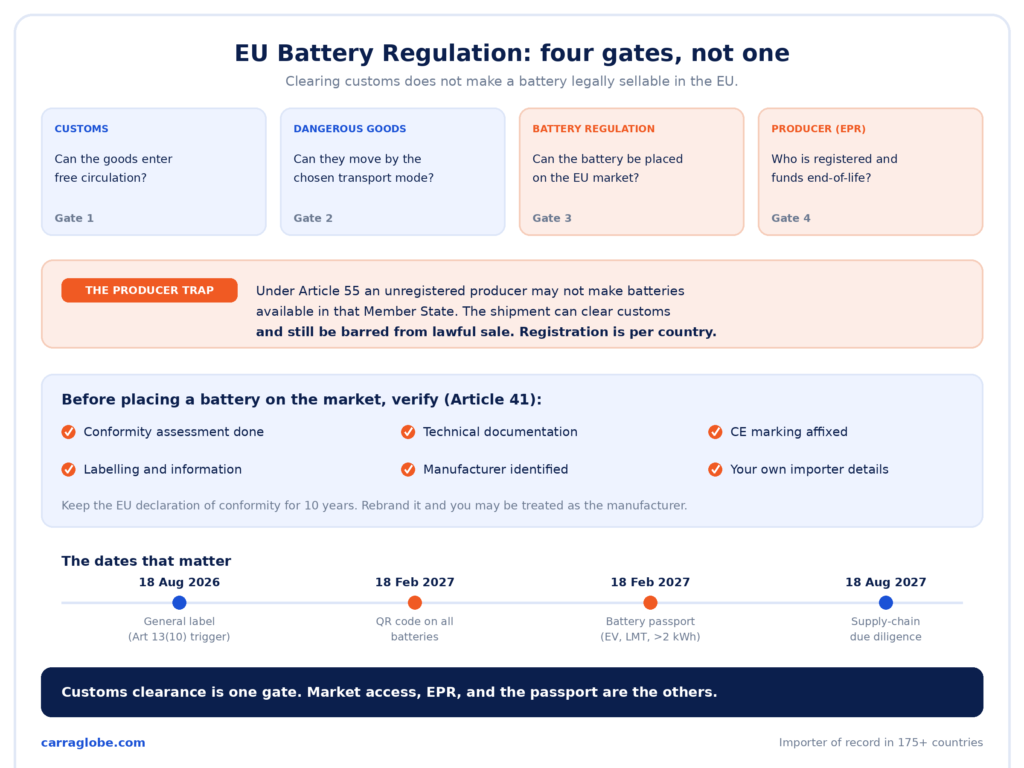
This is real due diligence, not a box-tick. The importer does not repeat the conformity assessment, but confirming that a CE mark merely exists is not enough. Before placing a battery on the market, an importer must verify that:
- the manufacturer carried out the appropriate conformity assessment and drew up the technical documentation;
- the battery bears the CE marking and the required labelling and information;
- the manufacturer is identified and contactable;
- the importer’s own name, registered trade name or trademark, postal address, and contact details appear on the battery, or where that is not possible, on its packaging or an accompanying document.
The duties continue after the goods land. An importer must keep a copy of the EU declaration of conformity for 10 years after the battery is placed on the market and ensure the technical documentation can be obtained or made available to national authorities on a reasoned request, working with the manufacturer where the file sits with them.
It must ensure that storage and transport under its control do not compromise conformity, and take corrective action, up to withdrawal or recall, where it identifies a non-compliant product. As with other EU product regimes, an importer that places a battery on the market under its own name or trademark, or modifies one already on the market, can be treated as a manufacturer and take on the far heavier manufacturer obligations.
Battery EPR registration: what importers need to know
This is the producer-registration trap, and it catches importers precisely because it sits outside the CE-marking framework entirely. Under the extended-producer-responsibility rules in Chapter VIII, the producer is generally the operator that first makes the battery available on the market in the relevant Member State, subject to the regulation’s definitions and the supply-chain structure, and that producer must register with the national registry and meet the associated collection, financing, and reporting duties. Importer and EPR producer are not automatically the same legal role.
For an importer bringing batteries from outside the EU, the importer may itself become the producer for these purposes, particularly where it is the first operator to make the battery available on the market in that Member State, though the result depends on the parties’ roles and the regulation’s producer definition and should not be assumed for every battery-containing product.
Under Article 55, a producer may only make batteries available on a Member State’s market if it, or its authorised representative for producer responsibility where applicable, is registered in that Member State.
The registration route, any authorised-representative requirement, and the reporting system are national, so the Article 55 obligation has to be read together with each Member State’s implementing rules. Registration is handled country by country, so a business placing batteries on the market in several EU countries, from Germany to the Netherlands, can face several registrations or representation arrangements. This is where an importer of record and the compliance stack meet, and where getting the roles mapped early avoids a shipment that clears customs but cannot lawfully be sold.
The 2027 battery passport
In short: from 18 February 2027, EV, LMT, and industrial batteries with a capacity greater than 2 kWh need a digital passport reached by QR code, and the economic operator placing the battery on the market must ensure it exists and stays accurate.
The digital battery passport is the headline 2027 obligation. From 18 February 2027, under Article 77, each EV battery, each LMT battery, and each industrial battery with a capacity greater than 2 kWh placed on the EU market or put into service must have its own battery passport, subject to the regulation’s definitions and transitional provisions.
It is reached through the QR code that Article 13(6) requires every battery to carry from the same date. Portable and SLI batteries must still bear that QR code, but it points to general product information rather than a passport, because the Article 77 passport obligation does not extend to them.
The passport is intended to hold the data required by Article 77 and Annex XIII: identity, material composition, carbon footprint, recycled content, performance and durability, supply-chain due-diligence information, and end-of-life data, with fields such as state of health reflecting the battery in use. The information is not all publicly visible: Article 77 sets different access levels for the general public, for authorities and notified bodies, and for parties with a legitimate interest. A battery in scope that lacks a compliant passport cannot lawfully be placed on the EU market from that date, which makes it a market-access condition, not a labelling nicety.
Under Article 77, the economic operator responsible for placing the qualifying battery on the EU market or putting it into service must ensure the passport is available, linked to the battery, and populated with accurate, current information. That operator may authorise another to act on its behalf. For batteries manufactured outside the EU, the importer may be that operator, depending on the supply structure and the parties’ legal roles.
The decisive question is not where the battery was made but which economic operator is legally responsible for placing the finished battery on the EU market. That operator must ensure the passport exists and that its information is accurate, complete, and current, though it may authorise another operator to act on its behalf. The assumption worth abandoning early is that an overseas manufacturer will hand you a passport that satisfies the EU requirement.
Two practical points follow. The passport combines battery-model information with data specific to the individual battery, and each qualifying battery is linked to it through a QR code and a unique identifier. Some of the underlying data may relate to the model, the production batch, or the manufacturing facility, but the record itself is per battery, so plan for individual-battery traceability rather than a single product-brochure page.
The plumbing is no longer theoretical: the horizontal digital product passport standards developed by CEN and CENELEC’s joint committee JTC 24, the EN 18216 to EN 18223 series, were published in 2026 and cited as harmonised standards by Commission implementing decision in July 2026. They define how a passport is identified, carried, stored, and made interoperable, which is the layer your suppliers’ systems will have to speak. The Commission maintains a battery passport implementation page tracking this work.
Two timing points are worth holding together. The passport requirement starts on 18 February 2027, while the separate battery due-diligence obligations apply from 18 August 2027 following the amendment made by Regulation (EU) 2025/1561.
Importers should plan the passport data architecture before February 2027, including the fields connected with supply-chain due diligence, while monitoring the implementing rules that determine how those fields must be supplied and accessed. The battery passport is a sector-specific digital product passport established by this regulation, and it is the first such passport to become legally mandatory, ahead of the wider framework being built under the Ecodesign for Sustainable Products Regulation (EU) 2024/1781.
The battery passport is not the whole regulation
It is easy to read “battery passport” as shorthand for the entire regime. It is not. The passport is one obligation among several, and for many importers the duties that bite first are the ones already live: CE marking, correct labelling and marking, and, above all, producer registration in each Member State where you place batteries on the market.
The regulation also carries a size dimension. The supply-chain due-diligence obligations are generally directed at economic operators with annual net turnover above 40 million euros, subject to the regulation’s detailed conditions, so smaller operators should not assume every due-diligence requirement applies to them in the same way. That threshold is separate from, and does not remove, the core verification, labelling, producer-registration, and record duties that apply to importers generally, so check it against your own position rather than assume it applies.
| Check | What the importer should verify |
|---|---|
| Battery category | Whether the product is portable, SLI, LMT, industrial, or EV, since duties differ by category |
| Conformity assessment | Appropriate procedure completed by the manufacturer |
| Technical documentation | Manufacturer has drawn it up and it is available |
| CE marking | Correctly affixed where required |
| Labelling and marking | Required labels, symbols, and information present and legible |
| Manufacturer | Identity and contact details present |
| EPR registration | Producer, authorised-representative, and registration responsibility identified for each Member State where the battery is made available |
| Battery passport | For EV, LMT, and industrial batteries with a capacity greater than 2 kWh placed on the market or put into service from 18 February 2027 |
| QR code | Required on all batteries from 18 February 2027 under Article 13(6) |
| Importer identification | Importer name, registered trade name or trademark, address, and contact details displayed as required |
| Language | Instructions and safety information in the language(s) required by the destination Member State |
| Carbon footprint | Declaration provided for the affected EV and rechargeable industrial categories under Article 7, allowing for the external-storage distinction and the applicable timing |
| Records | Copy of the EU declaration of conformity kept for 10 years and available to authorities |
Importing battery storage or hardware with batteries into the EU and unsure who carries these duties? Carra Globe coordinates EU market entry alongside customs clearance and acts as importer of record across 175+ countries, checking that the required product-compliance documentation has been provided and flagging gaps before shipment. Get a pre-shipment battery compliance check →
Customs clearance and market access are not the same
The Battery Regulation is a product-compliance and producer-responsibility regime, not a customs or tariff measure, and that difference shapes how you plan a battery import. Clearing customs and paying any duty gets goods into free circulation. It does not, on its own, make a battery legally sellable in the EU. Producer registration, labelling, and, where relevant, a passport are separate conditions that sit on top of the customs entry.
It helps to see which question each regime actually answers:
- Customs: can these goods enter EU free circulation?
- Battery Regulation: can these batteries be lawfully placed on the EU market?
- Dangerous-goods rules: can they legally move by the chosen transport mode?
- Extended producer responsibility: who finances and manages the end-of-life obligations?
- Battery passport: does the qualifying battery carry the required digital record?
Batteries also carry a dangerous-goods layer that most product categories do not. Lithium batteries may require a UN 38.3 test summary, dangerous-goods classification, approved packaging, marks, and Class 9 controls, depending on the chemistry, configuration, watt-hour rating, quantity, and transport mode, and air transport often imposes the most restrictive operational conditions. Our guides to lithium battery customs clearance and the HS code for lithium batteries cover that classification-and-transport side, which runs in parallel with the Battery Regulation duties described here.
The Battery Regulation is also not the only EU regime shifting compliance duties onto the importer. Our guide to EU Digital Product Passport importer liability covers the wider lifecycle-data framework the battery passport belongs to, and our note on the EU Cyber Resilience Act for importers covers the parallel cybersecurity gate for connected hardware. For the customs and IOR side of any battery shipment, our importer of record for renewable energy equipment page sets out how we handle solar, storage, and grid hardware.
Penalties and enforcement
The regulation requires Member States to set penalties for infringements that are effective, proportionate, and dissuasive, and to establish their own enforcement arrangements. There is no single EU-wide fine figure in the way some other regimes set headline tiers, so the exposure depends on the Member State and the nature of the breach.
The more immediate commercial risk for an importer is market access. A battery that is not correctly labelled, not covered by producer registration, or, from 2027, missing a required passport can be kept off the market. Sales can be restricted in the relevant Member State, and serious or unresolved non-compliance can create wider EU market-access consequences. For an import programme, the loss of the market the shipment was headed for is usually the consequence that matters most, and it can arrive well before any fine.
How to prepare
In short: identify the battery category, confirm who the first economic operator is in each Member State, map the supplier evidence, register for EPR, and build passport data ahead of February 2027.
The work is sequential, and most of it happens long before a shipment moves.
- Identify the category. Establish which products are batteries or contain them, and whether each is portable, SLI, LMT, industrial, or EV. Every duty that follows depends on this answer.
- Fix the roles. Confirm the economic operator for each product line, and whether you are the first to make the battery available in a given Member State, which is what pulls producer registration onto you.
- Map the evidence. Check CE marking, labelling, technical documentation, and the EU declaration of conformity with your suppliers, and confirm the carbon-footprint declaration where the category requires one.
- Register where required. Complete producer registration, or arrange authorised representation, in each Member State where the battery will be made available.
- Build the passport data early. For EV, LMT, and industrial batteries with a capacity greater than 2 kWh, start assembling supplier data well ahead of February 2027. Gathering it across a supply chain is the slow part, not the filing.
- Run compliance and customs as one workflow. Align these product checks with classification, dangerous-goods documentation, and the customs entry, rather than treating clearance and conformity as separate problems that meet at the border.
How Carra Globe helps
Carra Globe specialises in the international movement and customs compliance of high-value and regulated hardware, including the battery storage, industrial batteries, and battery-containing equipment most affected by this regulation. We help on three fronts:
- Customs: HS classification, duty, dangerous-goods documentation, and the customs entry itself.
- Importer verification: confirming the economic-operator role and checking that the manufacturer’s required conformity and labelling evidence has actually been provided.
- Coordination: flagging missing documentation or producer-registration gaps, and working with the manufacturer or a compliance specialist where specialist assessment is required.
We act as your importer of record across 175+ countries. Importer-of-record services do not automatically transfer the manufacturer, producer-responsibility, battery-passport, or conformity-assessment roles, which are confirmed separately for the product and destination market. Requirements vary by battery category, product, and role, and the regulation’s detail continues to develop through Commission acts, so we confirm the current position for your specific case before shipment.
Placing batteries or battery-containing hardware on the EU market? Tell us the products, the origin, and the destination, and we will map the customs and compliance path and act as your importer of record. Map your customs and Battery Regulation path →
Importer of Record · 175+ countries
Batteries clear four gates, not one. We handle the customs side and flag the rest before you ship.
Carra Globe acts as your importer of record, classifies the goods, handles the dangerous-goods paperwork, and checks that the product-compliance documentation a battery shipment needs has been provided. Explore how we help:
Free tools: HS Code Finder|Volumetric Weight Calculator|Pallet Calculator
Shipping batteries or battery-containing hardware into the EU? Tell us the products, origin, and destination, and we will map the path.
Get a compliance quoteFrequently asked questions
What is the EU Battery Regulation?
It is Regulation (EU) 2023/1542, the EU rules on batteries and waste batteries, covering sustainability, labelling, CE marking, producer responsibility, due diligence, and the battery passport across the battery lifecycle.
It replaced the 2006 Battery Directive and has applied since 18 February 2024, with obligations phased in on later dates.
When is the battery passport mandatory?
From 18 February 2027, under Article 77, for EV batteries, LMT batteries, and industrial batteries with a capacity greater than 2 kWh placed on the EU market. Portable and SLI batteries are not covered.
The passport is an electronic record linked to the battery by a QR code, holding lifecycle data from carbon footprint to end-of-life handling.
Do importers need to register for battery EPR?
Often yes. You may be treated as the producer where you first make the battery available in a Member State, depending on the supply structure, and registration conditions market access there.
Registration is done per Member State, so selling into several EU countries can mean several registrations.
When do battery due-diligence obligations apply?
From 18 August 2027. The original date of 18 August 2025 was delayed by two years under Regulation (EU) 2025/1561, published on 30 July 2025.
Guidance still presenting August 2025 as the current start date is outdated, unless it is expressly describing the position before the amendment.
Does the regulation apply to products with batteries built in?
Yes. Where a product contains or is supplied with a battery, the battery must meet the regulation’s requirements, and the operator placing that product on the market carries the duties.
The exact obligations depend on the battery category, the product design, and your role in the supply chain.
Who is responsible for creating the battery passport?
The economic operator responsible for placing the qualifying battery on the EU market or putting it into service, subject to Article 77 and the parties’ roles. That operator may be the importer.
That operator must ensure the passport is created, linked to the battery, and kept accurate, and may authorise another operator to act on its behalf.
Do industrial batteries need a battery passport?
Yes, from 18 February 2027, industrial batteries with a capacity greater than 2 kWh placed on the EU market require a battery passport under Article 77. Below 2 kWh they do not.
This captures most stationary storage and many UPS systems, so check the capacity of each battery rather than the system as a whole.
Does the battery passport apply to every energy-storage system?
Not to the system as a whole. It applies to each industrial battery within Article 77’s scope with a capacity greater than 2 kWh, placed on the EU market from 18 February 2027.
Assess the battery’s category and capacity separately from the nameplate rating of the complete storage system, and check what other EU product rules reach the system itself.
Do small businesses have to comply?
Yes for the core duties. Verification, labelling, and producer registration apply regardless of size. The turnover threshold affects the due-diligence chapter, not the regulation as a whole.
Treating the 40 million euro figure as a general exemption is a common and expensive misreading.
What happens if I import batteries without EPR registration?
Under Article 55, an unregistered producer may not make batteries available on that Member State’s market. The shipment can clear customs and still be barred from lawful sale.
Market-access restriction usually bites long before any penalty does, and Member States set their own penalties, which must be effective, proportionate, and dissuasive.
Does it apply to AA and AAA batteries?
Yes. Portable batteries, including AA, AAA, and button cells, fall within the regulation and must carry the Article 13 label and, from 18 February 2027, a QR code.
They do not need an Article 77 battery passport, which reaches only EV, LMT, and industrial batteries with a capacity greater than 2 kWh.
Does an importer of record automatically take on Battery Regulation compliance?
No. Acting as importer of record does not by itself make a provider the manufacturer, the EPR producer, the battery-passport operator, or a conformity-assessment body.
Those roles follow the legal structure and each party’s position under the regulation, and should be assigned deliberately rather than assumed to travel with the customs entry.
Does the EU Battery Regulation apply to UPS batteries?
Generally yes. Batteries in UPS and stationary storage equipment can fall within the industrial-battery category, though classification depends on the battery’s characteristics and use.
For qualifying industrial batteries above 2 kWh the passport requirement applies from 18 February 2027. The UPS system itself may attract other EU product and safety legislation, so assess the battery alongside the complete system.
What is the difference between the battery passport and the digital product passport?
The battery passport is a sector-specific digital product passport governed by the Battery Regulation. The wider digital product passport framework sits under the Ecodesign for Sustainable Products Regulation and will reach other product groups later.
They share technical infrastructure and standards, but the battery passport’s content and deadlines come from the Battery Regulation.
Is the Battery Regulation a customs or tariff rule?
No. It is a product-compliance and producer-responsibility regime, separate from customs and duty. Clearing customs does not make a battery sellable in the EU.
Registration, labelling, and, where relevant, a passport are parallel conditions that sit on top of the customs entry and the dangerous-goods rules.
Sources and verification
- Regulation (EU) 2023/1542 on batteries and waste batteries: the primary law. Article 7 on carbon footprint, Article 13 on labelling and QR codes, Article 41 on importer obligations, Article 48 on due diligence, Article 55 on producer registration, Article 77 on the battery passport, and Chapter VIII on extended producer responsibility are the provisions most relevant to importers. Read the regulation on EUR-Lex.
- Regulation (EU) 2025/1561: the amendment of 18 July 2025, published 30 July 2025, that moved the Article 48 battery due-diligence obligations to 18 August 2027 and reset the Commission guidance deadline to 26 July 2026. Read it on EUR-Lex.
- European Commission, batteries policy pages: scope, obligations, and implementation timeline.
- Battery category, carbon-footprint, and passport detail continue to be defined by Commission delegated and implementing acts: verify the current position against the Official Journal and Commission guidance before shipment.
Disclaimer: This guide is for informational purposes only and does not constitute legal, customs, or compliance advice, and Carra Globe does not act as a conformity assessment body. The EU Battery Regulation is being implemented in phases and its detailed requirements continue to be defined by Commission acts, so some specifics may change after publication. Obligations depend on the battery category, the product, and your role in the supply chain. Always verify the current requirements against the regulation and European Commission guidance, or with qualified counsel, before placing batteries on the EU market.