
The Customs Modernization and Tariff Act does not define “importer” in its definitions section, and it does not define “consignee” there either. The statute that governs every Philippine import uses both words throughout without ever setting out what they mean.
So the question “can my company be the importer of record in the Philippines” cannot be answered by looking up a definition. The answer sits in two other places: a section on who may lodge a declaration, and an administrative accreditation regime the statute never mentions.
Carra Globe provides importer of record and exporter of record services, so we have a commercial interest in your answer. What follows is written to be usable whether or not you ever speak to us.
Who may lodge a Philippine import declaration
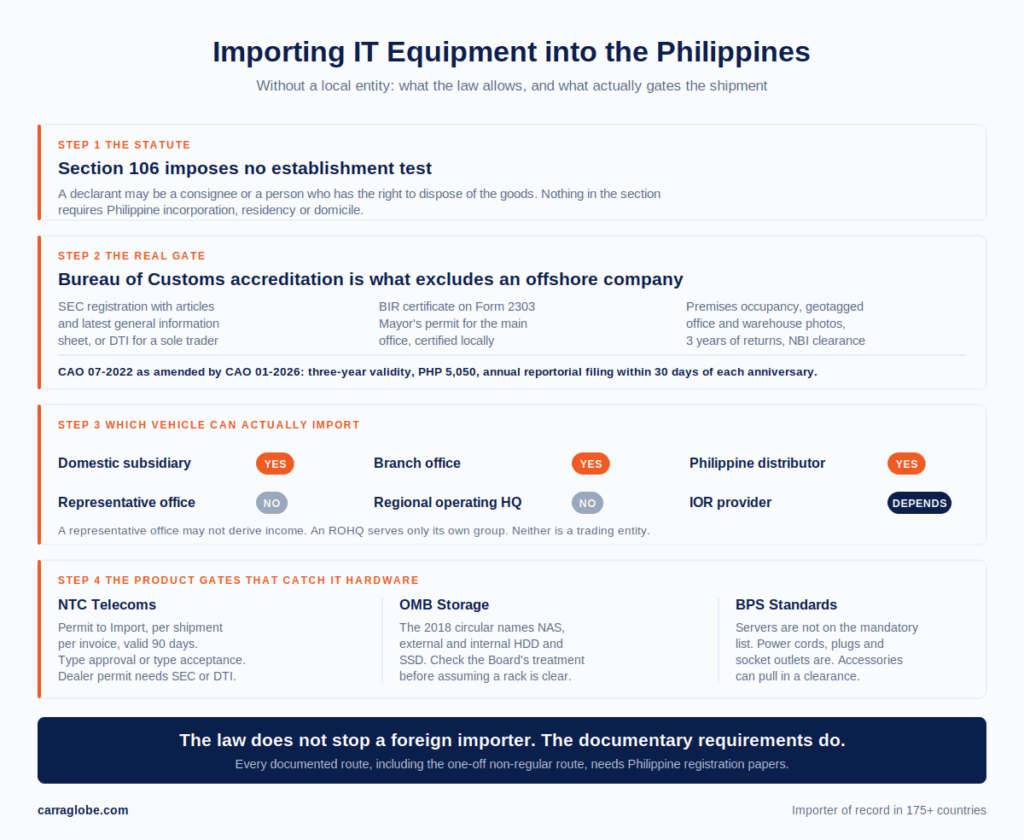
Does Philippine law require an importer to be established in the Philippines? The statute imposes no establishment test, but lodging a declaration requires Bureau of Customs accreditation, and every documented route needs Philippine registration documents, including the non-regular route for one-off shipments. A foreign corporation can be accredited through a Philippine-registered presence with a resident agent, but not as an offshore company that has simply appointed a local agent. For recurring shipments the working structure is an accredited Philippine importer.
This guide is about the law and the structures. If you want the service position instead, our importer of record in the Philippines page covers how we handle shipments, and this article explains what sits underneath it.
The operative provision is Section 106 of the Customs Modernization and Tariff Act, Republic Act No. 10863. It opens with a functional test rather than a corporate one: “A declarant may be a consignee or a person who has the right to dispose of the goods.”
It then lists who that may be: the importer as holder of the bill of lading, the exporter as owner of goods being shipped out, a customs broker acting under the importer’s authority, or a person duly empowered to act as agent or attorney-in-fact. Where the consignee is a company, it may authorise a responsible officer to sign the declaration on its behalf.
Worth naming the vocabulary problem at this point. “Importer of record” is commercial shorthand, not a defined term in the Act. The roles the statute actually works with are the importer, the consignee, the declarant, the holder of the transport document and, where one is engaged, the licensed customs broker or a duly empowered agent. When a provider says it will be your importer of record, the useful question is which of those statutory roles it is taking.
Read that on its own and a foreign company looks eligible: it has the right to dispose of its own goods, and nothing in the section requires Philippine incorporation, residency or domicile.
The catch is that Section 106 is not the whole gate. A declarant must also satisfy the Bureau’s accreditation requirements before it can transact. The practical limitation on a foreign company comes from those requirements and the documents they call for, not from any Philippine incorporation test in Section 106 itself.
What the declarant actually signs up to
What the role carries is where importer of record arrangements are won or lost.
| Party | What the CMTA says | What that means in practice |
|---|---|---|
| The declarant | Responsible for the accuracy of the goods declaration and for the payment of all duties, taxes and other charges due, and must sign the declaration even when assisted by a broker | This is the party the Bureau pursues. It is the name on the import history and the party exposed to post-clearance audit |
| The licensed customs broker | Likewise responsible for accuracy, but expressly not responsible for payment of duties, taxes and other charges | Section 106 lets a broker act as declarant, but appointing one does not by itself move the money liability, as importer of record versus customs broker explains |
| The consignee or endorsed bill holder | All imported goods are deemed the property of the consignee, or of the holder of the transport document if duly endorsed | For customs purposes the named party is treated as the owner. Who is on the bill is not a formality |
That split between accuracy and payment is unusual. If your structure assumes a broker absorbs fiscal exposure, the statute says otherwise.
Accreditation is the real gate, and it changed in 2026
Importer accreditation runs under Customs Administrative Order No. 07-2022, as amended by Customs Administrative Order No. 01-2026. The 2026 amendment is recent enough that most published guidance still describes the old position.
- Accreditation now runs three years, not one. Under the amended order it is “valid for a period of three (3) years from the date of issuance of the Certificate of Accreditation, unless otherwise suspended, revoked or cancelled”. The Bureau lists the processing fee at PHP 5,050, covering the full three years rather than each year.
- It is not maintenance-free. A new Annual Reportorial Compliance filing falls due within 30 days of each accreditation anniversary, and applicants sign an undertaking to submit it and to report any change of business circumstance.
- Automatic renewal got harder. It now requires six consecutive years of accreditation, or Authorized Economic Operator or Super Green Lane status.
- Automatic renewal runs to a seven working day clock from receipt of the complete documentary requirements. That is a renewal standard, not a first-time processing time, and the clock starts only once the file is complete.
- The Client Profile Registration System still exists. It was not abolished. Registration and accreditation are two separate steps, and the profile has to be activated before anything can be lodged.
- There is a separate non-regular importer route. It exists for a genuine one-off, and the undertaking requires the applicant to attest that it is the only importation and that no prior importation has been made in the last 365 days. It is not a registration-free route for an offshore company. A corporate applicant files SEC papers and BIR Form 2303, a sole proprietor files DTI registration and BIR Form 2303, and an individual applicant files a TIN card instead. None of those three is open to a company with no Philippine registration at all.
One 2026 change is a signal rather than a rule. The Accounts Management Office was realigned under the Post Clearance Audit Group, so accreditation now sits closer to the Bureau’s risk and audit side.
Why the paperwork excludes an offshore company
No clause in the accreditation regime says a foreign company may not apply. The constraint is produced by the documentary list instead.
A new importer must produce Securities and Exchange Commission registration with articles of incorporation and the latest general information sheet, or Department of Trade and Industry business name registration for a sole proprietorship. Then a Bureau of Internal Revenue certificate on Form 2303, a Mayor’s permit for the main office certified by the local permits office, proof of financial capacity, proof of lawful occupancy, geotagged photographs of office and warehouse, three years of income tax returns, and NBI clearance for signatories.
Test any provider on this point. Ask which entity will appear as declarant on the goods declaration, what its Bureau of Customs accreditation number is, and when it expires. If the answer is that your own company will be the importer of record in the sense you are used to elsewhere, ask how it satisfied the Mayor’s permit requirement. Our guide to verifying an importer of record provider sets out the rest, and paper IOR versus operational IOR explains why the answer matters when a shipment is held.
There is one genuine nuance, and it is routinely missed. The amended order expressly contemplates a foreign corporation as an accredited importer. Its list of principal officers includes an entry for “Foreign Corporation, the Resident Agent/Country Manager or equivalent officer”.
That is a real route. But the provision describes how a foreign corporation operating through a Philippine-registered structure identifies its principal officer. It does not create a registration-free route for an offshore entity with no Philippine business registration.
The structure that actually works
Here is the provision most guidance never reaches. The rules under the Foreign Investments Act list acts not deemed doing business in the Philippines, and one is this: “Appointing a representative or distributor domiciled in the Philippines which transacts business in the representative’s or distributor’s own name and account.”
That is the corporate law structure that makes the arrangement possible. A foreign company selling to a Philippine party which imports and resells in its own name and for its own account is not doing business in the Philippines. It needs no licence, no branch and no subsidiary for that reason alone, though accreditation, product permits, valuation and tax still have to be dealt with.
That exclusion should not be read across automatically to an importer of record arrangement. A distributor buying and reselling on its own account sits in a different commercial position from a specialist provider acting under a service agreement. The contracts, the declarant role, ownership of the goods, the payment flows and the actual conduct of the parties decide how it is analysed. What stays constant is that the Philippine entity is named as declarant and carries the Section 107 obligations, while your company is the commercial principal behind it.
The vehicles, and the two that are not trading entities
| Vehicle | Can it be the importer for onward sale? | The catch |
|---|---|---|
| Domestic subsidiary | Yes | A foreign-owned domestic market enterprise needs paid-in capital of US$200,000, reduced to US$100,000 where it involves advanced technology, is an endorsed startup, or employs at least fifteen direct Filipino employees forming a majority of direct staff |
| Branch office | Yes | No separate legal personality, so head office assets are exposed. Requires an SEC licence and a resident agent. This is the vehicle the accreditation rules contemplate for a foreign corporation |
| Representative office | No | The rules define it as an office that “does not derive income from the host country and is fully subsidized by its head office”, confined to information, promotion and quality control |
| Regional operating headquarters | No | It may derive income only by “performing qualifying services to its affiliates, subsidiaries or branches”. It is a group service centre, not a trading entity, and cannot sell goods to third-party Philippine customers |
| Philippine distributor | Yes | Where it imports and resells in its own name and for its own account, and the arrangement genuinely satisfies the Foreign Investments Act rules |
| Philippine importer of record provider | Depends on the structure | The distributor exclusion does not transfer automatically. The contracts, the declarant role, ownership of the goods and the conduct of the parties all have to be assessed |
The regional operating headquarters entry is worth pausing on, because it is regularly listed alongside subsidiaries and branches as an import route. On the statutory wording it is not one. An ROHQ can import equipment for its own operational use, but it cannot sell hardware to third-party customers.
One further question changes the capital answer. The Retail Trade Liberalization Act sets a minimum paid-up capital of PHP 25,000,000 for a foreign retailer, with PHP 10,000,000 per store. But retail trade means selling goods “for consumption” direct to the general public.
The implementing rules exclude sales to industrial and commercial users who use what they buy to render a service or produce goods they then sell, and sales made exclusively to government and government-owned corporations. The Securities and Exchange Commission applied that in Opinion No. 06-32 of 2 August 2006, holding that network security hardware marketed to business users rather than for personal, family or household use was “not embraced in the category of retail sale”.
The distinction predates the current statute. In Balmaceda v. Union Carbide Philippines, G.R. No. L-30442, the Supreme Court read goods for consumption as those which “directly satisfy human wants and desires and are needed for home and daily life”, and held that materials sold into manufacturing fell outside the retail trade law. Enterprise hardware sold business to business is therefore unlikely to be retail trade; consumer hardware sold direct to the public can be, including online. The sales model decides it, not the product.
The product gates that catch IT hardware
Getting the importer right is the first half. The second is whether your goods need a permit that the importer has to hold.
Radio and telecoms: three separate things, not one
- A Permit to Import, per shipment, for regulated equipment categories. The Philippines notified the World Trade Organization that this permit “is for a particular shipment only (per invoice) and is valid for a period of 90 days from the date of issuance”. The regime is expressly non-automatic, and what applies depends on the equipment category, the intended use and the circular in point.
- Type approval or type acceptance of the model. Type approval tests against national interface standards. Type acceptance recognises foreign certification where no national standard exists. A conformity certificate is a third grant on the same application form.
- A dealer or manufacturer permit for commercial or dealer activity. The application requires the business name appearing in the SEC or DTI registration or a business or Mayor’s permit. Own use imports are treated differently, so the test is the nature of the activity rather than the quantity in the box. That is the point at which Philippine registration becomes unavoidable.
The Philippine National Trade Repository lists core networking lines as regulated rather than freely importable, including switching apparatus, modems and other radio transmission apparatus.
Wi-Fi is exempt from a licence, not from type approval. The short range device circular removes the radio station licence and replaces it with a one-time registration. But it also provides that only type approved or type accepted devices are allowed for use in the country. Check the device category and the current requirement before shipping, because the licence exemption and the approval requirement are separate things.
For servers, switches and appliances with an embedded radio module, confirm whether the host needs its own type approval for that configuration. Certification bodies describe the requirement consistently, but we found no circular establishing it, so treat it as reported practice rather than settled rule. A machine with no radio sits outside the regime.
Storage: the regulator nobody expects
The Optical Media Board is assumed to be about discs. Its April 2018 circular recites that a far wider set of devices falls within its definitions, naming “USB Flash Drives or Thumb Drives, Secure Digital (SD) Cards, Network Attached Storage (NAS), External/Internal Hard Disk Drives (HDD), Solid State Drives (SSD)” among others.
Read that against a server shipment: those are the contents of the rack. Whether an ordinary server containing internal drives falls inside the operative permit requirement is not settled by that text alone, so check the Board’s current treatment rather than assuming server storage sits outside the regime.
Handsets are genuinely contested. The trade repository lists the Board alongside the telecoms regulator for cellular telephones under Republic Act No. 9239, but the 2018 circular names them in its recitals rather than an operative list. If you ship handsets, confirm with the Board rather than relying on either reading.
Product standards: the good news, and the trap
Mainstream IT hardware is not on the mandatory certification list. Computers, servers, routers, switches, data centre equipment and uninterruptible power supplies do not appear. The list runs to televisions and disc players, household appliances, lighting and wiring devices, and vehicle charging equipment.
The trap is in the same carton. Power cords, extension leads, plugs and socket outlets are listed. A shipment of otherwise uncontrolled servers can still trigger an Import Commodity Clearance requirement if it includes separately regulated products or accessories.
The split is clean. A foreign manufacturer can hold a PS licence, valid three years subject to annual surveillance. Only a Philippine importer can hold the Import Commodity Clearance, issued per shipment per bill of lading. Certification travels. Clearance does not.
Used equipment, encryption and the rest
- Used IT hardware is not prohibited as a class. Philippine commodities are freely importable, regulated or prohibited, and are generally not distinguished by whether they are new or used. That is a materially different position from Vietnam, which publishes a list of used IT products prohibited from import.
- Waste is where it turns. Electronic assemblies and scrap fall under the hazardous waste procedures implementing the Basel Convention. Import for recycling or for direct reuse is possible with registration and a per-shipment importation clearance. Import for final disposal is prohibited. Whether your goods are equipment or waste is the classification that decides it.
- Encryption is controlled, and by import as well as export. The Strategic Trade Management Act covers “export, import, transit, transshipment, or related services of strategic goods”, and the national list includes telecommunications and information security. Ordinary enterprise IT with standard encryption is the classic mass-market population, but a security appliance or hardware security module deserves a classification check rather than an assumption.
- 2G and 3G only devices are on the way out, but not on the same timetable. Memorandum Circular No. 003-09-2025, signed 28 August 2025, requires 3G to be switched off nationwide by 31 December 2026 and places 2G expressly on a different, as yet unannounced schedule. On devices it directs the regulator to issue a separate guideline stopping type approval applications for 2G and 3G only equipment and to coordinate on barring their import. That guideline is the operative instrument, so confirm its terms before shipping.
Duty, VAT and the preference everyone gets backwards
VAT on importation is 12 per cent, charged on the customs value plus duties, excise taxes and other charges. Twelve per cent of the commercial invoice alone therefore understates the liability.
The Philippines participates in the World Trade Organization Information Technology Agreement, which eliminates duty on covered IT products on a most favoured nation basis, so duty-free treatment is common. But “IT equipment” is not a tariff classification, so confirm the exact Philippine tariff line rather than assuming it.
There is no UK or EU preference on goods entering the Philippines. The United Kingdom and the Philippines have no bilateral agreement giving UK-origin goods preferential Philippine treatment. The European Union and the Philippines reached substantial agreement on 22 September 2026, but the text still has to complete legal revision, signature and ratification before it enters into force. The UK’s Developing Country Trading Scheme and the EU’s GSP+ both run the other way: they benefit Philippine exports into those markets, not British or European goods entering the Philippines.
Preferences that do exist come through the ASEAN agreements and the Regional Comprehensive Economic Partnership, so the useful question is where the goods lawfully originate, not where the seller is based. Our note on reducing import duty in the Philippines covers the practical routes.
One substantial exemption is narrower than most summaries suggest. Under the CREATE MORE Act, effective 28 November 2024, registered business enterprises can get duty exemption on importation for goods directly attributable to the registered project or activity.
VAT exemption on importation is the tighter one. It runs to registered export enterprises whose export sales are at least 70 per cent of total annual production for the preceding taxable year, and to high-value domestic market enterprises meeting a substantial investment capital threshold. An ordinary domestic market enterprise importing hardware for the Philippine market should not assume it qualifies.
For a qualifying project that materially changes the landed cost. It attaches to the registered enterprise and its registered activity, so the importing structure has to preserve that link and meet the incentive’s conditions.
The order to work in
- Decide who the declarant will be, and get the accreditation number and expiry in writing before anything else.
- Classify. The tariff line decides whether an NTC permit applies, and whether accessories drag in an Import Commodity Clearance. Our HS Code Finder and the guide to HS code 8471 for servers are a starting point.
- Check the radio position. Not just whether the product has Wi-Fi, but whether the host needs its own type approval for the module fitted.
- Confirm the goods are new, or establish that they are equipment for reuse rather than waste.
- Paper the arrangement so the Philippine party imports in its own name and for its own account, which is what keeps you outside the doing-business test.
- Then book the freight.
How Carra Globe handles Philippine shipments
We provide importer of record and exporter of record services for technology hardware across 175+ countries, alongside freight forwarding, DDP customs clearance, warehousing and white glove delivery, as set out on our Philippines importer of record service page.
In the Philippines that means being precise about the structure rather than selling a phrase: which accredited entity is the declarant, whether its accreditation runs past your landing date, whether the goods need a permit the importer must hold, and whether the arrangement keeps you outside the doing-business test. That applies whether this is a first shipment into a new country or one leg of a multi-country deployment.
Carra Globe already holds the importer-side licences, certifications and approvals its local importing structures require for the goods we handle, so your cargo moves without delay at the border, with customs clearance in 1 to 2 business days. Where a shipment needs an approval outside that scope, we say so before a delivery date is agreed rather than after the goods land.
Importer of Record · Philippines
The statute does not stop you. The accreditation file does.
Being clear about the boundary: no provider can make an unregistered offshore company the declarant on a Philippine goods declaration. What we do is name the accredited entity that will appear on the declaration, give you its accreditation number and expiry before you ship, check whether your goods need an NTC permit, an Optical Media Board registration or an Import Commodity Clearance the importer has to hold, and document the arrangement so it stays outside the doing-business test.
- Importer of record in the Philippines
- Importer of record services
- Exporter of record services
- DDP delivered duty paid
- DDP customs clearance worldwide
- Freight forwarding services
- White glove delivery
- Global warehouse and logistics
- IOR by country
- EOR by country
- Importer of record vs customs broker
- Paper IOR vs operational IOR
- How to verify an IOR provider
- Reduce import duty in the Philippines
- IT hardware import rules by country
Free tools HS Code Finder Volumetric Weight Calculator Pallet Calculator
Shipping IT hardware into Manila, Cebu, Clark or Davao without a Philippine entity? Send the packing list and the destination. We will tell you which accredited entity would be the declarant, which permits the goods trigger and who has to hold them, and where your structure would run into the doing-business test.
Check your Philippine shipmentFrequently asked questions
Can I import into the Philippines without a company there?
For recurring shipments, through an accredited Philippine importer importing in its own name and account. A non-regular route exists for a genuine one-off, but none of its three variants suits an unregistered offshore company.
Does the CMTA define who an importer is?
No. The statute defines neither importer nor consignee. Section 106 instead says a declarant may be a consignee or a person who has the right to dispose of the goods.
How long does Bureau of Customs accreditation last?
Three years under the 2026 amendment, up from one. An Annual Reportorial Compliance filing is due within 30 days of each accreditation anniversary.
Can a customs broker be my importer of record?
A broker may act as declarant under Section 106, but appointing one does not move the liability for duties and taxes. That stays with the declarant. Confirm who is actually named.
Does Wi-Fi equipment need approval in the Philippines?
Devices meeting the short range conditions are exempt from a radio station licence and take a one-time registration instead, but only type approved or type accepted devices may be used in the country.
Do servers need product certification in the Philippines?
Not under the product standards scheme. But separate storage devices and some components can trigger other regimes, including the Optical Media Board’s storage device rules. Check before assuming a server is clear.
Can I import used servers into the Philippines?
Used IT hardware is not prohibited as a class. The constraint is the hazardous waste regime: import for reuse or recycling is possible with clearance, but import for final disposal is prohibited.
Do UK or EU goods get a duty preference in the Philippines?
Not currently. Both trade on most favoured nation terms. The EU agreement reached substantial agreement in September 2026 but is not in force, and GSP+ benefits Philippine exports rather than EU imports.
The same question arises across the region. Our guides to importer of record in Singapore, Thailand and Indonesia set out how each market answers it differently, and import regulations by country puts them side by side.
Sources and verification
- Who may import: the Customs Modernization and Tariff Act, Republic Act No. 10863, official text via the Supreme Court e-Library, for Section 106 on the declarant, Section 107 on rights and responsibilities and Section 404 on property in the goods. Neither importer nor consignee is defined in Section 102.
- Accreditation: the Bureau of Customs Account Management Office for the current documentary requirements, which the Bureau heads “CAO No. 07-2022, as amended by CAO 01-2026”; Customs Administrative Order No. 01-2026 for the three-year validity, the foreign corporation provision and the reportorial requirement; the Bureau’s non-regular importer requirements for the one-off route and its 365-day undertaking; and its guidelines on importation.
- Foreign company structures: the implementing rules of the Foreign Investments Act, Republic Act No. 7042, for the doing-business definition, the distributor exclusion and the representative office definition, with Republic Act No. 11647 for the capital thresholds, and Republic Act No. 8762 as amended by Republic Act No. 11595 for retail trade.
- Retail trade and producer goods: SEC-OGC Opinion No. 06-32 of 2 August 2006, read in full, for the holding that network security hardware sold to business users is not retail sale, and Balmaceda v. Union Carbide Philippines, G.R. No. L-30442 of 30 September 1983, for the construction of goods for consumption. The exclusion for industrial and commercial users sits in the implementing rules, not in the Act itself.
- Radio and telecoms: the Philippines’ notification to the World Trade Organization import licensing portal for the Permit to Import and its 90-day per-invoice validity, and the Philippine National Trade Repository for the regulated status of networking lines and the split between dealers and own use.
- Mobile network decommissioning: National Telecommunications Commission Memorandum Circular No. 003-09-2025, signed 28 August 2025, for the 31 December 2026 nationwide 3G switch-off and the separate, undated schedule it gives 2G. We read a scanned copy of the signed original, not the regulator’s own posting, which we could not open on 28 September 2026.
- Storage devices: Optical Media Board Memorandum Circular No. 2018-002 of 5 April 2018 for the devices named as falling within its definitions, and the trade repository entry for cellular telephones, which lists the Board under Republic Act No. 9239. The circular names those devices in its recitals rather than an operative schedule, and the Bureau’s list of commodities regulated by the Board is a scan we could not read, so the handset position is given as contested.
- Product standards: the Bureau of Philippine Standards list of products under mandatory certification, and Department Administrative Order No. 5, series of 2008, for the Import Commodity Clearance being issued to an importer per shipment per bill of lading while a PS licence may be held by a foreign manufacturer.
- Used equipment and strategic goods: Department of Environment and Natural Resources Administrative Order No. 2013-22 implementing Republic Act No. 6969, for electronic assemblies and scrap and the prohibition on import for final disposal, and the Strategic Trade Management Act, Republic Act No. 10697, which covers import as well as export.
- Trade preferences: the European Commission on the September 2026 substantial agreement, and United Kingdom government material confirming most favoured nation terms.
- Verification note. Checked on 28 September 2026. Four things are flagged rather than stated: the signing dates of CAO 01-2026, because the Bureau’s copy is scanned, though the instrument and its three-year validity are confirmed; the host type approval rule for embedded radio modules, reported without a circular we could confirm; line-level duty rates, to be confirmed per code in the Tariff Commission’s finder; and the pre-border technical verification programme, still phasing in.
Disclaimer: This guide is for informational purposes only and does not constitute legal, customs or regulatory advice. Requirements change, and the position described is as at 28 September 2026. Confirm the current position with the competent authority or a qualified adviser before acting.