
A foreign company cannot make itself the importer in Vietnam by contract alone. Not through a service, and not because a provider says otherwise. In the ordinary structure for a shipment with no local entity, a Vietnamese trader imports in its own name and the declaration carries that company’s details.
“Import without a local entity” is commercial shorthand, not a description of a foreign company becoming the Vietnamese importer. The structure behind it is real and written into statute: entrustment, which is what an importer of record arrangement in Vietnam rests on. A separate registration route exists for qualifying foreign traders without a presence, narrower than the ordinary Vietnamese trader structure.
This guide sets out who may import, what entrustment does and does not transfer, which licences can sit with your side and which cannot, the 2025 and 2026 changes that reshaped this for IT hardware, and what is due to change again on 1 January 2027.
Carra Globe provides importer of record and exporter of record services, so we have a commercial interest in your answer. What follows is written to be usable whether or not you ever speak to us.
Who may import into Vietnam
Can a foreign company be the importer of record in Vietnam? Not in the sense used in other markets, and not by contract alone. In the usual structure a Vietnamese trader imports under an entrustment arrangement, acting in its own name and carrying the obligations that come with it. Vietnam also has a separate registration route for qualifying foreign traders without a presence, which is more limited than the ordinary Vietnamese trader structure used to import for a Vietnamese customer. The structure works. The shorthand does not.
Two provisions set the boundary. The Commercial Law defines traders as “lawfully established economic organizations and individuals that conduct commercial activities in an independent and regular manner and have business registrations”. Decree 292/2026/ND-CP, which replaced Decree 69/2018 on 5 September 2026, then gives a Vietnamese trader that is not a foreign-invested economic organisation a broad import right, exercisable without dependence on its registered business lines and subject to the prohibited and suspended lists. Foreign-invested economic organisations are treated separately, under Vietnam’s international commitments and the lists the ministry publishes.
So for ordinary commercial imports, acting as importer is tied to a Vietnamese registration or a specific statutory entitlement. Everything else in this article follows from that. Our guide to Vietnam customs rules for IT hardware covers the clearance side, and import regulations by country puts it next to your other markets.
Foreign trader without presence: why it is not a simple IOR route
Vietnamese law does recognise a “foreign trader without presence in Vietnam”, defined as a foreign trader with no direct investment, representative office or branch in the country. Reading that, exporters often assume it is the route in. It is narrower than it looks.
- It is not automatic. The trader has to obtain a certificate of registration of the right to export and import, which the authorities issue within thirty working days of a valid file.
- It does not reach the end customer. The decree permits buying goods for export and selling imported goods to Vietnamese traders that are registered to deal in those goods.
- It is not a distribution right. Distribution is defined in a separate instrument, and the registration route does not confer it.
Test any provider on this point. If a provider tells you that you will be the importer of record in Vietnam in the way you are in the Netherlands, ask which Vietnamese entity is named on the declaration and what registration it holds. Our guide to verifying an importer of record provider sets out the questions, and paper IOR versus operational IOR explains why the answer matters when something goes wrong.
What importer of record means in Vietnam: entrustment
“Importer of record” is commercial terminology. Vietnamese law works through its own roles: the trader, the entrusted party, the customs declarant and the holder of any applicable licence. This article uses “Vietnamese importer” as shorthand for the trader that imports commercially in a given structure.
In plain terms. A Vietnamese trader imports in its own name. Your company sits behind it as the entrusting party, without needing to be a trader in Vietnam. The entrustment contract decides who holds title and who carries duty and VAT. The statutory basis for each of those three points follows.
Entrustment is not a workaround. It sits in the Law on Foreign Trade Management, which allows traders to be “authorized to export or import goods that are not on the list of goods prohibited from export or import or are not goods temporarily suspended from export or import”, on the basis of a contract signed in accordance with the law.
The Commercial Law supplies the mechanics, and one phrase decides everything. The entrusted trader, which the Commercial Law calls the mandatory, conducts the purchase and sale “in his/her/its own name” on terms agreed with the entrusting party, and must be a trader dealing in goods consistent with the mandated goods. The entrusting party, the mandator, “may, or may not, be a trader”.
| Party | What the law says | What that means on the ground |
|---|---|---|
| The Vietnamese entrusted trader | Acts in its own name, and must be a trader dealing in goods consistent with the mandated goods | It is named on the declaration and faces customs. Confirm it is entitled to import your goods before relying on it |
| Your company, the entrusting party | Need not be a trader in Vietnam | This is the provision that lets a foreign company sit behind the import at all |
| A customs clearance agent | May act as customs declarant within the scope of its authorisation | It handles the formalities. That does not make it the commercial importer or the entrusted trader, as importer of record versus customs broker explains |
Two things this framework does not settle, and no honest guide should claim otherwise: where title passes under an entrustment, and how duty and VAT liability sits between the parties. Both turn on the contract, and both are questions for Vietnamese counsel before the first shipment.
Which permissions can move, and which cannot
The starting point is that the applicable licence or import condition has to be satisfied by the party the relevant regime names. Under Decree 292/2026/ND-CP, goods subject to a licence or a condition have to meet the licence, the condition and the management policy applying to that product line, and the licence sits with the exporter or importer. Entrustment does not automatically move that position.
Entrustment softens that. For licensed or conditional goods, “the entrusting party or the entrusted party must have a license and meet the conditions for export or import before signing the entrustment contract or accepting the entrustment, unless otherwise provided by law”. Those closing words matter, because the product regimes below do provide otherwise.
| Requirement | Can it sit with your side? |
|---|---|
| Testing against the applicable Vietnamese technical regulation | Yes, and it should be done before shipping |
| Certificate of conformity | Potentially, depending on the applicable regime. A certificate may be issued to the manufacturer and used by a Vietnamese importer where the rules permit it and the authorisation is in place |
| Certificate issued per consignment under the consignment method | No. It cannot be reused for other consignments or by other importers |
| Declaration of conformity | Not automatically transferable. The party responsible for the declaration is identified under the applicable product regime, and the required registration is completed in Vietnam |
| Civil cryptography import licence | Not something a foreign supplier can obtain because it is the manufacturer. The applicant must first hold the required Vietnamese civil cryptography business licence and meet the import licence conditions |
| Cybersecurity product import licence | Requires the applicant to hold the applicable Vietnamese cybersecurity product business licence. Overseas corporate status alone does not satisfy that requirement |
That table is the real answer to the question this article started with. Some manufacturer or product documentation may be usable by the Vietnamese importer where the regime permits it and the authorisation is in place. Importer-specific licences generally cannot simply be transferred.
Where Carra Globe sits in this. Through its Vietnamese importing structure, Carra Globe already holds every licence, certification and approval listed above, so your cargo moves without any delay, with customs clearance in 1 to 2 business days.
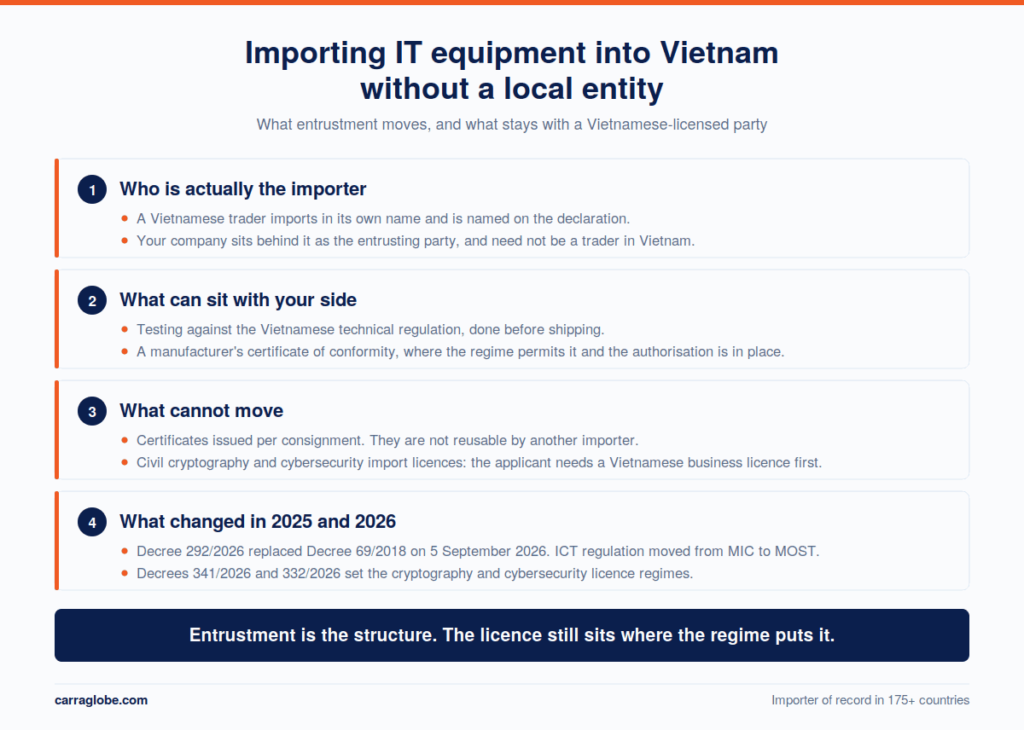
What changed in Vietnam’s IT import rules in 2025 and 2026
If your Vietnam playbook was written before 2026, several parts of it may now be out of date. This is what most guides have not caught up with.
- The foreign trade decree was replaced. Decree 292/2026/ND-CP took effect on 5 September 2026 in place of Decree 69/2018/ND-CP. The import right survives in the same terms, but a guide, template or contract clause citing Decree 69/2018 as live law is citing a repealed instrument.
- The regulator changed. ICT product regulation moved from the Ministry of Information and Communications to the Ministry of Science and Technology. Guidance still citing MIC circulars describes a ministry that no longer holds this brief.
- The conformity framework moved twice. Circular 29/2025/TT-BKHCN took effect on 31 December 2025, splitting products between certification with declaration and declaration only. Circular 36/2026/TT-BKHCN then took effect on 1 July 2026, issuing lists of medium and high risk products under the amended Law on Standards and Technical Regulations. Check which list your product sits on now rather than working from a 2025 copy.
- Civil cryptography changed. Decree 341/2026/ND-CP, in force 1 September 2026, sets the import licence regime under the Cybersecurity Law. Licences run three years and come from the Government Cipher Committee.
- Cybersecurity products got their own regime. Decree 332/2026/ND-CP, in force 19 August 2026, covers cybersecurity products and services, with import licensing through the Ministry of Public Security.
One more is coming. Decree 342/2026/ND-CP, issued 3 September 2026 and effective 18 October 2026, replaces Decree 09/2018/ND-CP on goods trading and directly related activities by foreign investors and foreign-invested economic organisations. If your plan involves a Vietnamese subsidiary rather than an entrustment, check its conditions before committing to a structure.
Encryption is the trap in a server shipment
The civil cryptography regime is narrower than the panic around it suggests, and sharper than the complacency. Official coverage of the new decree describes the licensing list as applying a three-part match, run within the licensing annex rather than off the tariff alone. All three of these have to correspond to the listed entry:
- the HS code
- the goods description
- the cryptographic technical characteristics
A general-purpose server with security features is a different classification question from a dedicated VPN concentrator, a hardware security module or a firewall whose function may fall inside the regulated categories, and the code, description and characteristics still have to be checked against the current annex rather than the marketing description. Where a product has both cryptographic and cybersecurity characteristics, which regime applies is itself a classification question, so do not assume one label settles it. Our guide to encryption import restrictions on network equipment covers the wider picture across markets.
For higher-end computing and other controlled technology, check Vietnam’s strategic trade control rules as well. Circular 30/2026/TT-BKHCN, effective 6 June 2026, issues the dual-use goods list and the licensing arrangements sitting with the Ministry of Science and Technology, so ordinary IT import treatment is not always the whole picture.
Used and refurbished IT hardware: prohibited categories, not an age allowance
This is where the most expensive mistakes happen, because the general rule and the IT rule are different.
Used IT equipment sits under its own prohibited list, not the general age rules for other used machinery. Circular 11/2018/TT-BTTTT publishes the list of used information technology products prohibited from import, with HS codes, reaching the headings that cover computers and network transmission equipment. There is no ten-year allowance to fall back on.
Refurbished is not a way around it. A refurbished machine is a used machine repaired or rebuilt with replacement parts. Refurbishment does not by itself take an item outside Vietnam’s used IT controls, so if your servers fall within the prohibited list, do not plan a redeployment on the assumption that rebuilding them makes them eligible for ordinary import. Our guides to importing used and refurbished IT equipment and used equipment under Vietnam’s Circular 30 go into the detail.
Defined authorisation routes exist. Circular 26/2025/TT-BKHCN, in force from 31 October 2025, governs importing goods on that prohibited list for specified purposes, including processing for foreign traders where the output is consumed abroad. Those routes are applications to a ministry, made by a Vietnamese trader, not a shipping decision.
Radio, duty and VAT
- Wi-Fi and Bluetooth. Certain short-range devices covered by the frequency exemption list, including specified equipment to the IEEE 802.11 standard meeting the listed conditions, do not need an individual frequency licence. The list was amended by Circular 01/2025/TT-BKHCN from 15 May 2025, which added the 5925 to 6425 MHz band on the listed conditions, so 6 GHz Wi-Fi equipment is now covered where it meets them. Exemption from a frequency licence is not exemption from conformity assessment. Licensed-band equipment, such as a private cellular installation, needs a licence held by the Vietnamese user.
- VAT. The standard rate is 10 per cent, reduced to 8 per cent for many goods by Resolution 204/2025/QH15 and Decree 174/2025/ND-CP, running from 1 July 2025 to 31 December 2026. Information technology products sat on the excluded list under the previous resolution and are not on the current one, so many IT lines now take the reduced rate. Telecommunications remains excluded, so check your specific code against the decree’s appendices rather than assuming either rate.
- Duty. UK-origin goods may claim preference under the UK and Vietnam agreement, and EU-origin goods under the EU agreement, subject to the origin rules and the Vietnamese implementing schedules. Some IT lines carry low or zero most favoured nation duty already, so check the exact line and the origin rule before building a claim around preference.
The order to work in
For a Vietnam shipment without a local entity, this sequence avoids the expensive mistakes. The freight commitment comes last on purpose.
- Confirm the goods are new. Used or refurbished IT hardware is the fastest way to a stopped shipment.
- Classify. The HS code shapes the conformity, cryptography and duty position, but the product description, technical characteristics and origin matter too. Our HS Code Finder and the guide to HS code 8471 for servers are a starting point.
- Check the product gates. Conformity certification or declaration, and whether the item is a cryptography or cybersecurity product.
- Identify the Vietnamese importer. Confirm that it is entitled to import the goods, and that it holds any licence or product-specific authorisation the applicable regime attaches to the importer.
- Paper the entrustment. Who holds title, who pays duty and VAT, who holds the certificates, and what happens if the shipment is held.
- Then book the freight.
Importer of Record · Vietnam
Entrustment is the structure. The licence still sits where the regime puts it.
Being clear about the boundary: appointing an importer of record in Vietnam does not make your company the Vietnamese importer, and it does not create a conformity certificate or a cryptography licence that the regime attaches to someone else. What we do is classify the shipment line by line, check it against the current conformity, cryptography and cybersecurity lists, name the Vietnamese party that will appear on the declaration, and tell you in writing where the answer is no.
- Importer of record in Vietnam
- Importer of record services
- Exporter of record services
- Importing without a local entity
- Vietnam customs rules for IT hardware
- Used equipment and Vietnam's Circular 30
- Encryption import restrictions
- How to verify an IOR provider
- IOR versus customs broker
- Importer of record in Singapore
- Importer of record in Thailand
- IOR by country
Free tools HS Code Finder Volumetric Weight Calculator Pallet Calculator
Shipping servers, network or security hardware into Vietnam? Send the part numbers, the destination site and whether the goods are new. We will check the conformity, cryptography and cybersecurity position before quoting, and say plainly if a licence application changes the date.
Check your Vietnam shipmentHow Carra Globe handles Vietnam shipments
We provide importer of record and exporter of record services for technology hardware across 175+ countries, including for companies with no entity in the destination market, as set out in importing without a local entity and on our importer of record in Vietnam page.
Vietnam is often a company’s first shipment into a new country, or one leg of a multi-country deployment. In Vietnam that means being precise about the structure rather than selling a phrase: which Vietnamese entity imports, what its registration covers, which certificates can travel with your product, and which licences cannot move at all.
Carra Globe already holds every licence, certification and approval set out above through its Vietnamese importing structure, so your cargo moves without any delay, with customs clearance in 1 to 2 business days. Where a shipment needs something outside that scope, we say so before a delivery date is agreed rather than after the goods land.
Frequently asked questions
Can I import into Vietnam without a company there?
For the usual structure, yes: a Vietnamese trader imports under an entrustment arrangement. A separate registration route exists for qualifying foreign traders without a presence, so the answer is not a flat no.
What is import entrustment in Vietnam?
A statutory arrangement where a Vietnamese trader imports in its own name on terms agreed with you. The law expressly allows the entrusting party not to be a trader in Vietnam.
Can a manufacturer’s conformity certificate be used by the Vietnamese importer?
Potentially, where the applicable regime permits it and the authorisation is in place. Certificates issued per consignment cannot be reused for other consignments or importers.
Can I import used or refurbished servers into Vietnam?
Specified used information technology products are on a prohibited import list. Refurbishment does not by itself remove a product from that regime, though defined routes exist for specified purposes.
Do firewalls and VPN appliances need a licence?
They can. Depending on the product, cryptography or cybersecurity licensing may apply, and the import licence requires the applicant to hold the matching Vietnamese business licence first.
Does Wi-Fi equipment need a frequency licence in Vietnam?
Standard short-range Wi-Fi devices sit on the licence exemption list. Conformity assessment still applies, and licensed-band equipment needs a licence held by the Vietnamese user.
Does a customs broker become the importer of record in Vietnam?
No. A broker can act as customs declarant within its authorisation, which is a different job from being the commercial importer or the entrusted trader. Identify both separately.
Who deals with customs if an entrusted shipment is held?
The Vietnamese entrusted trader acts in its own name, so it deals with the customs process. How costs and document obligations land between the parties is a matter for the contract.
The same question arises when a customer will not act as importer of record, which is a common trigger for these arrangements.
Sources and verification
- Who may import: Decree 292/2026/ND-CP, issued 22 July 2026 and in force from 5 September 2026, for the import right and the licensing rule; it replaced Decree 69/2018/ND-CP, whose English text as notified to the WTO remains the clearest rendering of the predecessor wording. The Commercial Law 2005 for the trader definition and mandated purchase and sale, Articles 155 to 157.
- Foreign traders without presence: Decree 90/2007/ND-CP, for the definition, the registration certificate and the limit on sales to registered Vietnamese traders. Entrustment is Article 50 of the Law on Foreign Trade Management 2017; the customs declarant definition is Article 4 of the Customs Law 2014.
- Conformity: Circular 36/2026/TT-BKHCN, effective 1 July 2026, for the medium and high risk product lists, and Circular 29/2025/TT-BKHCN, effective 31 December 2025, for information technology and telecommunications products subject to certification and declaration of conformity. Commercial databases report that the 2026 circular displaced the 2025 one, while the ministry’s own register still showed both as in force when we checked it on 23 September 2026, so confirm which list applies to your product before shipping. Also the Ministry of Science and Technology’s guidance on authorised use of conformity certificates, including the limits on per-consignment certificates.
- Cryptography and cybersecurity: Decree 341/2026/ND-CP, in force 1 September 2026, and Decree 332/2026/ND-CP, in force 19 August 2026, including the requirement that the enterprise be established under Vietnamese law. Dual-use goods sit in Circular 30/2026/TT-BKHCN, in force 6 June 2026.
- Used equipment: Circular 11/2018/TT-BTTTT, for the list of prohibited used IT products, with Circular 26/2025/TT-BKHCN for the authorisation routes.
- Radio, duty and tax: the Authority of Radio Frequency Management for the exemption list under Circular 08/2021/TT-BTTTT, as amended by Circular 01/2025/TT-BKHCN from 15 May 2025 and consolidated as Document 01/VBHN-BKHCN of 4 June 2025; Resolution 204/2025/QH15 of 17 June 2025 with Decree 174/2025/ND-CP for the reduced VAT rate to 31 December 2026; and UK and EU trade agreement guidance from gov.uk and the European Commission.
- Verification note. Several of these instruments publish their product lists as signed annexes rather than as searchable text, so this guide sets out the framework instead of reproducing the lists. Match your exact HS code, product description and technical characteristics to the current annex before shipping. Where a product sits near a boundary, we confirm it with the competent authority rather than assume it.
- This is not legal advice. Import rights, licensing and conformity in Vietnam are matters for the importer, its Vietnamese advisers and the authority concerned.
Disclaimer: This guide is for informational purposes only and does not constitute legal, customs or regulatory advice. Requirements change, and the position described is as at 24 September 2026. Confirm the current position with the competent authority or a qualified adviser before acting.