
Ask customs what a modular data centre is and the answer depends on what was inside the steel when it landed. Published decisions have put data centre and mining modules under electrical distribution equipment and prefabricated buildings, and similar battery enclosures under steel containers. None put the complete module under 8471 as a computer.
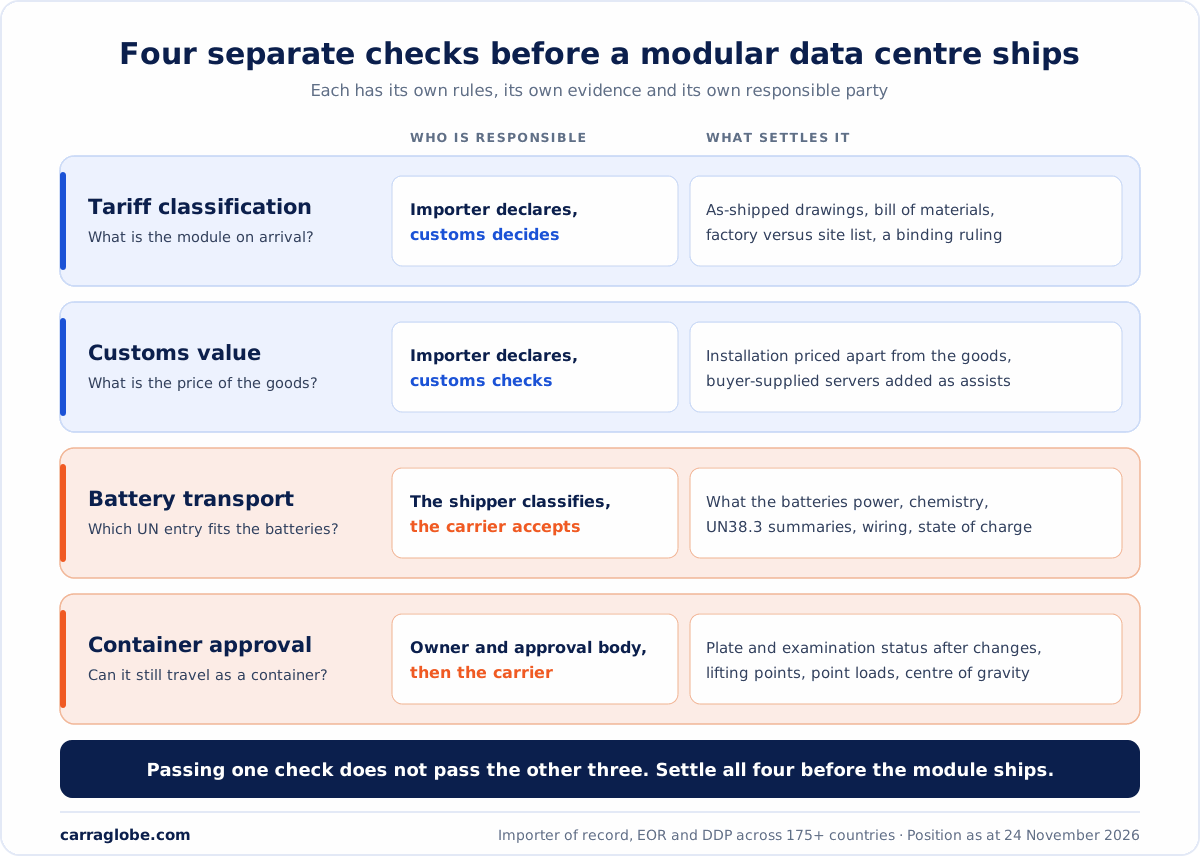
The tariff code helps decide the duty rate, the product-specific origin rule and any extra tariffs. Three other questions sit beside it. What goes into the customs value, which dangerous goods entry covers the batteries, and whether the module can still travel as a shipping container.
The short version. Customs classifies the module as it arrives, not as it will look on site. Installation and commissioning after import can stay out of the customs value if they are distinguished from the price of the goods. The UN3536 battery entry only covers batteries that power something outside the unit. A modified container may no longer carry a valid safety approval plate.
Carra Globe provides importer of record, exporter of record and delivered duty paid services for data centre equipment, so we have a commercial interest in this topic. Every ruling below is public, and you can read each one yourself.
What customs has actually decided
Seven decisions, up to July 2026. Most guides stop at “classification can be complex”. The published record goes further. Three of these rows are data centre or mining modules, and the rest are electrical buildings and battery enclosures built the same way.
| Decision | Product considered | Heading | Why |
|---|---|---|---|
| UK Upper Tribunal, BladeRoom v HMRC, 14 May 2015 | Modular data centre in ten sections, control servers fitted, customer servers not, classified for export from the EU | 9406, prefabricated buildings | Not a part of the servers, since a conventional building could do the same job |
| US CBP, NY N317967, 10 March 2021 | Modified 20-foot container with battery racks, no electrical fittings | 7309, steel containers | Built to store batteries in one place, not to carry goods |
| US CBP, NY N331604, 14 April 2023 | Immersion-cooled data centre modules with power distribution, without the customer’s servers or miners | 8537.10, up to 1,000 V | Principal function was distributing power |
| US CBP, NY N332995, 31 May 2023 | 45-foot immersion mining module with power distribution, controllers and Ethernet switches, for up to 240 miners fitted on site | 8537.10, not the miner heading 8543.70 | Principal function was distributing power to the miners |
| US CBP, HQ H329722, 16 June 2025 | Empty battery storage containers from China | 7309, not 8609 | Built to stay put, despite lifting hooks and supports |
| US CBP, HQ H356254, 14 April 2026 | 16-foot battery cube fitted with cables, terminal blocks and busbars | 8537.20, above 1,000 V | The fitted electrical apparatus moved it out of 7309 |
| US CBP, NY N362808, 21 July 2026 | Two prefabricated electrical buildings with switchgear, a motor control centre, a drive and a PLC | 8537.10, even though each is a building | The electrical apparatus decided the heading, not the shell |
Two lessons from the table. First, the same maker’s bare battery container went to 7309, while its later cube with busbars and terminal blocks went to 8537, so fitted apparatus can change the answer. Second, heading 8609 is not automatic. In H329722 the importer argued for it and lost, and the ruling confirmed an additional 25 per cent Section 301 duty on those goods at that time, so check current measures for your own entry. A module built to stay put is not a freight container for tariff purposes.
The rule underneath every ruling
Customs classifies what crosses the border. It starts from the goods’ design and condition as presented, read against the headings and legal notes, and intended function counts where those texts make it count. In N331604, the HVAC, transformers, cooling pods, dielectric fluid and computing equipment were all added after import, so customs classified a power distribution enclosure. General Interpretative Rule 2(a) also lets an unassembled or incomplete article count as the finished one when it already has its essential character. In NY N363422 of 31 July 2026, a flat-packed battery cabinet was classified as the complete steel container.
- Empty shell or skid. No default code. Heading 7309 covers steel containers over 300 litres, other than for compressed or liquefied gas, without mechanical or thermal equipment, and a building-like module may point to 9406.
- Wired for power, no IT. Heading 8537 needs a base equipped with two or more apparatus of headings 8535 or 8536 for electric control or distribution. Voltage then splits it, 8537.10 up to 1,000 V and 8537.20 above.
- IT pre-installed. General-purpose servers usually sit in 8471, as our HS code guide for servers explains. Whether a fully fitted module is one functional unit is not settled by any published decision we found.
- ASIC miners. CBP classified Antminer S9 and DragonMint miners under 8543.70 in NY N297495 of 8 June 2018, affirmed in HQ H300195 of 11 December 2019, and confirmed the Antminer S9 again in HQ H310388 of 28 July 2020, because they are not freely programmable. We found no later CBP ruling departing from that line. Our guide to importing ASIC miners covers the rest.
- GPU mining boards. In Atlas Power v United States on 27 January 2026, the Court of International Trade held NVIDIA CMP 170HX boards to be computer parts under 8473.30, and still refused them the Section 301 exclusions they claimed. As with H329722, the heading and the extra tariff are separate questions, and a trade court judgment can be appealed, so check its status before relying on it. A used mining module also raises the rules for used and refurbished IT equipment.
Get the decision in writing. For a seven-figure module, a binding ruling for the exact configuration is often worth the wait, from CBP in the US, or Binding Tariff Information or an Advance Tariff Ruling in the EU and the UK. Our free HS Code Finder is a good first pass, not a substitute.
When the module arrives in pieces
Each consignment is classified as it lands. A power skid, then a cooling module, then racks of IT is three imports, unless a rule lets customs treat them together. Declaring every entry under the code for the finished installation is a common mistake.
The functional unit rule is narrow. Section XVI Note 4 lets machines that together perform one clearly defined function share that function’s heading. Canada’s CBSA Memorandum D10-13-2 of 28 March 2014 treats a functional unit as an integral system whose components contribute together to one clearly defined purpose, the kind typically sold under a turnkey or one-price contract, and accepts that it can arrive in several consignments, even from different countries. Later extra or replacement components, auxiliary equipment and machines combined with locally sourced kit are classified on their own.
The UK route has strict conditions. HMRC’s split consignment procedure lets Chapter 84 and 85 goods use one commodity code, but only on these conditions.
- you apply at least one month before the first consignment arrives, and get approval before imports start
- the goods come under one contract with a single supplier and would fall under one heading if shipped together
- spare parts, accessories and unrelated goods stay out of the application
- you pay a duty deposit on each import, unless the goods enter duty-free on valid proof of preferential origin
Heading 9406 is not covered, so a module classified as a prefabricated building cannot use it, and many multi-supplier projects will not qualify. If your build spans several countries, our guide to multi-country IT deployments covers sequencing.
What belongs in the customs value of a turnkey module
The valuation rules decide, the contract proves it. Under the WTO Valuation Agreement, the Interpretative Note to Article 1 lets you exclude construction, assembly and technical assistance after import, and transport after import, if they are distinguished from the price of the goods.
- On-site work. Left inside a lump sum, installation and commissioning can attract duty, and in many countries import VAT. It must genuinely happen after import and be identifiable in the contract and invoices.
- Servers you supplied. Equipment the buyer sends to the builder free or at reduced cost can be an assist under Article 8, apportioned and added where not already in the price. Buyer-supplied engineering and design done outside the importing country and needed to produce the module can count too.
- Software and royalties. Pre-installed software is not automatically excluded, and royalties tied to the goods and a condition of sale can be added.
- Freight and insurance. Whether these sit in customs value depends on the importing country.
- Leases and group transfers. No sale may mean another valuation method, as our guide to importing where there is no sale explains. A sale between group companies can still use transaction value if the relationship has not influenced the price.
Customs value and preferential origin are separate calculations
Origin is its own test. In HQ H349837 of 8 December 2025, CBP found the Canadian-built immersion module from N331604 originating under the USMCA. Its USD 1.99 million value included about USD 522,000 of non-originating materials, giving 73.79 per cent regional value content against the 50 per cent minimum that the heading 8537 rule sets under the transaction value method (40 per cent under the net cost method).
The electrical buildings in N362808 qualified through the tariff shift rule instead. Keep a costed bill of materials by component and origin, and see our guide on how to calculate landed cost.
Before you sign the supply contract
- Split the price. Module, pre-installed equipment, freight, and on-site installation and commissioning as separate amounts.
- Name the importer. Agree the importer in each destination before the module is built.
- Get the bill of materials. Component values and origins drive valuation, origin and any ruling request.
- Get the battery design. Chemistry, capacity, test summaries and what the batteries power decide how the module can travel.
Why the obvious battery UN number may be wrong
UN3536 has a narrow scope. The entry for lithium batteries installed in a cargo transport unit looks made for a module with UPS batteries. But Special Provision 389 requires the batteries to be designed only to provide power outside the unit, as the US Pipeline and Hazardous Materials Safety Administration repeated in Interpretation 26-0051 of 8 July 2026. PHMSA declined to confirm the design it was shown, so classification stays the shipper’s job.
The other conditions matter too. Special Provision 389 also requires batteries that meet the general lithium battery rules, including testing, protection against overcharge and over-discharge, secure installation to prevent short circuits, accidental operation and significant movement, the UN number displayed and placards on two opposing sides, and no other dangerous goods in the unit beyond those needed for its safe and proper operation. That last condition matters where a module carries refrigerant, fire suppression cylinders or generator fuel.
A data centre UPS usually powers what is inside. So a module whose batteries back up its own servers may need a different entry, settled by a dangerous goods specialist from the battery chemistry, purpose, installation and transport mode. Do not default to UN3536, or jump to the equipment entry without that analysis.
Air depends on the entry. PHMSA’s lithium battery guide, revised October 2024, forbids UN3536 on aircraft unless specifically approved, and other entries carry their own limits on quantity, packing and carrier acceptance. Batteries shipped separately follow the ordinary rules in our lithium battery customs clearance guide.
The entry may change. On 27 October 2026, PHMSA proposed limiting UN3536 to lithium ion, with new entries UN3563 for lithium metal and UN3564 for sodium ion. It is a US proposal with comments closing on 28 December 2026, and international codes follow their own timetables, so check your route at booking.
When the container is the cargo
The plate is not the whole story. Containers travel under the International Convention for Safe Containers, with a safety approval plate and a current periodic examination or approved continuous examination programme. Structural changes must be notified so the approving body can decide whether the approval still holds, and under the IMO’s CSC.1/Circ.138/Rev.1 the owner must remove the plate if the container is modified without that process.
Doors, vents and chillers change the answer. Some modifications can be assessed and approved. A unit without a valid plate may need to travel as cargo on a flat rack or as breakbulk, with its own lifting and securing plan, which changes the freight quote, port handling and sometimes the road permits.
Weight is only half the question. A verified gross mass satisfies the vessel’s weighing rule for a packed container, but says nothing about point loads, centre of gravity or lifting points. Get the lifting drawing before you book. Our white glove delivery service covers positioning at site, and our guide to data centre construction freight covers the wider project.
Going to Europe? Two extra checks
Pre-charged cooling can need an F-gas registration. Under Regulation (EU) 2024/573, an importer of covered equipment generally needs a valid F-gas Portal registration before customs clearance, except for temporary storage. Where relevant, the customs declaration must give the F-gas Portal registration number, the EORI number, the commodity code, the net mass of the gases and their tonnes of CO2 equivalent. For HFC-charged refrigeration and air-conditioning equipment, the importer also needs a declaration of conformity showing quota coverage. Ask the builder early for the refrigerant type, its global warming potential and charge weight, and check it against the Annex IV prohibitions.
CE-marked parts do not certify the whole. Servers, UPS units and PDUs may each carry the CE mark, but that does not settle the module. Whether the integrated unit needs its own conformity assessment depends on its configuration, intended use and the EU product legislation that applies. Confirm separately who is the customs importer and who holds the product-compliance duties, as our guide to CE marking importer obligations explains.
What we see on real module shipments
Experience across module types and destinations. Our team has handled several full modular data centre shipments into the Middle East, Europe and the UK, Asia-Pacific, Africa and Latin America, including modules with IT pre-installed, empty shells and skids, power and UPS modules, cooling units and Bitcoin mining modules, with single consignments running into millions. The same four issues come up, the one-unit-or-parts classification question, the value split, battery papers that must match the installation, and size and handling. Each is easier to settle before the module is built than after it sails.
The file to build before the first module ships
- For classification. Drawings and photographs of the module as it will arrive, an as-shipped bill of materials with proposed HS codes, a list of factory versus site installation, the electrical single-line diagram with rated voltage, and server or miner specifications.
- For transport. Dimensions and actual gross weight, battery chemistry, capacity, UN38.3 summaries, wiring and state of charge, any refrigerant, fire suppression or fuel on board, the ocean carrier’s dangerous goods acceptance, and the plate and examination status with point loads, lifting points and centre of gravity.
- For the project. Confirmation of the importer and its approvals in each destination, a full landed cost covering duty, extra tariffs, trade remedies, import taxes and approvals, whether that importer structure lets you recover import VAT or GST, cargo and installation insurance agreed before booking, and destination electrical and site approvals, because customs clearance does not authorise energising the module.
- At origin. An export control check for GPU servers, encryption equipment or mining hardware, as our guide to export controls on data centre hardware explains.
How Carra Globe handles modular data centre imports
One file, checked before the module is booked. Our trade compliance team reviews the classification, value split, battery papers and container status before booking, and flags anything that needs a ruling, an approval or a different routing. We then act as importer of record where the client has no local entity, or work with the client’s own importing company where it has one.
Carra Globe works through importer-side registrations and local importing structures appropriate to the goods and destinations it accepts, its own in some markets and established local structures in others. Approvals falling outside the available structure are flagged before a delivery date is agreed.
Freight and site delivery. We arrange freight forwarding for out-of-gauge and heavy units, and delivered duty paid moves to site where that suits the project. Our importer of record for data centre equipment page sets out the wider service. To get a quote, send the module drawings, the bill of materials with values, the battery and refrigerant details, the collection and site addresses and your target date to info@carraglobe.com or through our contact page.
Importer of Record · Data centre modules
Classification, value, batteries and container status, settled before the module ships.
To be clear about the boundary, naming an importer of record does not decide the tariff heading, approve the batteries for transport or re-certify a modified container. What we do is review the module file before booking, act as importer where you have no local entity, and flag anything that needs a ruling, an approval or a different routing before a delivery date is agreed.
- IOR for data centre equipment
- Liquid cooling and coolant imports
- IOR for AI servers and GPU clusters
- Importing ASIC miners
- Lithium battery customs clearance
- HS code 8471 for servers
- Data centre construction freight
- How to calculate landed cost
- IOR by country
Free tools HS Code Finder Volumetric Weight Calculator Pallet Calculator
Shipping a modular or containerised data centre? Send the drawings, the bill of materials with values and the battery details. We will check the classification risk, the value split and how the module can travel before you book.
Check your module shipmentFrequently asked questions
What HS code is a containerised data centre?
There is no single code. Published decisions have used 8537 for data centre and mining modules fitted for power distribution and 9406 for a modular data centre building. Related battery enclosure rulings used 7309.
Can a modular data centre be classified as a shipping container under 8609?
Not automatically. US CBP has refused 8609 for battery containers that were built to stay in one place rather than carry goods, even when they had lifting fittings.
Do servers installed at the factory change the classification?
They can. Factory-installed IT is part of the module as presented, while IT imported separately for on-site installation is generally classified on its own, unless a procedure allows combined treatment.
Is installation included in the customs value of a data centre module?
Not if it genuinely happens after import and can be distinguished from the price of the goods with proper evidence. A turnkey price with no breakdown can pull it into the value.
Can a data centre module with lithium UPS batteries be shipped by air?
Possibly, but only after a dangerous goods assessment of that exact configuration and carrier acceptance. UN3536 itself is barred from aircraft in the US without specific approval.
Who should be the importer for a modular data centre?
An entity legally able to import there and meet the customs, tax and approval duties. That may be the operator’s local company, an eligible non-resident importer or a third-party importer of record.
Adjacent ground: importing liquid cooling systems and coolant, importer of record for AI servers and GPU clusters and what an importer of record does.
Sources and verification
This guide was checked against official rulings, regulations and guidance on 24 November 2026. We found no revocation or modification of any cited CBP ruling when we checked on that date. The CBP rulings concern specified goods and facts under US law, and BladeRoom is a UK tribunal decision under the tariff rules then in force. They show how classification is reasoned, but they do not decide the treatment of a different module or bind customs in another country.
- US Customs and Border Protection rulings. Modules and enclosures, NY N317967, 10 March 2021, NY N331604, 14 April 2023, NY N332995, 31 May 2023, HQ H329722, 16 June 2025, HQ H349837, 8 December 2025, HQ H356254, 14 April 2026, NY N362808, 21 July 2026, NY N363422, 31 July 2026. Cryptocurrency miners, NY N297495, 8 June 2018, HQ H300195, 11 December 2019, HQ H309938, 30 April 2020 and HQ H310388, 28 July 2020.
- US Court of International Trade. Atlas Power LLC v United States, Slip Op. 26-4, 27 January 2026.
- UK Upper Tribunal. BladeRoom v HMRC [2015] UKUT 0250 (TCC), 14 May 2015.
- HM Revenue and Customs. Apply to use a single commodity code to import your goods under split consignments, updated 29 May 2026.
- Canada Border Services Agency. Memorandum D10-13-2, Tariff interpretation of functional units, 28 March 2014.
- World Trade Organization. Agreement on Implementation of Article VII of the GATT 1994, including the Interpretative Note to Article 1 and Article 8.
- US Pipeline and Hazardous Materials Safety Administration. Interpretation 26-0051, 8 July 2026, the Lithium Battery Guide for Shippers, revised October 2024, and the proposed rule on harmonisation with international standards, 27 October 2026.
- International Maritime Organization. CSC.1/Circ.138/Rev.1, Revised recommendations on harmonized interpretation and implementation of the International Convention for Safe Containers, 5 August 2013, as amended by CSC.1/Circ.151 of 7 June 2016.
- European Commission. F-gas obligations for equipment and products and Regulation (EU) 2024/573, Article 23.
Disclaimer: This guide is for informational purposes only and does not constitute legal, tax, customs or dangerous goods advice. Classification, valuation and transport requirements depend on the exact module, its condition at import, the contract and the destination. The position described is as at 24 November 2026. Confirm the current position with the customs authority, your carrier and a qualified dangerous goods specialist before shipping.