
Most explanations of CE marking are written for manufacturers. That is understandable, since the manufacturer does the engineering work and signs the declaration. It is also why CE marking importer obligations are so often misunderstood, and why so many importers arrive at the subject believing their part is simply to check the mark is there.
Under EU law the importer has its own set of duties. They are lighter than the manufacturer’s, but they are real, they are separate, and they do not disappear because a supplier has signed something. In some situations they convert into full manufacturer obligations without anyone intending it.
This guide covers CE marking importer obligations in plain terms: what the mark means, the checks that fall to you, what you keep and for how long, and the one decision that quietly turns an importer into a manufacturer.
A note on scope. It deals with the general obligations that run across EU harmonisation legislation, and with the wider consumer-product net under the General Product Safety Regulation. Individual sectors such as medical devices and machinery carry their own regimes with additional duties, so treat what follows as the common framework rather than the last word for a regulated sector.
Quick answer
| Question | Short answer (check the applicable legislation for your product) |
|---|---|
| Is CE marking a certificate? | No. It is the manufacturer’s indication that the product complies with applicable EU harmonisation legislation after the required conformity assessment. The manufacturer signs the EU Declaration of Conformity |
| Does the importer have duties? | Yes, separate from the manufacturer’s, set out in EU product legislation |
| What are they, broadly? | Verify the manufacturer did the conformity assessment, check the declaration and documentation exist, add your name and address, keep records, act on non-compliance |
| Does the operator’s name and address appear on the product? | Generally yes, where the applicable legislation requires it. Depending on the product it may appear on the product, packaging, parcel or an accompanying document |
| How long do I keep the paperwork? | Commonly ten years from placing on the market, or the period the specific legislation sets |
| When might I become the manufacturer? | Where you place the product on the market under your own name or trademark, or modify it in a way affecting compliance |
Quick check: which set of duties applies to you?
Buying from outside the EU and selling under your supplier’s brand, unchanged?
Importer obligations.
Selling it under your own name or trademark?
Manufacturer obligations.
Modifying the product in a way that affects its compliance?
Manufacturer obligations may apply.
What the CE mark actually means
Worth clearing up first, because the misunderstanding here causes most of the downstream problems.
CE marking is not a certificate and no authority issues it. It is the manufacturer’s indication that the product complies with the applicable EU harmonisation legislation and that the required conformity assessment procedure has been completed. The manufacturer signs the EU Declaration of Conformity, and the mark is the visible result of that process rather than the process itself.
Two practical consequences follow. A CE mark can be affixed to a product that does not actually comply, because affixing it is a physical act rather than an approval. And “our supplier says it is CE marked” is not evidence of anything on its own. What matters is whether the underlying work was done and whether the paperwork exists.
The distinction that matters. The manufacturer is responsible for establishing conformity. The importer has a separate obligation to verify that the required conformity assessment and documentation are in place before placing the product on the EU market. Different jobs, and the second one is yours.
The framework sits in Decision 768/2008/EC, which sets out common definitions and the obligations of each economic operator, and in the individual pieces of product legislation that apply to your goods. For IT and electronics that commonly means electromagnetic compatibility, low voltage, radio equipment and restriction of hazardous substances legislation, with newer instruments layering on top.
The checks that fall to the importer
EU product legislation gives the importer a defined verification role before a product goes on the market. The exact wording varies by instrument, but the pattern is consistent.
First, verify the manufacturer’s work.
- The conformity assessment was carried out. Not that the mark is present, but that the manufacturer actually followed the applicable procedure for that product.
- The EU Declaration of Conformity exists. Ask for a copy. It should identify the product, name the legislation and standards applied, and be signed on behalf of the manufacturer.
- The technical documentation exists and can be made available. The manufacturer normally prepares it. What you need to establish is which EU-established operator holds it or can obtain it, and how it reaches an authority on request.
Second, check what reaches the customer.
- Marking and labelling. That the CE marking is present where required, and that identification, type or batch information is on the product.
- Instructions and safety information. Supplied with the product, in a language the end users in that market can understand.
- Storage and transport. While the product is under your responsibility, make sure conditions do not put its compliance at risk. This is the obligation sitting closest to the physical supply chain.
Third, make yourself and the manufacturer findable.
- Your own name and address. EU product legislation typically requires the importer’s name, registered trade name or trade mark and contact address on the product, or on the packaging or accompanying document where the product does not allow it.
- A reachable manufacturer. The European Commission states the importer should be able to make contact at any time, which matters when an authority asks a question years later.
That last point surprises people most often. Importing is not anonymous. Your details go on the goods so that a market surveillance authority has somebody inside the EU to contact, which is precisely the point of the obligation.
If a supplier’s test evidence looks thin, our notes on foreign test report recognition and on what to do when an accredited laboratory report is rejected cover the practical checks.
The moment you become the manufacturer
This is the single most consequential rule in the whole framework, and it catches resellers, integrators and white-label buyers regularly.
Put it on the market under your own name and you may become the manufacturer. The European Commission states that where importers or distributors market products under their own names, they take over the manufacturer’s responsibilities. Not the importer’s lighter duties, but the manufacturer’s.
That means responsibility for conformity assessment, the technical file and the declaration of conformity. The Commission notes that a party in this position needs sufficient information on the design and production of the product, because it assumes legal responsibility when the CE marking is affixed. The same generally applies where a product is modified in a way that affects compliance, subject to the wording of the relevant legislation.
For technology buyers this is not a theoretical risk. Rebadged hardware, an appliance sold under a house brand, a system integrated and then supplied as a single product: each of these can move the supplying party across the line. The commercial decision to put your logo on a box is also a regulatory decision, and it is usually taken by a marketing team who have never read the product legislation.
What about racking CE-marked equipment together?
This is the question integrators ask most, and the answer is less comfortable than the common assumption. Combining CE-marked products does not automatically produce a compliant whole. The Blue Guide puts it directly: the fact that components or parts are CE marked does not automatically guarantee that the finished product also complies.
What decides it is how the combination reaches the market. Where separate products are assembled and made available as a single functional unit, the party placing it on the market may need to assess the combination as a whole. Supplying separately CE-marked units that a customer racks and uses independently is a different situation, and the result depends on configuration, intended use, supply arrangement and applicable legislation.
The Blue Guide places that judgement on the party doing the combining, case by case. So the answer is not “CE plus CE equals CE”, and it is not “every rack needs a new mark” either. Somebody has to make the assessment deliberately, and if you are putting the system together and placing it on the market, that somebody is you.
Manufacturing changes matter too, and our note on product certification when manufacturing moves covers what has to be revisited when a production site changes.
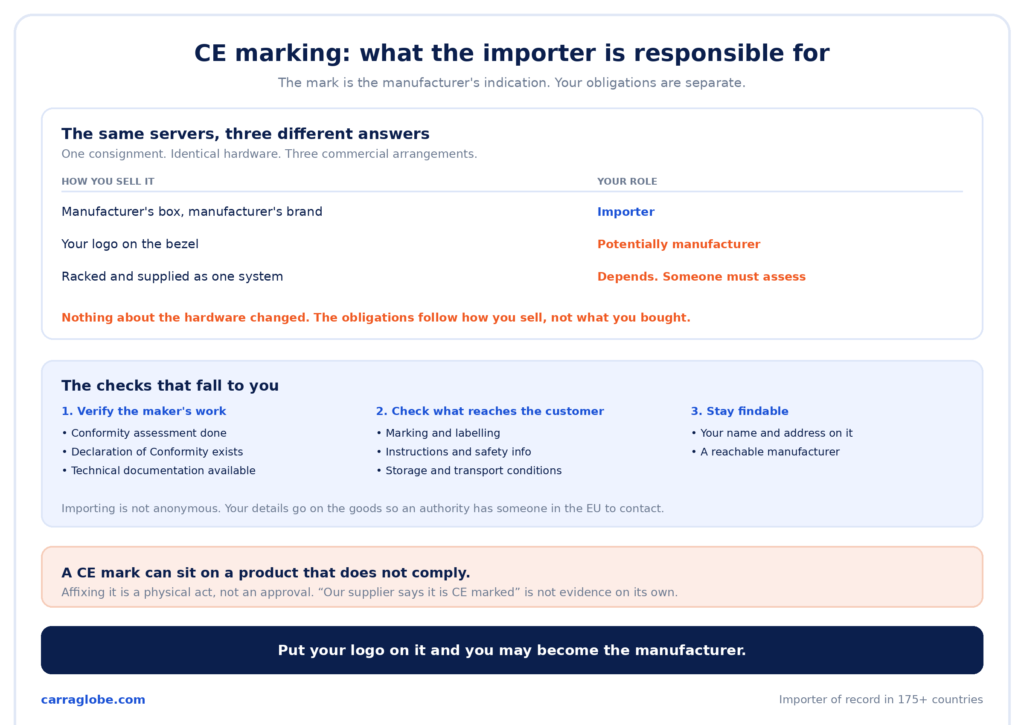
The same servers, three different answers
Take one consignment of rack servers arriving from an Asian manufacturer into the Netherlands. Identical hardware, identical paperwork from the factory. Three commercial arrangements, three very different positions.
| How you sell it | Your role | What that means |
|---|---|---|
| Resold in the manufacturer’s box, under the manufacturer’s brand | Importer | Verify the assessment and documents, add your details, keep the file. The manufacturer’s declaration stands |
| Resold with your logo on the bezel and your name on the invoice as the brand | Potentially manufacturer | You may take on conformity assessment, the technical file and the declaration, and you need enough information on design and production to stand behind them |
| Racked with switches and PDUs, supplied as one configured system | Depends | Somebody has to assess whether the combination is a product in its own right. If you assembled it and placed it on the market, that somebody is you |
Nothing about the hardware changed between those rows. What changed was the commercial arrangement, and each one was probably decided by a sales or marketing conversation rather than a compliance one. That is the practical lesson of this whole article: the obligations follow how you sell, not what you bought.
Somebody has to be in the EU
Alongside the product legislation sits Regulation (EU) 2019/1020 on market surveillance, and it introduced a structural requirement worth understanding before you plan a route to market.
For products within the scope of Article 4 of that Regulation, there must be an economic operator established in the Union responsible for the specified tasks. For a non-EU manufacturer the Article works through a structured set of options: an EU-established manufacturer, an importer, an authorised representative with a written mandate, or, where the others are unavailable, a fulfilment service provider established in the Union. Article 4 does not reach every product.
It covers those subject to the Union harmonisation legislation it lists, so check whether your product falls inside it. That operator can be the manufacturer where it is established in the EU, an authorised representative with a written mandate, the importer, or in some cases a fulfilment service provider. The tasks include holding the declaration of conformity and technical documentation and making them available to authorities on request, and cooperating with those authorities.
The practical effect for a company outside the EU is direct. If none of the required economic operators is established in the Union, there may be no lawful route for the affected products, which is why this question tends to reach logistics rather than legal.
Our page on importing without a local legal entity sets out the routes, and the market pages cover the country detail: Germany, Netherlands and Ireland, with the full set on our IOR by country index.
And a wider net for consumer products
One more instrument is worth knowing about, because it extends the same idea beyond CE-marked goods. The General Product Safety Regulation (EU) 2023/988 has applied since 13 December 2024, and its Article 16 requires an EU-established responsible economic operator for consumer products within its scope, performing the tasks set out in Article 4(3) of Regulation (EU) 2019/1020.
The GPSR applies to consumer products within its scope and operates alongside sector-specific Union product legislation, subject to its own rules on overlap. It does not simply replace CE legislation, but it can impose additional or residual safety and economic-operator requirements. The practical point for technology importers is that the EU-established operator requirement can reach further than the harmonisation legislation alone.
What you keep, and for how long
Record-keeping is the obligation most often discovered late, usually when an authority asks a question about a shipment that landed years ago.
EU product legislation commonly requires a copy of the declaration of conformity to be kept for ten years after the product is placed on the market, with the technical documentation available for the same period, though the exact duration is set by the legislation applying to your product and some newer instruments tie it to a support period instead. Check the instrument rather than assuming ten years everywhere.
The practical version of that obligation is a filing habit rather than a legal exercise. A folder per product model, carrying version, batch, manufacturing-site and shipment references where relevant, is worth considerably more than a reconstruction attempted under time pressure. What goes in it:
- The EU Declaration of Conformity
- Your own verification record, and the date you made it
- Relevant supplier correspondence
- Shipment details tying the document to the batch
- Where a notified body was involved, its certificate, any amendments or supplements, and the conformity-assessment references
The second item is the one nobody can reconstruct afterwards, which is why it is worth writing down at the time rather than trusting to memory.
When something is wrong
If you have reason to believe a product does not conform, the importer is expected to act rather than to pass the question back up the chain and wait.
Broadly, that means suspending or stopping placement on the market where required, informing the manufacturer, assessing the risk, arranging corrective action or withdrawal where appropriate, notifying market surveillance authorities where the applicable legislation requires it, and recording what was known, when it was known and what action followed. Where a product is on the market and unsafe, silence is not a neutral position.
Penalties are set by each Member State, and the Regulation requires them to be effective, proportionate and dissuasive. The more common consequence is simpler: goods detained, an authority asking for documentation you do not have, and a deployment stalled while somebody chases a declaration from a supplier who has moved on. For business-critical IT equipment, a compliance failure becomes an operational one, affecting clearance, deployment and site acceptance.
What this looks like for IT hardware
CE marking is a framework rather than a single rule, so the question is always which instruments apply to your product. For technology hardware several often apply at once, though each still has to be checked against the actual product rather than assumed from the category.
| What the product is | Potentially applicable EU framework |
|---|---|
| Mains-powered server, storage or network equipment | EMC and RoHS, plus the Low Voltage Directive or another electrical-safety instrument where the product falls within its voltage range and scope |
| The same equipment with WiFi or Bluetooth | Radio equipment legislation as well |
| Products with digital elements | Cyber Resilience Act requirements may apply, with obligations entering into application in stages |
| Equipment containing batteries | Battery legislation alongside the rest |
| Energy-related equipment | Ecodesign requirements where applicable |
The bottom half of that table is where the framework is currently moving. The General Product Safety Regulation has applied since 13 December 2024, the Cyber Resilience Act is phasing in, and Ecodesign requirements continue to expand by product category. An importer whose CE process was designed around EMC, RoHS and the Low Voltage Directive alone is working from a shorter list than the one that now applies.
Two of these are worth reading in their own right: our guides to the EU Cyber Resilience Act for importers and the EU Battery Regulation for importers. Digital Product Passport requirements may also become relevant under specific EU product legislation, depending on the product and framework.
The reason this matters at SKU level rather than category level is the second row of that table. Adding a wireless module to an otherwise identical server changes which legislation applies, and the purchase order will not tell you that. The build sheet will.
Importer of Record · 175+ countries
Shipping hardware into the EU? Settle who carries which obligation before it moves.
Carra Globe acts as your importer of record, checks the document set before shipment, and flags where branding or integration would move you from importer duties into manufacturer duties. Explore how we help:
Free tools: HS Code Finder|Volumetric Weight Calculator|Pallet Calculator
Planning an EU deployment? Tell us the products, the route and how they will be branded, and we will map the roles before anything moves.
Map the rolesWho carries what: the responsibility chain
Most confusion about CE marking comes from treating it as one responsibility rather than a chain of them. Laid out side by side, the roles separate cleanly.
| Party | Primary responsibility |
|---|---|
| Manufacturer | Design, conformity assessment, technical documentation, the declaration of conformity, affixing the CE marking |
| Authorised representative | The tasks specifically delegated in a written mandate, no more |
| Importer | Verify compliance before placing on the market, plus its own identification, handling and record obligations |
| Distributor | Due care before making the product available, and not acting in a way that affects compliance |
| Economic operator under Article 4 | Keep or ensure the specified compliance information can be made available, and cooperate with market surveillance authorities |
| Importer of record for customs | The customs import role, which is not automatically the same as the product-compliance role |
The row people get wrong is the last one. Appointing an importer of record settles who makes the customs declaration. An EU-established importer may also satisfy the economic-operator requirement where it is the legally relevant operator, but the two roles are legally distinct and should not be treated as automatically identical. Confirm in writing whether your importer accepts the product-compliance tasks: document availability, cooperation with authorities, risk notification and corrective-action support.
A working checklist
Nothing here is difficult. It is simply easier to do before the goods ship than after an authority asks.
- Identify which EU legislation applies to the exact product, working from the build and specification rather than the product category.
- Obtain the EU Declaration of Conformity and read it. Check it names the right product and the right legislation, and that it is signed.
- Confirm the technical documentation exists and that your supplier will produce it if an authority asks.
- Check marking, labelling and instructions against what the applicable legislation requires for that product.
- Arrange your own name and address on the product or packaging, and agree with your supplier who applies it and when.
- Decide whether you are branding it. If your name goes on as the brand, plan for manufacturer obligations rather than importer ones.
- Confirm who the EU-established economic operator is for the products where one is required.
- Open the file and keep it. Declaration, your verification record, correspondence, and shipment references, retained for the period the legislation requires.
How Carra Globe helps
Worth being clear about the division of work. We are not a notified body and we do not carry out conformity assessment or issue declarations of conformity. That sits with your manufacturer and, where testing is needed, with an accredited laboratory.
- Acting as importer of record across 175+ countries, including for data centre equipment, so an EU-established economic-operator requirement can be assessed and, where legally permitted, built into the import structure.
- Checking the document set before shipment, so a missing declaration or a mismatched product identifier is found at the desk rather than at the border.
- Flagging where the role is moving, particularly where branding or integration would take a client from importer duties into manufacturer duties.
Where a product genuinely needs assessment or testing that has not been done, we say so. That is a slower answer than anyone wants, and it is better than finding out from a market surveillance authority.
Shipping hardware into the EU and unsure who carries which obligation? Tell us the products, the route and how they will be branded, and we will map the roles before anything moves.
Map the roles before you ship →
Frequently asked questions
Does the importer have CE marking responsibilities?
Yes. EU product legislation gives importers their own duties, separate from the manufacturer’s, including verifying that conformity assessment was carried out and that the declaration and documentation exist.
Checking that the mark is present is only part of it. The verification behind the mark is the substantive obligation.
Does the economic operator’s name have to appear on the product?
Generally yes, where the applicable legislation requires it. Depending on the product it may appear on the product, the packaging, the parcel or an accompanying document.
The details are typically the name, registered trade name or trade mark and contact address. The purpose is traceability, so an authority has an operator inside the EU to contact.
When does an importer become the manufacturer?
Where it places the product on the market under its own name or trademark, or modifies a product in a way that affects its compliance. At that point the manufacturer’s obligations apply.
Rebadged hardware and own-brand appliances are the common routes into this without anyone intending it.
What happens if my supplier’s CE marking is wrong?
You cannot rely on the supplier’s statement alone. If you have reason to believe the product is non-compliant, do not place it on the EU market until the issue is resolved.
Take the corrective and notification steps the applicable legislation requires, and inform the manufacturer and the relevant authorities where the product presents a risk. The importer’s obligations are its own, so a supplier’s error does not transfer the responsibility back up the chain.
Is CE marking a certificate I can buy?
No. It is the manufacturer’s indication that the product complies with applicable EU harmonisation legislation after the required conformity assessment. No authority issues a CE certificate.
Treat any offer to sell you one with caution, and ask what is actually being provided.
How long do I have to keep the declaration of conformity?
Commonly ten years from when the product is placed on the market, though the exact period is set by the legislation applying to your product and some newer instruments use a different measure.
Keep your own verification record alongside it, because that is the part nobody can reconstruct later.
Is a customs importer of record the same as the EU economic operator?
Not automatically. A customs importer of record handles the customs import role. The Article 4 economic operator performs specified product-compliance tasks for products within the scope of Regulation (EU) 2019/1020.
The same company may hold both roles, but confirm the responsibilities in writing for the specific product and legislation rather than assuming one appointment covers the other.
Can we import into the EU with no EU entity?
For products within the scope of Article 4 of Regulation (EU) 2019/1020, an economic operator established in the Union must be responsible for the specified tasks. Without one there may be no lawful route.
That operator can be an EU-established manufacturer, an authorised representative, an importer, or in some cases a fulfilment service provider.
Sources and verification
- Framework: Decision 768/2008/EC, setting out common definitions and each economic operator’s obligations, plus the individual product legislation applying to your goods.
- Market surveillance: Regulation (EU) 2019/1020, including the Article 4 economic-operator requirement and the rule that Member State penalties be effective, proportionate and dissuasive.
- Guidance: the European Commission’s Blue Guide on the implementation of EU product rules, which covers combinations of products, substantial modification and the responsibilities of each economic operator.
- Consumer products: the General Product Safety Regulation (EU) 2023/988, applying from 13 December 2024, whose Article 16 extends the economic-operator requirement to products it covers.
- Importer duties: the European Commission page on importers and distributors, covering the importer’s verification duties, the requirement that contact with the manufacturer is possible at any time, and the effect of marketing under your own name.
- Background: the US National Institute of Standards and Technology publishes a useful CE marking FAQ for exporters, including the ten-year retention position and the point that the manufacturer affixes the marking unless an importer or distributor markets the product under its own name.
- Check the instrument that applies to you. CE marking is a framework covering many pieces of legislation, and obligations, retention periods and marking rules differ between them. Confirm the position for your exact product before shipping.
Disclaimer: This guide is for informational purposes only and does not constitute legal or regulatory advice, and Carra Globe is not a notified body and does not carry out conformity assessment. Obligations, retention periods and marking requirements vary by product and by the legislation that applies to it, and the rules change. This article reflects publicly available guidance as at 27 August 2026. Always confirm the position for your specific product with a qualified adviser or the relevant authority before placing goods on the EU market.