
Your customer in India has signed the order. Your freight forwarder has quoted. Your Importer of Record is appointed and the hardware is built.
None of that, by itself, gets servers into India.
Servers commonly classify under HSN 8471, and in 2023 India moved specified IT hardware under that heading from free to restricted import treatment. Where no exemption applies, import requires a prior authorisation from the Directorate General of Foreign Trade, applied for through the Import Management System. The application is made by the importer using its Importer Exporter Code. Appointing an Importer of Record does not automatically create or transfer an authorisation.
Carra Globe acts as importer of record in India, so we have a commercial interest in your answer. What follows is written to be usable whether or not you ever speak to us.
What “restricted” means under HSN 8471
Restricted is a category in India’s import policy, not a ban. Goods in it may be imported, but only against a prior authorisation issued by DGFT. Where the restriction applies and no exemption is available, the goods need that authorisation before they can lawfully enter, regardless of how well the rest of the file is prepared.
Do servers need DGFT import authorisation in India? Generally yes, where the server falls within the restricted HSN 8471 scope and no exemption applies. The importer applies through DGFT’s Import Management System using a permanent Importer Exporter Code. An Importer of Record can provide an eligible Indian importer, but appointment alone does not create or guarantee the authorisation. Applications under the 2026 procedure close on 15 December 2026, and every authorisation issued under it expires on 31 December 2026.
What happens if you get it wrong
The consequence of getting that wrong sits in customs law rather than trade policy. Goods imported contrary to a restriction may be liable to confiscation under section 111(d) of the Customs Act 1962 and may attract a penalty under section 112, with section 125 providing for release in lieu of confiscation where applicable. The exposure is therefore to the consignment itself and not only to a procedural delay, which is why the authorisation question belongs before the booking.
The move happened in stages. DGFT Notification No. 23/2023 of 3 August 2023 shifted specified items under HSN 8471 from free to restricted, Notification No. 26/2023 of 4 August 2023 adjusted the commencement, and Notification No. 38/2023 of 19 October 2023, read with Policy Circular No. 06/2023-24 of the same date, amended the conditions and widened several exemptions from 1 November 2023. The operating detail has been set annually since, and calendar year 2026 runs on Policy Circular No. 08/2025-26 of 17 December 2025.
A separate question from duty. An import authorisation decides whether the goods may enter at all. Customs duty decides what entry costs. A favourable duty position does not soften an authorisation requirement. Duty planning for India is covered in reducing import duty in India.
Which items are covered
The restricted list under HSN 8471 covers laptops, tablets, all-in-one personal computers, ultra small form factor computers and servers.
Classification is the first thing to settle, because the policy condition follows the heading rather than the commercial description. A chassis your engineering team calls an appliance, a node or a compute unit may still classify to 8471. Many rack-mounted server and accelerated-computing platforms fall within the heading, including the units covered in importing NVIDIA H200 servers, but classification should be established from the actual hardware and tariff characteristics rather than the product name. Our working notes on HS code 8471 for servers cover the boundary cases, and the cost of incorrect HS codes covers what getting it wrong costs.
Servers are on the list alongside the consumer devices, but they are not treated identically, and the difference sits in the exemptions rather than in the restriction itself. That is what most summaries of this regime leave out.
The exemptions, and where servers are treated differently
The restriction does not catch every shipment of these items. The notifications and Policy Circular No. 06/2023-24 provide a set of exemptions, and where servers are concerned they are worth reading as a whole rather than case by case.
| Exemption | What it covers | Position for servers |
|---|---|---|
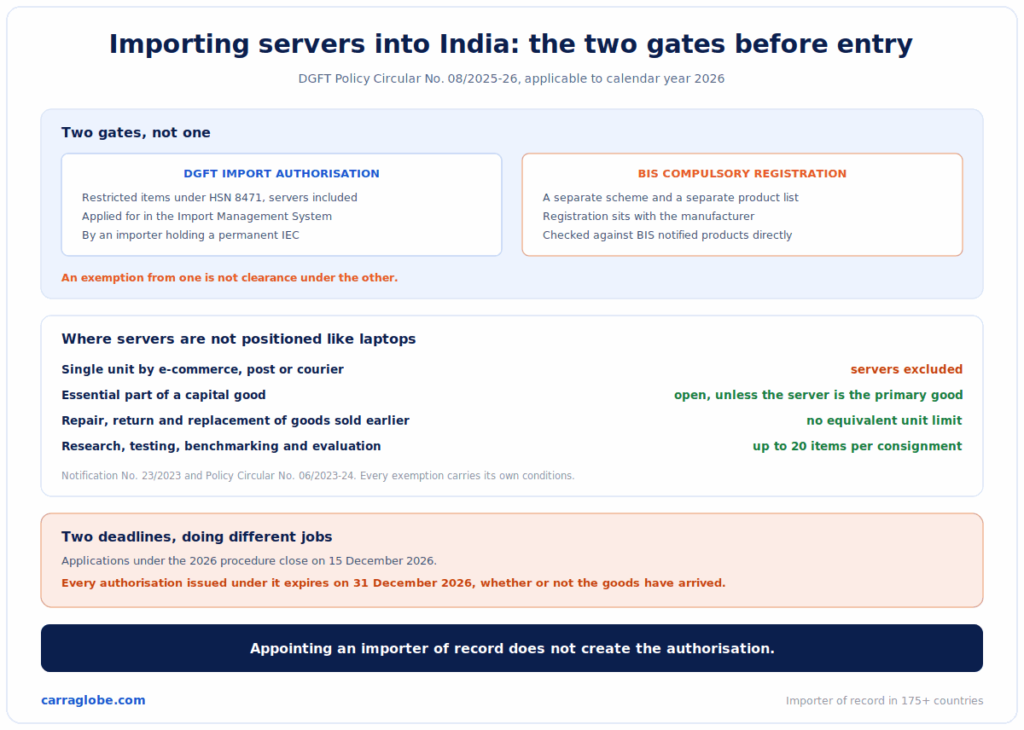
| Single unit by e-commerce, post or courier | One laptop, tablet, all-in-one PC or ultra small form factor computer per shipment | Servers excluded |
| Essential part of a capital good | IT hardware accompanying machinery, for example a laptop supplied with a diagnostic system | Does not apply where the server is itself the primary capital good |
| R&D, testing, benchmarking, evaluation, repair and re-export, product development | Up to 20 items per consignment, not for sale, destroyed or re-exported afterwards | Available on conditions |
| Repair, return and replacement of hardware sold earlier, and re-import after repair abroad | Self-certification basis, no cap on units per consignment, for hardware previously supplied | Available on conditions |
| SEZ, EOU, EHTP, STPI and BTP units | Captive consumption | Available on conditions |
| Hardware manufactured in an SEZ and imported by a DTA unit | On payment of applicable customs duties. Re-packing, labelling, refurbishing, testing or calibration alone is not manufacturing | Available on conditions |
| Spares, parts, assemblies, sub-assemblies, components and other inputs | Not subject to the restriction, where correctly classified as such | Available on conditions |
| Supply to Central Government or its agencies for defence or security, and State Government for security | Import by private entities for those supplies | Available on conditions |
| Imports under the Baggage Rules | As amended from time to time | Not a practical route for rack hardware |
Read down the right-hand column and the pattern is visible. The server-relevant exemptions are tied to specific circumstances or purposes: qualifying research and testing movements, repair and return movements, specified SEZ, EOU, EHTP, STPI and BTP situations, qualifying capital-good situations and specified government or security supplies. The one route closed outright is the single unit by e-commerce, post or courier, which names servers as an exception. The capital-good route stays open where a server is an essential part of the capital good, and fails only where the server is itself the primary capital good.
That has a practical consequence. A vendor who has moved sample laptops into India without an authorisation has learned nothing transferable about moving a rack. The repair and return route is particularly relevant to installed-base and warranty movements, and the notification provides no equivalent 20-item limit for it, a point we cover in IOR and EOR for returned goods and reverse logistics. That route only works as a pair, so the outbound leg needs the same attention as the inbound one, which is the subject of exporting equipment for repair and the customs treatment on return.
Where refurbished hardware sits
The IMS application captures whether goods are new or refurbished, so both are contemplated, and the published material creates no separate authorisation regime for refurbished units under this restriction.
One exemption does narrow for them. Where goods undergo only re-packing, labelling, refurbishing, testing or calibration inside a Special Economic Zone, that is not treated as manufacturing, so the SEZ to DTA route fails on that basis. A refurbishment operation inside an SEZ does not, by itself, turn imported hardware into SEZ-manufactured hardware.
An exemption from this restriction is not clearance. BIS runs a separate gate under the Electronics and Information Technology Goods (Requirement for Compulsory Registration) Order, 2012. Notified entries include laptops, notebooks and tablets against IS 13252 (Part 1), moving to IS/IEC 62368-1. That list is not the DGFT restricted list, so check the BIS notified products directly. Registration sits with the manufacturer, acting through an authorised Indian representative where it is foreign, so this is another gate an IOR appointment does not answer.
What the 2026 Import Management System requires
Where no exemption reaches the goods, the authorisation has to be applied for. Policy Circular No. 08/2025-26 states that importers shall apply in the Import Management System for Import Authorization on the DGFT website, submitting online the entity, item and supporting information the portal requires for HSN 8471 goods.
DGFT’s own terminology is Import Authorization under the Import Management System. The trade calls it an import licence and the search language follows, but the authorisation is the instrument that exists.
What the application captures, based on DGFT’s published user help file for restricted imports:
- Permanent Importer Exporter Code, selected from the applicant’s own registered codes. This is the field that decides who the applicant can be
- Entity name, branch code and a named nodal person with contact details
- Item details, quantity, CIF value, country of origin and whether the goods are new or refurbished
- Port of import and purpose of import
- Address details and a justification for the import
- Imports in the preceding three licensing years
- Sale and turnover figures for the preceding three financial years
Worth being clear about that source. The notifications set the policy and the circular establishes the procedure. The user help file explains the portal fields and nothing more, so it is not a substitute for either. The last two fields are also the ones most often misreported.
The two fields most often misreported
The import history section is not mandatory. DGFT’s published user help file for restricted imports, which dates from 2021 and covers the restricted-import application generally rather than this scheme specifically, says to fill it if you have imported within the last three years and to skip it otherwise, because it is optional. The current screen should be confirmed on the portal. The turnover section carries default values of zero which the applicant may modify. A first-time importer is therefore not blocked at the form.
That matters because the opposite is widely repeated. There is no mandatory three-year history field. How DGFT decides an application carrying no established Indian trading record is a separate question the published material does not answer.
The published material also gives no processing time. Neither the circular nor the user help file says how long DGFT takes to decide. Treat the decision as an open-ended step rather than assume a turnaround, and start it well before the freight is booked.
How the authorisation behaves once issued
The 2026 circular allows multiple applications during the year and provides that any request for amendment arising during the validity of an authorisation may be submitted on the DGFT website. It does not set out in its own text which fields may be amended or on what limits, so a change to quantity, specification or CIF value after issuance should be checked against the amendment facility for that authorisation before the shipment moves. Every authorisation issued under Policy Circular No. 08/2025-26 is valid only until 31 December 2026.
The circular also records that MeitY may undertake a mid-term review to provide updated inputs to DGFT, and that DGFT reserves the right to amend, modify, suspend or withdraw the procedure in whole or in part at any time. A position confirmed in March should therefore be re-checked before a shipment moves in November.
The problem for a foreign vendor with no Indian entity
The authorisation is applied for by an importer holding a permanent IEC. DGFT’s published IEC manual requires a firm PAN, address evidence such as a sale deed, lease agreement or utility bill, and an Indian bank account evidenced by a cancelled cheque or bank certificate, and it sets out no route for a foreign entity holding none of those.
A foreign vendor with no Indian establishment would therefore generally not be the IEC holder needed to make the application itself. The practical question becomes which eligible Indian importer will hold the code and apply, rather than how the foreign vendor can apply directly.
That narrows a foreign vendor’s questions to four, and they belong at the quotation stage rather than at the airport.
- Who is the Indian importer on this transaction?
- Does that party hold a permanent IEC?
- Does it already hold an authorisation covering these goods, this quantity and this CIF value?
- If not, can it apply, and when?
Our page on importing IT equipment into India without a local entity explains where a third-party importer arrangement genuinely removes a barrier. This regime is where it does not remove all of them.
What an Importer of Record can and cannot do here
An IOR is not a regulatory shortcut. Appointing an Importer of Record does not automatically remove an import authorisation requirement. Where Indian policy requires a DGFT authorisation for the specific hardware, the transaction must still satisfy that requirement. The first question is therefore not who will clear the shipment, but who is legally able and prepared to make the required import application.
Set against that, an IOR arrangement does real work on this lane. It can provide an eligible Indian importer where the foreign vendor has none, carry the importer-side obligations, file the declaration, settle duties and taxes, hold the documentation trail, coordinate with the other regulators the goods touch, and deliver to site. That is the ordinary scope described in our India IOR services and in the wider Importer of Record India page.
What an IOR appointment does not do, on the face of the published material:
- It does not transfer a customer’s existing authorisation to the IOR
- It does not substitute the customer’s trading history for the information in the IOR’s own application
- It does not guarantee that DGFT will grant an authorisation because an IOR has been appointed
- It does not convert a restricted item into a free one
The one point we will not assert
There is one point we will not assert in either direction. Whether an authorisation obtained by one party can be relied on for goods that are subsequently delivered to a different end user is a question for the specific facts and the conditions printed on the instrument. The published notifications do not resolve it for every structure.
Anyone building a deployment around a particular answer should confirm it for their shipment rather than assume it. The question to put to DGFT or an Indian adviser is a specific one: does the importer’s authorisation cover the consignee, end user, quantity, CIF value and purpose shown on the proposed entry. We would rather flag the gap than fill it with a guess, which is the same standard applied in Importer of Record versus consignee.
The 15 December window, and shipments landing after 31 December
2026 dates. Policy Circular No. 08/2025-26 opened the IMS application window on 22 December 2025 and closes it on 15 December 2026. Authorisations issued under this procedure are valid until 31 December 2026. This article reflects the DGFT procedure currently applicable to calendar year 2026, as at 21 September 2026.
Two deadlines, doing different jobs. The first is the last date on which an application can be made. The second is the date on which the instrument stops working, whether or not the goods have arrived.
For anything planned into Q4, lead time now has a regulatory component as well as a manufacturing and freight one. A build slot in November that slips into January does not simply arrive late. It arrives against an authorisation that has expired, under a procedure not yet published.
Shipments landing after 31 December
We are not going to predict what the 2027 procedure says or when it appears. The 2026 procedure runs through 31 December 2026, which makes the next DGFT policy update the watch point for anything planned beyond that date, and this page will be updated when it is published.
In the meantime a shipment that can be lawfully imported and entered in 2026 against a valid authorisation is in a better position than one that cannot. That belongs in the project plan rather than in a December discovery, particularly where a deployment has a fixed energisation date.
How Carra Globe approaches restricted IT hardware into India
Carra Globe Ltd is a UK company, number 16657216, providing Importer of Record, Exporter of Record, DDP and trade compliance services across 175+ countries. Importing IT and data centre hardware is a large part of what we handle, and India is a lane where we screen before we quote.
On a restricted 8471 shipment, the sequence we work through:
- Classify the hardware, because the policy condition follows the heading and not the product name
- Establish whether any exemption genuinely reaches the goods, with the server carve-outs checked rather than assumed
- Identify the Indian importer, whether it already holds an authorisation covering these goods, and if not whether it can apply inside the 15 December 2026 window
- Check the authorisation will still be valid on the date the entry is filed, not the date the shipment was planned
- Flag the authorisation position in writing before a delivery date is committed
- Handle the importer-side obligations, declaration, duties and delivery once the route is clear
Where a shipment cannot move on the timeline the customer wants, we say so at the screening stage. That is a less comfortable conversation than a quotation, and a considerably cheaper one than hardware sitting on a customs hold.
Related reading: our AI server import into India, IOR for AI servers and GPU clusters and importing IT hardware into restricted countries.
Importer of Record · India
We act as your Indian importer. The authorisation still has to be granted.
Being clear about the boundary: appointing an importer of record does not create a DGFT authorisation, transfer one, or guarantee that an application succeeds. What we do is classify the hardware, work out whether an exemption genuinely reaches it, establish who the Indian importer will be, and tell you the authorisation position in writing before a delivery date is committed.
- Importer of Record in India
- Importing without an Indian entity
- India IOR services
- AI server import into India
- HS code 8471 for servers
- Reducing import duty in India
- IOR for data centre equipment
- Returned goods and repair movements
- IOR by country
Free tools HS Code Finder Volumetric Weight Calculator Pallet Calculator
Shipping restricted IT hardware into India? Send the specification, quantity and target delivery date. We will screen the authorisation position before quoting, and say so plainly if the timeline does not work.
Check your India import positionFrequently asked questions
Do servers need an import authorisation for India?
Generally yes, where they fall under HSN 8471 and no exemption applies. Servers are on the restricted list and require a prior DGFT Import Authorization obtained through the Import Management System.
Can an Importer of Record obtain the DGFT authorisation for me?
Appointing an IOR does not by itself create or transfer an authorisation. The application is made by an importer holding a permanent IEC, and DGFT decides it on its own merits.
Does the single-unit courier exemption cover a server?
No. The exemption for one unit imported through e-commerce, post or courier applies to laptops, tablets, all-in-one PCs and ultra small form factor computers. Servers are excluded from it.
Is the three-year import history mandatory on the IMS application?
No. DGFT’s user help file states that the section may be skipped where there were no imports in the last three years. The turnover fields default to zero and can be modified.
When does the 2026 application window close?
Applications under the 2026 procedure can be submitted until 15 December 2026. Authorisations issued under it remain valid only until 31 December 2026.
What happens to a shipment arriving after 31 December 2026?
It cannot rely on an authorisation issued under the 2026 procedure. The position must be checked against whichever DGFT procedure applies at that time, which had not been published when this article was written.
Do spare parts for servers need an authorisation?
Generally no, where the goods are correctly classified as spares, parts, assemblies, sub-assemblies or components covered by the applicable exemption. A complete server cannot be relabelled as a spare to use that route.
Sources and verification
- Primary instruments: DGFT Notification No. 23/2023 of 3 August 2023, moving specified HSN 8471 items from free to restricted; Notification No. 26/2023 of 4 August 2023 adjusting the commencement; Notification No. 38/2023 and Policy Circular No. 06/2023-24, both of 19 October 2023, amending the conditions and widening the exemptions with effect from 1 November 2023.
- The 2026 procedure: DGFT Policy Circular No. 08/2025-26 of 17 December 2025, setting the Import Management System procedure for calendar year 2026, including the 22 December 2025 opening, the 15 December 2026 closing and validity to 31 December 2026.
- Application mechanics: DGFT Restricted Imports, Permanent IEC User Help File, version 1.0 of April 2021, for the application fields and the optional status of the import history section. It covers the restricted-import application generally and predates this scheme, and DGFT services under the Import Management System. These are DGFT’s own guidance on the portal and are not the legal source.
- IEC requirements: DGFT Importer Exporter Code (IEC) Module User Help File, for the firm PAN, address evidence and Indian bank account behind an IEC.
- Consequences: Customs Act 1962, sections 111(d), 112 and 125, for confiscation, penalty and release in lieu of confiscation where goods are imported contrary to a restriction.
- The second gate: Electronics and Information Technology Goods (Requirement for Compulsory Registration) Order, 2012, for the separate BIS registration scheme and its notified product list.
- This is not customs or legal advice. Scope, exemptions and procedure are matters for DGFT, the applicable notification and a qualified Indian adviser.
Disclaimer: This guide is for informational purposes only and does not constitute legal, tax or customs advice. This article is general information about Indian import policy for IT hardware and is not legal or customs advice. Import policy conditions, exemptions and procedures may change, and DGFT has reserved the right to amend, modify, suspend or withdraw the Import Management System procedure at any time. Positions should be confirmed with DGFT, the applicable notification and a qualified adviser for the specific goods, importer and shipment. Accurate as at 21 September 2026.