
A vendor wins a shortlist place for an Indonesian government data centre. The hardware side is familiar: racks, switches, storage. The equipment is certified, the price is competitive, the local partner is in place. Then the tender documents ask for an Indonesia TKDN certificate and a score.
The instinct is to treat that as another certification to obtain. Book the audit, submit the paperwork, get the number. For a wholly imported finished product, that is not how it works.
Carra Globe acts as importer of record in Indonesia, so we have a commercial interest in this subject. What follows is written to be usable whether or not you ever speak to us, including the parts where the honest answer is that we cannot help.
What is Indonesia TKDN?
Tingkat Komponen Dalam Negeri, or TKDN, is Indonesia’s domestic-component measure. It expresses the qualifying Indonesian content of a product under the applicable methodology, as a procurement and industrial-policy measure rather than a technical certification.
Certification is overseen by the Ministry of Industry, with verification by independent bodies known as LVI. The current framework is Minister of Industry Regulation No. 35 of 2025, issued 11 September 2025 and effective from December 2025, replacing the earlier TKDN and BMP framework.
It consolidates the certification procedures for TKDN and for the Company Benefit Weight, or BMP. The two remain distinct measures, although procurement rules may combine them for preference purposes. The framework generally provides five-year certificate validity, extended from three and subject to product category, monitoring and reassessment. LVI processing was cut from 22 working days to around nine or ten.
The distinction that matters for IT hardware: SDPPI type approval asks whether your switch or access point may be used on Indonesian networks. SNI asks whether it meets applicable standards, and the classification decides the duty. TKDN measures the qualifying domestic content of that server, switch or storage array under the applicable Indonesian methodology. The first two are technical gates a compliant product passes. The third is a question about where the value was created, and no amount of testing changes the answer.
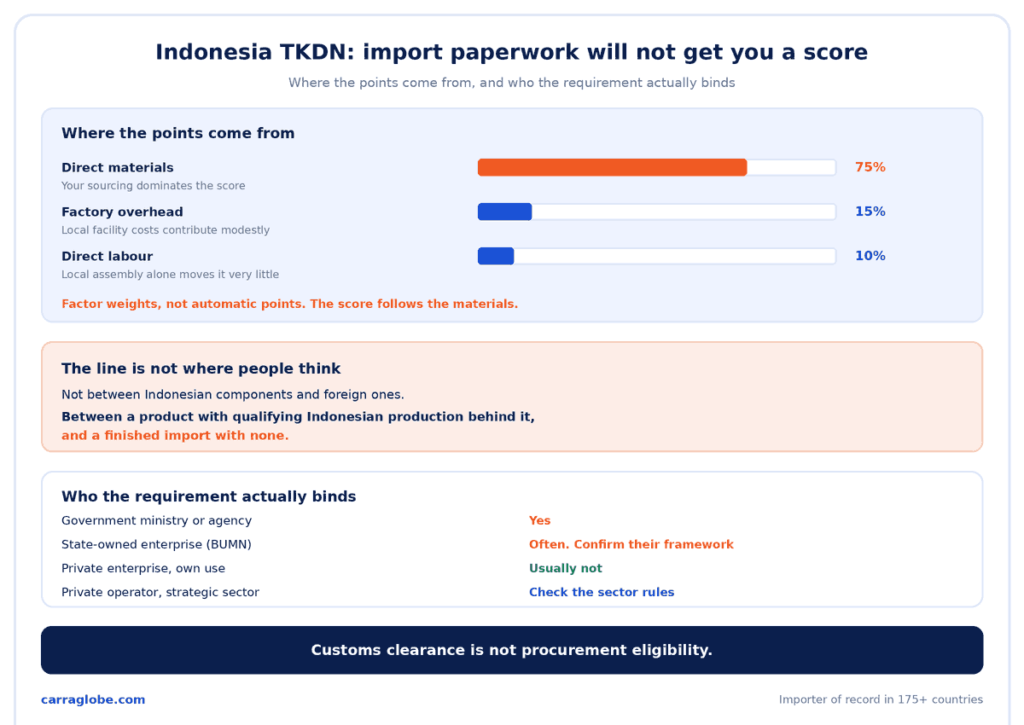
The distinction that changes the plan
Here is the part that reframes this for anyone shipping finished hardware into Indonesia, and it is narrower than it first sounds.
A finished product imported into Indonesia cannot acquire TKDN qualification through import paperwork. Where there is no qualifying Indonesian production or domestic content behind the product, there is generally no TKDN route an importer can create by obtaining customs or import documentation. It is not a low score that better paperwork fixes.
Note carefully what that does not say. A product manufactured in Indonesia using imported components is a different case, and the 2025 reform deliberately made it easier. The regulation gives greater recognition to domestic industrial activity even where imported components remain necessary for production.
So the line is not between Indonesian components and foreign ones. It is between a product with qualifying Indonesian production behind it and a finished import with none.
For a wholly imported finished server, TKDN is not a hurdle to clear with a better audit. That is uncomfortable reading if you have already been shortlisted, and considerably less uncomfortable than discovering it after committing to a bid.
Where it actually bites
Worth establishing scope before anyone panics, because TKDN does not apply to every Indonesian sale.
| Who you are selling to | Does TKDN decide anything? |
|---|---|
| Government ministry or agency | Yes. Procurement rules prioritise products meeting the thresholds |
| State-owned enterprise (BUMN) | Often relevant, especially in regulated infrastructure and telecom procurement. Confirm the BUMN’s own framework and the tender |
| A private enterprise buying for its own use | Usually not, unless the buyer imposes it contractually |
| A private operator in a regulated strategic sector | Check. Sector-specific rules can apply beyond public procurement |
Practical relevance is highest in sectors subject to domestic-product procurement rules, including parts of telecommunications, electronics, infrastructure, energy and medical equipment. Sell servers to a private bank and TKDN may not be decisive. Sell to a state-owned telecom or infrastructure buyer and it can become a major procurement gate alongside the technical and import requirements.
For the government procurement preference framework, a key threshold is combined TKDN plus BMP of at least 40%, with TKDN of at least 25%. In that scoring structure BMP can contribute up to 15 percentage points, with the exact calculation depending on the applicable rules and evidence of matters such as investment, employment and supply chain partnership.
It operates as a priority sequence rather than a single pass mark. Under the procurement preference structure, products meeting the combined threshold receive the strongest preference, subject to the applicable rules. Where qualifying domestic products are unavailable or insufficient, lower TKDN categories and other domestic products come into consideration before an import route is reached. Sector rules and individual tender documents may impose different requirements, so read the tender.
Where the points come from
This is the detail that decides whether a localisation strategy is worth attempting, and it is rarely explained to vendors before they commit.
For goods, the calculation weights three production factors. These are factor weights rather than automatic points: the actual score depends on the qualifying domestic share within each factor and the applicable calculation method.
| Factor | Weighting | What that means in practice |
|---|---|---|
| Direct materials | 75% | Where your components come from dominates the score |
| Indirect factory overhead | 15% | Local facility costs contribute modestly |
| Direct labour | 10% | Local assembly alone moves the number very little |
Read the labour row twice. A common assumption is that a local assembly line solves TKDN. At a 10% weighting, screwing imported components together in Indonesia contributes far less than vendors expect.
The example below is illustrative only. The materials component is determined under the applicable TKDN methodology and evidence requirements, rather than by counting the percentage of components purchased locally.
Suppose materials are 20% domestic, while labour and overhead are entirely local. Weighted out, that is 15% from materials, 10% from labour and 15% from overhead, giving 40%. Change nothing but the materials to fully imported and the same operation produces 25%.
Labour and overhead do contribute, so assembly is not irrelevant. It is simply not a route to a high score on its own. The score follows the materials, which makes a serious TKDN strategy a sourcing decision rather than an assembly one, and a much longer conversation with your manufacturer than with your logistics provider.
What a pure importer can actually do
Four options, and the first is more often correct than vendors like to admit.
- Accept the channel is closed and sell elsewhere. Private enterprise, multinationals operating in Indonesia and non-prioritised procurement remain open, and our importer of record service covers 175+ countries if the answer is a different market. Losing one channel is not losing the market.
- Partner with a local manufacturer whose product already carries a certified score, and sell through or alongside them rather than against them. That changes who imports, so our note on liability when a reseller imports is worth reading first.
- Localise the sourcing, not just the assembly. The 75% materials weighting is where the score lives, so this is a manufacturing decision with a long lead time.
- Test the availability question. Government procurement guidance allows imported products where the relevant domestic options are unavailable or cannot meet the required volume or specification. Whether that route opens for a given tender depends on the procuring entity’s process, so raise it properly rather than assuming.
Option four is worth pursuing properly. Plenty of specialist infrastructure hardware has no meaningful Indonesian equivalent, which is a materially different conversation from arguing your imported product should score.
TKDN is not your import problem
Worth separating clearly, because the two get conflated and they run on different tracks.
Importing IT hardware into Indonesia raises its own requirements: who is eligible to act as importer, SDPPI type approval for telecom and radio equipment, SNI where standards apply, and the licensing and quota regime covered in our note on Indonesian import quota rules. None of those are TKDN, and clearing them does not produce a TKDN score.
Where you want a landed price for the buyer, that is a delivered duty paid question, and our note on customs holds on IT shipments covers what happens when the import side is not settled.
Customs clearance does not make an imported product eligible for every Indonesian procurement channel. You can import the equipment entirely lawfully and still be ineligible for the tender that prompted the shipment, because the buyer requires domestic content qualification rather than import compliance.
The broader lesson is worth holding onto: import compliance and procurement eligibility are not the same gate, and clearing one says nothing about the other.
Does TKDN apply to imported goods?
TKDN and import status are different questions. A finished product can be imported into Indonesia lawfully while still failing to qualify for procurement channels that require domestic content.
A third-party importer of record does not create TKDN value. It depends on the Indonesian production behind the product, not on who is named on the customs entry.
A worked example: a US server OEM
A manufacturer builds a complete server in the United States. It ships as a finished product to an Indonesian government data centre project.
Carra Globe can act as importer of record in Indonesia and handle the import side: eligibility, the entry, duties and taxes, delivery to site. All of that works, and none of it turns a US-built server into a TKDN-qualified Indonesian product. If the tender requires domestic content, that sits with the bid team rather than the logistics team.
Four questions before you bid
- Is the buyer government, state-owned, or private? This decides whether TKDN is relevant at all.
- Does the tender state a required score, and is it TKDN alone or combined with BMP?
- Is any part of your product manufactured or sourced in Indonesia? If genuinely none, certification is not the route.
- Is there a comparable certified domestic product? If not, the availability question is worth raising before conceding.
Question one takes a sentence and saves the other three where the answer is private enterprise.
How Carra Globe helps
The boundary first, because it is unusually clear here. We are not a TKDN certification body, we do not obtain TKDN scores, and no importer of record can. That process runs between your manufacturer, the Ministry of Industry and an accredited verification body.
What we do is the import side, and flagging this before it becomes a lost bid.
- Acting as importer of record in Indonesia where you have no local entity, covered across 175+ countries.
- Screening the import requirements before shipment, including type approval, standards and the licensing position, so a gap is known at quotation rather than at the port.
- Handling the rest of the chain, from freight forwarding and staging to white glove delivery to the rack.
- Telling you when TKDN is likely to decide the outcome, so the question reaches your bid team before the paperwork does.
Where the procurement channel is closed to a wholly imported product, we will say so rather than sell you an import structure that does not solve it.
Underneath it all sits global trade compliance. Our note on importer of record for telecom equipment covers the wider picture, and our case studies show comparable deployments.
Shipping hardware into Indonesia? Send the equipment list and who the end buyer is. If TKDN is the blocker we will tell you. If the procurement route is open, we will map the import requirements from there.
Importer of Record · Indonesia
We handle the import. TKDN sits with your manufacturer, and we will say so.
Being clear about the boundary: we are not a TKDN certification body and no importer of record can obtain a score for you. That runs between your manufacturer, the Ministry of Industry and a verification body. What we do is get the hardware in, and tell you early when TKDN is likely to decide the tender.
- Importer of Record in Indonesia
- Indonesia import quota rules
- IOR for telecom equipment
- Importing without a local entity
- IOR by country
- How to calculate landed cost
Free tools HS Code Finder Volumetric Weight Calculator Pallet Calculator
Bidding into Indonesia? Send the equipment list and who the end buyer is. If TKDN is the blocker we will tell you. If the procurement route is open, we will map the import requirements from there.
Check your Indonesia positionFrequently asked questions
Can a foreign company get TKDN certification?
A foreign company cannot create TKDN qualification simply by importing a finished product. A foreign-invested company that manufactures in Indonesia is different, and its Indonesian production and sourcing can form part of the calculation.
The 2025 reform made that route more accessible, giving greater recognition to Indonesian production even where components are imported.
Does TKDN stop me importing into Indonesia?
No. TKDN is not itself a customs clearance requirement. It can affect whether a product qualifies for particular procurement channels, while import licensing, approvals and standards are separate.
Goods can clear customs perfectly well and still fail a procurement requirement.
Does local assembly solve TKDN?
Less than most vendors expect. Direct labour carries a 10% weighting while direct materials carry 75%, so assembling imported components locally moves the score modestly.
Labour and overhead do contribute, so assembly is not irrelevant. It simply should not be mistaken for a high-TKDN strategy on its own.
What score do I need?
Under the 2025 procurement reform, products with combined TKDN and BMP of at least 40% and a minimum TKDN of 25% are prioritised. Individual tenders may state their own requirements.
Read the tender rather than assuming the general threshold applies unchanged, and price the import side separately using our guide to what an importer of record costs.
How long does a TKDN certificate last?
Under the 2025 framework, TKDN and BMP certificates are generally valid for five years, extended from three, subject to monitoring and possible reassessment.
Confirm the treatment for your product category, and keep the audit trail for material sourcing and local vendor transactions, since it remains an ongoing obligation.
Sources and verification
- The certification framework: Minister of Industry Regulation No. 35 of 2025 on the terms and procedures for certification of TKDN and BMP, issued 11 September 2025 and effective from December 2025, replacing the earlier TKDN and BMP certification framework and its associated 2011 and 2022 rules. The Ministry of Industry operates the TKDN certification portal.
- The procurement thresholds: Presidential Regulation No. 46 of 2025 on government procurement of goods and services, under which products meeting the combined TKDN and BMP threshold receive preference. Implementing guidance continues to be issued, so the practical application can depend on subordinate rules and the individual tender.
- Calculation and weightings: for goods, the production factors are weighted direct materials 75%, indirect factory overhead 15% and direct labour 10%. Certificates carry five-year validity under the 2025 framework, with LVI processing reduced to around nine or ten working days from 22.
- Thresholds and sector rules change. Confirm the current position and the specific tender terms rather than relying on a general figure.
Disclaimer: This guide is for informational purposes only and does not constitute legal, procurement or customs advice. TKDN thresholds, calculation rules, sector requirements and certification procedures are set by the Indonesian authorities and change over time, and individual tenders may impose their own terms. This article reflects publicly available information as at 15 September 2026. Always confirm the current position with the relevant authority, the procuring entity or a qualified adviser.