
Importing IT hardware looks simple until the first shipment is held. Servers, switches, storage arrays, and the gear a data centre runs on are high-value, often export-controlled, and almost always on a deadline, which is exactly why the rules trip importers up. This guide answers the questions IT and data centre buyers actually search for, because IT hardware trade compliance is less about theory than about the specific things that go wrong, and how to stop them.
This is for data centre operators, IT procurement and infrastructure leads, hardware vendors, and the supply-chain teams responsible for landing equipment on site. If you are importing servers or data centre gear across a border, the answers below are the ones that save shipments.
IT hardware trade compliance is the set of rules governing how servers, networking, and data centre equipment are imported, covering classification, export controls, certification, and the importer of record. Most holds happen because the equipment is high-value and export-controlled, and because no compliant importer was in place before the shipment arrived.
How Do I Import Servers Into a Country Where I Have No Local Entity?
You appoint an importer of record established in that country to import the servers on your behalf. Most countries require the importer to be a locally registered entity, so without one of your own, you cannot clear the goods directly, but an importer of record can act as the legally accountable party, file the customs entry, pay the duties, and deliver the hardware to your site, all without you setting up a local company.
This is the single most common situation in IT hardware importing, expanding into a market faster than you can establish a legal entity there. The importer of record route is what makes it possible, and we explain the fundamentals in our guide to what an importer of record is and the practical detail in how to import IT equipment without a local entity. For data centre projects specifically, the full process is on our importer of record for data centre equipment page.
Why Are My Servers Being Held at Customs?
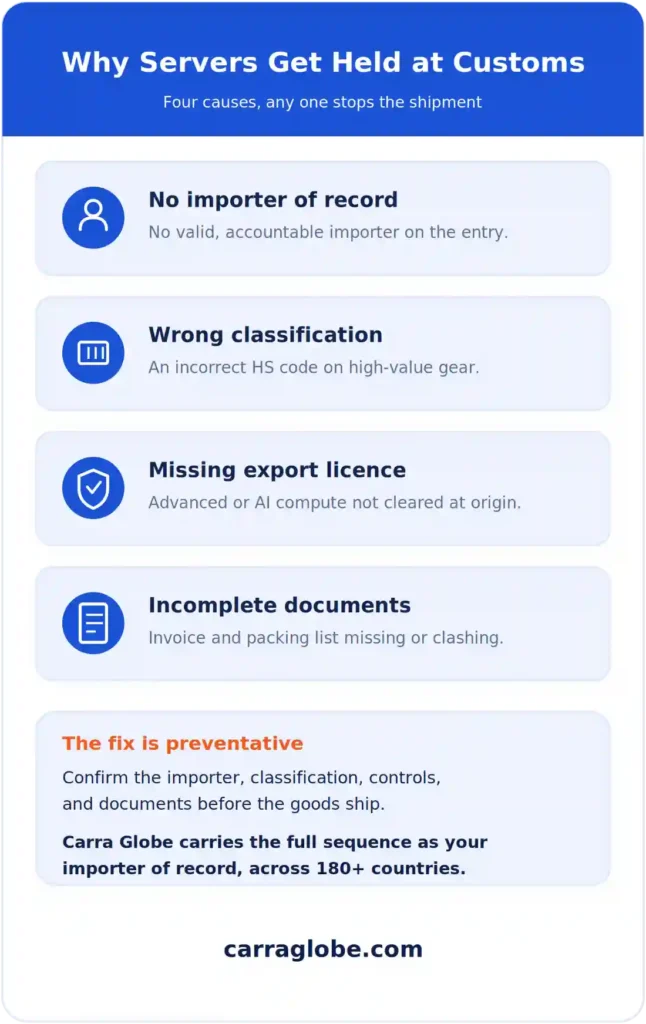
Servers are usually held for one of four reasons: no valid importer of record on the entry, an incorrect tariff classification, a missing export licence or control clearance, or incomplete documentation. And here is the thing, it does not matter whether it is a single rack of switches or a full shipment of AI servers, any one of those four will stop it cold. The value and technical nature of the goods means customs scrutinises this kind of cargo far more closely than ordinary freight.
The fix is almost always preventative rather than reactive. Once a shipment is held, resolution typically takes anywhere from a few days to several weeks depending on the cause, a documentation fix is fast, but a classification dispute or a missing licence can drag on, and demurrage and storage charges accrue the whole time. Getting the importer of record, classification, controls, and documents right before the goods move avoids the hold entirely. We go deeper into resolving and preventing these in our guide to a customs hold on servers.
Importing servers or data centre hardware into a market where you have no entity? Carra Globe acts as your importer of record and handles classification, controls, clearance, and delivery to site, so your hardware arrives on schedule.
Is IT Hardware Subject to Export Controls?
Yes, much of it is. A growing range of IT hardware, particularly high-performance servers, advanced chips, and AI compute equipment, is subject to export controls that restrict where it can be sent, to whom, and for what end use. These controls operate at the export end, in the country the goods leave, and the requirements can change quickly as policy shifts.
This matters even when you are the importer, because an export-control problem at origin stops your shipment before it ever reaches you. Checking whether the specific hardware, the destination, and the end use trigger any control is part of compliant importing, not just the exporter’s job. We cover the discipline in our guide to ITAR and EAR compliance for IT hardware, and the tighter rules around AI compute in our AI hardware importer of record guide.
Are AI Servers and GPUs Harder to Import Than Standard Hardware?
Yes, significantly. AI servers, GPU clusters, and high-performance accelerators are the single most controlled category of IT hardware, because the same chips that train AI models are the ones export rules are designed to restrict. Importing them means tighter licence screening, closer end-use scrutiny, and a real risk of the shipment being stopped at origin if the controls are not cleared first.
The practical takeaway is that AI compute cannot be treated like ordinary server hardware. The classification, the destination, and the end user all have to be screened against current controls before the goods move, and those controls change faster than almost any other area of trade. We go deeper into this in our AI hardware importer of record guide, which is the place to start if your data centre runs on accelerated compute.
What HS Code Do Servers and Data Centre Equipment Use?
Servers and most data processing machines fall under Harmonized System heading 8471, which covers automatic data processing machines, while networking equipment such as switches and routers generally sits under heading 8517. The exact subheading depends on the specific device, and it determines the duty rate and whether any controls apply, so precise classification matters. Duty on IT hardware varies widely by country and product, from zero in markets that treat data processing machines as duty-free under information-technology agreements, to several percent elsewhere, which is precisely why the code, and the origin behind it, has to be right.
Getting the code wrong is one of the most expensive mistakes in IT hardware importing, because it drives the duty and can mask a control requirement. An incorrect classification surfaces later as underpaid duty, penalties, or a failed audit. We set out the stakes in our guide to the cost of incorrect HS codes for high-tech equipment, and you can confirm a classification against the official US Harmonized Tariff Schedule.
How Do I Avoid Delays That Threaten My Commissioning Date?
You protect the commissioning date by handling compliance before the equipment ships, not at the border. That means confirming the importer of record, classification, any certification, and export-control position in advance, and sequencing delivery to the build. A data centre runs to a fixed commissioning schedule, and a customs hold on one critical component can delay the entire deployment.
The practical answer is a provider that treats the import as part of the project timeline rather than a separate logistics step. Clearing customs and then delivering to the data centre in sequence with the construction programme is what keeps the schedule intact. Our warehousing and logistics and white glove delivery support are built for exactly this kind of staged, time-critical delivery.
What Changed for IT Hardware Importers in 2026?
Three things changed at once, and IT hardware sits in the crosshairs of all three. Export controls on high-performance servers, GPUs, and AI accelerators widened, so more of the exact equipment data centres buy now needs licence screening before it can ship. Customs enforcement tightened the bar on who may act as an importer of record. And duty-free thresholds for low-value imports were removed in major markets. An import structure that cleared GPUs and servers cleanly in 2024 can be the thing that gets them held now.
Because advanced compute is precisely what the new export rules target, the combination of high-value goods, tighter enforcement, and expanding controls makes the importer of record decision more consequential for IT buyers than it has ever been. The June 2026 Customs Enforcement Executive Order, covered in our analysis of the order, raised the bar on bonding and good standing, and the wider shift is set out in our 2026 importer of record landscape report.
What Documents Does a Data Centre Import Usually Need?
A compliant IT hardware shipment travels with a consistent set of documents, and customs holds often come down to one of them being missing or contradicting another. While the exact list varies by country and product, a data centre import generally needs the following.
- Commercial invoice. States the value, the parties, and the goods, and forms the basis of the customs valuation and duty.
- Packing list. Itemises what is in each carton or pallet, which customs cross-checks against the invoice.
- Bill of lading or air waybill. The transport document proving the shipment and its route.
- Certificate of origin. Establishes where the goods were made, which drives the duty rate and any trade-defence exposure.
- Export licence or control documentation. Required where the hardware, such as advanced servers or AI compute, is export-controlled.
- Product certifications. Electrical, safety, or electromagnetic compatibility certificates where the destination requires them.
The single most important thing is consistency. The values, quantities, and descriptions have to match across every document, because a discrepancy between the invoice and the packing list is one of the most common triggers for a hold. An experienced importer of record checks this alignment before the goods move.
The IT Hardware Trade Compliance Checklist
Before any IT or data centre shipment moves, these are the points that determine whether it clears cleanly. Working through them in advance is what separates a smooth import from a held one.
- Importer of record confirmed. A legally accountable importer is in place in the destination country before the goods ship.
- Classification verified. The correct HS code is assigned, setting the duty and flagging any controls.
- Export controls checked. The hardware, destination, and end use are screened for any licence or control requirement at origin.
- Certification secured. Any electrical, safety, or product certification the destination requires is documented and in place.
- Documentation complete. The commercial invoice, packing list, and supporting documents are accurate and consistent.
- Delivery sequenced. Clearance and site delivery are timed to the commissioning schedule.
A single accountable importer of record can carry every item on this list, which is the most reliable way to keep IT hardware moving across borders. The full scope of that role is set out in our guide to importer of record requirements.
Frequently Asked Questions
Do I need an importer of record to import IT hardware?
In most countries, yes, especially if you have no local entity. The importer of record is the legally accountable party for the import, and for IT hardware that includes export-control screening and accurate classification.
If you have no entity in the destination country, an importer of record acts on your behalf, which is the standard way IT and data centre operators import into new markets without setting up locally.
Why is data centre equipment more complex to import than general goods?
Because it combines high value, export controls, certification, and fixed commissioning deadlines. A single held component can delay an entire deployment, and customs scrutinises this equipment more closely than ordinary cargo.
This is why data centre imports reward a sector-aware importer of record that handles compliance ahead of shipping, not a generalist freight booking.
What is the most common reason IT hardware is held at customs?
A missing or invalid importer of record. After that, incorrect classification, a missing export-control clearance, or incomplete documentation. On high-value IT hardware, any one stops the shipment.
Almost all of these failures are preventable by getting the compliance right before the goods move, which is far cheaper than resolving a hold that is accruing storage charges daily.
Can one importer of record handle IT hardware across several countries?
Yes, and for multi-country deployments it is the stronger approach. One importer of record means one compliance standard and one accountable party, instead of a separate arrangement in every market where gaps appear.
It matters most for operators rolling out across regions, where the same hardware faces a different import path in every country.
If you take one thing from this, make it the sequence: confirm the importer of record, verify the classification, screen for export controls, secure any certification, and align the documents, all before the shipment moves. That order is what keeps servers clearing and reaching the rack on schedule, and it is far cheaper than resolving a hold after the fact. Carra Globe handles that full sequence as an importer of record and trade compliance partner across more than 180 countries, including Delivered Duty Paid shipping and site delivery, if you would rather hand the whole chain to one accountable party.