
The UAE already has one of the lowest tariff regimes in the world, a flat 5% on most goods, yet many businesses importing IT hardware, data centre equipment, and machinery into Dubai and Abu Dhabi still pay more than they need to, or pay duty they could have deferred or avoided entirely.
The reason companies fail to reduce import duty UAE is rarely the headline rate. It is one of three missed levers: they route goods straight to the mainland when a free zone would have suspended the duty, they never claim the CEPA or GCC preferential rate their origin qualifies for, or they misclassify goods under the wrong HS code.
This guide covers how the UAE’s duty and free zone system actually works, every verified legal method to reduce your bill, the 2026 rule changes that affect Designated Zones, and the compliance requirements that sit alongside duty management. It is educational reference material; the commercial options are kept separate and clearly marked.
Reduce Import Duty UAE: At a Glance
- The base rate is low already: a flat 5% GCC Common External Tariff on CIF value covers almost all goods, with much of IT and machinery at the low end or exempt.
- Free zones are the biggest lever: goods entering a free zone such as JAFZA, DMCC, or IFZA from abroad pay no duty or VAT on entry, and goods later re-exported outside the GCC stay entirely tax-free.
- CEPA and GCC claims cut the rest: the UAE’s fast-growing network of Comprehensive Economic Partnership Agreements, plus zero-duty GCC-origin treatment, reduce or eliminate duty on qualifying goods.
- VAT is 5% on CIF plus duty: recoverable if you are VAT-registered, an upfront cost if you are not.
- 2026 brings tighter rules: the move to 12-digit HS codes and stricter Designated Zone controls under Federal Decree-Law No. 16 of 2025 make correct classification and zone compliance more important, not less.
How the UAE’s Import Duty Structure Actually Works
The UAE applies the GCC Common External Tariff, a flat 5% duty on the CIF value (cost, insurance, and freight) of most imported goods from outside the GCC customs union. The same structure applies across Dubai, Abu Dhabi, and every emirate, and across the GCC states of Saudi Arabia, Kuwait, Bahrain, Oman, and Qatar. A small number of categories sit outside the 5%: tobacco carries 100%, alcohol carries a high rate, and essential items such as fresh produce, medicine, and medical equipment are often at 0%.
For most IT hardware and industrial equipment, the effective duty is low and, in many cases, machinery and equipment enter duty-free.
On top of duty, the UAE applies a 5% Value Added Tax on imports, calculated on the CIF value plus the customs duty. If your business is registered for VAT, that import VAT is generally recoverable through your VAT return; if it is not, the VAT becomes a real cost.
Duty and VAT are both calculated from the declared CIF value using the HS classification, which is why classification and valuation are the two technical decisions that most affect what you actually pay. It is worth noting that roughly a third of all UAE imports qualify for some exemption or reduction, which means the headline 5% overstates what a well-structured importer actually pays.
Free Zones: The UAE’s Single Biggest Duty Lever
This is where the UAE differs from almost every other market, and it is the mechanism most importers underuse. The UAE operates dozens of free zones, including Jebel Ali Free Zone (JAFZA), the Dubai Multi Commodities Centre (DMCC), and the International Free Zone Authority (IFZA), and the customs treatment inside them is fundamentally different from the mainland.
Goods entering a free zone from abroad are not subject to customs duty or VAT at the point of entry. The tax is suspended, not merely reduced. Duty and VAT only become payable if and when the goods leave the free zone and enter the UAE mainland.
If instead the goods are re-exported from the free zone to a destination outside the GCC, they remain entirely tax-free, no duty, no VAT, ever. For a business that imports, stores, consolidates, or lightly processes goods and then distributes across the region or beyond, a free zone can convert an immediate 5% duty and 5% VAT cost into a deferred cost, or eliminate it altogether on the re-export portion.
The 2026 rules make this lever more powerful but also more demanding. Under Federal Decree-Law No. 16 of 2025, Designated Zones must maintain strict physical fencing, access controls, and audit records to keep their “outside the state” tax status.
Businesses moving goods between two Designated Zones must maintain digitally indexed gate passes and transport logs, which the Federal Tax Authority now treats as critical audit artifacts. If a zone or a movement fails these conditions, the 5% VAT can be charged after the fact. The free zone advantage is real and substantial, but in 2026 it has to be operated correctly, with the documentation to prove the goods stayed outside the mainland.
Free zone or Designated Zone: the distinction that decides your VAT
These two terms are often used interchangeably, but for duty and VAT they mean different things, and the difference matters. A standard free zone is, for VAT purposes, fully within the UAE. A Designated Zone is a specific free zone that has been formally listed by the Cabinet and is treated as “outside the state” for VAT on the movement of goods.
The legal basis is precise. Article 51 of Federal Decree-Law No. 8 of 2017, the UAE VAT law, authorises the Cabinet to designate certain zones as outside the UAE for VAT purposes, and the official list is issued under Cabinet Decision No. 59 of 2017 as amended.
Two points follow that catch businesses out. First, the “outside the state” status applies to goods only; services supplied within a Designated Zone are standard-rated at 5% exactly as they would be on the mainland. Second, the status is conditional and periodically updated: a zone that qualified when you set up may not still qualify, and goods that are consumed inside the zone, or moved without the required customs records, can lose the treatment and attract 5% VAT after the fact. Confirming your zone’s current Designated status, and keeping the movement records to prove it, is part of capturing the benefit.
UAE Duty and Tax at a Glance: The Numbers That Drive Landed Cost
| Element | Rate / Rule | Basis |
|---|---|---|
| Customs duty (most goods) | 5% GCC Common External Tariff | CIF value, by HS code |
| Customs duty (much IT and machinery) | Often 0% or low | Category-dependent |
| Free zone entry (JAFZA, DMCC, IFZA) | 0% duty and VAT suspended | Payable only on transfer to mainland |
| Re-export outside the GCC from a free zone | Entirely tax-free | No duty, no VAT |
| GCC-origin goods | 0% duty | With certificate of origin |
| CEPA-origin goods | Reduced or eliminated | With valid origin documentation |
| VAT | 5% | CIF plus duty; recoverable if registered |
| Tobacco / alcohol | 100% / high rate | Excise categories |
Want these numbers run for your actual goods? We can produce a free UAE import route comparison showing your duty and VAT under free zone versus mainland entry. See your free zone vs mainland savings.
The Verified Methods to Reduce Import Duty into the UAE
These are legal duty-reduction methods, using the free zone regime, preferential agreements, and reliefs UAE and GCC customs law provides for, not avoidance. Each depends on correct documentation and defensible classification.
- Use a free zone for storage, consolidation, and re-export. If your goods are destined for re-export outside the GCC, or you want to defer duty until the point of sale into the mainland, importing through a free zone suspends duty and VAT on entry and eliminates them entirely on the re-exported portion. This is the single largest lever for distribution and regional-hub businesses.
- Claim the CEPA preferential rate. The UAE has one of the fastest-growing free trade networks in the world through its Comprehensive Economic Partnership Agreements, with more than 35 signed and 18 in force by mid-2026, including India, Turkey, Indonesia, Israel, and Vietnam. Where your goods qualify by origin, the CEPA rate reduces or eliminates the duty, but only with valid origin documentation.
- Claim zero-duty GCC-origin treatment. Goods of GCC origin move within the customs union at 0% duty, provided a valid certificate of origin supports the claim. For businesses sourcing from within the Gulf, this is a straightforward saving that is often missed.
- Classify goods correctly, and prepare for 12-digit HS codes. Duty is assessed on the HS classification, and in 2026 the UAE is moving to mandatory 12-digit HS codes. A minor classification error can push a shipment into a “Customs Suspense” status and delay it for days, as well as attract the wrong rate. Accurate classification protects both the rate and the timeline.
- Manage customs valuation correctly. Because duty and VAT are calculated on CIF value, ensuring the declared value reflects only the correct dutiable elements, and that freight and insurance are accurately stated, keeps the base from being inflated. This is correct structuring, not undervaluation, which carries penalties. Techniques such as first sale for export valuation can further reduce the dutiable base where the supply chain qualifies.
- Register for VAT and recover the 5%. The 5% import VAT is recoverable through the VAT return for a registered business. Ensuring the import structure names a VAT-registered entity as importer turns the VAT from a cost into a recoverable item.
Importer of Record · 175+ countries
Importing IT or high-value hardware? We can be your Importer of Record.
Carra Globe acts as your Importer of Record so you can ship into markets where you have no local entity. We carry the legal liability, handle certifications and duties, and give you one itemised quote:
Have a shipment in mind? Send us your lane and goods, we will confirm and quote.
Get a compliance quote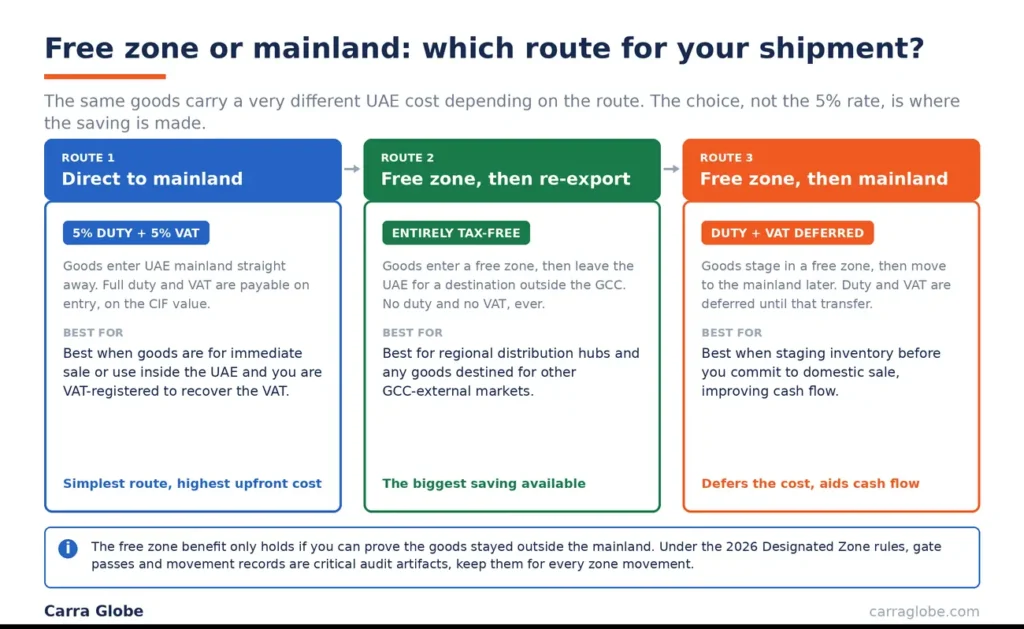
Free Zone or Mainland: The Decision That Sets Your Cost
The single most consequential duty decision for a UAE importer is not the rate, it is the route. The same goods can carry a very different cost depending on whether they enter the mainland directly or pass through a free zone first.
- Direct to mainland: 5% duty and 5% VAT payable on entry. Correct if the goods are for immediate sale or use inside the UAE and you are VAT-registered to recover the VAT.
- Through a free zone, then re-export: no duty and no VAT at all. Correct if the goods are destined for other GCC-external markets or regional distribution.
- Through a free zone, then into the mainland later: duty and VAT deferred until the transfer, improving cash flow. Correct if you are staging inventory before committing to domestic sale.
Getting this decision right, per shipment and per corridor, is where the real UAE duty saving is made or lost. It is also where the 2026 Designated Zone documentation rules bite, because the free zone benefit only holds if you can prove the goods stayed outside the mainland.
The Compliance Layer That Sits Alongside Duty
Reducing duty is only part of a clean UAE import. Commercial imports require an importer with a valid trade licence and customs registration, filed through the relevant emirate’s customs system, Dubai Customs for Dubai, and the Federal Tax Authority governs the VAT layer. Regulated categories carry their own requirements: telecommunications and wireless equipment need TDRA (Telecommunications and Digital Government Regulatory Authority) type approval, and many products require ESMA or Emirates Conformity Assessment Scheme conformity before they can clear.
This is where an importer of record matters beyond simply paying duty. A foreign company without a UAE trade licence and customs registration cannot appear as the importer on the declaration, which is also why a freight forwarder cannot act as your importer of record, and a free zone structure only delivers its duty benefit if the entity, the licence, and the zone compliance are correctly aligned.
The party that holds the trade licence, files the declaration, manages the free zone documentation, secures the necessary type approvals, and is registered to recover the VAT is doing the work that makes the duty saving real. Getting that structure wrong means overpaying duty, losing the VAT recovery, or losing the free zone status, sometimes all three.
Frequently Asked Questions
How much is import duty in the UAE in 2026?
The standard rate is a flat 5% GCC Common External Tariff on CIF value, applied across all emirates. Much IT hardware and machinery is duty-free or low. A 5% VAT applies on CIF plus duty. Tobacco and alcohol carry much higher rates, and essentials like medicine and fresh produce are often 0%. Because free zones and preferential agreements apply widely, the effective rate a structured importer pays is frequently below 5%.
Do free zone companies pay customs duty in the UAE?
Not on entry. Goods entering a free zone from abroad have duty and VAT suspended. Tax becomes payable only if the goods move into the UAE mainland. Goods re-exported outside the GCC stay entirely tax-free. This makes free zones the UAE’s single biggest duty lever for storage, consolidation, and re-export. In 2026, keeping the benefit requires strict Designated Zone documentation proving the goods stayed outside the mainland.
How can I reduce or lower my import duty into the UAE legally?
Legally, by using a free zone for re-export or duty deferral, claiming the CEPA or GCC-origin preferential rate with valid documentation, classifying goods correctly, and registering for VAT to recover the 5%. These are reliefs UAE and GCC law provides for, not avoidance. Undervaluation or misdeclaration is illegal and carries penalties. The right method depends on whether your goods are for the mainland or for re-export.
What is a CEPA and does it reduce UAE import duty?
A Comprehensive Economic Partnership Agreement is a UAE free trade agreement that reduces or eliminates duty on qualifying goods. The UAE has 18 in force by mid-2026, including India, Turkey, Indonesia, and Vietnam. If your goods qualify by origin under an in-force CEPA, you can claim the preferential rate with valid origin documentation. As with any FTA, the saving is lost if the origin paperwork is not obtained and filed.
What is the de minimis value for UAE customs?
The UAE applies a low-value threshold that differs by emirate: around AED 300 in Dubai and AED 1,000 in Abu Dhabi for courier shipments. Goods above it are subject to 5% duty and 5% VAT. This matters most for e-commerce and small parcel importers. For commercial pallet shipments of IT hardware, the de minimis is not in play, full duty and VAT rules apply regardless of value.
What documents are required for customs clearance in Dubai?
A commercial invoice, packing list, bill of lading or air waybill, and the customs declaration. A certificate of origin is needed for a GCC or CEPA rate, and regulated goods need conformity approval. For free zone entries, gate passes and movement records are also required, and in 2026 the Federal Tax Authority treats these as critical audit artifacts for keeping Designated Zone VAT treatment.
Can I import into Dubai without a trade licence?
Not as the named importer. Commercial import into the UAE requires a valid trade licence and customs registration. A company without one imports through an importer of record that holds both. This is the core reason foreign companies use an importer of record for the UAE: it provides compliant market access, including free zone structuring, without the cost and time of establishing a licensed UAE entity.
How long does customs clearance take in the UAE?
For compliant shipments with complete documentation, UAE customs clearance is typically fast, often within a day or two, supported by Dubai’s highly digitised customs systems. Incomplete or misclassified entries can trigger delays. A classification error can place a shipment in “Customs Suspense” status and hold it for days. Our guide to how long customs clearance takes covers the levers for keeping it quick.
Do I need a local entity to import into the UAE?
Commercial imports require an importer with a valid UAE trade licence and customs registration. A foreign company without one cannot be named on the declaration, so it uses an importer of record that holds both. An importer of record gives you compliant access, including free zone structuring and the type approvals regulated goods require, without setting up your own UAE entity.
How Carra Globe Helps
For companies importing servers, networking hardware, data centre equipment, and other IT infrastructure into the UAE, the duty saving and the compliance requirement are two halves of the same job.
Carra Globe acts as your importer of record in the UAE, holding the trade licence and customs registration, filing declarations through Dubai and federal systems, structuring free zone and mainland routing, securing TDRA and conformity approvals, and managing VAT recovery, across 175+ countries.
Our guide to calculating landed cost shows how duty, VAT, and fees combine into your true cost per shipment, and because misclassification is the leading cause of clearance delay, our breakdown of the cost of incorrect HS codes is worth reading before your next entry. For data centre and IT infrastructure moves specifically, see our guide to IT hardware and data centre trade compliance, and for a shipment already at the border, how to resolve and prevent a customs hold. To see how these methods apply to your corridors, speak to our trade compliance team.
Official primary sources: Dubai Customs (tariff and clearance) and the Federal Tax Authority (VAT and Designated Zones).