
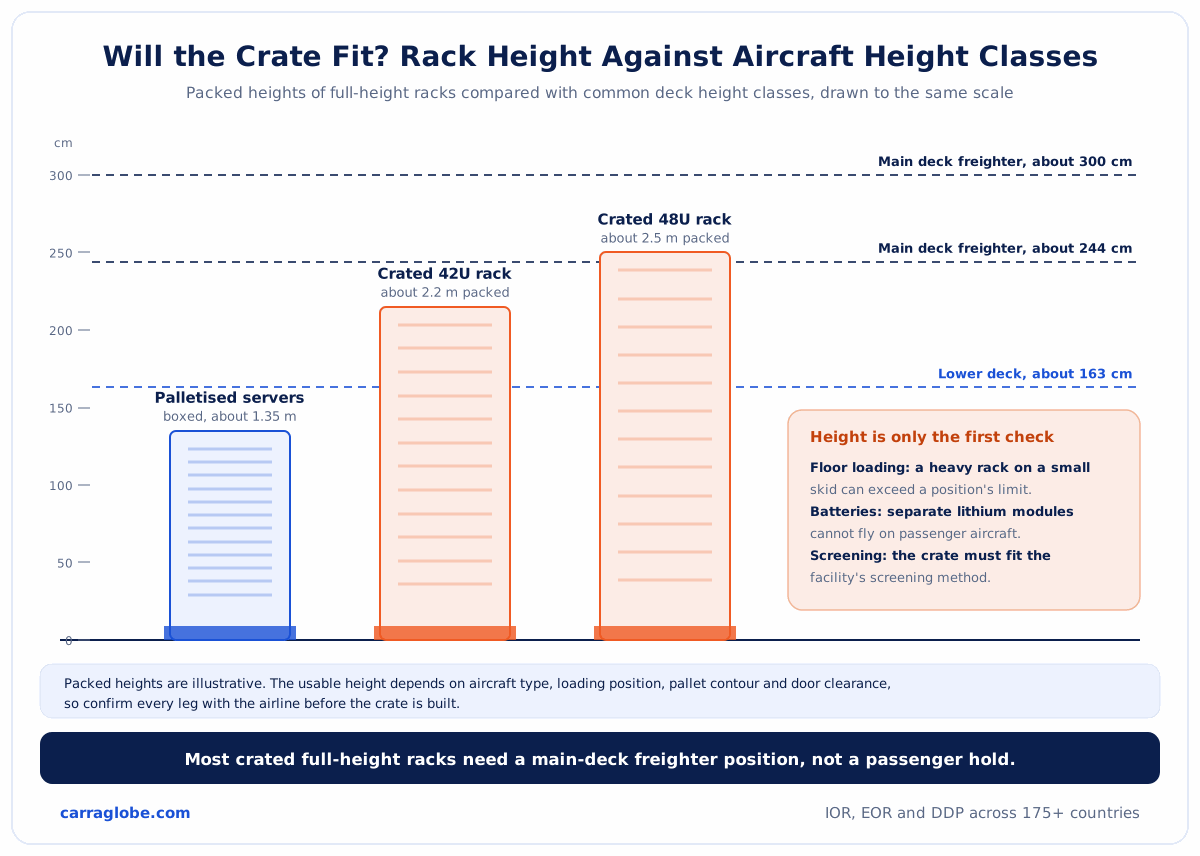
Many 48U cabinets stand around 2.2 metres tall before anyone builds a crate around them. A common planning reference for a passenger widebody’s lower hold is about 163 centimetres. That gap decides more about shipping server racks by air freight than the rate card does.
The short version. Yes, empty, populated and GPU racks can all fly, once the carriers accept the packed size, weight, batteries and screening. Decide what is in the crate first, then measure the crate, not the cabinet. Battery type and packing decide which aircraft can carry it, oversized pieces need a screening plan, and a populated rack may be classified as one system. Confirm every leg of the route before the crate is built.
Carra Globe provides importer of record, delivered duty paid and freight forwarding services, so we have a commercial interest in your answer. What follows is written to be usable whether or not you ever speak to us.
Start with what is in the crate
A rack is not one kind of cargo. The same cabinet raises different problems depending on what travels inside it.
| What you are shipping | The question that decides it | Check before booking |
|---|---|---|
| Empty rack, servers boxed separately | Can each piece fit and be screened? | Packed dimensions of the cabinet and every carton |
| Fully populated rack | Can the rack carry its load in transit? | The maker’s shipping load rating and approved configuration |
| GPU or AI rack | Can the aircraft floor take a heavy, concentrated load? | Gross weight, footprint, centre of gravity and insurance value |
| Rack with UPS or battery modules | Which dangerous goods rules apply? | Battery chemistry, watt-hours, UN number and packing instruction |
Many shipments combine two or more of these. A GPU rack with installed UPS modules raises the floor loading question and the battery question together. Our guide to shipping AI servers internationally covers the classification and licence side that sits alongside this.
Will the crate fit the aircraft?
Measure the finished crate. The height that matters is the packed external height, including the skid, shock base, crate top and any lifting fixtures. Take the cabinet height from the maker’s drawing, since 42U and 48U models vary.
Height references decide the aircraft. Published aircraft and cargo-operator specifications give lower-deck height references of about 163 cm (64 inches) and main-deck freighter references of about 244 cm (96 inches) and 300 cm (118 inches). These are not universal limits or interchangeable contours. The usable height depends on the aircraft, loading position, pallet contour and door clearance, so a crated full-height rack will often need a main-deck freighter position, confirmed against the route.
Weight is not only a total. Aircraft floors are rated by running load and contact pressure, so a heavy GPU rack on a small skid can exceed a position’s limit even when its gross weight looks acceptable. A wider base or load-spreading platform may help, but the airline has to approve it against its floor and restraint limits. Give the airline the gross weight, base dimensions, actual contact footprint and centre of gravity, and let its load control team confirm the position.
Check every leg. A crate accepted on the first flight can still be refused at a transit hub, so get confirmation from every operating carrier and handler, not just the airline that quoted. Our pallet calculator helps plan footprints before the crate is designed.
Batteries decide which aircraft, not just the paperwork
Start with the chemistry. Not every UPS uses lithium-ion cells, and lead-acid batteries follow different dangerous goods entries. For lithium-ion, the classification depends on how the battery travels.
| How the battery travels | UN number and packing instruction | Passenger aircraft | Cargo aircraft only |
|---|---|---|---|
| Lithium-ion battery modules shipped on their own | UN3480, PI 965 | Forbidden | Up to 35 kg (Section IA) or 10 kg (IB) per package |
| Batteries packed with the equipment they power | UN3481, PI 966 | Up to 5 kg per package | Up to 35 kg (Section I) or 5 kg (Section II) |
| Batteries installed in the equipment | UN3481, PI 967 | Up to 5 kg per package | Up to 35 kg (Section I) or 5 kg (Section II) |
The limits are net battery weight per package, not the rack’s gross weight. A standalone lithium-ion battery assembly shipped without the equipment it powers is generally assessed under UN3480, which keeps it off passenger aircraft unless the relevant state authorities have given prior approval. A separate battery cabinet still needs assessing on its actual function and build.
The 30% charge rule depends on the packing instruction. Since 1 January 2026, lithium-ion batteries packed with equipment under Section I must travel at no more than 30% of rated capacity, and under Section II the same applies to cells and batteries above 2.7 Wh. Batteries shipped on their own were already held to 30%. For lithium-ion batteries installed in equipment, 30% is strongly recommended but not mandatory, so a populated rack with internal batteries is not automatically caught.
Paperwork the carrier will ask for. Lithium cells and batteries must normally have passed the UN 38.3 tests, with narrow exceptions for prototypes and low production runs under state approval. Batteries the maker has identified as defective for safety reasons, or damaged batteries that could overheat, catch fire or short-circuit, are forbidden by air. Ask the maker for the battery model, chemistry, watt-hour rating, quantity and classification, and confirm the UN 38.3 test summary is available on request. Our guide to lithium battery customs clearance covers the import side.
Labels and declarations. Section I shipments travel with a Shipper’s Declaration for Dangerous Goods and hazard labels, and packages restricted to freighters carry the Cargo Aircraft Only label. Section IB packages also carry the lithium battery mark, and Section II shipments carry that mark without a declaration. The mark is not needed for packages holding only button cells installed in equipment, or for up to two packages each holding no more than four cells or two batteries installed in equipment. Airlines also publish operator variations that can be stricter than the regulations.
Coming on 1 January 2027. The 68th edition of the air dangerous goods regulations adds rules for hybrid batteries combining lithium-ion and sodium-ion cells, revises prototype and low production run provisions, and phases out the old lithium battery mark that carried a telephone number. Use the current mark, although the old one alone should not get a package rejected.
Oversized crates need a screening plan
Every regime needs secure cargo. In the UK and EU, an approved known consignor can secure its own cargo at source, provided it stays protected, and other cargo is screened by a regulated agent before it can fly as secure. In the US, all cargo carried on passenger aircraft must be screened by methods the Transportation Security Administration approves, and certified facilities can screen it before it reaches the airline. All-cargo flights follow separate programmes. The EU’s old account consignor route ended on 30 June 2021, so ignore guidance that still mentions it.
Size is where racks run into trouble. The US screening technology list, updated in October 2026, describes a large-aperture imaging category able to take items of at least 122 cm wide, 153 cm high and 122 cm long, weighing 1,000 kg. These are equipment ratings, not acceptance limits, but a full-height rack crate will commonly exceed the 153 cm height. Ask your forwarder which screening method the facility will use for the actual crate size before crating starts.
Crating and protecting the rack
Treated wood only. Crates, skids and dunnage made from raw solid wood generally fall under ISPM 15, which requires approved treatment and the official mark. Packaging made wholly of processed wood such as plywood, or wholly of wood 6 mm thick or less, is exempt. After pausing enforcement from March to December 2025, US customs has again enforced the hyphen between the country code and the treatment facility number since 1 January 2026. Check the ISPM 15 mark on crates bound for the US.
Use the right load rating. A rack’s static load rating is not permission to ship it full. Look for the maker’s specific shipping load rating and approved transport configuration, including rail support, restraints and weight distribution. The dynamic rating usually covers rolling the rack across a level floor inside a building, so do not read either figure as a transport rating. Leave servers installed only where the rack maker or integrator has approved that configuration for transport. Otherwise, ship the cabinet empty and the servers in their own packaging. Either way, wrap populated equipment in antistatic, moisture-resistant film with desiccant.
Record what happens on the way. Shock and tilt indicators show whether their set thresholds were exceeded, and electronic loggers record timed events. Neither replaces good packaging or proves damage on its own. Note the serial numbers and photograph the indicators at collection and on arrival. Liquid-cooled racks need the maker’s instructions on coolant, sealing and orientation, since some are drained and others travel filled, as our guide to importing liquid cooling coolant explains.
What the rack costs to fly
Air freight charges on the higher of the actual weight and the volumetric weight. A common method multiplies length, width and height in centimetres and divides the result by 6,000, though carriers and contracts can differ. Our volumetric weight calculator does the sum.
| Example crate, 140 x 110 x 250 cm | Actual weight | Volumetric weight | Chargeable weight |
|---|---|---|---|
| Populated GPU rack | 1,100 kg | 642 kg | 1,100 kg |
| Same crate, empty cabinet | 300 kg | 642 kg | 642 kg |
The empty cabinet pays for space it does not fill, which is one reason some teams ship cabinets by sea and servers by air. Freighter positions, special handling and dangerous goods fees can also outweigh the per-kilo rate on a rack.
Customs may treat a populated rack as one system
Classification can change when the rack is full. An empty cabinet, a standalone UPS and a loose server each need their own classification. A built rack may instead qualify as a single processing unit or system, depending on its function and build, though mounting items in one cabinet does not by itself make them one customs unit. In a March 2026 ruling, US customs classified a rack-scale AI system with 18 compute trays as a processing unit under 8471.50. Our guide to the HS code for servers explains the headings.
Origin is not always where it was assembled. The same ruling found the rack’s origin for US trade remedies was Taiwan, because its Taiwanese-origin compute trays gave the system its character and were not substantially transformed by assembly in Mexico. Separately, the system qualified for USMCA preference under a rule for digital processing units, subject to the other requirements. The ruling applies only to its own facts.
Itemise the value. Describe the complete rack clearly on the invoice and attach a component schedule for the cabinet, servers, GPUs, networking, UPS, cooling and accessories. Show freight and insurance where the destination’s valuation rules need them. GPU racks also need an export control assessment, separate from the tariff code, as our guide to export controls on data centre hardware explains, and cover is worth arranging early, as our guide to cargo insurance for IT equipment sets out.
The sheet to send before booking
| Item | What the forwarder needs |
|---|---|
| Configuration | Empty, populated, GPU or battery-equipped, with the maker’s drawing |
| Packed size | Length, width and height of the finished crate, plus gross weight |
| Weight distribution | Base footprint, contact points and centre of gravity |
| Batteries | Chemistry, watt-hours, how they travel, UN number, packing instruction and test summary available |
| Transport approval | The maker’s shipping load rating and approved configuration |
| Customs | Description, component schedule, value and origin |
| Delivery | Site access, dock, lift and positioning requirements |
Who confirms what along the route
Customs release is not delivery, so the last row matters as much as the first.
| Stage | Who confirms | What to confirm |
|---|---|---|
| Collection | Freight forwarder | Vehicle, tail lift or forklift, and site access |
| Export warehouse | Regulated agent | Screening method for the actual crate size |
| Origin airport | Airline or handling agent | Dimensions, weight, position and dangerous goods acceptance |
| Transit airport | Connecting airline and handler | The onward aircraft can take the same crate |
| Destination airport | Importer of record and broker | Classification, value, origin and any import approvals |
| Data centre | Delivery team | Dock height, lift and floor rating, upright route to the hall, who uncrates, and serials against the packing list |
How Carra Globe handles rack shipments by air
Carra Globe and its team ship fully integrated racks, empty racks with boxed equipment, GPU and AI racks and racks carrying UPS batteries, among other configurations. We act as importer of record at destination and as exporter of record where the origin requires it, so the freight, customs and delivery are planned together.
The problems on rack shipments rarely come from one rule. They come from a crate measured too late, a battery datasheet that arrives after booking, or a transit leg nobody checked. So we confirm the packed dimensions, battery classification, screening method and every aircraft on the route before the crate is built, and arrange white glove delivery into the data hall.
Carra Globe works through importer-side registrations and local importing structures appropriate to the goods and destinations it accepts, its own in some markets and established local structures in others. Approvals falling outside the available structure are flagged before a delivery date is agreed.
For a quote, send the booking sheet above with the draft commercial invoice, battery datasheets and MSDS, and the collection and data centre addresses. Our IOR by country page covers 175+ countries. Reach us at info@carraglobe.com.
Server Racks · Air Freight · Batteries · Customs
Send the rack configuration and crate size. We will tell you which aircraft, battery route and customs steps the shipment needs before the crate is built.
A rack that fits the warehouse may not fit the aircraft, the screening tunnel or the battery rules for the route. So the useful conversation is what is in the crate, how big it is when packed and how the batteries travel. Where something sits outside the structure available, you hear that before a delivery date is agreed.
- Importer of record for AI servers and GPU clusters
- HS code for lithium batteries
- What to do about a customs hold on servers
- Returned goods and reverse logistics
- Multi-country IT equipment deployments
- Importer of record in the USA
- Data centre construction freight in 2026
- Comparing DDP quotes for IT equipment
- Importing used and refurbished IT equipment
- HS code for GPU chips
- AI and GPU import compliance
- Importing H200 GPU servers
- Dangerous goods shipping rules in 2026
- IOR services in Singapore for tech imports
- Data centre cabling fire ratings
Free tool HS Code Finder
Moving racks by air? Send the draft invoice, the rack configuration and shipping load rating, packed or estimated crate dimensions and weight, battery datasheets and MSDS, and the collection and data centre addresses. We will come back on aircraft, batteries, customs and timing.
Check my rack shipmentFrequently asked questions
Can a server rack fly on a passenger aircraft?
Rarely as a full-height crate. Lower-deck references are about 163 cm, so most crated 42U and 48U racks need a main-deck freighter position, confirmed by the carrier.
Do UPS batteries in a server rack need to be at 30% charge?
It depends. Batteries packed with equipment must be at 30% or less since January 2026. For batteries installed in equipment, 30% is recommended, not mandatory.
Can lithium UPS battery modules travel separately on a passenger flight?
Generally no. Lithium-ion batteries shipped on their own fall under UN3480 and PI 965, which are forbidden on passenger aircraft without prior state approval.
Should servers stay installed in a rack for shipping?
Only if the rack maker or integrator has approved that configuration for transport, with a shipping load rating. Otherwise ship the servers separately.
How is chargeable weight calculated for a server rack?
It is the higher of actual and volumetric weight, commonly length by width by height in centimetres divided by 6,000. Use the finished crate’s dimensions.
Why are oversized rack crates delayed at airport security?
Air cargo needs security controls before loading, and a full-height crate commonly exceeds the height screening equipment takes. Agree the method before crating.
What HS code applies to a complete server rack?
It depends on its build. A 2026 US ruling classified one rack-scale AI system under 8471.50, but each rack and country needs its own assessment.
Do wooden rack crates need ISPM 15 treatment?
Raw solid wood crates and skids generally do, with the official mark. Packaging wholly of plywood or wood 6 mm or thinner is exempt, and the US enforces the mark’s hyphen.
What changes for battery shipments on 1 January 2027?
The 68th edition of the air dangerous goods rules adds hybrid battery provisions, revises prototype and low production run rules and phases out the old battery mark.
Adjacent ground: importer of record for data centre equipment and AI server import duties in 2026.
Sources and verification
Each rule was checked against regulator, intergovernmental or standard-setting publications available on 10 November 2026, using the newest edition we could find.
- Lithium batteries. ICAO’s revisions in the 2025-2026 Technical Instructions, the Dangerous Goods Panel supplement on PI 966 and IATA’s 2026 lithium battery guidance and the FAA’s 2026 lithium battery shipping guide.
- 2027 changes. IATA’s significant changes to the 68th edition, effective 1 January 2027.
- Security. The UK CAA’s known consignor guide, CAP 1810 version 5, July 2026, Regulation (EU) 2017/815 on the end of account consignors, ICAO’s phase-out page, the TSA’s cargo programmes page and its Air Cargo Screening Technology List, version 13.1, October 2026.
- Wood packaging. The IPPC’s adopted standards list, including ISPM 15, and US Customs and Border Protection’s notice of 12 January 2026 on the ISPM 15 hyphen requirement.
- Customs. US Customs and Border Protection ruling N359764 of 31 March 2026.
- Aircraft heights. The lower-deck and main-deck height references come from published aircraft and cargo-operator loading specifications and are planning references only. Confirm limits with the operating airline.
Disclaimer: This guide is for informational purposes only and does not constitute legal, customs, dangerous goods or engineering advice. Requirements depend on the specific rack, battery, packaging, route and carrier. The position described is as at 10 November 2026. Confirm the current position with the airline, a qualified dangerous goods professional and your importer of record before shipping.