
In Malaysia, the document that releases a network switch at the border lasts three months, covers one model and belongs to one company. Miss that and a data centre deployment can stall on paperwork, even when every item in the rack is approved. This guide shows what each item in a typical shipment needs when you ship IT equipment to a Malaysian data centre, who has to hold the approvals, what changed in 2026 and why shipments get held.
The short version. Equipment that can communicate or connect to a public network, and IT and networking equipment under tariff codes assigned to SIRIM, needs a SIRIM approval held by a Malaysian registered company. Only then can a Certificate of Approval be issued, for each model on each shipment. Settle the holder, the model list and the description before the racks leave.
Carra Globe provides importer of record, delivered duty paid and freight forwarding services, so we have a commercial interest in your answer. What follows is written to be usable whether or not you ever speak to us.
Three clocks run on every shipment
The certificate of conformity. SIRIM QAS International approves a specific model and issues a certificate of conformity (CoC) to the holder. This is the product approval, not the shipment document. A renewal can run for up to five years, and the holder may renew from a month before expiry.
The labelling ID. Approved equipment carries the certification mark through SIRIM’s self-labelling programme. The labelling ID is either a common ID for the brand or the holder’s own, and it is renewed each year. Each unit’s serial or IMEI number has to be registered before the import document for that consignment is issued.
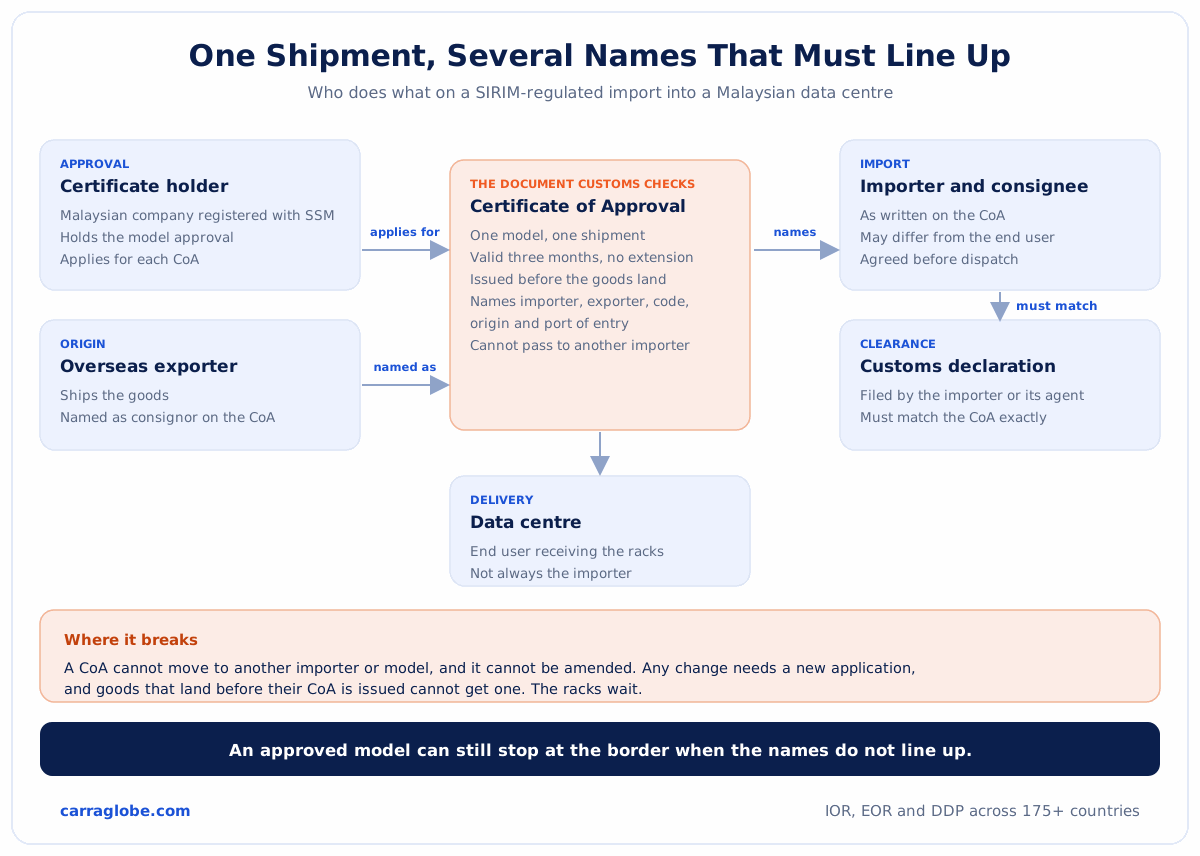
The Certificate of Approval. The CoA is the document customs relies on, and it is issued only for equipment SIRIM has already approved. It is applied for through the ePermit system for one model per application per shipment, names the importer, exporter, tariff code, origin and port of entry, runs for three months and cannot be extended or amended. SIRIM will not issue one for equipment already brought into Malaysia, so it has to be in place before the goods land.
A Release Letter is a separate route for products with no communication or wireless features that share a tariff code with communications equipment. It lasts a year for its model and covers several shipments.
A rack holding ten approved models therefore needs ten CoA applications, and a project that slips past three months needs fresh ones. Our earlier guide to SIRIM rules for IT hardware covers the approval process itself.
What each item in the rack needs
A data centre consignment rarely holds one kind of product. Each line on the packing list can trigger a different check.
| Item | What to check | Common trap |
|---|---|---|
| Switches, routers and firewalls | SIRIM approval and a CoA for each model, where the tariff code falls under SIRIM | Optional Wi-Fi or cellular modules that the approval does not cover |
| Servers and storage | Whether the code is assigned to SIRIM, and whether the model communicates or connects to a public network | Assuming a computing appliance is outside SIRIM’s scope |
| GPU servers | The same as servers, with the accelerators described accurately | Close customs attention, and a strategic trade assessment and possibly a permit if they carry controlled advanced AI chips and later leave Malaysia |
| Wi-Fi access points and wireless kit | SIRIM approval covering the radio, tested to the current short range device specifications and bands in MCMC’s spectrum plan | Regional variants set to bands Malaysia does not allow |
| UPS units, PDUs and lithium batteries | Electrical approval where the item is regulated, and dangerous goods documents for air transport | Battery papers missing when the freight is booked |
| Power cords and plugs | Cords and plugs pre-approved by the electrical regulator, as MCMC’s 2026 baseline code requires | Cords supplied for another country’s sockets |
| Used or refurbished kit | Whether SIRIM’s prohibition on used communications equipment applies, and the e-waste ban | Assuming proof of reuse is enough |
GPU servers draw attention. Customs at KLIA has seized servers with advanced AI chips declared as electronic components, so describe the accelerators, quantity and value plainly. Our guide to the importer of record for AI servers and GPU clusters covers the wider checks.
Batteries and cords are easy to forget. UPS and server batteries need the right air transport papers, as our guide to lithium battery customs clearance explains. MCMC’s baseline code requires cords and plugs to be pre-approved by the relevant regulator. For products within its regulated scope, that is the Energy Commission in Peninsular Malaysia, while Sabah and Sarawak run their own approvals.
Used kit needs a decision first. SIRIM’s rules prohibit importing used or refurbished equipment within their scope, and e-waste as described in item 19 of the customs prohibition order has been banned since 1 April 2026. Working kit for reuse is not automatically e-waste, so read our guide to importing used and refurbished IT equipment before booking it.
Duty, sales tax and the data centre exemption
The tariff code drives both the checks and the tax. Alongside the communications and public network test, the CoA covers IT and networking equipment whose code is assigned to SIRIM, so a model can be approved and still trip on the code. Sales tax follows the same code. Since 1 July 2025, goods not listed as exempt or at 5% are taxed at 10%. Our guides to the HS code for servers and the HS code for routers and switches explain the usual headings.
Data centre operators may qualify for relief, but the two taxes differ. MDEC’s updated policy, intended to start on 1 January 2026, applies only to Malaysia Digital companies in data centre activities, which its FAQ defines as co-location operators, hyperscalers meeting set criteria and cloud infrastructure or platform providers. The import duty exemption is limited to direct and specialised equipment used for approved activities. The sales tax exemption covers locally manufactured equipment, and imported equipment may still be considered only for significant investments, such as AI-driven data centres.
Every application is assessed case by case and needs Ministry of Finance approval, so neither relief is automatic. MDEC said in July that its procedures were still being finalised, and a later update says complete applications are processed first in, first out.
Confirm approval before pricing a landed cost. Exempt equipment still needs its CoA.
Who holds the approval decides who can import
For a product approval, the applicant must be a company registered with the Companies Commission of Malaysia (SSM). It can be a manufacturer, assembler, importer, network operator or service provider, or an authorised consultant, and a consultant can also file on behalf of an applicant.
A certificate of conformity can change holder through set procedures. A name change within the same entity is a change request, a move to another company in the group needs a parallel by comparison application, and a move outside the group needs a new normal application. The CoA itself cannot move to another importer or model, or be sold or lent. On a data centre delivery, the importer of record and the consignee can still be different companies.
In practice, a reseller or integrator without a Malaysian company cannot borrow the end client’s approval or the maker’s. The certificate holder applies for each CoA, declares the import to customs and names the importer, so agree the holder, the named importer, the consignee and the customs declaration before shipment. For an identical model already approved for another holder, a new applicant can use the parallel application route, with the maker’s authorisation. Our page on importer of record in Malaysia explains how that role works.
What changed in 2026
- 1 January. The intended start of MDEC’s exemption policy for data centre companies, still being finalised in July.
- 1 April. The e-waste import ban announced on 4 February took legal effect under P.U. (A) 151/2026, for waste within item 19 of the prohibition order.
- 5 May. MCMC registered its baseline code for communications equipment, T022:2026. Its EMC requirements cover emissions and immunity, and safety follows IEC 62368-1. A third revision of the short range device specifications covers Wi-Fi and wireless kit.
- 28 October. Customs at KLIA announced its fifth seizure of the year involving servers with advanced AI chips, this time 30 units declared as electronic components.
- 5 November. Published summaries of SIRIM notice SQASI/CMCS/1/26/011 say equipment within the applicable requirements now needs immunity evidence, with affected renewals moved to a comparison application. The notice is not public, so confirm it for your equipment with your test lab.
None of these changes the basic route. They do raise the cost of an approval that lacks immunity data, a vague description or a used server without a clear purpose.
Why data centre shipments get held in Malaysia
These are the causes we see most on Malaysian shipments, and each one can be prevented before dispatch.
- No approval or CoA for the exact model. A variant with a different radio module or hardware revision may not be covered.
- The wrong importer named. The importer or consignee on the CoA does not match the customs declaration or the agreed importing arrangement.
- A code or value mismatch. The invoice and packing list disagree, as our guide to fixing a wrong HS code on an invoice explains.
- Battery or dangerous goods papers. The UPS or server batteries were not declared correctly for air transport.
- A CoA that is late, expired or mismatched. The goods landed before it was issued, the three-month window closed, or it names another model or importer.
- A description that hides the goods. Complete GPU servers described only as components invite inspection.
In our experience, complete Malaysian shipments with approvals already in place mostly get customs release the same day, before delivery to site. They can take one to two days if customs flags goods for a recheck. Our guide to a customs hold on servers covers what to do if one happens.
When equipment leaves Malaysia again
Data centre kit does not always stay. SIRIM’s CoA categories include imports for re-export, imports after repair and imports for replacement, so a returned or swapped unit has its own route back in. Goods moving into a free zone, a bonded facility or onward in transit are declared differently from goods entering the principal customs area for installation.
Leaving is stricter for AI hardware. Since 14 July 2025, Malaysia has controlled the export, transshipment and transit of specified advanced AI chips, a move MITI announced for chips of US origin. Exporters check each chip, and any computer containing one, against set technical limits. Where it meets them or cannot be ruled out, they submit an assessment form at least 30 days ahead, and the Strategic Trade Secretariat decides whether a permit is needed.
So check the chip model before a faulty GPU server goes back for repair, as our guide to export controls on data centre hardware explains. Our guide to returned goods and reverse logistics covers the return leg.
Five checks before the racks leave
- List every model and variant in the consignment, including hardware revisions and optional radio modules, and check any used or refurbished items against SIRIM’s prohibition and the e-waste rules.
- Confirm the importing arrangement, naming the certificate holder, the importer and consignee on each CoA, and a customs declaration that matches.
- Register the serial numbers and secure the CoAs before the goods land, within three months of arrival.
- Check the tariff code, duty and sales tax for each line, any exemption the data centre holds, and match the invoice to the packing list.
- Prepare battery transport papers and electrical approvals for cords, plugs and other regulated items before the freight is booked.
How Carra Globe handles Malaysian data centre deliveries
The holder question is settled first. Carra Globe acts as importer of record in Malaysia and clears through a licensed customs agent. We can apply for and hold SIRIM certificates as the local holder, register the serial numbers and apply for each shipment’s CoA, and may already hold approvals for some models. Carra Globe and its team have handled 200+ Malaysia shipments since 2020, including deliveries to Malaysian data centres, and we handle lithium batteries shipped with equipment. Onboarding usually takes one to two days, separate from any approval time.
Because the approvals sit under our own entity and each CoA is shipment-specific and cannot be transferred, we handle Malaysian shipments door to door. The one exception is a client arranging air freight to Kuala Lumpur, with Carra Globe acting as importer of record from arrival. After release, we can arrange white glove delivery into the data hall, with serial numbers checked against the packing list.
Carra Globe works through importer-side registrations and local importing structures appropriate to the goods and destinations it accepts, its own in some markets and established local structures in others. Approvals falling outside the available structure are flagged before a delivery date is agreed.
For equipment leaving again, we act as exporter of record where the shipment allows. Our IOR by country page covers 175+ countries. For a quote, send the draft commercial invoice, the model list with variants, total weight and dimensions, the collection and data centre addresses, the datasheets and the MSDS for any batteries. Reach us at info@carraglobe.com.
Malaysia · Data Centres · SIRIM · Customs
Send the model list and the data centre address. We will tell you which approvals, CoAs and importer the shipment needs before anything ships.
Every model in a Malaysian data centre shipment can need its own approval and its own Certificate of Approval, held by the company named as importer. So the useful conversation is which items need what, who holds the approvals and how the goods are described. Where something sits outside the structure available, you hear that before a delivery date is agreed.
- Importer of record for data centre equipment
- Shipping AI servers internationally
- Importing H200 GPU servers
- AI and GPU import compliance
- HS code for GPU chips
- AI server import duties in 2026
- HS code for lithium batteries
- Data centre cabling fire ratings
- Resolving customs holds on IT shipments
- Multi-country IT equipment deployments
- IOR services in Singapore for tech imports
- Importer of record in Indonesia
- Importer of record in Thailand
- Importer of record in Vietnam
- Comparing DDP quotes for IT equipment
Free tools HS Code Finder Volumetric Weight Calculator Pallet Calculator
Racks heading to a Malaysian data centre? Send the draft invoice with models, variants, quantities and values, the datasheets, battery MSDS, weights and dimensions, and the collection and data centre addresses. We will come back on approvals, CoAs, the importer and timing.
Check my Malaysia shipmentFrequently asked questions
Do servers need SIRIM approval in Malaysia?
It depends. Servers under IT and networking codes assigned to SIRIM, or able to communicate or connect to a public network, need SIRIM approval or certification before a CoA is issued.
Who can hold a SIRIM certificate?
For a product approval, only a company registered with SSM in Malaysia, such as a manufacturer, assembler, importer or network operator. A consultant can file it, but a foreign seller needs a local holder.
How long is a SIRIM CoA valid?
Three months from approval, for one model on one shipment. It cannot be extended and must be issued before the goods arrive, so a delayed shipment may need a fresh one.
Can I use my client’s or the manufacturer’s SIRIM certificate?
Not directly. A CoA cannot pass between importers. A new Malaysian holder can seek its own approval for an identical model through a parallel application, with the maker’s authorisation.
Why are servers held at Malaysian customs?
Usually a missing approval or CoA, an importer who is not the approval holder, mismatched codes or values, missing battery papers, or a vague description.
Do GPU servers need a permit to leave Malaysia?
Possibly. Since July 2025, specified advanced AI chips, including those inside computers, are assessed before export or transit, and the Strategic Trade Secretariat decides whether a permit is needed.
What changed for SIRIM approvals in November 2026?
Published summaries of a SIRIM notice say equipment within scope needs EMC immunity evidence from 5 November 2026, under MCMC’s T022:2026 code. Confirm it with your test lab.
Can I import refurbished servers into Malaysia?
Be careful. SIRIM’s rules prohibit importing used or refurbished equipment within their scope, and e-waste has been prohibited since 1 April 2026. Check before shipping anything second-hand.
How long does Malaysian customs clearance take?
In Carra Globe’s experience, complete shipments with approvals in place mostly clear the same day, and can take one to two days if customs flags goods for a recheck.
What sales tax applies to IT equipment imported into Malaysia?
It depends on the tariff code, with 10% the default since July 2025. MDEC relief for data centre companies covers imported equipment’s sales tax only in limited cases.
Adjacent ground: importer of record in Singapore and importing liquid cooling coolant for data centres.
Sources and verification
Each rule was checked against government, regulator or intergovernmental publications available on 8 November 2026. Where an official source could not be opened, the relevant section says so.
- SIRIM approval and CoA. SIRIM QAS International certification requirements for communication, multimedia and hybrid equipment (clauses 3, 6, 12 to 15 and 17) and Malaysia’s import licensing notification for telecommunication apparatus on the WTO portal.
- Technical code. MCMC MTSFB TC T022:2026, Communications Equipment Baseline Requirements, registered 5 May 2026, and the MTSFB technical code register.
- SIRIM immunity notice. SIRIM QAS announcement SQASI/CMCS/1/26/011 of 13 October 2026, as described in published summaries. The notice itself is issued through SIRIM’s certification portal and could not be opened publicly.
- Electrical approvals. The Energy Commission of Sabah page on importing electrical equipment and Suruhanjaya Tenaga’s electrical equipment page.
- Data centre exemption. MDEC’s policy update announcement of 26 December 2025, its FAQ on the import duty and sales tax policy update and its status update on applications.
- Import prohibitions. The Customs (Prohibition of Imports) (Amendment) (No. 3) Order 2026, P.U. (A) 151 on e-waste, and the Customs (Prohibition of Imports) Order 2023, P.U. (A) 117, as amended. SIRIM’s requirements still cite the earlier 2017 order.
- Sales tax. Royal Malaysian Customs Department FAQ on the 2025 sales tax rate changes and its list of sales tax orders.
- Strategic trade. MITI press statement of 14 July 2025 on US-origin AI chips under section 12 of the Strategic Trade Act 2010, and its industry guideline on the advanced AI chips directive.
- Seizures. RTM’s report of 28 October 2026 on the KLIA seizure.
Disclaimer: This guide is for informational purposes only and does not constitute legal, customs, tax or certification advice. Requirements depend on the specific equipment, its classification, the approval holder and the importer. The position described is as at 9 November 2026. Confirm the current position with SIRIM, MCMC, the Royal Malaysian Customs Department or your importer of record before shipping.