
Almost every rejected test report we see involves a laboratory that did nothing wrong. The laboratory is ISO/IEC 17025 accredited. The certificate is current, the accreditation body is a signatory to the international arrangement, and the testing itself was competently done. The report is submitted, and the regulator refuses it.
In brief:
- Accreditation is not acceptance. The international accreditation body itself states that accreditation makes acceptance more likely, without guaranteeing it.
- Accreditation is scope-specific. A laboratory accredited for one method, one product type or one edition of a standard is not accredited for the next.
- Accreditation expires and can be suspended, and certificates are sometimes still circulating after either.
- Some regulators add their own layer on top, so an accredited laboratory must also be recognised, designated or approved before its report counts.
- Checking takes minutes. Being wrong costs months, because the only remedy is testing the product again.
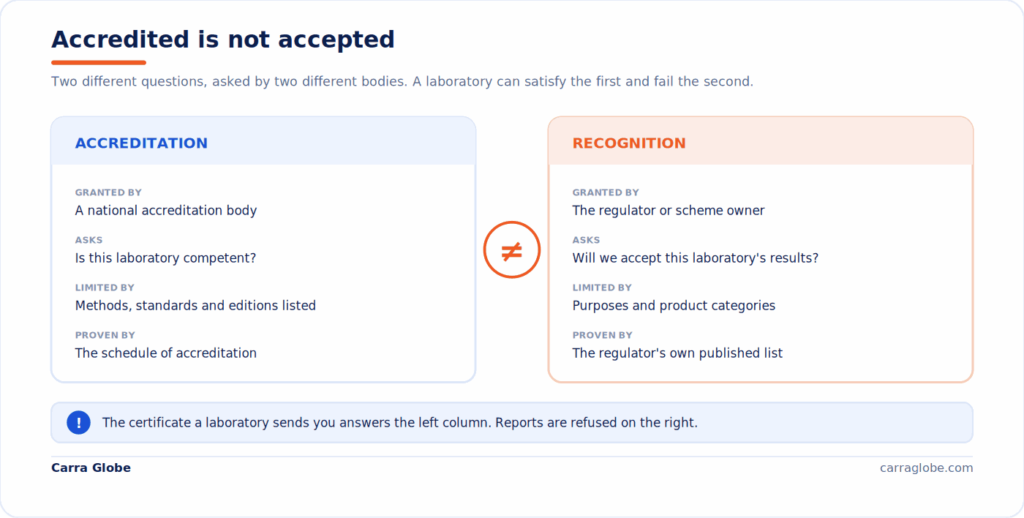
This happens often enough to be predictable, and the reason is a distinction almost nobody makes: accreditation and recognition are different things, granted by different bodies, answering different questions. Accreditation asks whether a laboratory is technically competent. Recognition asks whether a particular regulator will accept its work. A laboratory can hold the first in full and the second not at all.
This article is the companion to our guide on foreign test report acceptance, which covers which markets accept whose testing. This one covers the layer beneath it: why a laboratory that looks entirely qualified can still produce a report that does not work.
Two Different Questions, Answered by Two Different Bodies
Accreditation is granted by a national accreditation body, which assesses a laboratory against ISO/IEC 17025 and confirms it is competent to perform particular tests. That is a statement about capability, made by a technical peer.
Recognition is granted by a regulator or a scheme owner, and it says something narrower: that this authority will accept results from this laboratory for this purpose. India operates a laboratory recognition scheme under the Bureau of Indian Standards. Brazil requires the designated certification body to evaluate and approve a laboratory before testing. Indonesia maintains a list of recognised foreign laboratories and separately recognises laboratories under mutual recognition agreements.
The international position is stated plainly by the accreditation community itself. A laboratory accredited by a body that signs the international arrangement is more likely to have its results accepted abroad, but there is no guarantee that those results will be accepted by other parties in that market. Acceptance is a decision that belongs to the receiving authority, and accreditation is evidence offered to it rather than an instruction binding it.
That is the whole misunderstanding in one sentence. Buyers treat accreditation as a passport. It is closer to a reference.
The reason this is worth attention now rather than eventually is that the gap between the two is widening. Markets that once accepted foreign testing on the strength of accreditation alone are adding recognition layers of their own, and standards are being revised at a pace that outruns the scopes granted against them. The number of ways a competent report can fail is growing, and none of the new ones are visible on the report.
The Architecture Changed in January 2026
There is a development here that has not reached most compliance checklists, and it matters for anyone whose procedures name the old institutions.
On 1 January 2026, the International Laboratory Accreditation Cooperation and the International Accreditation Forum both ceased operations and were replaced by a single body, Global Accreditation Cooperation Incorporated. The new organisation operates one multilateral recognition arrangement covering both laboratory accreditation and management system certification, where previously the two ran separately.
Two practical consequences follow. Existing accreditations remain valid and there is no interruption to services, so nothing needs to be redone. But the former marks are being phased out over a transition period running to 2029, which means certificates, contracts, quality manuals and supplier questionnaires that name the old arrangements will gradually go out of date. Regional peer evaluation continues through the existing regional cooperations, so the machinery underneath is unchanged.
It is not an emergency. It is the kind of change that quietly makes documentation wrong, and documentation that is wrong in a compliance file is worth checking before someone else finds it.
Six Reasons You Get a Rejected Test Report From a Good Laboratory
Each of these involves a genuinely accredited laboratory and genuinely competent testing. None is a quality failure. They are ordered by how often they surprise people who thought they had done the work, rather than by how often they occur.
- The regulator requires its own recognition on top of accreditation. This is the failure that catches the most sophisticated buyers, because everything about the laboratory checks out. Accreditation settles the competence question, and the market separately requires the laboratory to be recognised, designated or approved before its report is admissible at all.
- The scope does not cover the method. Accreditation is granted for listed methods and parameters, not for the laboratory as a whole. Accreditation for one type of test does not extend to a related one performed in the same building by the same people.
- The scope does not cover the edition of the standard. A laboratory accredited against one edition may not hold accreditation for the revised version. Where a standard has been updated, and many have been during 2026, the edition matters as much as the number.
- The scope does not cover the product type. A method can be accredited for one product category and not another, so the question is whether your product falls inside the listed scope rather than whether the test is one the laboratory performs.
- The accreditation has expired or been suspended. Certificates sometimes remain in circulation after the underlying accreditation has lapsed or been suspended. The certificate in your file is a snapshot. The database is the current position.
- The accreditation body is not in the right arrangement. Accreditation is only as portable as the body that granted it. Where the accrediting body sits outside the relevant international or bilateral arrangement, the accreditation may carry little weight with the destination.
There is a seventh that is not about the laboratory at all. Some regimes require steps to be taken before testing begins, such as notifying the certification body of the manufacturing unit and the traceability of the sample. Where the sequence is wrong, the report can be unusable no matter which laboratory produced it.
The Asymmetry That Makes This Worth Doing
Most compliance checks are a judgement about proportionate effort. This one is not, because the two sides of the trade are so far apart.
Verifying a laboratory’s accreditation properly, meaning checking the scope, the status and the expiry in the accreditation body’s own database rather than reading the certificate the laboratory supplied, is reported to take roughly a quarter of an hour. Restarting testing after a rejection is reported to run from several thousand to tens of thousands of euros depending on the product and the test programme, with three to six months lost.
Those figures will vary by sector and by market, and they should be treated as indicative rather than as a quotation. The shape of the asymmetry is the point. A check measured in minutes stands against a remedy measured in quarters, and unlike most import problems this one has no documentary shortcut. The regulator is not disputing the measurement. It is declining the source, and the only way to change the source is to test again.
For a hardware programme with an installation date, that is not a compliance cost. It is a schedule failure, and it lands on the logistics team long after the testing decision was made by someone else.
Commissioning testing for a market you have not shipped to before? The question that decides whether the report works is not whether the laboratory is good. It is whether the destination recognises it, for that scope, on the date you file. Carra Globe acts as importer of record across 175+ countries and checks the conformity route alongside the customs position, before samples are shipped.
How to Verify a Laboratory Properly
The common mistake is to accept the certificate the laboratory sends. The certificate tells you an accreditation existed on the day it was issued. It does not tell you the current status, and it rarely tells you the scope in enough detail to answer the only question that matters.
- Get the schedule of accreditation, not the certificate. The schedule, sometimes called the scope document, lists the specific methods, standards and parameters covered. Obtain it from the accreditation body’s public directory rather than from the laboratory.
- Match the scope to your standard and its edition. Confirm the exact standard number, the revision year, and that your product type falls within the listed scope.
- Check status and expiry in the database on the day you rely on it. Accreditation can lapse or be suspended between the certificate being issued and your submission being filed.
- Confirm the accrediting body is in the relevant arrangement, and, where the destination requires it, that the arrangement is one the destination actually participates in.
- Ask the destination regulator’s own question separately. Where the market operates a recognition, designation or approval layer, accreditation alone will not answer it.
- Confirm the required sequence before commissioning anything, because some regimes require notification or approval before testing rather than after.
The practical difficulty is knowing where to start looking, because the directory you need belongs to the accreditation body rather than to the laboratory or the regulator. Every economy has one or more national accreditation bodies, each publishing a searchable register of the laboratories it accredits and the scopes it has granted them. The route in is to identify the body named on the certificate, find its register, and search there. Where a laboratory declines to say which body accredited it, or names one in a different country from where it operates, that is itself the answer.
Some regulators make step five straightforward. India publishes its list of recognised and empanelled laboratories with a validity date against each entry, and offers a search by Indian Standard number, so you can ask which laboratories are recognised for your standard rather than whether a given laboratory is recognised. Brazil publishes its designated certification bodies. Where a market does not publish, the question goes to the regulator or to whoever will file on your behalf.
What to Do If the Report Has Already Been Rejected
Most guidance on this subject stops at prevention, which is not much use if the rejection has already arrived. The options are narrower than at the planning stage, but they are not always nothing.
Establish first which of the failures actually occurred, because the remedies differ. A scope gap sometimes has a partial answer: if the laboratory holds accreditation for most of the programme and not for one method, only the uncovered tests may need repeating rather than the entire suite. A laboratory can also apply to extend its accredited scope, which does not help a shipment already waiting but can be worth arranging if you will return to that market.
A lapsed accreditation is usually terminal for that report. A missing regulator recognition normally is too, since it goes to admissibility rather than to quality. A sequencing failure, where testing began before a required notification, is the one most worth challenging, because it is procedural and the certification body may have a route to regularise it.
Practically, the first call is to the certification body or regulator rather than to the laboratory, because the laboratory has a commercial interest in the answer being that its report is fine. Ask what specifically is deficient and what would cure it. Our view is that a written answer to that question is worth more than any amount of arguing about the technical merits of the testing, which were rarely the problem in the first place.
Then plan the retest against real availability rather than optimism. Laboratory queues in markets that have recently restricted foreign testing are the obvious pressure point, and a sample has to physically get there. That movement is itself a cross-border shipment needing an exporter of record, and it is worth arranging in parallel with the booking rather than after it.
Where This Bites Hardest
The exposure is not evenly distributed. It concentrates wherever a regulator has added its own recognition layer on top of accreditation, and wherever standards are being revised quickly.
- India operates a formal laboratory recognition scheme, and requires recognition for the specific product category and Indian Standard rather than in general.
- Brazil puts the certification body in charge of evaluating laboratories, applies a priority order that places domestic laboratories first, and requires notification before testing starts.
- Indonesia requires the accrediting body itself to be in a recognised arrangement with the national accreditation committee, which is a step beyond checking the laboratory.
- Telecoms and radio equipment attract the most type approval regimes, and therefore the most recognition layers, of any product category we handle.
- Medical devices face reviewers who increasingly question the competence of the laboratory that generated the data, not only the data itself.
The common factor is that none of these can be answered by looking at the report. They are answered before the report exists, by asking a question about the laboratory that most procurement processes never think to ask.
Frequently Asked Questions
What is the difference between accreditation and recognition?
Accreditation is a national accreditation body confirming a laboratory is technically competent against ISO/IEC 17025. Recognition is a regulator or scheme owner confirming it will accept that laboratory’s results for a specific purpose.
A laboratory can hold the first and lack the second, which is the most common cause of a rejected report.
Does ISO/IEC 17025 accreditation mean my test report is accepted everywhere?
No. Accreditation makes acceptance more likely but does not guarantee it, and the international accreditation community says so explicitly. Individual markets remain free to impose their own requirements.
It is evidence offered to the receiving authority rather than an instruction binding it.
What is ISO/IEC 17025?
The international standard setting requirements for the competence of testing and calibration laboratories. Accreditation against it is granted by a national accreditation body, for specific listed methods rather than for the laboratory as a whole.
It answers whether a laboratory can perform a test properly. It does not answer whether a given regulator will accept the result.
Can I rely on an accreditation certificate the laboratory gave me?
Only as a starting point. A certificate reflects the position on its issue date, and accreditation can lapse or be suspended afterwards. Certificates are sometimes still circulating after either has happened.
Check the accreditation body’s own public directory on the day you rely on it, and get the schedule of accreditation rather than the certificate.
How do I check a laboratory’s accreditation scope?
Ask for the schedule of accreditation rather than the certificate, and verify it in the accreditation body’s public directory. Check the method, the standard edition, the product type, and the current status.
Certificates supplied by the laboratory show a position on the date of issue, not the position today.
What replaced ILAC and IAF in 2026?
Both ceased operations on 1 January 2026 and were replaced by Global Accreditation Cooperation Incorporated, which operates a single multilateral recognition arrangement. Existing accreditations remain valid.
The former marks are being phased out over a transition period, so documentation naming the old bodies will need updating.
Can a laboratory extend its accreditation to cover my test?
Yes, laboratories can apply to extend their accredited scope, but it takes time and involves assessment by the accreditation body. It will not rescue a shipment that is already waiting.
It can be worth arranging where you expect to return to the same market with similar products.
Is a rejected test report always a retest?
Usually, but not always in full. Where only part of the programme fell outside the accredited scope, sometimes only those tests are repeated. Procedural failures may occasionally be regularised.
Establish precisely which failure occurred before assuming the whole programme has to start again.