
A DDP price answers a commercial question. Your supplier takes responsibility for getting the goods to the agreed destination, clearing them for import and bearing the duties and import taxes that DDP allocates, and you see one number instead of five. What the price does not tell you is whose name goes in the importer box on the customs declaration at the other end. That field is central to the customs position, and it does not by itself settle who may recover the tax.
Those are two separate questions, settled by two different bodies of rules. Incoterms allocate cost and risk. The destination decides who may be named and who may deduct the tax. Nothing obliges the two answers to agree.
The short answer. Under an agreed DDP rule the seller takes contractual responsibility for arranging import clearance and bearing the duties and import taxes that rule allocates. That allocation does not remove the need to identify an importer, it does not make the seller eligible to be one, and it does not move the right to recover import tax. Where a DDP quote is made to work by naming whichever party fits, the recovery position can end up separated from the party actually bearing the cost.
Carra Globe provides importer of record, exporter of record, delivered duty paid and freight forwarding services, so we have a commercial interest in your answer. What follows is written to be usable whether or not you ever speak to us.
| The question | The short answer |
|---|---|
| Does DDP make the seller the importer of record? | No |
| Who may be named as importer? | Whoever the destination permits |
| Who bears the duty and import tax cost? | The seller, under the agreed DDP allocation |
| Who may recover the import tax? | The party the destination’s tax law identifies |
| What should the buyer ask for? | The import declaration, the named entity, the declared value and the tax evidence |
Two questions, and only one of them is on the quote
Delivered Duty Paid sits at the far end of the Incoterms range. Where the parties agree it, the seller carries the goods to the agreed place in the destination country, takes responsibility for arranging import clearance, and bears the duties and import taxes that the rule allocates. For a buyer it is the least work of any term, which is exactly why procurement teams ask for it.
The rule tells you who pays. It is silent on who is permitted to appear as the importer, because that is not within its gift. Incoterms are a contractual allocation between buyer and seller, not a statute. A commercial term agreed between two companies in London and Taipei cannot grant either of them standing under Japanese or Brazilian customs law. Eligibility is determined by the destination’s applicable customs and tax rules.
So a DDP shipment still needs an importer of record, and someone has to be it. Three outcomes are common. The seller uses its own local entity where it has one. The seller appoints a third party to act as importer of record. Or the seller, or a forwarder acting for the seller, names the buyer, which is where most of the trouble in this article starts.
| The question | Settled by | Appears on a DDP quote |
|---|---|---|
| Who bears duty and import tax as a contractual cost | The Incoterm. Under DDP those costs are allocated to the seller | Yes, this is the quote |
| Who may legally be named as importer | Destination customs law and registration rules | Rarely |
| Who carries the declaration liability afterwards | Destination customs law, the entry roles it defines, and any direct or indirect representation arrangement | No |
| Who may deduct or reclaim the import tax | Destination tax law, which taxable person it points to, and the statutory recovery conditions | No |
| Who holds the entry documents and declared value | Destination record-keeping rules, the parties, representatives and clearance arrangement. The buyer should require access by contract | No |
Rows two to five are where disputes come from, and none of them is priced. The recovery row varies most, because the test can turn on ownership, importer status or the representation arrangement depending on the country, which is why a rule learned in one market travels badly. None of this is a criticism of DDP. It is a warning against treating a delivery price as though it settled a compliance question.
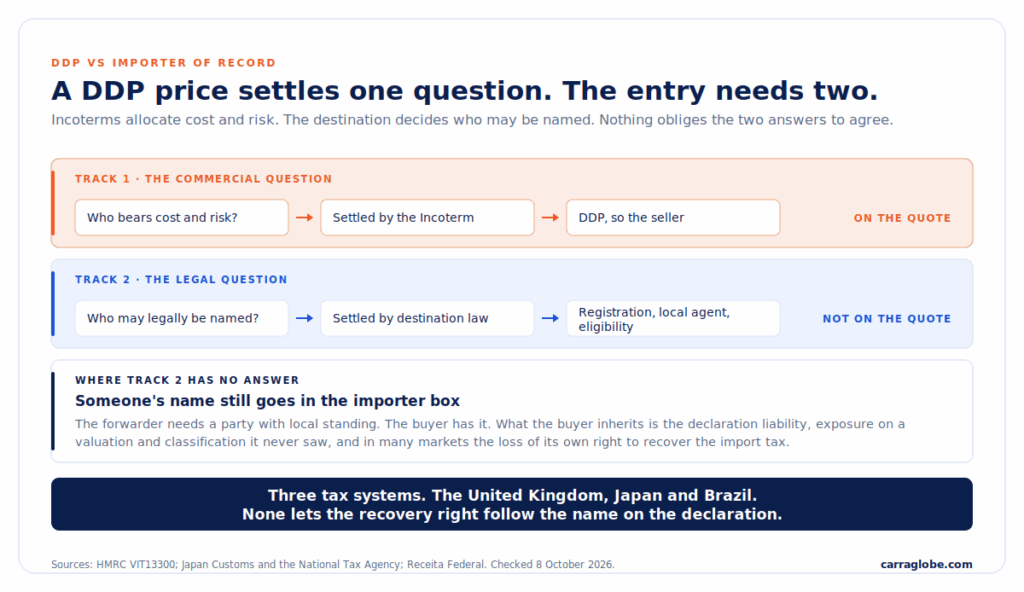
The right to recover does not follow the name on the declaration
This is the part that costs real money. The mechanism differs from country to country, and the four we examined do not share a statutory test. What they share is a practical lesson. The party named in the customs declaration is not automatically the party entitled to recover every form of import tax, and in some systems it is explicitly not.
United Kingdom, normally the VAT owner
The test is ownership, not the name on the entry. HMRC’s internal guidance states the default plainly. “Import VAT may only be claimed by the owner of the goods who would be entitled to reclaim the import VAT.” On the mechanics it adds that “In all circumstances it is the owner, whose details (EORI) should be shown in box 8 of the import declaration”.
That is not a test of legal title. Owner here is HMRC’s VAT concept, the person with the right to dispose of the goods as owner, and HMRC accepts that where a contract envisages title passing later, title need not have passed at the earlier point. The commercial reality at import decides it, not the title clause read alone, and the service side sits on our importer of record in the United Kingdom page.
Why this section says normally. The owner rule is the default structure, not the only one. HMRC separately describes an agent treated under section 47 of the VAT Act as importing and supplying the goods as principal, and that agent may recover subject to the normal rules. HMRC also describes a pre-import sale in which an overseas seller remains importer of record while the UK owner is the party entitled to recover. Neither is a general workaround. Both are reasons to say normally rather than only.
Japan, where the position follows the principal rather than the agent
The credit follows the principal, not the filer. Japan arrives at a comparable place by a different route. The National Tax Agency identifies the party liable for import consumption tax as the one who takes the goods out of the bonded area. Where a customs broker handles the clearance, the liability sits with the principal that commissioned the broker rather than with the broker. Appointing someone to act does not move the position onto them.
On recovery the National Tax Agency is explicit in a published Q&A. Where a company commissions an import agent, the input tax credit for the import consumption tax belongs in that company’s own return, and it cannot be taken by the agent handling the import. The credit follows the party whose transaction it is, not the party that filed.
Brazil, the acquirer and not the named importer
The law separates the two positions on purpose. Brazil makes the split visible in the structure of the law itself. Under an importação por conta e ordem, where a Brazilian importer imports on the order and account of a third party, Receita Federal’s own guidance records that the import PIS and COFINS credits are taken by the acquirer rather than the importer, and that the importer cannot deduct credits generated by that payment. The IPI credit follows the acquirer on the same logic.
Meanwhile liability runs the other way. Brazilian law makes the person who registers the import declaration in their own name a joint and several debtor for the tax. So within this account and order structure the law separates the two positions deliberately. Being named as importer carries the customs and import liability, and it does not by itself deliver the relevant credits to the importing service provider. Other Brazilian import structures work differently.
What to take from these three. Each one decides recovery by its own statutory test, and none of them simply hands the right to whoever appears in the importer box. If your supplier’s DDP structure names a party for convenience, treat the recovery position as an open question until someone shows you the rule that answers it.
What £225,392 of import VAT at risk looks like
A real case, and it never looked like a problem at the border. Numbers make this concrete in a way that principles do not. In one case we handled, £225,392 of import VAT was paid or recorded in connection with a shipment where the overseas seller was named as the importer. The goods arrived. Nothing was seized and no penalty was issued. The problem surfaced later, in the finance team rather than at the border.
The customer discovered that the VAT documentation it held did not support its intended recovery position. The entry had been made correctly in the sense that goods moved and tax was paid. It had simply been made in a shape that separated the recovery position from the party carrying the cost. That is a recovery and cash flow problem rather than an automatic permanent loss, and resolving it took corrective work on the import position rather than a phone call.
Two things stand out. It was invisible at delivery, which is the whole difficulty with this failure mode, and the cash flow damage arrived before anyone understood the documentation damage.
About the figures in this article. The operational examples and numbers here are anonymised internal case information supplied by Carra Globe. They are not independently audited, amounts and circumstances have been anonymised where necessary, and they describe what we have seen rather than a market-wide pattern.
It is not an isolated shape. Over the last twelve months we handled roughly fifteen to twenty-five cases where a client had used a previous DDP provider and then needed help obtaining customs entries, declared values, import VAT evidence or other import documentation. In one of those, the customer had taken delivery but held nothing that established how the shipment had been declared at all, so the import position had to be reconstructed before anyone could say what could be obtained or corrected.
Where a DDP quote cannot be delivered as sold
Some markets will not accommodate the simple version of DDP, because the importer role depends on something an overseas seller does not hold. In our experience the recurring ones are Japan, Brazil and Saudi Arabia, and they fail for three different reasons rather than one.
Japan requires a notified agent inside the country
The gate is a notified local agent. A non-resident may make an import declaration in Japan through a notified Customs Procedure Agent, and not otherwise. The mechanism sits in Article 95 of the Customs Act and is filed on Customs Form C No. 7500.
Three details matter commercially, and the fuller picture is on our importer of record in Japan page.
- The agent must have an address or residence in Japan.
- An agent that is not a licensed customs broker cannot act as a business, so either the agent holds a licence or a licensed broker is engaged.
- Where a non-resident does not respond to a request to appoint one, the Director-General of Customs may designate a connected person instead.
A naming note, because you will meet two terms. Japan Customs’ national guidance uses Customs Procedure Agent for 税関事務管理人. Yokohama Customs uses ACP, Attorney for Customs Procedures, in its own English material, so both appear in official sources and both will surface in search. Customs Procedure Agent is the term to use against the current national guidance.
Brazil gates it on registration and caps it on value
The gate is registration, and then a ceiling. Brazil requires the legal entity acting as declarant to hold the relevant habilitação to operate in foreign trade, covered further on our importer of record in Brazil page. The conditions are registration-shaped rather than discretionary, needing a CNPJ in active status, adhesion to the electronic tax domicile, and regular CPF status for everyone in the share and management structure. A foreign company without the required Brazilian registration would not meet those stated conditions.
The second constraint catches growing programmes. The habilitação comes in modalities, and Receita Federal currently publishes Limitada thresholds of US$50,000 or US$150,000 per consecutive six-month period depending on assessed financial capacity. Check the current implementing instrument before relying on either figure. The planning point stands whatever the number is, because a rollout can outgrow its own importer’s authorisation partway through.
One terminology point, since it affects what you find when you search. Many sources still call this RADAR. The current instrument is Normative Instruction RFB No. 1,984/2020 with Portaria Coana No. 72/2020, and Receita Federal’s own word is habilitação.
Saudi Arabia, where the obstacle is registration rather than prohibition
The gate is registration, not a prohibition. Saudi Arabia deserves a more careful description than it usually gets, and we will give it one even though a blunter claim would suit us better. We found no official Saudi source expressly forbidding a non-established foreign company from being the named importer. What we found is a set of registration gates an overseas seller will struggle to pass, and a recovery test that asks a different question from the British one.
So the Saudi question is not whether the overseas seller owns the goods. It is whether the entity you intend to name can be the importer there at all, and whether it then meets the deduction conditions.
Importer registration on the Fasah platform is documented by the Zakat, Tax and Customs Authority as requiring a commercial register or ID number.
Under the deferred duty conditions specifically, the goods owner must record imports under a commercial registration number and be registered for VAT, which is a condition of that facility rather than a rule for every Saudi import. For some regulated products, SABER registration also runs off a commercial registration, and the applicable technical regulation assigns conformity responsibility to an in-Kingdom party, which may be a resident manufacturer, a Saudi agent or the importer depending on the regulation.
On tax, Saudi Arabia does not apply the United Kingdom’s ownership test. The GCC VAT framework links import VAT treatment to the person treated as the importer under the applicable customs rules. The Authority’s own guideline then addresses the importer and the deduction conditions. It states that import VAT on goods is paid by the importer and describes the importer’s right to deduct that tax subject to the deduction rules and to use in the course of economic activity, and it states that a person who is not a taxable person is not entitled to deduct import VAT.
We stop there deliberately, and we are not turning that into a conclusion that the importer is the only party who could ever recover by another route. The section dealing specifically with import VAT deduction did not extract cleanly enough for us to set out its conditions, so read it directly before relying on the detail. Our own position sits on our importer of record in Saudi Arabia page.
The disclosure problem, or being named without being told
Sometimes the buyer is simply not told. There is a version of this worse than an expensive surprise, and it happens more than the industry admits. The buyer is not told it is the importer of record. It finds out afterwards.
We have handled it. In one case a company discovered it had been identified as the importer of record for equipment shipped into its market, without having understood it was accepting that role. It did not control the customs documentation and was unclear on the declared value, the classification and the import obligations attached. We were asked to review the position and work out how the shipment could be regularised.
The mechanics are mundane, which is why it slips through. A seller quotes DDP. The seller cannot be the importer in that market, or does not want the registration burden. A forwarder arranging the clearance needs a name with local standing in the importer field. The buyer has that standing. The buyer’s details go in the box. No one has to lie for the buyer to end up unaware of the role it has been given.
What can land on the buyer is not trivial. Depending on the destination and on how the representation was arranged, it can include declaration liability, exposure on a valuation and classification it never saw, penalty risk where something is wrong, and record-keeping duties. It picks that up while believing it bought a delivered price.
If you buy on DDP and have never been shown an import declaration for those shipments, find out whose name is in the importer field before you order again. If it is yours, the commercial arrangement has not settled the question, and what follows from that depends on the destination’s rules and on any representation arrangement in place.
What to establish before you accept a DDP price
These are short questions and they are reasonable to ask of any supplier. A seller who can answer them has identified the structure. A seller who cannot has not yet shown that the quoted price is operationally supported.
- Who will be named as importer of record, by legal entity name. Not “we handle it”. A name.
- What registration does that entity hold in the destination. In Brazil, a habilitação and its modality. In Japan, a notified Customs Procedure Agent. In Saudi Arabia, a commercial registration.
- Who holds the right to dispose of the goods as owner at import. In the United Kingdom this VAT-specific ownership test, rather than the title clause alone, is what HMRC applies to import VAT recovery.
- Whose details go in the import tax recovery position. Ask for box 8 or its local equivalent specifically.
- Will I receive the entry, the declared value and the import tax evidence. Agree this before shipment, because reconstructing it afterwards is the expensive version.
- What happens if the named importer cannot be used. A supplier who has thought about this has an answer. One who has not will discover the problem with your cargo.
One more, and it is the one that saves the most money. Ask whether the DDP price assumes the import tax is recoverable. If it does, and it turns out not to be recoverable by you, the real cost of that shipment is the quoted price plus the irrecoverable tax, and the comparison you ran against other suppliers was wrong.
How Carra Globe works with this
Most of our work is DDP-structured, though not all of it, and the part that is not is the part worth noticing. Over the last twelve months, measured by shipment count, 85% of our importer of record shipments involved Carra Globe acting as importer of record under a DDP structure and 15% were importer of record only, with the client or their customer named. That remaining 15% exists because DDP is not always the right answer, or not always an available one. These are not competing products. They are different answers to the question of who may be named.
Carra Globe works through importer-side registrations and local importing structures appropriate to the goods and destinations it accepts, its own in some markets and established local structures in others. Where a destination needs an approval that falls outside the available structure, we flag it before a delivery date is agreed rather than after. We provide exporter of record services on the origin side where that is the constraint instead.
Where a standard DDP structure cannot be delivered as quoted, we do not label the shipment DDP and proceed. We restructure around the importer that can legally perform the role, which may be Carra Globe, a local registered importer, or the customer’s own entity. You are told which, and why, before you commit to a date.
If you are carrying one of the problems in this article already, the useful first step is small. Send us the entry documents for a recent shipment, or tell us you cannot get them, and we will tell you where the import position actually sits. Reach us at info@carraglobe.com.
DDP · Who Is Named On The Entry
Send us one import entry. We will tell you whose name is in the importer box.
A DDP price settles who pays. It does not settle who may be named as importer, and it does not move the right to recover the import tax. Those are decided by the destination, not by the quote, and the gap between them is where a six-figure recovery position can quietly end up with the wrong party. If you have never seen a declaration for your DDP shipments, that is the document to ask for first.
- What an importer of record is
- Importer of record vs consignee
- Importer of record vs customs broker
- Paper IOR vs operational IOR
- How to choose an importer of record
- What an importer of record costs
- Importer of record requirements
- DDP customs clearance worldwide
- Which incoterm protects tech shipments
- EU de minimis, IOR and DDP
- Delivery documentation for imports
- Importing without a local entity
- IOR for technology OEMs
- Bundling freight forwarding with IOR
- IOR by country
Free tools HS Code Finder Volumetric Weight Calculator Pallet Calculator
Buying on DDP and never seen the entry? Send one import declaration, the commercial invoice and the destination. We will tell you who is named as importer, what the declared value says, and whether the recovery position sits where you assumed it did.
Check who is namedFrequently asked questions
Does DDP mean the seller is the importer of record?
No. DDP obliges the seller to clear the goods and bear duties and taxes. Whether the seller may be named as importer depends entirely on the destination’s own eligibility and registration rules.
Why can I not reclaim import VAT on a DDP shipment?
In the United Kingdom recovery normally follows the owner, which HMRC defines as having the right to dispose of the goods as owner. That is a VAT test, not simply whether title passed.
Can I be the importer of record without agreeing to it?
Your details can appear on a declaration without you having understood the arrangement. Whether that makes you the legally responsible importer depends on the destination’s rules and the representation arrangement.
Which markets make DDP hardest to deliver as quoted?
In our experience Japan, Brazil and Saudi Arabia recur, for different reasons. Japan has a Customs Procedure Agent mechanism, Brazil has habilitação requirements, and Saudi Arabia has registration and product compliance gates.
Is DDP or importer of record better?
Neither. They answer different questions. DDP allocates cost and risk, an importer of record satisfies a legal requirement, and most cross-border programmes need both settled.
What should I keep from every DDP shipment?
The import declaration, the declared value and classification, and the import tax evidence. Reconstructing these afterwards is slow and sometimes impossible, as our own rescue cases show.
Adjacent ground: DDP compared with DAP, import VAT and the importer of record and how a freight forwarder differs from an importer of record.
Sources and verification
Every regulatory claim above is sourced to a government or official authority, checked on 8 October 2026. Where we could not verify something, the entry says so.
- United Kingdom: HMRC, VIT13300, updated 4 June 2026. Source of “Import VAT may only be claimed by the owner of the goods who would be entitled to reclaim the import VAT”, of “In all circumstances it is the owner, whose details (EORI) should be shown in box 8 of the import declaration”, and of ownership as the right to dispose of goods as owner.
- Why we say normally: the same manual records that title need not have passed where a contract envisages it passing later, that a section 47 agent treated as importing and supplying as principal may recover, and that on a pre-import sale an overseas seller may remain importer of record while the UK owner recovers. Its wording about there being no provision in UK law for deduction sits in a narrow non-owner context and is not generalised here.
- Japan, the agent: Japan Customs, Customs Clearance Procedures for Persons Living Abroad, citing Article 95 of the Customs Act, for the designation requirement, the Japanese address or residence condition and the licensed broker condition. The notification requirement and the Director-General’s power to designate a connected person are from the Customs Procedure Agent System leaflet. The form is Customs Form C No. 7500.
- Japan, the two names: national guidance uses Customs Procedure Agent. Yokohama Customs uses “an ACP (Attorney for Customs Procedures)” in its own English material, so both terms appear in official sources.
- Japan, the tax: National Tax Agency, No.6133, law as at 1 April 2026, for liability sitting with the party taking the goods from the bonded area and with the principal rather than the broker. The credit position is from the NTA’s published question and answer on commissioned import procedures, as at 1 August 2025.
- Brazil, eligibility: Receita Federal, habilitação via Habilita, for the CNPJ, electronic tax domicile and CPF conditions. Thresholds at Pergunta 07. Instruments named on the Portal Único Siscomex legislation page. The threshold figures are what Receita currently publishes; the live consolidated instrument was unreachable, so confirm before relying on a number.
- Brazil, liability and credit: Decreto-Lei No. 37 of 1966, article 32, for the person registering the declaration being a joint and several debtor. The allocation of import PIS and COFINS credits to the acquirer rather than the importer under importação por conta e ordem is from Receita Federal’s published questions and answers for legal entities, chapter XXIII, and the IPI treatment from specific tax treatment.
- Saudi Arabia, the gates: importer registration requiring a commercial register or ID number, Register as an Importer or Exporter, updated 31 August 2026. Clearance by owners or a licensed broker, and the deferred duty conditions, are at articles 40 and 38 of the Controls Regulating Customs Procedures, published in Umm Al-Qura, 29 December 2023. SABER registration and the in-Kingdom conformity party are from SABER and a SASO technical regulation, article 1/1, verified in that regulation only.
- Saudi Arabia, the tax: liability and non-resident registration at articles 42 and 50 of the GCC Common VAT Agreement. The deduction position is from the Arabic edition of the Authority’s imports guideline, section 5.4 for the importer paying and having the right to deduct under the deduction rules, and section 5.5 for a non-taxable person not being entitled to deduct.
- What we did not confirm: section 10.3 of that guideline, dealing specifically with deduction on imports, did not extract cleanly in either the Arabic or the English edition, so we set out no position on whether a taxable person who is not the importer may deduct. No official Saudi source was found expressly permitting or prohibiting a non-established foreign company being the named importer, so we describe the gates rather than assert a ban.
- Incoterms: a trademark of the International Chamber of Commerce, current edition Incoterms 2020. The DDP description here is a plain-language summary, not a quotation.
- Carra Globe figures: the 85% and 15% split by shipment count over the last twelve months, the fifteen to twenty-five documentation rescue cases in the same period, the £225,392 of import VAT, the recurring restructure markets and the client identified as importer of record without having understood it. Supplied by Carra Globe operations on 8 October 2026, anonymised, and not independently audited.
- Verification note. The rules cited are British, Japanese, Brazilian and Saudi only. Every other market sets its own importer eligibility and recovery rules, so confirm the destination before a DDP price is quoted or accepted.
Disclaimer: This guide is for informational purposes only and does not constitute legal, customs, tax or trade compliance advice. Importer eligibility, import tax recovery and documentation requirements depend on the specific goods, the parties, the point at which title passes, the intended use and the destination, and they change. The position described is as at 8 October 2026. Confirm the current position with the competent authority or a qualified adviser before acting.