
Washington’s January chip tariff was drawn narrowly, so many conventional servers fall outside its tariff lines or chip performance bands. The risk now is a second round that press reports in late August said could reach complete servers and laptops. For anyone importing servers into the US, the useful work is knowing today’s rule exactly and preparing the paperwork a wider one would demand.
The short version. Since 15 January 2026, a 25% Section 232 duty applies only to three computer tariff lines, and only where a chip falls in one of two narrow performance bands. Several end uses are exempt, including US data centres adding more than 100 MW of new AI load. A second round has been signalled but not published, so classify, document end use and model the cost now.
Carra Globe provides importer of record, exporter of record, delivered duty paid and freight forwarding services, so we have a commercial interest in your answer. What follows is written to be usable whether or not you ever speak to us.
What we are hearing from server importers
The questions changed in January. Across more than 1,500 US shipments handled by Carra Globe and its team, including over 300 with network equipment, clients now ask before booking whether an exemption applies, and customs and brokers have asked us about chip content, origin and value. The most common question is whether the tariff applies to a complete server at all.
Where things stand on 4 November 2026
| Point | Position |
|---|---|
| January chip tariff | 25%, in force since 15 January 2026 |
| Tariff lines | 8471 50, 8471 80 and 8473 30 only |
| Chip test | Two narrow performance bands |
| Exemptions | Seven end uses, claimed under 9903.79.03 to .09 |
| Phase 2 | Signalled, not published |
| July 2026 forced labour Section 301 tariff | Specified IT provisions exempt under U.S. note 52(b), so check the exact classification |
| Drawback | Not available on the chip tariff |
What the January tariff actually taxes
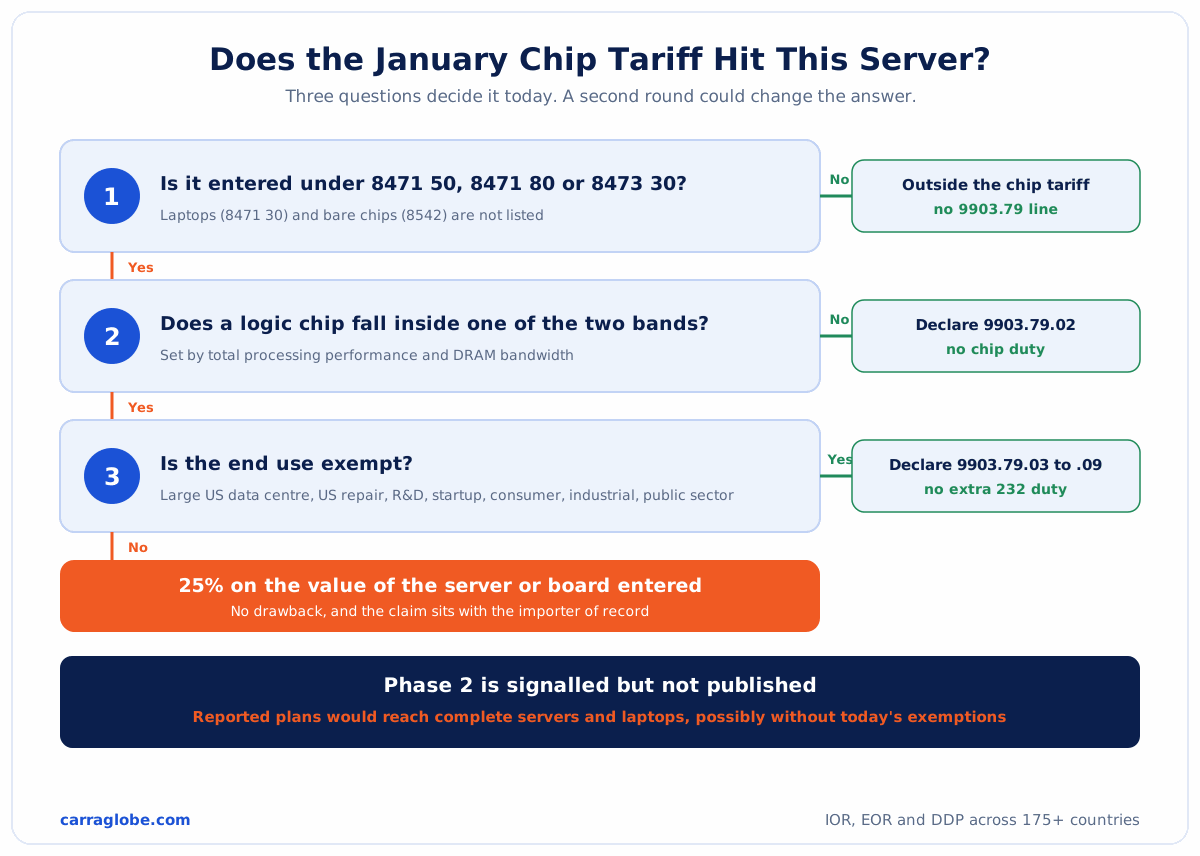
It is a narrow tariff on certain articles containing qualifying chips. Proclamation 11002 adds a 25% Section 232 duty to articles classifiable under 8471 50, 8471 80 or 8473 30 that contain a logic chip whose processing performance and DRAM bandwidth both fall within the same band.
- Band one. Total processing performance above 14,000 and below 17,500, with total DRAM bandwidth above 4,500 and below 5,000 GB/s.
- Band two. Total processing performance above 20,800 and below 21,100, with total DRAM bandwidth above 5,800 and below 6,200 GB/s.
Use chip-level figures, not system marketing. Total processing performance (TPP) equals 2 × MacTOPS × the bit length of the operation, added up across every processing unit on the chip. MacTOPS is the theoretical peak of multiply-accumulate operations, in trillions per second. DRAM bandwidth is the combined bandwidth between the chip and its DRAM, counting HBM and GDDR but not memory reached remotely over an interconnect. Ask the manufacturer for these chip-level specifications, since the server’s headline AI figure will not settle the test.
Outside the listed lines or bands, the additional Section 232 duty does not apply. Articles under those three lines that miss both bands fall under 9903.79.02 with no additional Section 232 duty, and servers classified elsewhere fall outside this measure. Other duties may still apply. Laptops (8471 30) and bare chips (8542) are not listed. Where the duty applies, it is charged on the value of the whole article entered, not the chip alone. See our guides to the HS code for servers, the HS code for GPU chips and importing advanced AI accelerator servers.
The exemptions are end-use claims
Chips inside the bands can still be exempt through an end use. Each qualifying use has its own heading, from 9903.79.03 to 9903.79.09, which removes the additional Section 232 duty but not ordinary duties or other tariffs.
- US data centres. Only a facility requiring more than 100 megawatts of new load dedicated to AI inference, training, simulation or synthetic data generation.
- Repair and replacement carried out in the US.
- Research and development in the US.
- Startups that qualify as emerging growth companies.
- Consumer uses outside data centres.
- Civil industrial uses outside data centres.
- Public sector applications in the US.
Claim it at entry, and keep the proof. The importer claims an exemption by declaring the matching 9903.79 heading on the entry. No advance approval or certification form had been published as at 4 November, although Commerce can add end-use certifications by Federal Register notice. Keep records of where the equipment goes and why, since entry records must generally be kept for five years from the date of entry. A facility adding 100 megawatts or less of qualifying new load falls outside this definition, however large the site. Our guide to AI server import duties in 2026 shows the full landed cost.
What phase 2 could change
The second round is signalled, not published. The January proclamation records Commerce’s recommendation of a broader Section 232 semiconductor tariff at a significant rate, with an offset for companies building in the US, and the White House has said the President may extend tariffs to derivative products. It also directed Commerce to update the President on the data centre chip market by 1 July 2026, and no public release of that update was found by 4 November. No proclamation, notice or comment period existed as at 4 November 2026.
Reporting points at complete systems. Press reports from 27 August said a broader proposal could cover laptops, gaming consoles and data centre servers, possibly phased in. On 2 September, Commerce Secretary Howard Lutnick said companies building in the US would not pay, while others should expect to. These reports relied on unnamed sources, and no official text has confirmed their scope, rates or exemptions.
A second investigation is also open. Since March 2026, Section 301 investigations into excess capacity in 16 economies, including China, Taiwan, Malaysia, Vietnam, Mexico, Japan, Korea and the EU, have covered electronics and semiconductors. No remedy had been published, and it is not server-specific, but it is another possible route to new duties.
How it stacks with other US duties
Existing China-specific Section 301 duties still stack. CBP lists Section 301 first in the order of declared duties, so China-origin goods can pay them alongside the chip tariff, depending on the exact line. In practice, a China-origin server can owe both where both measures cover its classification.
The July 2026 forced labour Section 301 tariff excludes listed IT classifications. It adds 10% or 12.5% to products of 60 economies, with China at 12.5%, and for specified products of the EU, Taiwan, Japan, South Korea and Switzerland the rate is adjusted by reference to the MFN duty.
U.S. note 52(b), claimed under 9903.05.86, excludes specified provisions within 8471, plus 8473 30, 8517 62 and 8542, whether or not the January chip tariff applies. The test runs on the full tariff number, so a server is exempt only if its exact subheading is listed, not simply because it sits in heading 8471. See our guide to the Section 301 electronics exemption.
The IEEPA tariffs are gone, other duties are not. After the Supreme Court decided in February 2026 that IEEPA did not authorise the tariffs at issue, CBP stopped collecting them, and the temporary 10% Section 122 surcharge that followed expired on 24 July 2026. See our guide to the Supreme Court ruling on IEEPA tariffs.
Six steps to take before phase 2 lands
- Classify every line to its full US tariff number, servers, boards and accessories separately.
- Get the chip data from the manufacturer, meaning total processing performance and DRAM bandwidth, so you can show whether the bands apply.
- Document the end use, such as the data centre’s planned load, the R&D project or the repair contract.
- Settle the importer of record, since it declares the 9903.79 heading and carries the liability.
- Confirm the origin and export status, because China-origin servers can carry Section 301 duties, and advanced GPU systems may need export clearance in the country they ship from.
- Model two costs, today’s duty and a scenario where complete servers carry a new tariff without exemptions, using a full landed cost calculation.
Watch the official channels. Changes will arrive as a proclamation, a Federal Register notice or a CBP message, not as press reports. Our guides to CBP customs audits in 2026 and the 2026 customs enforcement order explain why records matter.
Importing servers or GPU systems into the US? Send Carra Globe the model list, chip specifications, origin and end use, and we will confirm the tariff headings, the importer of record and the duty position before anything is booked. Request a US server shipment check.
Who can be the importer
A foreign company can import, with conditions. Under 19 USC 1484, the importer of record must be the owner or purchaser of the goods, or a licensed customs broker designated by the owner, purchaser or consignee. A non-resident corporation also needs a resident agent who can accept legal process, normally in the state of the port of entry, or for remote location filing the state where the filing originates. It must also post a bond with a resident corporate surety.
Many overseas sellers use their customer, a US entity or an importer of record service that names an eligible importer, as our guide to importing IT equipment without a local entity explains.
The importer carries the tariff decision. It declares the 9903.79 heading, any exemption and the value, and answers for them. Under CBP’s notice of 19 August 2026, effective 18 September, CBP can void importer numbers with inaccurate Form 5106 details, and the physical address must be the importer’s actual business location, never that of a registered agent, customs broker, forwarder or any other party. See what an importer of record does and our page on importer of record in the USA.
How Carra Globe handles US server imports
We settle the tariff position before the goods move. Carra Globe arranges importer of record services for servers and GPU systems entering the US, through its own US structure for some shipments and established partners for others, depending on the shipment. We also handle onsite delivery through white glove delivery and larger projects through our importer of record for data centre equipment service.
Carra Globe works through importer-side registrations and local importing structures appropriate to the goods and destinations it accepts, its own in some markets and established local structures in others. Approvals falling outside the available structure are flagged before a delivery date is agreed.
When equipment later leaves the US, we can act as exporter of record, and our IOR by country page covers 175+ countries. For a quote, send your draft commercial invoice with models, quantities, values and origin, chip specifications, battery details, total weight and dimensions, and the delivery address. Reach us at info@carraglobe.com.
United States · Servers · Chip Tariffs
Send the model list and delivery address. We will tell you which tariff headings apply and who should be the importer of record before anything ships.
The January 2026 chip tariff reaches only a narrow band of servers, but a second round could reach complete systems. So the useful conversation is which tariff line and chip data apply, which end use you can document, and who stands as importer of record. Where something sits outside the structure available, you hear that before a delivery date is agreed.
- IOR for AI servers and GPU clusters
- AI GPU import compliance
- Section 232 and full customs value
- Reducing US import duty in 2026
- Claiming IEEPA tariff refunds
- HS codes for electronics and tech
- DDP versus importer of record
- What an importer of record costs
- The cost of incorrect HS codes
- ITAR and EAR on IT hardware shipments
- When servers are held at customs
- Importing used and refurbished IT
- Returned goods and reverse logistics
- Comparing DDP quotes for IT kit
- Global IOR for technology OEMs
Free tools HS Code Finder Volumetric Weight Calculator Pallet Calculator
Importing servers or GPU systems into the US? Send the draft invoice with models, quantities and values, datasheets, battery details, chip specifications, origin, end use, weights and dimensions, and the delivery address. We will come back on the headings, importer, duty position and timing.
Check my US server shipmentFrequently asked questions
Does the 2026 semiconductor tariff apply to complete server systems?
Only where it is classified under 8471 50, 8471 80 or 8473 30, its chips fall in a band and no end use applies. Those missing the bands use 9903.79.02, and other classifications fall outside.
Do I need an importer of record to ship servers to the USA?
Every entry needs an eligible importer of record, such as your customer, your US entity, your own company with a resident agent and bond, or a service that names an eligible importer.
Can a non-US company import servers without a US entity?
Yes, with a resident agent, usually in the port of entry’s state, and a customs bond. Many use an importer of record instead.
What duties apply to servers imported from China?
Existing China-specific Section 301 duties can apply depending on the line, plus the chip tariff where in scope. Only subheadings listed in U.S. note 52(b) escape the July 2026 forced labour tariff.
How do I clear GPU servers through US customs?
Declare the full tariff number with the matching 9903.79 heading, keep the chip specifications and end-use records, and check export control status separately.
What happens if my server shipment is held by US customs?
CBP may ask for specifications, origin, value or end-use evidence. Answer promptly, but release timing depends on the reason for the hold and any further review.
Adjacent ground: the Chip Security Act and AI hardware importers and export controls on data centre hardware.
Sources and verification
Shipment counts and the questions clients ask are Carra Globe’s own, covering US shipments handled by Carra Globe and its team. Regulatory points were checked against official publications on 4 November 2026.
- Chip tariff. Proclamation 11002 in the Federal Register of 20 January 2026, including U.S. Note 39 and headings 9903.79.01 to 9903.79.09.
- CBP guidance. CSMS 67400472 of 14 January 2026 on declaring the semiconductor duties.
- Phase 2 signals. The White House fact sheet of 14 January 2026.
- Forced labour exemptions. The Harmonized Tariff Schedule, 2026 Revision 22, chapter 99, U.S. note 52(b), listing products exempt under 9903.05.86.
- Section 301. USTR’s forced labour Section 301 action of July 2026 and CBP’s implementing guidance.
- Excess capacity investigations. USTR’s notice of 17 March 2026 initiating Section 301 investigations into 16 economies.
- Recordkeeping. 19 USC 1508 and 19 CFR 163.4 on how long customs records are kept.
- Importer of record. 19 USC 1484 on who may make entry, 19 CFR 141.18 on non-resident corporations, and CBP’s notice of 19 August 2026 on accurate importer data.
- Verification note. US tariff actions are changing quickly, and treatment depends on the exact goods, chips, origin and end use. Check the current position for your shipment before relying on this guide. This guide is general information, not advice on your shipment.
Disclaimer: This guide is for informational purposes only and does not constitute legal, customs or tax advice. Requirements depend on the specific equipment, its classification, value, origin and end use, and the parties involved. The position described is as at 4 November 2026. Confirm the current position with CBP or your importer of record before shipping.