
From 1 December 2026, Argentina changes how Wi-Fi routers, access points and other regulated telecom equipment get approved. They still need a registration with ENACOM, the national communications regulator, before anyone can sell or deliver them commercially in Argentina, subject to specific exemptions. What changes is who tests the equipment, how the registration is granted and how long existing approvals last. So if you plan to ship network equipment to Argentina in the coming weeks, check each model’s registration before you book freight.
The short version. From 1 December 2026, new homologation applications for equipment to be sold go through a certification agency recognised by ENACOM, and the registrations granted have no fixed expiry. Existing registrations keep a three-year transition. A registered model can still be sold and delivered while its registration is valid, if the importer is entitled to rely on it. A new model for sale generally needs the new route first, subject to specific exemptions, and customs clearance is a separate check.
Carra Globe provides importer of record, freight forwarding and delivered duty paid services, so we have a commercial interest in your answer. What follows is written to be usable whether or not you ever speak to us.
What changes on 1 December 2026
A new route to the same register. Argentina has required telecom equipment to be listed in RAMATEL, its register of telecom activities and materials, for decades under Resolution 729/80. Resolution 57/2026 approved the procedure that replaces it, and Resolution 843/2026 moved both its start and the repeal of Resolution 729/80 from 1 September to 1 December 2026.
| Aspect | Until 30 November 2026 | From 1 December 2026 |
|---|---|---|
| Procedure | Registrations processed under Resolution 729/80 | New RAMATEL regulation under Resolution 57/2026 |
| Who checks the equipment | ENACOM’s existing process | A recognised certification agency issues a certificate of conformity, and ENACOM grants the registration |
| Validity | Registrations valid on 26 February 2026 run for three years from that date. Those granted under the old procedure since then run for three years from grant. After that, each must move to the new rules or is cancelled automatically | No fixed expiry, but Class A products face market surveillance every two years and registrations can be cancelled |
| Product families | Model by model | One registration can cover a family that shares brand, maker, manufacturing technology, functions, standards and interface characteristics |
What it means for a shipment. Shipments of models already registered carry on as before, within each registration’s validity and subject to the importer’s entitlement covered in question 3. A new model that needs homologation for sale goes through a recognised certification agency, which issues the certificate of conformity on the basis of test reports.
ENACOM published an operating guide for those agencies on 22 October 2026, but its approval pages, checked on 17 November 2026, did not yet list any recognised agency. Ask the registration holder or ENACOM which agency can take your model, and get a testing and approval estimate before you commit to an installation date.
What the agency will ask for. Under ENACOM’s operating guide, the technical file, preferably in Spanish, covers a user manual or brochure, internal and external photos, a block diagram with a description of how the equipment works, a proposed RAMATEL label and test reports on representative samples. Samples need firmware with an RF test mode, and conducted tests need temporary RF ports. For Class A, the reports come from laboratories ENACOM recognises. Other laboratories count only for Class B, in a set order of priority.
ENACOM’s standards page lists five laboratories accredited under the current rules for its Wi-Fi and broadband radio standard, so ask the agency which it can use for your model.
A certificate stays valid while its technical and administrative conditions hold. Adding models to a family, a change in the technical rules or a new country of manufacture means updating it, so tell the holder if your supply chain moves.
Is the date certain? A professional council of telecom engineers went to court in May 2026 to have Resolution 57/2026 suspended, then filed an action to annul it. In September 2026 it described the case as still pending. ENACOM’s approval page, checked on 17 November 2026, still gives 1 December as the start date.
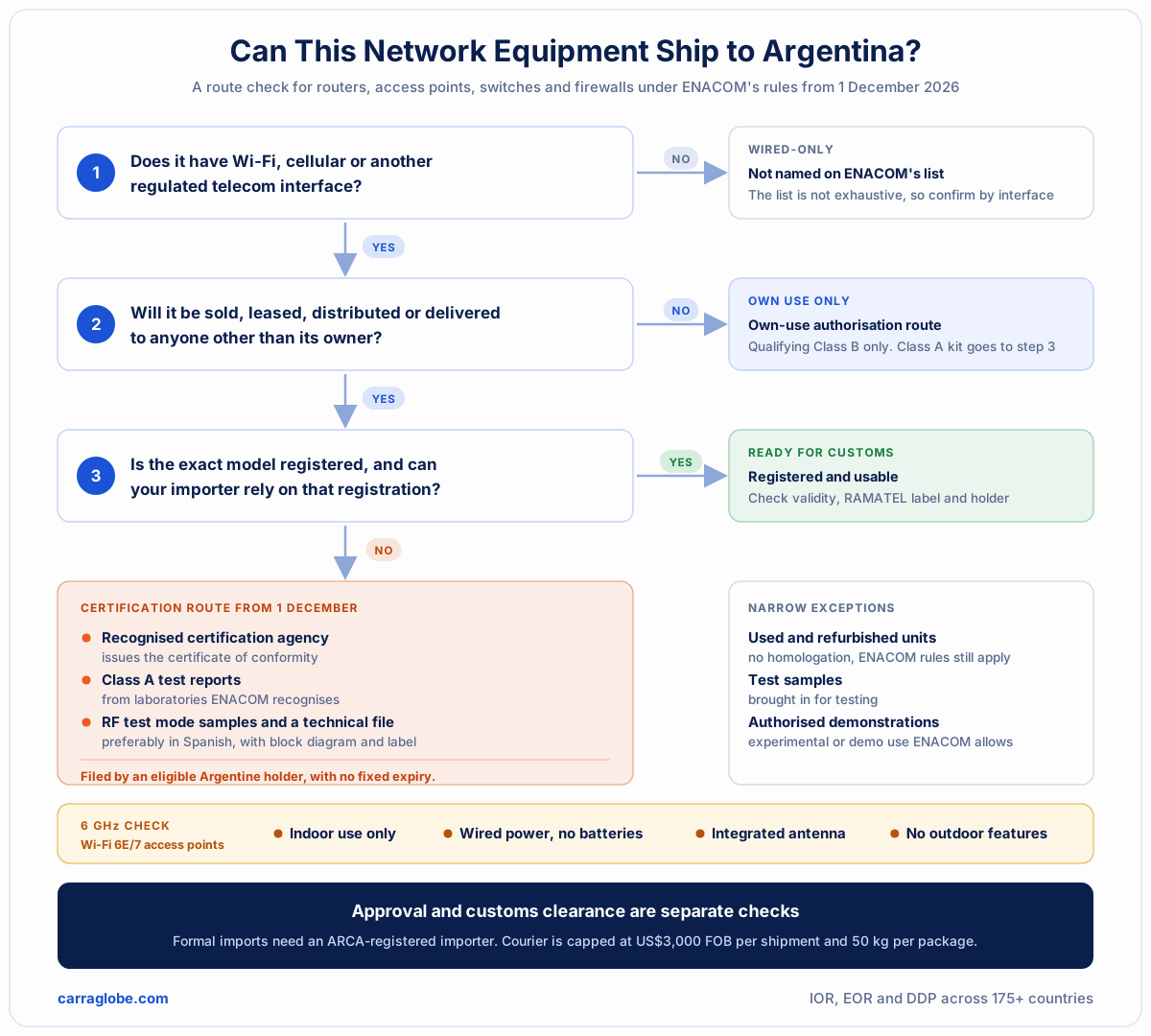
Three questions to answer before you book
1. Is the exact model registered?
Registration attaches to a brand and model, or from December to a product family. ENACOM’s equipment approval page links to its listing of registered equipment, which shows the brand, model, registration number and holder. Check the exact model and part number on your invoice, including any radio module, not just the product line. Units must also carry the identification the rules require.
Which devices are in scope. ENACOM’s list of regulated materials names Wi-Fi routers, access points, gateways and cellular modems. It does not name wired-only switches or firewalls, but the list is not exhaustive, so check each device by its actual interfaces. Encryption, radio approval and product safety can each apply separately, as our guide to encryption import restrictions for network equipment explains.
6 GHz Wi-Fi. Argentina allows the 5,925 to 7,125 MHz band indoors only. Under ENACOM’s broadband radio standard, an access point using it must run on wired power rather than batteries, have no features for outdoor use and, apart from modules, use an integrated antenna. Users must be told about the indoor-only restriction, and that notice can go on a label, the packaging or in the manual. So check the band plan of any Wi-Fi 6E or Wi-Fi 7 access point before you order it for Argentina, especially an outdoor model.
Selling online. Listings must show the RAMATEL registration number, both on suppliers’ own websites and on platforms acting as intermediaries in consumer sales. An advert for a model not yet registered must say that its availability depends on approval.
2. Is the equipment being sold, or used only by its owner?
The registration rule applies to commercialisation, which the regulation defines widely as selling, leasing, distributing, delivering or offering equipment in Argentina. A reseller delivering access points to a client is commercialising them. A separate authorisation route, based on a declaration of conformity, exists for qualifying Class B professional equipment used only by the applicant. Wi-Fi routers and access points sit in Class A, so an internal deployment does not automatically qualify.
Two narrower exceptions exist. Units brought in as test samples, and equipment for experimental or demonstration use within an activity ENACOM has authorised, are excepted from the ban on delivery before approval. Equipment lent rather than sold raises its own valuation questions at the border, as our note on importing when no sale takes place explains.
3. Who holds the registration, and who is the importer?
For equipment to be sold, only parties in RAMATEL’s register of activities can hold the registration. That means a local representative of the manufacturer, a domestic manufacturer or an importer, each with Argentine tax registration. A foreign reseller with no Argentine entity cannot hold one, because a local representative must be a company established in Argentina. The Class B own-use route does not require that register.
Where a local representative holds the registration, an importer it has formally designated can import the model without registering it again. Any other importer cannot assume that someone else’s registration covers its shipment.
The customs importer is a separate role. For a formal import, the party on the declaration must be registered with ARCA, Argentina’s tax and customs agency, and answers for duties, taxes and the accuracy of the entry. If you have no local entity for that role, an importer of record in Argentina provides it.
Three shipments, three different answers
A reseller delivering access points to a client. An integrator ships twenty Wi-Fi access points to a customer’s office in Buenos Aires. That is commercialisation, so each model needs a valid registration held by a registered party, and the units need the required identification. A model registered under the old procedure must still be within its validity. An unregistered model needs the certification agency route and its lead time.
A company sending firewalls to its own office. A multinational ships two firewalls and a switch to its Argentine branch. Wired-only units are not named on ENACOM’s list, so confirm them by their interfaces. A firewall with built-in Wi-Fi or LTE normally falls into Class A and needs a valid registration before it is delivered commercially, subject to the regulation’s exemptions. The declared value and classification still need settling, as our guide to the HS code for routers and switches explains.
A used or refurbished replacement unit. The regulation exempts used, refurbished and artisanal equipment from homologation, but the equipment must still comply with ENACOM’s rules and the user bears the consequences. Used goods raise separate customs questions, as our guide to importing used and refurbished IT equipment explains, so treat this as a narrow exemption. A faulty unit being returned needs its own export process, covered in our guide to returned goods and reverse logistics.
ENACOM approval and customs clearance are separate checks
ENACOM’s rules sit alongside customs rules, not in place of them, as our explainer on what an importer of record does sets out. Whatever the route, the goods must be correctly described, classified and valued, and any duties and taxes due must be paid.
Why a gap can surface after clearance. When Argentina repealed its SEDI import statistics system in February 2025, the joint resolution said compliance with technical standards should be ensured when goods are used or sold, not as a condition of the import declaration. ENACOM’s rules still apply. A missing registration can simply surface later, when the equipment is delivered or offered for sale.
Courier limits. General courier imports, with or without a commercial purpose, are capped at US$3,000 FOB per shipment and 50 kg per package. Goods that need another agency’s approval before clearance can be excluded, so check each shipment with the courier and the customs broker. The separate small shipments regime is only for consignments without a commercial purpose. Companies can also import qualifying samples for prospective buyers within the same limits, but a unit installed permanently on a live project is not a sample. Our guide to resolving and preventing customs holds on IT shipments covers what happens when a shipment is stopped.
Before you book, check these
- Model numbers. The exact model, part number and hardware revision of every device, with any Wi-Fi, Bluetooth or cellular radio noted.
- Registration status. Each regulated model’s RAMATEL number, holder, any importer designation and, for older registrations, the transition deadline.
- Sale or own use. Whether the equipment is commercialised or used only by its owner, since the route differs.
- Registration holder. For a model needing homologation for sale, an eligible holder, the right laboratory evidence (recognised laboratories for Class A, the set priority order for Class B), test-ready samples, the technical file and the certification lead time.
- Importer of record. For a formal import, the registered Argentine importer responsible for the entry, not the end user by default. For a courier shipment, the recipient and the clearance procedure.
- Approval lead times. A delivery date planned around approvals as well as freight, as our guide to certification lead times by country shows.
- Documents. The commercial invoice with model numbers and values, the packing list and the technical datasheets.
- Like-for-like quotes. Every quote covering the importer, duties, taxes and delivery, as our guide to comparing DDP quotes for IT equipment explains.
How Carra Globe handles network equipment into Argentina
Approval status first, freight second. Carra Globe and its partners ship network and IT equipment into Argentina. The importer is a mix by shipment, sometimes our Argentine partner and sometimes the client’s own entity. Our partner is registered with ENACOM and can hold model registrations, so we check every radio-capable model’s status before we book and tell you if anything needs registering first.
When the file is complete and the models are already registered, customs clearance usually takes 1 to 2 working days, not counting any approval work, inspection or hold. Where you need one, we arrange the importer of record through our Argentine partner. If you already have an eligible Argentine entity, we work through it and coordinate customs clearance and white glove delivery to the site.
Carra Globe works through importer-side registrations and local importing structures appropriate to the goods and destinations it accepts, its own in some markets and established local structures in others. Approvals falling outside the available structure are flagged before a delivery date is agreed.
You do not need to know whether your equipment is registered before you contact us. That check is part of the review. To start, send the model numbers, datasheets, quantities, destination city and installation date to info@carraglobe.com or through our contact page. Once we confirm the route, we will need the following.
- The draft commercial invoice with unit values
- Any existing ENACOM registration numbers, and who holds them
- Whether the equipment is being sold or delivered to a client, or used by your own company
- Weights, dimensions and the number of boxes
- The collection and delivery addresses, and the date you need it installed
Argentina · ENACOM · RAMATEL · Network Equipment
Tell us the models and where they are going. We will confirm each one's ENACOM status and the importer before anything ships.
From 1 December 2026, new ENACOM registrations for telecom and network equipment follow the new RAMATEL procedure. So the useful conversation starts with the exact model numbers, whether the equipment is sold or used by its owner, and who will be the importer. Where something sits outside the structure available, you hear that before a delivery date is agreed.
- Import and export permits in Argentina
- Importer of record in Brazil
- Shipping IT hardware to Brazil without an entity
- Importer of record in Colombia
- Importer of record in Uruguay
- Importer of record in Paraguay
- Importer of record in Bolivia
- NOM certification for IT hardware in Mexico
- Importing network equipment into the US
- ATA carnets and temporary imports
- How long customs clearance takes
- Delivery documentation for imports
- DDP or DAP
- Customs clearance for emergency spare parts
- When servers are held at customs
Free tools HS Code Finder Volumetric Weight Calculator Pallet Calculator
Shipping network equipment to Argentina? Send the draft invoice with model numbers, datasheets, any ENACOM registration numbers you hold, whether the equipment is sold or for your own use, weights and dimensions, and the collection and delivery addresses. We will come back on approvals, the importer, customs and timing.
Check my Argentina shipmentFrequently asked questions
What changes with ENACOM on 1 December 2026?
The new RAMATEL regulation applies. New homologation applications for commercialisation need a certificate of conformity from a recognised agency, and registrations have no fixed expiry.
Do I need ENACOM approval to ship routers to Argentina?
New Wi-Fi routers and access points are Class A, so each model needs a valid registration before it is sold or delivered, subject to exemptions. Customs clearance is a separate check.
Who can hold an ENACOM registration?
For commercial homologation, an eligible party in RAMATEL’s register of activities, such as a local representative, domestic manufacturer or importer with Argentine tax registration.
Are old ENACOM registrations still valid?
Yes, for three years. That runs from 26 February 2026 for registrations valid then, or from grant for later old-procedure ones. Each must then move to the new rules or is cancelled.
Can I ship network equipment to Argentina without a local company?
Yes. For a formal import, an eligible Argentine importer of record can act, provided each regulated model is registered and any required importer designation is in place. Some shipments qualify for courier clearance or exemptions.
Do used or refurbished network devices need ENACOM approval?
The new regulation exempts used and refurbished equipment from homologation, but it must still comply with ENACOM’s rules and the user bears the responsibility.
Adjacent ground: the EU and Mercosur trade agreement and your first shipment into a new country.
Sources and verification
This guide is based on ENACOM’s resolutions and guidance and Argentina’s customs rules, as published in the Boletín Oficial and on official government sites, as available on 17 November 2026. Product classes and lead times can change as the new procedure settles, so confirm each model’s status with ENACOM or the registration holder.
- ENACOM. Resolution 57/2026, Boletín Oficial, 26 February 2026, the full text, including the RAMATEL regulation (Annex I sections 7, 8, 9.3, 9.4, 9.5 and 9.10) and the list of regulated materials (Annex IV), Resolution 843/2026, the equipment approval page and the operating guide for certification agencies, 22 October 2026 (guide PDF, sections 3 to 8), the technical standards page with standard ENACOM-Q2-63.02 V23.1, points 5.3 and 5.4, and Resolution 756/2023 on the 6 GHz band.
- ARCA and customs. Joint General Resolution 5651/2025, repealing SEDI, 25 February 2025 and the courier rules in ARCA General Resolution 5883/2026, 29 July 2026, which amends General Resolution 5608/2024, consolidated text with the US$3,000 per shipment and 50 kg per package limits.
Disclaimer: This guide is for informational purposes only and does not constitute legal or regulatory advice. Requirements depend on the equipment, its use, the importer and the date of import. The position described is as at 17 November 2026. Confirm the current position with ENACOM, a licensed customs broker or your importer of record before shipping.