
If you ship laptops, servers, network kit or medical devices by air, the main changes under the air freight rules 2027 concern how equipment batteries are classified, marked and counted, rather than broad new bans. Each consignment still has to meet its packing instruction and the airline’s own rules. The changes are small, and small changes are the ones that slip through a busy dispatch team.
The short version. The 68th edition of the IATA Dangerous Goods Regulations applies from 1 January 2027. For equipment shippers, the battery mark moves to the current version without a phone number, button cells installed in equipment no longer count towards the battery mark exemption, and sodium-ion batteries are added across more of the rules. The 30% state of charge limit for many lithium-ion batteries packed with equipment, in force since 1 January 2026, stays.
Carra Globe provides freight forwarding, importer of record and white glove delivery services, so we have a commercial interest in your answer. What follows is written to be usable whether or not you ever speak to us.
What changes on 1 January 2027
The rule book changes edition. Airlines apply the IATA Dangerous Goods Regulations, built on the ICAO Technical Instructions. The 68th edition takes effect alongside ICAO’s 2027 to 2028 edition, and each airline can add stricter variations of its own.
| Change | What it means for your shipment |
|---|---|
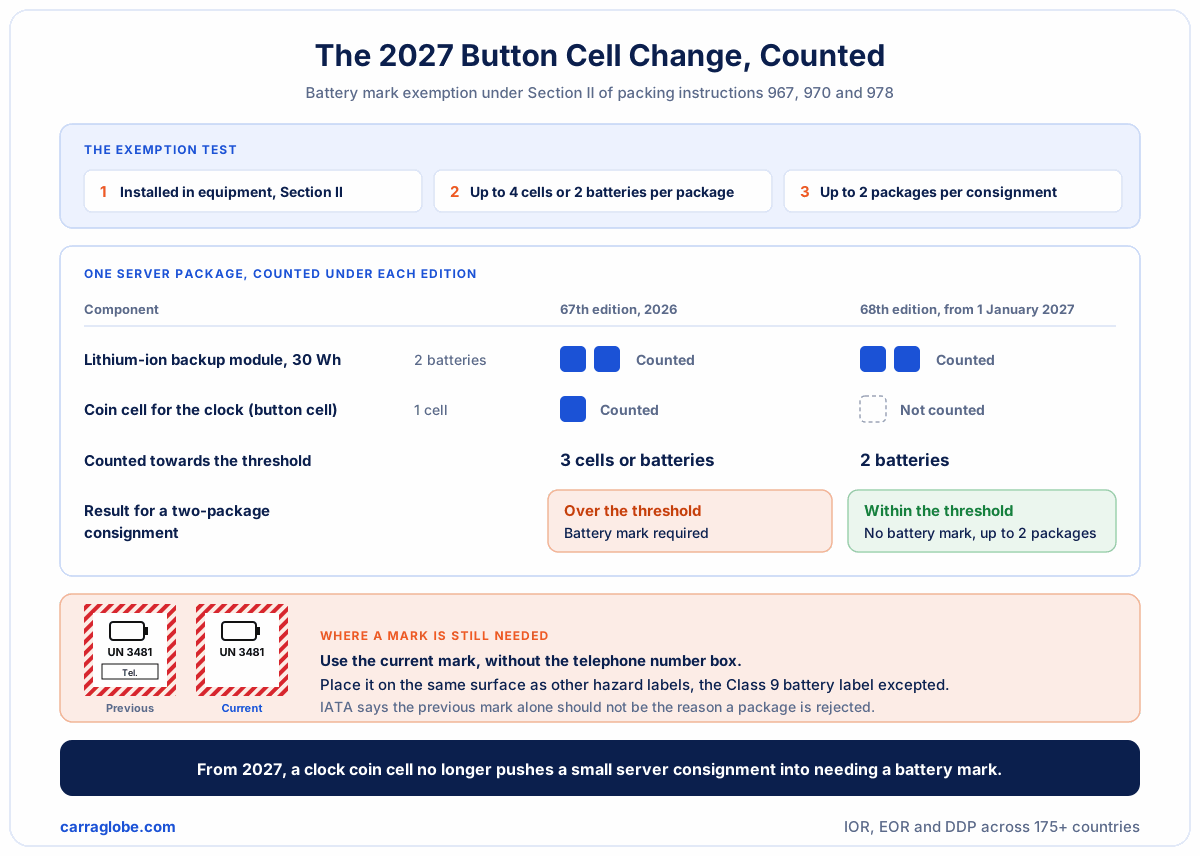
| Battery mark | Use the current mark, which has no box for a phone number. IATA says the older mark alone should not be the reason a package is rejected, but shippers are expected to switch. |
| Mark placement | Where a package needs the battery mark and other hazard labels besides the Class 9 battery label, the mark goes on the same side as those labels. |
| Button cells | In Section II of packing instructions 967, 970 and 978, installed button cells no longer count towards the 4 cell or 2 battery threshold for the battery mark exemption. |
| Sodium-ion batteries | Added to more packing instructions and special provisions, with new special provision A235 for classifying hybrid lithium and sodium batteries. |
| Equipment and vehicles | Special provision A214 adds guidance on telling battery-powered equipment apart from battery-powered vehicles. |
| MRI machines | New special provision A236 covers the transport of modern MRI machines. |
| Overpacks | An overpack need not repeat every marking on the packages inside, although required marks and labels must still be visible or reproduced. |
Why the button cell change matters. Under Section II of packing instruction 967, a consignment of up to two packages, each with no more than 4 cells or 2 batteries installed in equipment, needs no battery mark. Many servers and laptops carry a coin cell for the clock that used to count, so from 2027 more small consignments fall inside the exemption, as the server example below shows.
Engineers flying with kit. Passenger rules are separate. Each person may carry no more than two power banks, which must not be recharged on board, and from 2027 power banks over 100 Wh are forbidden and the usual spare battery allowance falls from 20 to 18.
Key dates
- 1 January 2026. The mandatory 30% state of charge limit applies to lithium-ion batteries packed with equipment, in Section I and for Section II cells and batteries over 2.7 Wh.
- 27 March 2026. An ICAO addendum limits passengers and crew to two power banks each.
- 1 January 2027. The 68th edition of the IATA Dangerous Goods Regulations and ICAO’s 2027 to 2028 edition apply.
Which entry applies to your equipment
The UN number and packing instruction depend on the battery chemistry and on whether the batteries travel alone, packed with the equipment they power, or installed in it.
| How the batteries travel | Lithium-ion | Lithium metal | Sodium-ion (organic electrolyte) | Passenger aircraft |
|---|---|---|---|---|
| On their own | UN 3480, PI 965 | UN 3090, PI 968 | UN 3551, PI 976 | No, cargo aircraft only* |
| Packed with equipment | UN 3481, PI 966 | UN 3091, PI 969 | UN 3552, PI 977 | Yes, within package limits |
| Installed in equipment | UN 3481, PI 967 | UN 3091, PI 970 | UN 3552, PI 978 | Yes, within package limits |
*Ordinary rules. In exceptional cases, special provision A201 lets some batteries travel on passenger aircraft with the required State approvals, and A334 sets the quantity and packaging conditions the authorities consider. The airline must still accept the shipment.
Section II or Section I. For lithium-ion batteries packed with or installed in equipment, the size of each cell and battery decides which rules apply.
| Section II | Section I | |
|---|---|---|
| Applies to | Cells up to 20 Wh and batteries up to 100 Wh | Larger cells and batteries |
| Battery weight per package | Up to 5 kg | Batteries in equipment, 5 kg on passenger aircraft and 35 kg on cargo aircraft |
| Marks and labels | Battery mark, unless the small-consignment exemption for batteries in equipment applies | Class 9 lithium battery label, no battery mark |
| Paperwork | Air waybill compliance statement where the battery mark is applied | Shipper’s declaration, prepared by trained staff |
Lithium-ion batteries shipped on their own never qualify for Section II and follow Section IA or IB of packing instruction 965.
Two cases that catch shippers out. A lithium UPS is not automatically equipment. IATA treats the battery entry as the starting point, and a UPS may count as equipment with batteries inside where the battery is not a significant part of its mass or volume. And batteries damaged or defective in a way that could cause dangerous heat, fire or a short circuit are forbidden by air, including in equipment recalled for a battery safety defect. Other defects, such as a faulty charge light, need a separate assessment.
What already applies and does not change
- 30% state of charge for batteries packed with equipment. Mandatory for lithium-ion batteries in Section I and for Section II cells and batteries over 2.7 Wh. A higher charge needs approval from the State of Origin and the State of the Operator under special provision A331.
- A recommendation for batteries inside equipment. IATA strongly recommends no more than 30% state of charge, or no more than 25% indicated capacity. It is not mandatory.
- The UN 38.3 test summary. The maker and later distributors must make it available on request, on paper or online, for each cell and battery type, except equipment whose only lithium cells are button cells. It need not travel with every shipment unless a state or airline asks. Our guide to lithium battery customs clearance covers the import side.
- Loose batteries fly cargo aircraft only. Where air is impractical, sea freight follows the IMDG Code instead, as our note on dangerous goods shipping by sea explains.
What to check, by type of equipment
Laptops and tablets
Laptops ship with the battery installed, under packing instruction 967. A spare packed with the laptop falls under packing instruction 966 and the 30% limit, since a typical laptop spare is well over 2.7 Wh. A power bank, or a battery shipped without the laptop, counts as a battery on its own and is cargo aircraft only. Our guide on how to ship laptops to Europe covers the customs side.
Servers, storage and UPS units
A worked example. Two rack servers ship in two cartons, each holding two 30 Wh lithium-ion backup modules and a coin cell for the clock. In 2026 each carton counted three cells or batteries, over the threshold, so the consignment needed the battery mark. From 2027 the coin cell is left out, each carton counts two, and no mark is needed. A third carton, or a lithium UPS classed as a battery, changes the answer, as our guide to shipping server racks by air freight shows.
For full data centre fit-outs, check each item’s batteries separately, as our note on data centre construction freight explains.
Network and radio equipment
Routers, switches and access points often carry only a coin cell. Handheld radios and portable access points with smaller lithium-ion packs usually ship under Section II, and need the battery mark unless the two-package exemption applies, while larger packs move to Section I. Radio equipment also needs approval in many destinations, as our guide to how you import network equipment into the US explains.
Medical devices
A worked example. A patient monitor ships with its battery installed and a spare in the same carton. The mixed-package rules apply, including special provision A181 where relevant. The package is marked as UN 3481, lithium-ion batteries packed with equipment, both packing instructions must be met, and the total battery weight must stay within the package limit. The documents follow Section I or Section II, depending on the battery ratings and the packing instruction’s conditions, and a spare over 2.7 Wh must be at no more than 30% charge.
Take the watt-hour rating of each cell and of the complete battery from the maker’s specification, not the device label. The import rules are separate again, as our page on importer of record for medical devices explains.
Before you book, check these
- Classify each battery. Chemistry, watt-hour rating, and whether it travels alone, packed with the equipment or installed in it.
- Check battery condition. Rule out damage or safety defects that could cause dangerous heat, fire or a short circuit.
- Have the UN 38.3 test summary. Or the maker’s link to it, for each battery type.
- Mark and label correctly. The current battery mark where needed, on the same side as other hazard labels apart from the Class 9 battery label, and not covered by tape or straps.
- Protect the batteries. Against short circuits and damage, with equipment protected against accidental activation where required, in packaging that meets the packing instruction.
- Check state of charge. Meet the 30% limit where it applies, and be ready to confirm it.
- Check the airline’s variations. Many airlines set stricter rules than IATA, including limits on passenger aircraft.
- Plan for cargo aircraft. Cargo aircraft only shipments have fewer flights, so book early on busy lanes, as our Asia air cargo capacity update shows.
- Check insurance and tariff codes. Confirm the policy covers declared battery shipments, as our guide to cargo insurance for IT equipment explains, and classify separate batteries by chemistry with our guide to the HS code for lithium batteries.
How Carra Globe handles battery-powered equipment by air
Battery checks are part of the booking, not an afterthought. Carra Globe and its team ship laptops and tablets, servers, storage and UPS units, network and radio equipment and medical devices by air, which carries most of our freight, including 130+ laptop shipments into EU countries. Dangerous goods documents, including the shipper’s declaration where one is needed, are prepared by our own trained staff or through certified airline and forwarding partners, depending on the lane.
What you get from a pre-booking review. We confirm the UN number, packing instruction and Section, the marks, labels and documents needed, any information still missing and whether the shipment can fly on passenger aircraft or needs a cargo aircraft, then check the airline’s requirements. The shipper stays responsible for describing the goods correctly, with our help where needed, and the airline makes the final acceptance decision.
Where available, we act as importer of record at destination, and as exporter of record for shipments leaving a market. Carra Globe works through importer-side registrations and local importing structures appropriate to the goods and destinations it accepts, its own in some markets and established local structures in others. Approvals falling outside the available structure are flagged before a delivery date is agreed.
To start, send the following to info@carraglobe.com or through our contact page.
- Equipment and battery make and model, with datasheets
- Battery chemistry, watt-hour rating and the number of cells and batteries per unit and per carton
- Whether batteries are installed, packed with the equipment or shipped on their own
- Battery condition, and the UN 38.3 test summary or the maker’s link to it
- The draft commercial invoice, weights, dimensions and number of cartons
- Collection and delivery addresses, and the date you need delivery
Air Freight · Lithium Batteries · Dangerous Goods · 2027
Tell us what the equipment is and what batteries it carries. We will confirm the packing, paperwork and flight before anything ships.
From 1 January 2027, the 68th edition of the IATA Dangerous Goods Regulations applies to every air shipment with batteries. So the useful conversation starts with the battery type, its rating and how it is packed. Where something sits outside the structure available, you hear that before a delivery date is agreed.
- When servers are held at customs
- Resolving and preventing customs holds on IT shipments
- Customs clearance for emergency spare parts
- Exporting equipment for repair
- Exporting retired AI hardware
- AI and GPU import compliance
- CE marking duties for importers
- Delivery documentation for imports
- Your first shipment to a new country
- How long customs clearance takes
- DDP or DAP
- Comparing DDP quotes for IT equipment
- HS code for medical devices
- ATA carnets and temporary imports
- Protecting high-value cargo
Free tools HS Code Finder Volumetric Weight Calculator Pallet Calculator
Shipping battery-powered equipment by air in 2027? Send the draft invoice, datasheets, the battery safety data sheet and UN 38.3 test summary, how the batteries are packed, weights and dimensions, and the collection and delivery addresses. We will come back on packing, flights, customs and timing.
Check my battery shipmentFrequently asked questions
What changes in air freight rules on 1 January 2027?
The 68th edition of the IATA Dangerous Goods Regulations applies. For equipment, it phases out the old battery mark, sets where the mark goes and adds sodium-ion batteries.
Can I still use the lithium battery mark with a phone number?
Use the current mark without a phone number. IATA says the old mark alone should not cause rejection, but shippers are expected to switch to the current version.
Do button cells count towards the battery mark exemption?
Not from 2027. In Section II of packing instructions 967, 970 and 978, installed button cells no longer count towards the 4 cell or 2 battery threshold for the exemption.
Do batteries in equipment need 30% state of charge?
For lithium-ion batteries installed in equipment, it is strongly recommended, not mandatory. Lithium-ion batteries packed with equipment have needed 30% or less since 1 January 2026, except Section II batteries of 2.7 Wh or less.
Can lithium batteries in equipment fly on passenger aircraft?
Yes, batteries installed in or packed with equipment can, within package limits and airline rules. Lithium-ion batteries shipped on their own are cargo aircraft only.
What documents do I need to ship batteries by air?
The UN 38.3 test summary must be available on request, marks and labels must be correct, and Section I needs a shipper’s declaration. IATA does not require a safety data sheet.
Do sodium-ion batteries follow the same rules?
They have their own UN numbers and packing instructions, modelled on the lithium ones. The 2027 edition adds them to more provisions and sets how to classify hybrid batteries.
Can I ship servers with lithium UPS batteries by air?
Yes, but IATA treats a lithium UPS as a battery first, which can make it cargo aircraft only. It may count as equipment where the battery is not a significant part of the unit.
Do airlines add their own battery rules?
Yes. Airlines publish operator variations that can be stricter than IATA, including limits on passenger aircraft, so check the carrier before booking.
Adjacent ground: EU air cargo security in 2026 and the EU Batteries Regulation for importers.
Sources and verification
This guide is based on IATA’s published list of changes for the 2027 edition, its current battery guidance and ICAO’s 2026 addendum, as available on 15 November 2026. The full 2027 manuals are licensed publications, so check specific provisions against them or with a trained dangerous goods specialist.
- IATA. The list of significant changes for the 68th edition (2027), the Dangerous Goods Regulations page, the lithium and sodium-ion battery guidance document, 2026, the lithium batteries page and the guidance to operators on power banks.
- ICAO. The Technical Instructions for the Safe Transport of Dangerous Goods by Air, 2027 to 2028 edition (Doc 9284) and Addendum No. 1 to the 2025 to 2026 edition, 27 March 2026.
Disclaimer: This guide is for informational purposes only and does not constitute legal or dangerous goods advice. Requirements depend on the battery type, its rating and how it is packed, the aircraft and the airline. The position described is as at 16 November 2026. Confirm the current position with the airline, a trained dangerous goods specialist or your freight forwarder before shipping.