
Most FCC Covered List headlines over the past year have been about drones and home Wi-Fi routers. The change that matters more for enterprise IT arrived on 13 October 2026, and it sits one layer down, inside the bill of materials. A new model can now be refused FCC authorisation because of who made a chip or module inside it. If you import network equipment into the US, or move servers and access points through US customs clearance, that is the part to read first.
The short version. From 13 October 2026, a device can be refused FCC authorisation if it contains a logic-bearing part made by a company named on the Covered List, such as Huawei or ZTE, where the device would be barred had that company made all of it. Existing authorisations are not cancelled by this rule, though the exact model, its configuration and any later changes still need checking. The router entry added in March 2026 covers consumer-grade routers, and the FCC’s own guidance places enterprise equipment outside it. New models and later component swaps are where enterprise shipments are most exposed.
Carra Globe provides importer of record, exporter of record, delivered duty paid and freight forwarding services, so we have a commercial interest in your answer. What follows is written to be usable whether or not you ever speak to us.
What changed on 13 October 2026
The ban now looks at parts, not just the brand on the box. FCC 26-50, the Third Report and Order in ET Docket 21-232, was adopted on 22 July 2026, published on 11 September and took effect on 13 October. Under the amended 47 CFR 2.903, a device cannot be authorised if it contains a logic-bearing hardware component produced by a Covered List entity, where the device would be barred had that entity made the whole thing. That covers certification, the supplier’s declaration route and equipment that would otherwise be exempt.
“Logic-bearing” is wider than it sounds. The definition, now in 47 CFR 2.902, means any physical part, from an integrated circuit to a sub-assembly, that uses digital techniques and timing signals above 9,000 cycles a second, or that generates and uses radio-frequency energy to process data. In practice that is processors, controllers, network chips and modules. The FCC says housings, fasteners, resistors, wiring and plain battery cells fall outside it, and software and firmware are not covered for now.
Only producer-based entries trigger it. The component rule follows the Covered List entries that name a company, such as telecommunications equipment produced by Huawei or ZTE. It does not reach the newer location-based entries, like routers produced in a foreign country, unless the component maker is separately listed. Some entries, including those for Hytera, Hikvision and Dahua, only apply to certain uses, so the result can depend on where the equipment ends up.
Existing grants are not cancelled by this rule. The component prohibition is prospective, although a separate FCC procedure can limit existing authorisations of covered equipment after public notice. Applications pending on 13 October are exempt unless they are later amended to add, swap or change a logic-bearing part. The order adds no new duty to trace component lineage, but supplier records showing who made each logic-bearing part are still the evidence you will want if a filing or shipment is questioned.
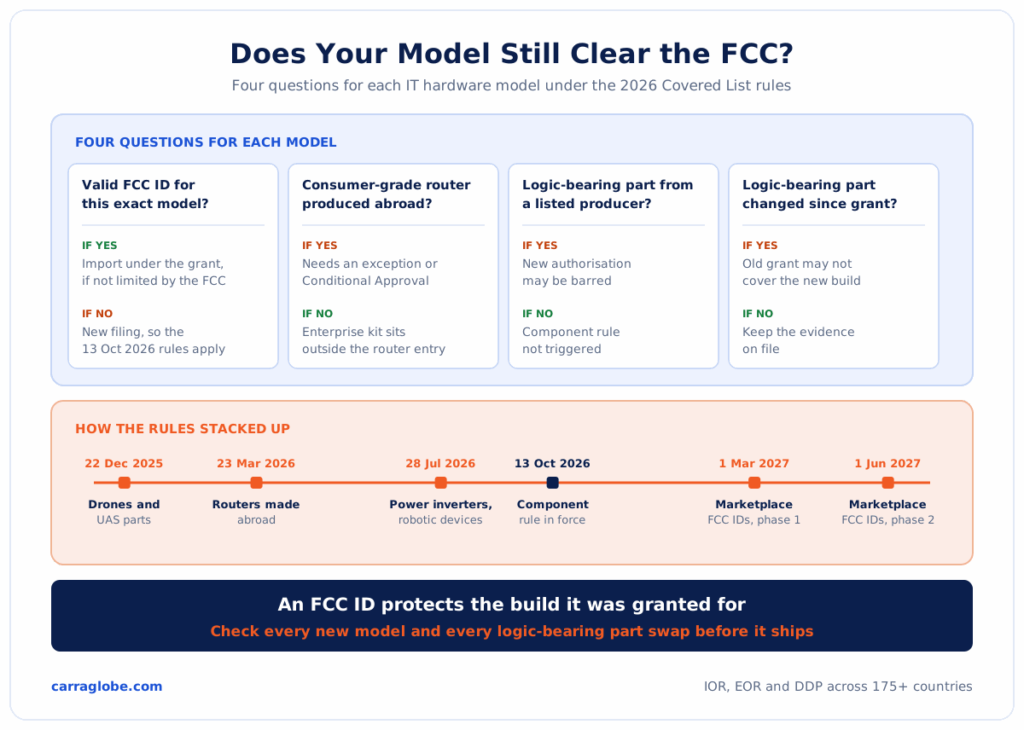
New Covered List entries since December 2025
Four location-based entries now sit alongside the named companies. They work differently from the component rule. A new model in one of these categories, made abroad, may be unable to get FCC authorisation unless it fits an exception or holds a Conditional Approval. The approving body differs by entry, with the Department of War or the Department of Homeland Security named for routers and inverters and the Department of War alone for robotic devices, so check the FCC notice for your category.
| Covered List entry | Added | What an IT importer should check |
|---|---|---|
| UAS and UAS critical components produced in a foreign country | 22 December 2025 | Mainly drone programmes, with listed exceptions |
| Routers produced in a foreign country, unless granted a Conditional Approval | 23 March 2026 | Whether the model is a consumer-grade router under the FCC’s definition |
| Foreign-produced power inverters, unless granted a Conditional Approval | 28 July 2026, definition revised 20 August 2026 | Whether rack, site or renewable power equipment falls within the revised definition. Inverters eligible for the Section 45X advanced manufacturing tax credit for domestic production are not treated as foreign-produced, subject to the FCC’s conditions |
| Foreign-produced advanced robotic devices, unless granted a Conditional Approval | 28 July 2026 | Warehouse and data centre automation on the same basis, see IOR for robotics |
“Produced” includes design, not just assembly. For routers, the FCC’s guidance says production covers any major stage, including manufacturing, assembly, design and development. A router designed in one country and built in another can therefore still count as produced abroad. Conditional Approvals are granted by product series with end dates, and the FCC publishes them, so check the current list rather than a supplier’s slide deck.
Is your router “consumer-grade”? FCC guidance follows a NIST definition of devices mainly for residential use that the customer can install. It counts retail, self-installed small business routers, home gateways, ISP-installed home routers and home LTE or 5G units. Industrial, enterprise and military equipment, optical network terminals and femtocells fall outside it. A data centre switch or a carrier-grade router is not caught by this router entry, though the component rule can still apply if a listed producer made a logic-bearing part. Judge by the FCC definition, not a marketing label.
What still clears US customs
A valid FCC authorisation is the starting point. The FCC says foreign-produced routers that already hold an authorisation may continue to be imported, sold and used. Under 47 CFR 2.1204, an RF device can be imported if it holds a valid authorisation, if it does not need one and meets the FCC’s rules, or under one of the listed exceptions. The ultimate consignee must be able to document which condition it relied on. Check that the grant has not been limited under 47 CFR 2.939(e) and that it matches the exact model, variant and configuration being shipped.
Who stands as importer matters for the FCC file too. For equipment on the supplier’s declaration route, 47 CFR 2.909 requires a responsible party located in the US, and for imported equipment that role can fall on the importer. A foreign company with no US entity can still enter goods through customs if it appoints a resident agent and posts a bond under 19 CFR 141.18. These are separate duties. An importer of record in the USA can handle the customs entry, bond and records, but the FCC responsible party for each product still needs to be named and agreed.
Kit without a grant has three narrow routes in. The general rules in 47 CFR 2.1204 let unapproved devices enter for testing or pre-sale staging, but never for sale. For new foreign-produced router models, FCC guidance refers to small batches for development, so check the route for any covered device first. Neither route is automatically open to every device the Covered List rules affect.
| Route | Quantity | Main conditions |
|---|---|---|
| Testing and development, 2.1204(a)(3) | Up to 4,000 units per model | Not sold or marketed. More needs written approval from the FCC’s Office of Engineering and Technology |
| Pre-sale staging, 2.1204(a)(11) | Up to 12,000 units per expected FCC ID | Tested at an FCC-recognised lab and filed with a certification body. Removable “cannot be delivered, displayed or operated” label, no delivery to end users, records kept 60 months. Only useful where certification is available, so not for covered equipment |
| Proposed limit for covered equipment | 40 units | Proposed alongside FCC 26-50 and published on 7 August 2026. Comment periods closed in September 2026, and it is not current law as at publication |
Keep the evidence with the shipment, not in someone’s inbox. For each model, hold the FCC ID or supplier’s declaration, the grantee name and the exact model and variant on the invoice. Our guides on the HS code for routers and switches and the HS code for servers cover the classification side, and a CBP customs audit is where gaps in that file tend to surface. If a shipment is already stopped, see our note on a customs hold on servers.
Where enterprise shipments get caught
New models are the first pressure point. Radio equipment appeared in between 25% and 50% of the 1,500+ US shipments handled by Carra Globe and its team, and more than 300 included routers, switches or access points. That is the hardware most likely to go through a fresh authorisation when a vendor refreshes a product line, from campus networking to AI servers and GPU clusters, and a fresh filing is exactly where the component rule bites.
“Equivalent” part swaps are the quiet risk. A supplier changes a controller or radio module mid-cycle because of availability and calls it like for like. That change may need a new filing or review, depending on the FCC’s modification rules and whether the revised device would itself be barred from authorisation. Ask suppliers to notify you of logic-bearing component changes before they ship, not after, and apply the same check to emergency spare parts.
Radio modules carry their own history. Under the earlier rules a device became covered if it contained a covered modular transmitter, and that still stands. Servers and laptops with embedded Wi-Fi, Bluetooth or cellular modules deserve a module-level check. The same goes for used and refurbished IT equipment, where the original authorisation record is often the first thing missing.
If you also sell online, the dates are in 2027. Listing equipment on a marketplace alongside fulfilment or similar services now counts as marketing. Marketplaces with physical access to or title over the goods must show a valid FCC ID from 1 March 2027, and those relying on seller certification from 1 June 2027. Our page on importer of record for VARs and technology resellers covers the reseller side.
Bringing a new model or a refreshed product line into the US? Send Carra Globe the model list with FCC IDs, radio modules and destination, and we will tell you where the Covered List rules could affect the shipment before it leaves. Request a US import check.
A five-step check before your next US order
- Pull the FCC ID for every model and variant on the order, and confirm the grant covers the exact configuration you are buying.
- Flag anything new, meaning models with no grant yet, or filings made on or after 13 October 2026.
- Ask who made the logic-bearing parts, the actual producer rather than the distributor, for processors, network chips and radio modules.
- Check router and power products against the location-based entries and the FCC’s current list of Conditional Approvals.
- Lock component changes in the contract, so a supplier cannot swap a logic-bearing part without telling you first.
How Carra Globe handles US network equipment shipments
We look at the FCC position before we accept a US shipment. Carra Globe acts as importer of record for IT, data centre and network hardware entering the US, with a self-operated US office. See our pages on the importer of record in the USA, importer of record for telecom equipment, importer of record for data centre equipment and global IOR for technology OEMs.
Carra Globe works through importer-side registrations and local importing structures appropriate to the goods and destinations it accepts, its own in some markets and established local structures in others. Approvals falling outside the available structure are flagged before a delivery date is agreed.
When equipment later leaves the US, Carra Globe can act as exporter of record, and export controls on data centre hardware may apply on the way out. Wider coverage across 175+ countries is on our IOR by country page.
For a US quote, send us your draft commercial invoice, datasheets with FCC IDs, the delivery address and the date the goods need to arrive. Reach us at info@carraglobe.com.
United States · FCC · Importer Of Record
Send the model list. We will tell you where the Covered List rules could touch your US shipment.
From 13 October 2026, a new model can be refused FCC authorisation because of who made a logic-bearing part inside it, and foreign-produced consumer routers need a Conditional Approval. So the useful conversation is which models already hold an FCC ID, which are new, and which parts have changed since the grant. Where something sits outside the structure available, you hear that before a delivery date is agreed.
- EU Cyber Resilience Act for importers
- Shipping AI servers internationally
- CBP heightened import disclosures
- Customs enforcement order and IORs
- UFLPA detentions and the IOR
- Section 232 on full customs value
- Reducing US import duty in 2026
- Certificates of origin for US imports
- IOR for system integrators
- How to choose an importer of record
- What an importer of record costs
- Lithium battery customs clearance
- Importer of record in Canada
- Importer of record in Mexico
- HS codes for electronics
Free tools HS Code Finder Volumetric Weight Calculator Pallet Calculator
Shipping servers, switches or access points into the US? Send the model numbers with FCC IDs, radio modules, quantities and your arrival date. We will come back on the FCC position and the import route.
Check my US shipmentFrequently asked questions
Does the component rule affect equipment already authorised?
Not directly. It applies prospectively from 13 October 2026, subject to transition rules, but later part changes may need review and covered equipment grants can be limited separately.
Are enterprise routers on the FCC Covered List?
Not under the router entry. The FCC’s guidance places industrial, enterprise and military equipment outside “consumer-grade router”, while small business routers sold at retail and self-installed are inside it.
Can I still import a foreign-made router that already has an FCC ID?
Yes. The FCC says previously authorised foreign-produced routers may continue to be imported, sold and used. New models need a Conditional Approval before they can be authorised.
What is a logic-bearing hardware component?
A physical part using digital techniques and timing signals above 9,000 cycles a second, or radio-frequency energy to process data, such as a processor or module. Passive parts like housings and resistors are excluded.
Can I import unauthorised samples for testing?
The current general rule allows up to 4,000 units of a model for testing or development, provided none are sold. The FCC has proposed a lower limit for covered equipment, so check first.
Do I need an importer of record to ship network equipment to the US?
Not always. A foreign company can enter goods with a US resident agent and bond. An importer of record can handle the entry and documents, while the FCC responsible party is agreed separately.
Does the rule cover software or firmware?
Not at present. The FCC declined to extend the component prohibition to software or firmware, though it kept wider component questions open for a later decision.
Adjacent ground: what an importer of record does, IT hardware certification lead times by country, the Chip Security Act for AI hardware importers and encryption rules for network equipment.
Sources and verification
Shipment figures are Carra Globe’s own, covering shipments handled by Carra Globe. Regulatory points were checked against FCC, Federal Register and eCFR publications on 24 October 2026.
- The component rule. FCC 26-50, Third Report and Order in ET Docket 21-232, as published in the Federal Register on 11 September 2026 and effective 13 October 2026.
- The rule text. 47 CFR 2.903 on prohibited authorisations, including logic-bearing components and modular transmitters, with the definition of a logic-bearing hardware component in 47 CFR 2.902.
- The US responsible party. 47 CFR 2.909, requiring the supplier’s declaration responsible party to be located in the US.
- Nonresident importers. 19 CFR 141.18, on resident agents and bonds for nonresident corporations entering goods.
- Marketplace obligations. FCC 26-50 also sets the 1 March 2027 and 1 June 2027 compliance dates for online marketplaces, in new 47 CFR 2.803(c).
- Proposed testing limit. The Third Further Notice of Proposed Rulemaking adopted with FCC 26-50 and published on 7 August 2026, proposing a 40-unit testing limit for covered equipment.
- Limiting existing grants. The Second Report and Order, FCC 25-71, effective 26 December 2025, which allows existing authorisations of covered equipment to be limited under 47 CFR 2.939(e).
- Imports. 47 CFR 2.1204 on import conditions, including the 4,000-unit testing allowance, the 12,000-unit pre-sale condition and the consignee’s documentation duty.
- The list. The FCC Covered List, including the entries for UAS, routers, power inverters and advanced robotic devices, and the Conditional Approvals.
- Routers. The FCC’s FAQs on routers produced in foreign countries (updated 12 May 2026), covering scope, production, imports and samples.
- Power inverters and robots. The FCC’s FAQs on advanced robotic devices and power inverters, including the 20 August 2026 revision.
- Conditional Approvals. FCC Public Notice DA 26-775 of 27 July 2026, listing approved router series.
- Verification note. The FCC updates the Covered List and its Conditional Approvals often, so check the current position for each model before relying on this guide. Nothing here is advice on your shipments.
Disclaimer: This guide is for informational purposes only and does not constitute legal, customs or regulatory advice. Whether a device is affected depends on its classification, its components, who produced them and how it will be used. The position described is as at 27 October 2026. Confirm the current position with the FCC or your importer of record before shipping.