
Send switches, access points, laptops or a server to Vietnam by DHL or UPS and the courier still collects the box and delivers it. What happens at customs in between changed on 16 November 2026, when the Ministry of Finance’s Circular 142/2026/TT-BTC took effect.
For an IT reseller, integrator or IT team, the practical question is this. Will the box clear on the simplified courier route, or does it need a full import declaration with a named importer? Many enterprise IT orders need the second, and the sections below explain why and what to have ready.
The short version. Vietnam’s simplified courier route only covers goods worth VND 1,000,000 or less (roughly USD 39 at November 2026 rates) that need no licence, certification or inspection. Many business IT shipments fail one of those tests, so they clear on a full declaration under a Vietnamese importer’s tax code. Since 16 November 2026, goods that do qualify also need an electronic identity check.
Carra Globe provides importer of record and delivered duty paid services, so we have a commercial interest in this topic. The route check below works whether or not you ever ship with us.
What Circular 142 changed on 16 November
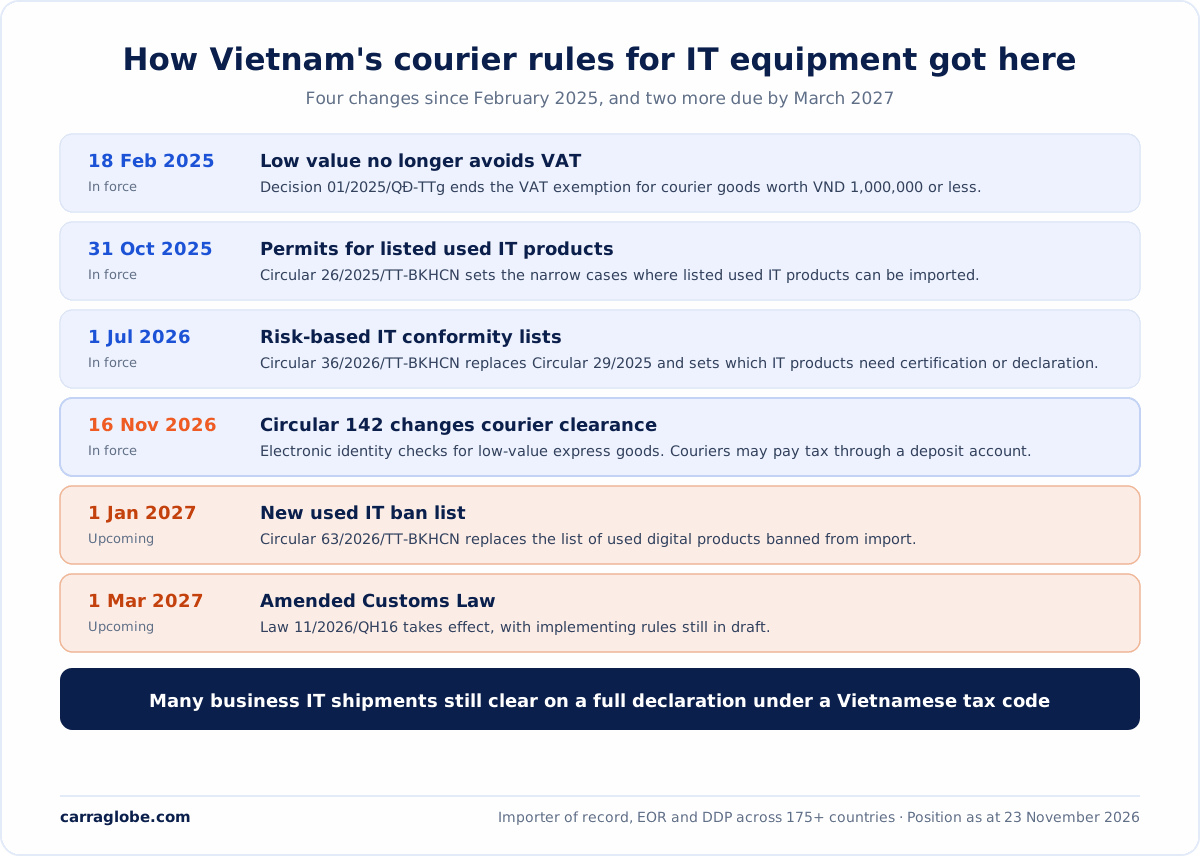
Two circulars amended at once. Circular 142/2026/TT-BTC was signed on 29 September 2026 and took effect on 16 November 2026. It amends Circular 191/2015/TT-BTC on international express delivery and Circular 49/2015/TT-BTC on postal goods. Three changes matter for IT equipment.
- Electronic identification. Express shipments fall into documents (Group 1), qualifying low-value goods (Group 2) and other goods. Low-value goods now need electronic identification and authentication, and where the express company declares for the owner, it must ask the receiver to cooperate with customs on the check. The Customs Department’s letter 23663/CHQ-GSQL of 29 October 2026 confirms that documents are not covered.
- Tax paid on the owner’s behalf. Express companies may pay duty, VAT, customs fees, fines and late-payment interest for the goods owner. They can prepay into the customs authority’s deposit account at the State Treasury, and the amount for each declaration is deducted from that balance before release. The express company is then responsible for those amounts.
- New declaration data. Low-value import declarations keep type code A45, and the data now has to identify the exporter, importer, goods, transport, storage location, customs value, freight, insurance and taxpayer.
VAT and duty underneath. Since 18 February 2025, under Decision 01/2025/QĐ-TTg, low value no longer exempts courier goods from import VAT, which is now generally payable on taxable goods whatever their value. The import duty exemption remains under Article 29 of Decree 134/2016/NĐ-CP, as amended by Decree 18/2021/NĐ-CP. It refers to a customs value of VND 1,000,000 and to duty payable of VND 100,000, but Circular 142 links express Group 2 to the value limit, so a dearer shipment should not be treated as eligible just because its duty is low.
Fees and carrier practice. Circular 86/2025/TT-BTC, in force since 12 October 2025, sets a customs fee of VND 10,000 per declaration for goods sent by express or postal services. At least one carrier’s notice for the November change also says each import and export shipment, documents included, now needs its own declaration. Brokerage charges sit on top, so check your courier’s practice before you quote a customer.
Which route will your box take?
Three questions, in this order. If either of the first two answers is yes, plan for a full import declaration rather than the simplified courier route. If the third is yes, first confirm the goods may be imported at all, because a full declaration does not override an import ban.
- Is the customs value above VND 1,000,000? That is roughly USD 39, so a single enterprise access point, switch or laptop will almost always be worth more. If the value is close, confirm the entry route with your courier.
- Does the product need certification, a licence or specialised inspection? Since 1 July 2026, the Ministry of Science and Technology’s Circular 36/2026/TT-BKHCN has set Vietnam’s IT safety lists, replacing Circular 29/2025/TT-BKHCN. Certain high-risk radio products, including specified Wi-Fi access points, need a conformity declaration based on certification by a designated body and state quality inspection at import, depending on frequency band, transmit power and the applicable technical regulation. Medium-risk products need a conformity declaration before they go on the market. The model’s functions and radio features, not just its HS code, decide which applies. Our certification lead times guide explains the planning.
- Is the equipment used or refurbished? Used IT products on Vietnam’s prohibited list generally cannot be imported unless one of the narrow cases in Circular 26/2025/TT-BKHCN applies and a permit is granted, such as re-import of out-of-warranty products sent abroad for repair, or production equipment moved within the same organisation. Ordinary used office equipment does not qualify automatically. From 1 January 2027, Circular 63/2026/TT-BKHCN brings in a replacement list that covers headings such as 8471 and 8517, with specified used components and refurbished products under listed codes. Our guide to used and refurbished IT equipment covers the wider picture.
Courier can still carry it. A box that passes all three may qualify for the low-value route once the courier confirms its group. Anything else that may legally be imported needs a full declaration, but DHL or UPS can still carry it. Our Vietnam customs rules for IT hardware explain the product side in more detail.
The two routes side by side
| Simplified courier route | Full import declaration | |
|---|---|---|
| Which goods | Meets the Article 29 courier duty exemption and needs no licence, certification or specialised inspection | Other goods that may legally be imported but do not qualify for the courier route, which covers many enterprise IT orders |
| Who declares | Usually the express company as declarant for the owner, on a low-value declaration (type A45) | A customs declarant for the Vietnamese importer, under the importer’s tax code |
| Identity | Electronic identification and authentication for express Group 2 goods from 16 November 2026, not Group 1 documents | The importer’s own registration and tax code |
| Duty and VAT | No import duty within the exemption. VAT generally payable on taxable goods | Import duty where payable, based on classification, origin and value, with VAT assessed separately |
| Product documents | The usual invoice and declaration data, but no product-specific licence or conformity document, because goods needing one do not qualify | Conformity certificates or declarations, permits and battery papers where the product requires them |
Five things to send before the courier collects
Where holds start. The holds we see on IT shipments mostly trace back to one of these five details.
- The importer and its tax code. Decide who the importer is. It can be the end user’s Vietnamese company, a local partner, or an importer of record. Give the courier that party’s details and tax code, and keep them consistent across the declaration and supporting documents. Naming an individual instead of the intended company as importer can cause mismatches and clearance delays. If you are not sure what the role involves, here is what an importer of record does.
- An invoice customs can classify. List each model with a plain description, quantity, unit value and the HS code. “Network equipment” on one line with a lump-sum value is the classic hold. Our HS code guide for servers shows the level of detail customs expects.
- A value that matches the goods. Use the real transaction value, or a supportable value where nothing is being sold. Equipment loaned to a site or moving between group companies still needs one, as our guide to importing where there is no sale explains.
- Product documents planned. Confirm the model’s conformity obligation, and whether it bites at import or before sale, before the box moves. Leaving an import-stage step until arrival can turn a short clearance into a long hold.
- Battery paperwork. Laptops, UPS units and many servers carry lithium batteries. Confirm whether the batteries are in the equipment, packed with it or shipped alone, because the UN number, packing instruction and any state-of-charge limit depend on that. Have the manufacturer’s UN38.3 test summary available where it applies, as carriers may ask for it. Equipment containing only button cells is generally outside that requirement. Our lithium battery customs clearance guide covers the documents.
What to tell the receiver in Vietnam
- Confirm the importer. Agree which company is named as importer, and send its tax code before the label is printed.
- Expect contact from the courier. On low-value shipments, the courier may ask the receiver to complete the new electronic identity check. A slow reply can hold the box.
- Budget for VAT. Low value no longer exempts courier goods from import VAT, so agree who pays it before the goods arrive.
Courier, air freight or sea?
Pick the mode on cost and timing. Courier suits a few boxes that need to arrive fast. From several cartons or a pallet, air freight under a formal entry can work out cheaper per kilo and gives you more control over the broker and documents. Sea freight suits rack-scale deployments with time to spare. No mode avoids the import obligations. If you are comparing offers, our DDP quote comparison guide shows what a complete quote should include.
How Carra Globe handles Vietnam IT shipments
Courier, air and sea, cleared under the right importer. Our team has handled more than 150 shipments into Vietnam. We move them by air and sea freight, and by DHL or UPS where the client asks for it or the budget suits it. Depending on the shipment, the importer is Carra Globe as importer of record, a local partner, or the client’s own Vietnamese entity.
What we see at clearance. For shipments with a complete file and no outstanding inspection or approval, customs processing usually takes one to two working days. A required inspection, a pending approval or the final delivery adds time. The holds we deal with tend to come from missing product conformity documents, an HS code or value that does not match the goods, a missing importer tax code, or battery papers.
Carra Globe works through importer-side registrations and local importing structures appropriate to the goods and destinations it accepts, its own in some markets and established local structures in others. Approvals falling outside the available structure are flagged before a delivery date is agreed.
The rest of the move. We also arrange freight forwarding and delivered duty paid moves into Vietnam, and our trade compliance team checks each file before booking. Our importer of record in Vietnam page sets out the service in full. To get a quote, send a draft invoice with models, quantities and values, the weight and dimensions, the collection and delivery addresses, datasheets, and the battery details with an MSDS or UN38.3 summary where you have one, to info@carraglobe.com or through our contact page.
Importer of Record · Vietnam
Courier, air or sea, your IT shipment still needs the right importer in Vietnam.
To be clear about the boundary, naming an importer of record does not replace a conformity certificate or a used equipment permit where the product needs one. What we do is confirm the customs route, the importer and tax code, the HS codes and the product and battery documents before the box leaves, and flag anything missing before a delivery date is agreed.
- Importer of Record in Vietnam
- Importing without a Vietnamese entity
- Vietnam customs rules for IT hardware
- Certification lead times by country
- Used and refurbished IT equipment
- Lithium battery customs clearance
- HS code 8471 for servers
- Comparing DDP quotes
- IOR by country
Free tools HS Code Finder Volumetric Weight Calculator Pallet Calculator
Sending IT equipment to Vietnam? Send the models, quantities, values and delivery address. We will check which customs route applies and what the receiver needs before you book the courier or freight.
Check your Vietnam shipmentFrequently asked questions
Can I ship IT equipment to Vietnam by DHL or UPS?
Yes. Courier is a valid mode, but many business IT shipments still clear on a full import declaration under a Vietnamese importer’s tax code, not the simplified low-value route.
What changed for courier shipments to Vietnam on 16 November 2026?
Circular 142/2026/TT-BTC added electronic identity checks for qualifying low-value express goods, let express companies pay taxes for owners through a prepaid customs deposit account, and updated declaration data.
Is there a duty-free limit for courier shipments to Vietnam?
Yes, for import duty, at a customs value of VND 1,000,000 or less, with a related VND 100,000 duty figure. Confirm the route for dearer goods. Low value no longer exempts VAT.
Does a laptop sent to Vietnam by courier need a tax code?
For an ordinary business shipment, expect to give the Vietnamese company’s tax code. Personal imports can use other identification, so confirm the entry type with your courier.
Can used IT equipment be couriered to Vietnam?
Only in narrow cases. Listed used IT products need a permit under Circular 26/2025/TT-BKHCN, and a replacement list under Circular 63/2026/TT-BKHCN applies from 1 January 2027.
Who is the importer when a courier clears IT equipment in Vietnam?
The party named with its tax code on the declaration, typically the end user’s Vietnamese company, a local partner or an importer of record, not the courier.
Adjacent ground: importing IT equipment into Vietnam without a local entity, import VAT and the importer of record and how to calculate landed cost.
Sources and verification
This guide is based on Vietnamese government sources available on 23 November 2026. Several implementing details, including fee practice and the electronic identification process, are applied by carriers and customs offices in practice, so confirm the current position with your courier or customs declarant before you ship.
- Government of Vietnam. Circular 142/2026/TT-BTC, issued 29 September 2026, effective 16 November 2026, amending Circulars 191/2015/TT-BTC and 49/2015/TT-BTC.
- Ministry of Finance, Tax and Customs Magazine. Changes to customs procedures for postal and express goods, 1 October 2026 and changes for low-value goods from 16 November, 14 November 2026 and the Customs Department’s letter 23663/CHQ-GSQL on electronic identification, reported 1 November 2026.
- Ministry of Science and Technology. Circular 36/2026/TT-BKHCN, 30 June 2026, effective 1 July 2026, Circular 63/2026/TT-BKHCN, 27 October 2026, effective 1 January 2027, and the Ministry of Finance’s summary of the new list, 29 October 2026.
- Other instruments cited. Decision 01/2025/QĐ-TTg on import VAT for low-value courier goods, Decree 134/2016/NĐ-CP as amended by Decree 18/2021/NĐ-CP, Ministry of Finance Circular 86/2025/TT-BTC on customs fees, and Ministry of Science and Technology Circular 26/2025/TT-BKHCN.
Disclaimer: This guide is for informational purposes only and does not constitute legal, tax or customs advice. Requirements depend on the product, its value, the importer and the date of each shipment. The position described is as at 23 November 2026. Confirm the current position with Vietnamese customs, your courier or a licensed customs declarant before shipping.