
Since 3 September 2026, an Indian customs officer releasing a facilitated consignment of medical devices has had a written list to work through. It asks whether the licence, the invoice, the label, the batch certificate and the remaining shelf life all describe the same goods. An importer can hold a perfectly valid MD-15 and still lose days at the port because one of those documents says something slightly different.
We wrote this for manufacturers, distributors and hospital buyers importing medical devices into India such as imaging, monitoring, lab and IVD or surgical devices, and it sticks to what decides whether a shipment clears.
The short version
- Licence. An Indian authorised agent holds the MD-15, never the foreign maker. Class A non-sterile, non-measuring devices are registered instead.
- Release. Customs checks that the licence, invoice, label and batch certificate describe the same product.
- Shelf life. 40 to 60 per cent must remain on the date of import.
- Ports. Only notified entry points can clear devices.
- Refurbished. An environmental permission is possible for listed equipment, but it does not settle clearance on its own.
Carra Globe provides importer of record services in India and delivered duty paid shipping, so we have a commercial interest in this topic. Every rule, circular and notification below is public and listed in the sources.
Who can hold the licence, and why that choice lasts
The foreign manufacturer cannot hold it. Rule 34 of the Medical Devices Rules 2017 puts the application, in Form MD-14, in the hands of the manufacturer’s authorised agent in India. That agent needs a manufacturing licence, a wholesale licence or an MD-42 registration of its own. The licence itself is issued in Form MD-15, and Rule 36 gives the regulator up to nine months to decide on a complete file.
Pick the agent carefully, because changing it means a fresh licence. CDSCO’s FAQ says so plainly. A manufacturer that lets a distributor hold the MD-15 for convenience can find, if the relationship sours, that the licence does not move with it. Decide at the start whether it should sit with your own Indian entity, a distributor or an independent licence holder. Our guide to importing medical devices without a local entity sets out how those structures work.
Adding a second importer is a smaller job. Where a device is already licensed to one agent and the legal and actual manufacturing site is unchanged, CDSCO accepts a subsequent importer. The new agent files its own MD-14, power of attorney and fees with a copy of the existing licence and the manufacturer’s undertaking that the master files have not changed. Less paperwork, though CDSCO does not promise a quicker answer.
Retention fees keep the licence alive. Rule 37 makes the MD-15 perpetual only while the retention fee is paid every five years, and only while it is not suspended or cancelled. Miss the date and there is a 90-day window with a late fee of 2 per cent a month. After that the licence is deemed cancelled, so if you are relying on someone else’s licence, ask for the retention date.
The licence holder is normally the importer on the bill of entry. Rule 3 defines the authorised agent as the person the overseas manufacturer appoints, by power of attorney, to import the device. That company also needs an Importer Exporter Code to file the entry, and the officer will compare the licence holder printed on the label with the licence. Get the licence holder, importer and consignee consistent across the invoice, label and bill of entry before you book.
Fees are charged per site and per device. The Second Schedule starts at USD 1,000 a site and USD 50 a device for Class A and rises to USD 3,000 a site and USD 1,500 a device for Class C and D, with IVDs on their own scale. Fifty Class B devices from one factory come to USD 52,000 before a single unit ships. The application also needs the power of attorney, the master files, a quality management certificate, a free sale certificate, labels and instructions for use.
What changed in August 2026. G.S.R. 744(E) added the European Union to the countries named in Rule 63. For a device with no Indian predicate, EU approval can now support a waiver of local clinical investigation, provided the device has been on that market for at least two years, CDSCO is satisfied with its safety data and the applicant commits to a post-marketing clinical investigation in India. The same notification asks Class A non-sterile, non-measuring registrants to self-certify quality management compliance. If you also sell into Europe, our guide to importing medical devices into the EU covers that side.
What the officer checks before release
The checklist comes from CBIC Circular 40/2026-Customs. Issued on 3 September 2026, it tells officers what to verify before out of charge on bills of entry the partner agency system has facilitated, in other words where CDSCO has not called the shipment in itself. Checklist V covers devices and IVDs and asks for self-certified copies of the following.
- The licence. The MD-15, or the registration number for Class A non-sterile, non-measuring devices.
- The invoice. Item names and pack sizes that match the licence, with a packing list and certificate of origin.
- The label. Item name, licence number, licence holder, actual manufacturer and storage conditions matching the licence, plus the batch, lot or serial number and the dates that apply.
- Residual shelf life. Under Rule 47, at least 40 per cent where total shelf life is under 90 days, 50 per cent up to a year and 60 per cent above a year, counted on the date of import.
- A batch certificate. A certificate of analysis or quality certificate for each batch.
- The storage premises. The licensed premises, and an undertaking that packaging and contents are intact.
Mismatches go to the CDSCO port office. That is what the circular says should happen to any discrepancy or doubt, and in our experience it is the point where a quick clearance becomes a long one. Our guide to how long customs clearance takes shows where that time goes. Shelf life is the easy one to miss. A device with a 24-month shelf life needs at least 14.4 months left on the day it is imported, and a slow port can eat that margin.
Mundra shows how strictly this is read. In a show cause notice of 14 September 2026, customs there proposed confiscating medical examination gloves as prohibited goods under Section 111(d) of the Customs Act, because two of the overseas makers were not covered by CDSCO registration. Gloves from the covered makers in the same imports were left alone. The officer had matched every manufacturer against the licence.
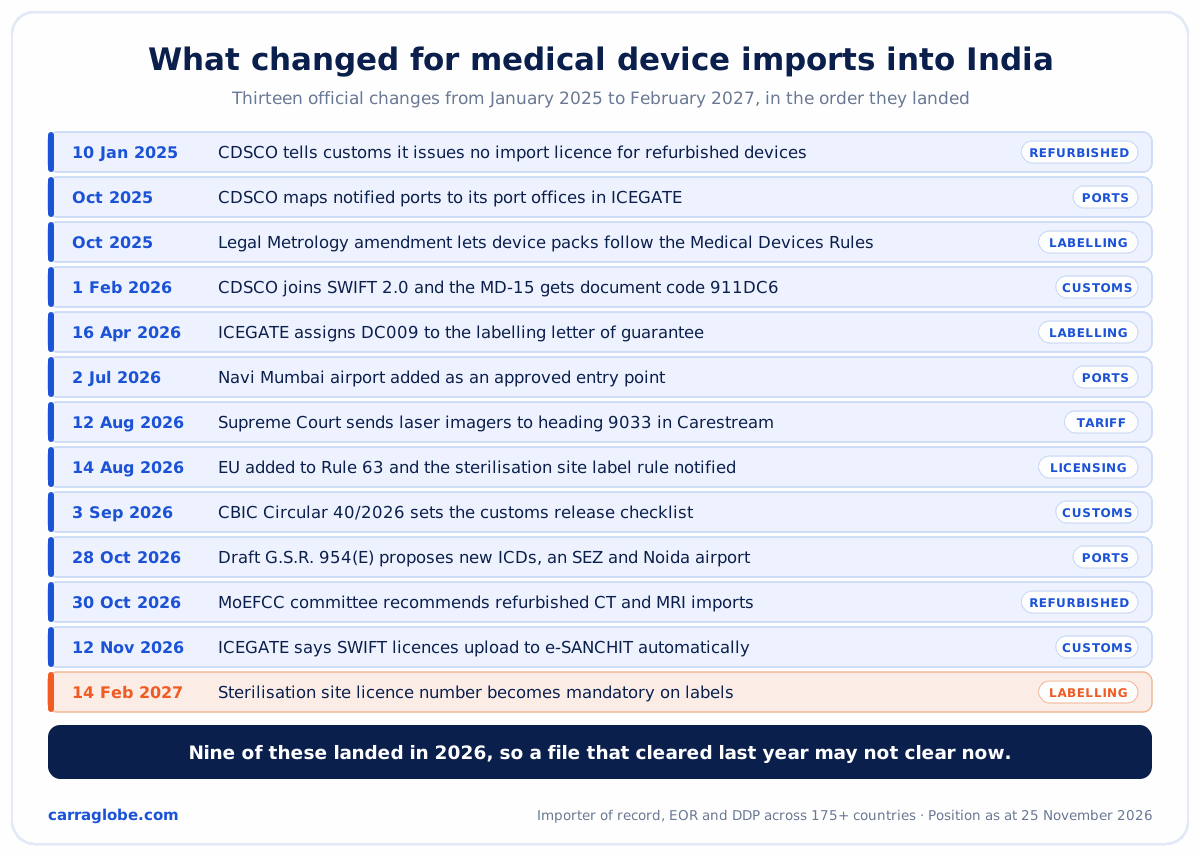
The systems are still catching up. CBIC Circular 05/2026 of 1 February 2026 brought CDSCO onto SWIFT 2.0, the clearance single window, and gave the MD-15 the document code 911DC6. Seven months later, Circular 40/2026 admitted the integration was still under process and asked officers to exercise due diligence, which in practice means reading the documents themselves. An ICEGATE advisory of 12 November 2026 adds a useful detail. Licences issued through SWIFT 2.0 upload to e-SANCHIT automatically, so quote the reference number in the bill of entry instead of uploading the MD-15 again under the wrong code.
How labelling defects turn into holds
India-specific details can go on a sticker. Rule 44(n) allows the import licence number, the importer’s name and address, the actual manufacturing premises and the date of manufacture to be added by sticker where they are not printed. The sticker should sit alongside the original label information without covering or contradicting it. Apply it at the factory if you can, because the officer will compare the finished label with the licence at the port.
A letter of guarantee can rescue a shipment with label faults. Customs may release goods with labelling defects against a letter of guarantee, filed as declaration code DC009 under an ICEGATE advisory of 16 April 2026. The importer undertakes to relabel within a month, not to dispose of the goods without written consent, to return them within ten days of a notice and to reship or surrender them within two months if ordered. DC007, which the February circular first used for this, stays as the packaging-integrity undertaking. Useful as a fallback, but we would not plan around it.
Sterile devices need a new label line from February 2027. Under G.S.R. 743(E) of 14 August 2026, where sterilisation is outsourced to another licensed facility, the label must carry that facility’s licence number. Compliance becomes mandatory on 14 February 2027, six months from notification.
Legal Metrology labelling now defers to the device rules. Packaged devices also fall under the Legal Metrology (Packaged Commodities) Rules. Since the Legal Metrology (Packaged Commodities) Amendment Rules 2025, notified in October 2025, medical device packages follow the labelling requirements of the Medical Devices Rules, so a label built to Rule 44 avoids a second set of formatting rules.
Where the shipment can land
Only notified entry points can clear devices. Imports must come through ports notified under Rule 43A of the Drugs Rules 1945, and in October 2025 CDSCO mapped its port offices to those ports in ICEGATE. Cargo that lands somewhere else cannot simply be moved across for clearance. After release, devices can be stocked at any of the importer’s registered warehouses, not only the address on the licence.
More entry points are on the way. Navi Mumbai airport joined the list on 2 July 2026 under G.S.R. 561(E). Draft G.S.R. 954(E) of 28 October 2026, which the Health Ministry announced on 3 November as covering drugs, medical devices and cosmetics, would add ICDs at Sonipat, Piyala, Harsaru, Dadri, Gandhidham and Mundra, Sanath Nagar, Thimmapur and Whitefield, plus Noida International Airport and the Bommasandra SEZ. Comments are open for thirty days from the Gazette’s release, so check the current list before booking.
The tariff code and the duty bill
The licence does not settle the duty. On 12 August 2026, in Carestream Health India v Commissioner of Customs, 2026 INSC 837, the Supreme Court looked at dry laser imagers that print diagnostic images. It found they had no diagnostic function of their own. Because they served equipment in both 9018 and 9022, Note 2 to Chapter 90 sent them to the residual heading 9033 00 00 rather than the claimed 9018 90 19, the diagnostic heading our HS code guide for medical devices covers, and the Court refused a concessional rate as well.
The ruling turned on its own facts and does not fix one code for every imaging accessory. It does show why printers, workstations and other add-ons need their own tariff analysis rather than riding on the main system’s code, a point our guide to the cost of incorrect HS codes takes further.
What goes into the duty. Expect basic customs duty, the Social Welfare Surcharge, IGST and a 5 per cent Health Cess on devices in headings 9018 to 9022, subject to specific exemptions. CBIC’s Budget 2026 guidance confirms the cess is still levied. An accessory classified in 9033 falls outside those headings, so the classification moves the cess as well as the duty. There is no single rate for medical devices, and our guides to reducing import duty in India and calculating landed cost show how the figures stack up.
What can hold a shipment beyond the MD-15
| Device type | Extra check beyond the MD-15 | Why it holds shipments |
|---|---|---|
| X-ray imaging | AERB type approval for the X-ray model, and AERB procurement permission for each consignment of a type-approved model | Add-ons can be classified away from the main system, as in Carestream |
| Monitoring and ICU | Wi-Fi or Bluetooth can trigger WPC Equipment Type Approval or self-declaration, depending on the equipment category and radio parameters | Lithium batteries bring their own transport rules |
| Lab and IVD | Batch certificates for every reagent and kit | Short shelf lives and cold chain make Rule 47 bite hardest |
| Surgical and sterile | Outsourced sterilisation site licence number on the label from 14 February 2027 | Batch, lot and expiry data must match the certificate line by line |
For battery-powered equipment, our lithium battery customs clearance guide covers the shipping side.
Spare parts, demo units and other routes
Spare parts usually ride on the main licence. CDSCO’s FAQ treats a like-for-like spare that changes nothing about performance, safety or intended use as a spare part, and components defined in the device master file are listed on the main licence. A part that changes any of those is a device in its own right. When an MRI or CT is down in a hospital, the master file is what proves which kind of part is arriving, so have it ready before the part ships. Our guide to emergency spare parts clearance covers the urgent cases.
Devices that will not be sold need their own permission. Customs checks that permission against the invoice quantity.
| Purpose | Application | Permission |
|---|---|---|
| Clinical investigation, test, evaluation, demonstration or training | MD-16 | MD-17 test licence, valid three years |
| Small quantity of a device approved in its country of origin, for a named patient with a life-threatening or seriously disabling condition, through a government hospital or statutory institution | MD-18 | MD-19 |
| Small quantities for personal use | MD-20 | MD-21 |
A demo unit sent on a commercial invoice with no test licence or MD-15 behind it will probably be questioned, unless it is a registered Class A non-sterile, non-measuring device. Bear in mind that a test licence does not cover a clinical investigation on patients, which needs its own approval. If the unit leaves India again after the demonstration, plan the return leg with it, as our guide to returned goods and reverse logistics explains. Components imported for manufacturing in India have a separate checklist, which asks for a manufacturing licence in Form MD-05 or MD-09.
Used and refurbished equipment
Two regulators take different positions. In a letter of 10 January 2025 to customs, published at the time by law firms and the trade press though never on CDSCO’s own website, CDSCO said it issues no import licences for refurbished devices. The environment ministry takes a different line. Under the Hazardous and Other Wastes Rules, high-end, high-value used medical equipment can be imported for reuse with MoEFCC permission, and a memorandum of 15 October 2024 lists 38 eligible types, including MRI, CT and cone-beam CT. Used critical care equipment is prohibited outright.
MoEFCC is still granting permissions. It asks for at least seven years of residual life certified by a chartered engineer, proof the model is not phased out, OEM spares support, a warranty and maintenance cover, and purchase orders from end users. On 30 October 2026, its expert committee recommended refurbished CT, MRI, cath lab and mammography imports, deferred some older MRIs and limited a few permissions to research with no resale.
An environmental permission is only one approval. In April 2026, CDSCO told the MoEFCC committee that its own mandate is device quality and safety under the Medical Devices Rules and that it had no comments on the committee’s recommendations. By September the committee was recording that CDSCO’s guidelines on refurbished equipment were still unfinished, and AERB approval still applies to X-ray units. Get every approval in writing before paying for a refurbished scanner. Our guide to used and refurbished equipment covers the general rules.
What we see on real shipments into India
We have cleared several device shipments into India, covering imaging and diagnostic systems, patient monitors and ICU equipment, lab and IVD equipment and surgical devices. Some went through our Indian partner, which holds the licences, and some through the client’s own Indian entity. Our India AI server import case study shows how one of those clearances ran from start to finish.
Four problems account for most of the delays. A licence or registration that does not quite match the goods, a label missing an India-specific detail, used or refurbished units, and port or document issues. Then there is India’s own wrinkle. Shipments can be questioned even when every document is in order, so we plan every consignment as if an officer will read each document against the others, and we confirm which CDSCO port office covers the entry point before the bill of entry is filed.
The file to build before the first shipment
Treat this as the India layer on top of our general customs compliance checklist.
- The MD-15 or Class A registration, listing every device and site you plan to ship, with its retention date.
- The licence holder’s details, including its manufacturing licence, wholesale licence or MD-42 and storage premises.
- A commercial invoice using the licence’s item names and pack sizes.
- Label artwork and stickers checked against the licence and Rule 44.
- A shelf-life calculation for each batch, to the expected date of import.
- A certificate of analysis for each batch.
- Documents uploaded on e-SANCHIT before filing, as Circular 40/2026 asks, quoting the reference number for any licence already in SWIFT 2.0.
- A proposed tariff code for each item, including accessories and spares, so a wrong HS code on the invoice is caught before filing.
- Other approvals, such as AERB for X-ray and WPC for wireless devices.
- The entry point, confirmed against the notified list.
- A separate permission for demo, trial, investigational or refurbished units.
How Carra Globe handles medical device imports into India
We start by checking the licence fits the shipment. Our trade compliance team confirms that the licence or registration held by our Indian partner, or by your own Indian entity, covers the exact manufacturer, site and devices. Where it does not, the extra licensing is done before any commercial shipment moves. Then we check that the invoice, labels, shelf life and batch certificates agree with each other. Our medical device import service page sets out what we cover across other markets.
Carra Globe works through importer-side registrations and local importing structures appropriate to the goods and destinations it accepts, its own in some markets and established local structures in others. Approvals falling outside the available structure are flagged before a delivery date is agreed.
From factory to hospital. We arrange freight forwarding into a notified entry point and white glove delivery for imaging and ICU equipment that needs positioning on site. If you have no company in India, our guide to importing into India without a local entity explains the options. For a quote, send the device list, licence status, label artwork and target date to info@carraglobe.com or through our contact page.
Importer of Record · Medical devices India
Licence, label, shelf life and entry point, checked before the devices ship.
To be clear about the boundary, an importer of record does not replace the MD-15 or CDSCO registration that covers your devices. What we do is confirm the licence held by our Indian partner or your own entity covers the exact manufacturer, site and devices, check the documents agree with each other, and flag anything that needs a separate permission or a different entry point before a delivery date is agreed.
- Importer of record in India
- Importing without an Indian entity
- Reducing import duty in India
- Importing medical devices into the EU
- HS code for medical devices
- Medical devices without a local entity
- Used and refurbished equipment
- How to calculate landed cost
- Medical device import service
Free tools HS Code Finder Volumetric Weight Calculator Pallet Calculator
Shipping medical devices into India? Send the device list, the licence or registration status and the label artwork. We will check the licence fit, shelf life and entry point before you book.
Check your device shipmentFrequently asked questions
Who can hold a medical device import licence in India?
The manufacturer’s authorised agent in India, holding a manufacturing licence, a wholesale licence or an MD-42 registration. The foreign manufacturer cannot hold it, and changing the agent needs a fresh licence.
Can a manufacturer appoint a second importer in India?
Yes, where the legal and actual manufacturing site is unchanged. The new agent applies with its own MD-14, a copy of the existing licence and the manufacturer’s undertaking that the device and plant master files have not changed.
What does Indian customs check before releasing medical devices?
Under CBIC Circular 40/2026, on facilitated bills of entry the officer checks the MD-15 or registration, the invoice, the label details, residual shelf life, a certificate of analysis for each batch and the storage premises. Anything that does not match goes to the CDSCO port office.
What residual shelf life do imported medical devices need in India?
Under Rule 47, at least 40 per cent where total shelf life is under 90 days, 50 per cent from 90 days to a year and 60 per cent above a year, counted on the date of import.
Can refurbished medical equipment be imported into India?
Possibly, but there is no single settled route. MoEFCC can permit listed high-end used equipment for reuse with at least seven years of residual life, while CDSCO issues no licence for refurbished devices and its guidelines were not finalised in 2026.
Does a demo medical device need an import licence in India?
A demo unit not covered by an MD-15 usually needs a test licence, depending on its use, applied for in Form MD-16 and granted in Form MD-17, and it cannot be sold. Class A non-sterile, non-measuring devices are registered instead.
Adjacent ground: the India-EU free trade agreement, IOR services in India, resolving and preventing customs holds and what an importer of record does.
Sources and verification
This guide was checked against official rules, circulars, notifications and guidance on 25 November 2026, the day of publication.
- Ministry of Health and Family Welfare. Medical Devices Rules 2017, as amended. Gazette notifications G.S.R. 743(E) and G.S.R. 744(E) of 14 August 2026, G.S.R. 561(E) of 2 July 2026 and draft G.S.R. 954(E) of 28 October 2026, with the Health Ministry press release on new entry points, 3 November 2026.
- Central Drugs Standard Control Organisation. FAQ on the Medical Devices Rules 2017, its 2024 FAQ and Addendum 03 of November 2025, and the list of CDSCO port offices. Letter to the Principal Commissioner of Customs on refurbished devices, 10 January 2025, as published by law firms and the trade press.
- Central Board of Indirect Taxes and Customs. Circular 40/2026-Customs of 3 September 2026, Circular 05/2026-Customs of 1 February 2026, Notification 08/2020-Customs on Health Cess and the Budget 2026-27 customs FAQ.
- ICEGATE. Declaration Code DC009 for CDSCO NOC under SWIFT 2.0, 16 April 2026 and Use of Licenses, Permissions, Certificates and Other Authorizations in BE/SB Filing, 12 November 2026.
- Ministry of Environment, Forest and Climate Change. Revised list of high-end, high-value used medical equipment, 15 October 2024 and decisions of the 160th Expert Committee meeting, 30 October 2026, with the 155th and 159th meeting decisions of April and September 2026.
- Other official sources. Supreme Court of India, Carestream Health India Pvt Ltd v Commissioner of Customs, 2026 INSC 837, 12 August 2026. Mundra Customs show cause notice 150/2026-27/ADC/ZDC/MCH, 14 September 2026. Department of Consumer Affairs, Legal Metrology (Packaged Commodities) Amendment Rules 2025. AERB regulatory requirements for suppliers of X-ray equipment. Department of Telecommunications, Equipment Type Approval.
Disclaimer: This guide is for informational purposes only and does not constitute legal, regulatory or customs advice. Licensing, labelling and classification depend on the exact device, its risk class and the importer’s licences. The position described is as at 25 November 2026. Confirm the current position with CDSCO, customs and a qualified regulatory adviser before shipping.