
CE marking asks whether a product meets the applicable EU product requirements. WEEE asks a different question entirely: who is responsible for its end-of-life obligations. And the answer, more often than importers expect, is you.
The word doing the damage is “producer”. In ordinary usage it means the company that made the thing. Under the WEEE Directive it is a legal status that can attach to manufacturers, own-brand resellers, importers and certain distance sellers, depending on how the equipment is placed on the market in that Member State. WEEE producer obligations then follow that party, in that country, for that equipment.
This guide is written from the importer’s side: when the importer becomes the producer, why the answer changes from one country to the next, what registration involves, and the one contractual assumption that leaves companies exposed. WEEE is a directive transposed separately into each national law, so treat what follows as the framework and confirm the position in each market you supply.
What are WEEE producer obligations?
WEEE producer obligations are the duties applying to whoever is treated as the producer of electrical and electronic equipment in a market: registration, reporting, financing collection and treatment, and product identification.
Quick answer
| Question | Short answer (confirm per country) |
|---|---|
| Does WEEE only apply to consumer products? | No. The Directive covers business-to-business equipment as well, including servers, networking and data centre hardware |
| Am I the producer if I only import? | Often yes. Placing equipment from another country on a national market on a professional basis is one of the four routes into the definition |
| Is it one registration for the EU? | No. Registration is national, in each Member State where you place equipment on the market |
| Can I use my supplier’s registration? | Generally not. The obligation attaches to the party placing the goods on that national market, not to the factory |
| Can I appoint someone locally? | Yes, via an authorised representative appointed by written mandate under Article 17 |
| Does outsourcing it transfer the liability? | Delegating the work is not the same as transferring the responsibility. Check which one your contract actually does |
Quick check: are you the producer?
Established in a Member State and professionally placing equipment from outside it on that market?
Usually the producer there.
Reselling under your own brand, with the maker’s brand no longer on the equipment?
Usually the producer there.
Selling EEE by distance directly to users in a Member State where you are not established?
Usually the producer, and Article 17 requires a representative.
National transposition decides the final answer in each market.
An importer of record is not automatically a WEEE producer. Customs and WEEE use different legal concepts, so being the customs importer does not settle who the producer is in each Member State. Six questions establish it: who imports the equipment, who places it on that national market, who is established where, whose brand is on it, who sells to the end user, and which national rules apply.
Carra Globe acts as importer of record across 175+ countries. We are not a WEEE compliance scheme and do not act as your Article 17 representative, so what follows is how we flag these obligations upstream rather than a service we sell.
The four routes into “producer”
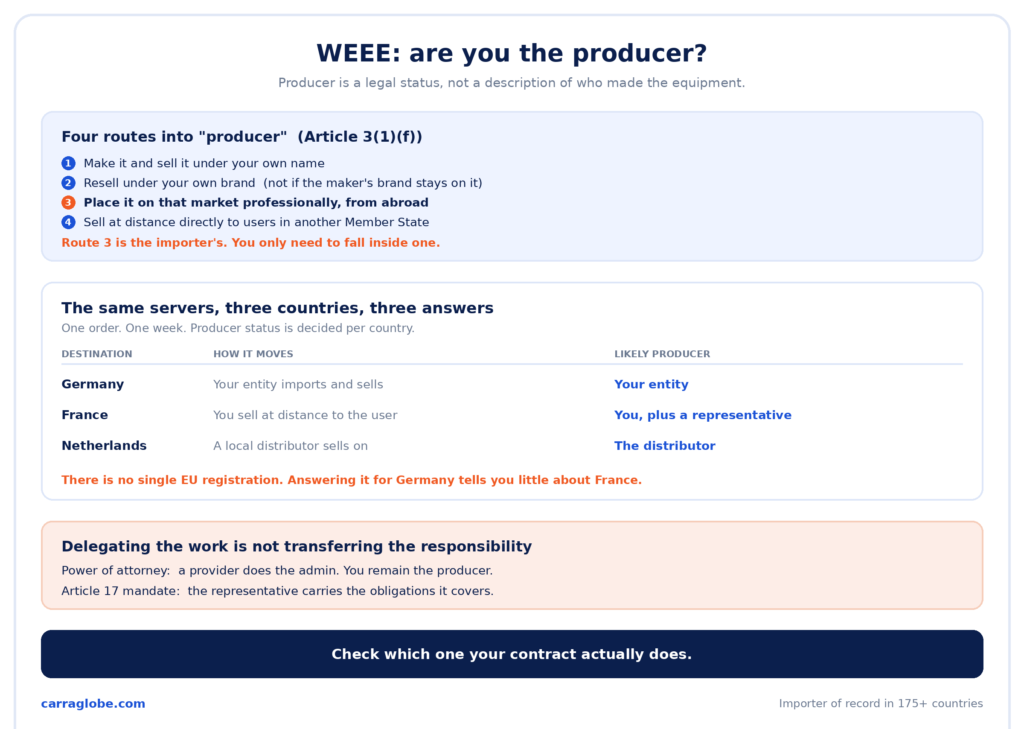
Directive 2012/19/EU defines a producer at Article 3(1)(f) through four alternative limbs. You only need to fall inside one.
- You make it and sell it under your own name in a Member State where you are established, or have it made for you and market it under your name there.
- You resell someone else’s equipment under your own name or trademark within that Member State. With an important carve-out: a reseller is not the producer where the actual producer’s brand still appears on the equipment.
- You place equipment on that market on a professional basis, where it comes from a third country or from another Member State. This is the importer’s limb, and it is the one most people miss.
- You sell at distance directly to users in a Member State while established in another Member State or outside the EU.
The Directive provides the common framework, but the practical registration and producer-responsibility outcome runs through each Member State’s national law and register. Confirm the national definition and registration route for the specific transaction.
Read the third limb again, because it is the whole article in one sentence. It does not ask whether you designed the product, branded it or touched it. It asks whether you put it on that national market professionally. A company that buys finished servers and ships them into Germany satisfies it without doing anything a normal person would call producing.
The carve-out worth knowing. Limb two inverts what most people expect after reading about CE marking. There, putting your brand on a product moves you toward manufacturer obligations. Here, the reverse also applies: if the original producer’s brand is still visible on the equipment, a reseller is not treated as the producer. Branding decisions move the obligation in both directions, so check which way yours points.
The same servers, three countries, three answers
Here is where WEEE stops resembling the other EU regimes an importer deals with. “Producer” is not a status you hold across Europe. It is a status you hold in a country, and it is decided country by country.
Consider an illustrative order of rack servers from a Taiwanese manufacturer going to three customer sites. The table assumes the stated parties and sales structure are the ones actually placing the equipment on each national market.
| Destination | How it moves | Who is likely the producer there |
|---|---|---|
| Germany | Your German entity imports and sells to the customer | Your German entity, on the importer limb. Register with the national register there |
| France | Your German entity sells directly at distance to a French end user | Potentially your German entity on the distance-selling limb, and an Article 17 authorised representative may be required in France |
| Netherlands | A Dutch distributor buys from you and sells on under the maker’s brand | Likely the Dutch distributor, subject to the national producer definition and the actual supply arrangement |
Same hardware, same purchase order, same week. Three markets, and your obligation is different in each. The practical effect is national: Member States maintain their own producer registers and systems for implementing producer responsibility, so the producer obligation has to be determined in each market.
The practical consequence is that a European rollout is not one WEEE question. It is one question per destination country, and answering it for Germany tells you very little about France.
What being the producer actually involves
Unlike CE marking, this is not a one-time exercise per product. It is an ongoing operational obligation, and it groups into three parts.
First, get on the register.
- Register before placing equipment on that market, where the national law makes registration a condition of market placement. Each Member State maintains its own producer register, and the practical sequence is registration first, shipment second.
- Register in every Member State where you are the producer. Supplying a country does not by itself make you the producer there. There is no single EU-wide registration, and the national registers are separate systems with separate requirements.
Second, pay for the end of life.
- Finance the applicable collection and treatment obligations. Depending on the Member State and on whether the equipment is household or business WEEE, this may mean joining a producer compliance scheme, paying producer responsibility fees, arranging take-back directly, or another permitted national mechanism.
- Check the take-back and user-information duties. Producer responsibility can extend beyond paying fees to arranging take-back and informing users. Business equipment often works differently from household equipment, and the contract, the category and national law can decide who finances or arranges collection.
- Understand the timing mismatch. You contribute now against equipment that will be discarded years from now. The precise financing model depends on national law, the category, and whether the equipment is household or business WEEE.
Third, keep reporting.
- Report quantities placed on the market to the national register, on the cadence that register requires. This data feeds national collection and recovery targets.
- Mark the equipment, including the crossed-out wheeled bin symbol and producer identification.
- Keep the numbers reconcilable to your shipment records, because a reported figure you cannot tie back to entries is difficult to defend.
That third group is what makes WEEE producer obligations an operational commitment rather than a project. Initial registration happens before you place equipment on the market, but keeping the registration and your producer information current is itself an ongoing duty, and reporting continues on the national schedule for as long as you keep selling.
Does it apply to business and data centre equipment?
Yes, and the assumption that it does not is a common and expensive one. Many importers treat WEEE as a consumer regime, something for household appliances and phones rather than enterprise infrastructure.
The Directive covers electrical and electronic equipment broadly, including equipment used by users other than private households, so many servers, switches, storage arrays and UPS units can fall within scope. Classification is product-specific, though, and the Directive excludes categories including large-scale stationary industrial tools and large-scale fixed installations. A data centre build is not automatically WEEE from end to end.
Outside private households the financing, take-back and collection arrangements can differ from those for household WEEE. But selling business to business does not, by itself, take equipment outside WEEE scope.
For hardware moving in and out of a market for other reasons, our notes on returned goods and reverse logistics and equipment sent for repair cover the customs handling that runs alongside this.
Why DDP makes the producer question sharper
One commercial term deserves singling out, because it changes the odds considerably. Under delivered duty paid terms the seller takes the goods through import and delivers them to the customer, which frequently makes the seller the party placing the equipment on that national market. That is the test the producer definition turns on.
So if you are quoting DDP into Germany or the Netherlands, the producer question is not academic. It sits inside your landed cost, alongside duty and clearance, and it is easier to price before you win the deal than to absorb afterwards. Our comparison of DDP and DAP sets out how the two terms shift responsibility.
Why “it is not on the old WEEE list” no longer works
This trips up importers of newer equipment, and it is worth knowing precisely.
Until 14 August 2018 the Directive applied to equipment falling within ten listed categories, which left room to argue a product sat outside them. From 15 August 2018 Article 2 applies the Directive to all EEE, subject to specified exclusions, with equipment classified into the six categories in Annex III. The Directive itself calls this open scope.
So the question is no longer “is my product on the list”. It is whether the product meets the definition of EEE and whether any exclusion applies. Those exclusions include large-scale stationary industrial tools and large-scale fixed installations, though not equipment that is not specifically designed and installed as part of such an installation. For data centre hardware that distinction is worth taking seriously rather than assuming either way.
The practical instruction is not to classify a whole project as one WEEE item. Assess the individual equipment, how it is designed and installed, whether it can function independently of the installation, and whether the large-scale fixed installation exclusion applies under the national implementation.
Establishment, and the way around it
The Directive’s starting position is that to fulfil producer obligations in a Member State, a producer should be established in that Member State. For a company selling across Europe without an entity in every market, that would be an obvious barrier.
Article 17 provides the route through it, and covers two situations. A producer under the first three limbs, established in another Member State, may appoint a person in the destination country as its authorised representative to fulfil its obligations there. A producer under the distance-selling limb, selling into a Member State where it is not established, must make that appointment.
In both cases the appointment must be by written mandate. Note that this does not mean every importer needs an Article 17 representative. An importer established in the market it supplies registers there directly.
This can be a useful mechanism for meeting WEEE obligations in a destination market without establishing a separate legal entity there, subject to the national implementation and to the scope of the representative’s mandate. Our page on importing without a local legal entity covers the wider set of routes, with country detail on the market pages for Germany and the Netherlands, and the full list on our IOR by country index.
The distinction that decides your exposure
If you take one thing from this article, take this. It is the difference between an arrangement that protects you and one that only looks like it does.
Delegating the work is not the same as transferring the responsibility. A power of attorney can let a provider perform administrative tasks on your behalf while the producer relationship is unchanged. An Article 17 appointment is a distinct mechanism: the representative fulfils the producer obligations covered by its written mandate in that Member State. The mandate, the national law and the register determine what it actually handles and how liability is allocated. Companies routinely sign the first believing they have the second.
The question to put to any provider is short and awkward, which is why it usually goes unasked. Are you my authorised representative under Article 17 in this country, appointed by written mandate and named as such on the national register? Or are you administering my registration while the obligation stays with me?
Both arrangements are legitimate. They carry very different consequences when a register queries a figure or an authority opens an enquiry. What matters is knowing which one you have bought, in each country, in writing.
Importer of Record · 175+ countries
Planning an EU rollout? Know which obligations attach in each destination before the freight is booked.
Carra Globe acts as your importer of record across the EU and flags the producer-responsibility questions each destination raises, WEEE, batteries and packaging, so they are priced and planned rather than discovered. Explore how we help:
Free tools: HS Code Finder|Volumetric Weight Calculator|Pallet Calculator
Shipping into several EU markets? Tell us the destinations, the entities involved and how the equipment is branded, and we will map the import structure before anything moves.
Talk to us about your rolloutWhere WEEE sits among the neighbouring rules
WEEE rarely arrives alone. For a technology importer it usually appears as one of several producer-responsibility obligations attaching to the same shipment, each with its own register, its own fees and its own reporting.
| Regime | What it asks of you | Separate registration? |
|---|---|---|
| WEEE | Fund and report on collection and recycling of the equipment | Yes, per Member State |
| Batteries | Obligations for batteries placed on the market or built into products | Usually yes, and separately |
| Packaging | Producer responsibility for the packaging the equipment arrives in | Usually yes, and separately again |
| RoHS | Substance restrictions and conformity obligations for the equipment itself | Generally not a separate producer registration |
A single shipment of servers can therefore raise separate WEEE, battery and packaging questions, each with its own producer test, registration route and reporting. Whether all of them apply depends on the equipment, its embedded components, the packaging and the destination country. Our guides to the EU Battery Regulation, the Cyber Resilience Act and the Digital Product Passport cover the neighbours.
And the UK is separate
Worth stating plainly for anyone treating “Europe” as one market. The EU Directive does not cover the United Kingdom. Great Britain operates its own producer responsibility rules for electrical and electronic equipment, with a comparable but separate definition of producer, and Northern Ireland carries additional considerations. An EU WEEE registration does not cover the UK, and a UK registration does not cover the EU.
A working sequence
Six steps, in the order that avoids the most rework.
- List the destination countries, not the products. WEEE is answered per market, so the country list is the unit of work.
- For each one, identify who places the equipment on that market. Your entity, a local distributor, or you selling at distance from elsewhere.
- Check the branding. Whose brand is visible on the equipment changes the answer, in both directions.
- Decide the structure per country. Local entity, authorised representative, or an arrangement where a distributor carries the obligation.
- Register before the first shipment, not after it. In many Member States registration is a condition of placing EEE on the market, though the precise rule, register and enforcement mechanism are national.
- Set up the reporting from the start, tied to your shipment data, because reconstructing volumes later is the part that goes wrong.
How Carra Globe helps
Being straight about the boundary first. We are not a producer compliance scheme and we do not operate as your authorised representative under Article 17. Those are defined roles with their own requirements. An importer of record is not automatically a WEEE producer or an Article 17 authorised representative.
- Mapping the likely producer and registration responsibility per destination before shipment, subject to confirmation under national law, rather than discovering it from a register.
- Acting as importer of record across 175+ countries, including for data centre equipment, and being clear about what that role does and does not cover.
- Flagging the neighbouring obligations that attach to the same consignment, so batteries and packaging are not discovered separately and late.
Where you need an Article 17 representative or a compliance scheme, we say so and work alongside them. The value we add is upstream: knowing which questions each destination raises before the freight is booked.
Planning a European rollout? We act as importer of record across the EU and flag the producer-responsibility obligations, WEEE, batteries and packaging, before your freight is booked. Tell us the destinations, the entities involved and how the equipment is branded.
Talk to us about your EU rollout →
Frequently asked questions
Is the importer the producer under WEEE?
Often yes. One limb of the definition covers a party established in a Member State that places equipment from a third country or another Member State on that market on a professional basis.
You do not need to have manufactured or branded anything to fall inside it.
Do I need to register for WEEE in every country?
In each Member State where you are the producer, yes. WEEE is implemented nationally and there is no single EU-wide registration covering all markets.
Registration, reporting, financing, take-back and representative requirements all have to be checked per country, and an appointment in one does not extend to another. A European rollout is a country-by-country question rather than a single one.
Does WEEE apply to business and data centre equipment?
Often yes. The Directive covers equipment used by users other than private households, so many servers, networking and storage products can fall within scope.
The exact result depends on the equipment’s function, design and installation, and on whether a Directive exclusion applies.
Can I use an authorised representative for WEEE registration?
Yes, where Article 17 and the relevant national law allow or require it. The representative can fulfil the producer’s WEEE obligations in that Member State, including registration and reporting.
Where a producer established in a Member State sells EEE by distance communication directly to users in another Member State in which it is not established, Article 17 requires an authorised representative in that destination Member State. It is the mechanism that makes European coverage possible without incorporating in every market.
What is the difference between WEEE and RoHS?
RoHS restricts hazardous substances in the equipment itself and sits within the CE conformity framework. WEEE governs what happens at end of life, through producer registration, financing and reporting.
They apply to broadly similar equipment but ask different questions, and only WEEE generally involves a national producer register.
How often do I have to report WEEE?
On the cadence the national register sets, which varies by Member State. Reporting continues for as long as you keep placing equipment on that market.
Build the reporting off your shipment data from the start, because volumes reconstructed later are the part that tends to go wrong.
Does an importer of record automatically become the WEEE producer?
No. These are different legal roles. Who the WEEE producer is depends on how the equipment is placed on the national market, which parties are established where, the branding, and the applicable national rules.
The same company can hold both roles, but that has to be established per country rather than assumed from the customs arrangement.
Can I rely on my supplier’s WEEE registration?
Generally not. The obligation attaches to the party placing the equipment on that national market, which is often you rather than the factory that made it.
Ask which national registers your supplier actually appears on, and for which entity, before assuming you are covered.
If I outsource WEEE compliance, am I still liable?
It depends which arrangement you have. A power of attorney delegates the tasks while the responsibility stays with you. An Article 17 authorised representative appointment is a different instrument.
Establish in writing, per country, which one your provider is offering.
What to remember
Producer is a legal status, not a description of who manufactured the equipment.
It is decided country by country, from how the goods reach each national market.
There is no single EU registration, and an importer of record is not automatically the producer.
Delegating the work is not the same as transferring the responsibility. Check which one your contract does.
Sources and verification
- The Directive: Directive 2012/19/EU on waste electrical and electronic equipment, including the producer definition at Article 3(1)(f), the authorised representative mechanism at Article 17, and the national register and reporting provisions.
- National transposition: Germany’s environment agency explains EU-wide enforcement of producer responsibility and the German register, and Ireland’s EPA publishes IMPEL guidance on Article 17 covering how authorised representatives are appointed across Member States.
- Outside the EU: the UK operates its own regime, with gov.uk guidance on EEE producer responsibilities setting out a comparable but separate definition of producer.
- Confirm nationally. WEEE is a directive transposed into national law, so registers, categories, thresholds, fees and reporting cadence differ by Member State. Check each destination before placing equipment on that market.
Disclaimer: This guide is for informational purposes only and does not constitute legal or regulatory advice. Carra Globe is not a producer compliance scheme and does not act as an Article 17 authorised representative. Producer definitions, registration, financing and reporting obligations are set by national law, vary between Member States, and change. This article reflects publicly available guidance as at 28 August 2026. Always confirm the position for your products and destinations with a qualified adviser or the relevant national authority.