
There is a document filed with Chinese, Vietnamese or Mexican customs before your goods leave. You have probably never seen it.
It may be your supplier who files it. It may equally be a trading company, a distributor, a consolidator or a third-party logistics provider, which is the range CBP itself names. Either way you may have no contractual right to it, limited ability to verify it, and no visibility into the value or classification declared on it.
US Customs and Border Protection is now asking whether you should have to hand it over. Its own phrase is the broader one, foreign export documentation, so whatever that filing is called in the country where it was made, it may be in scope.
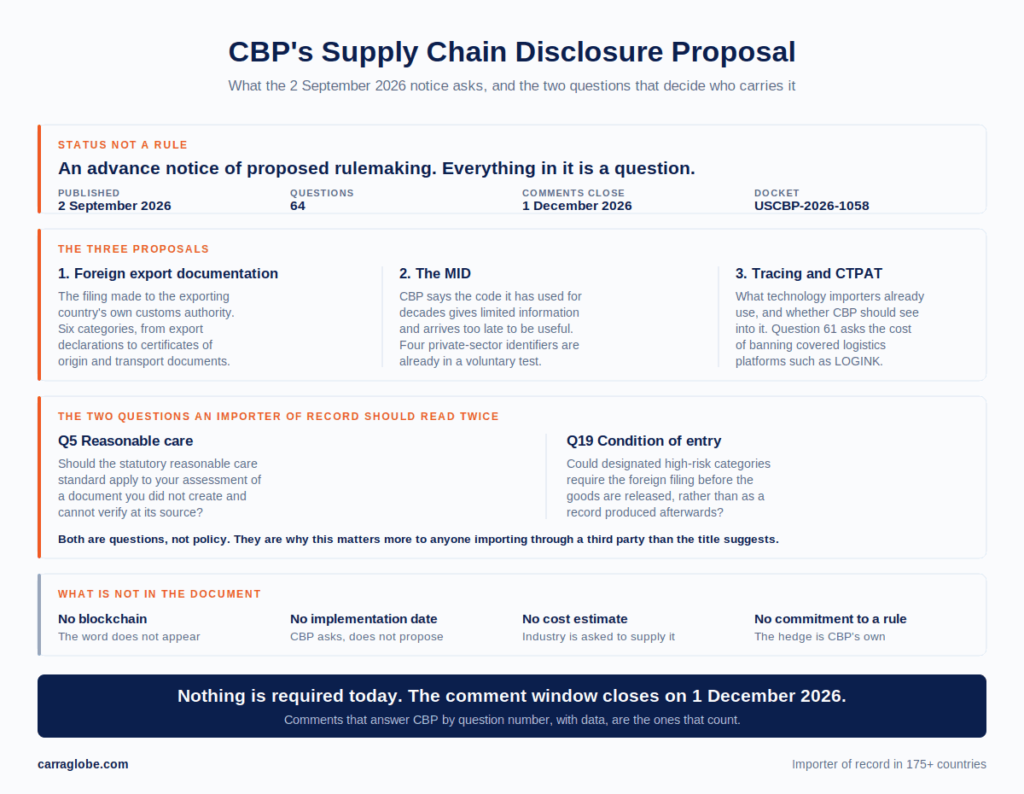
The vehicle is an advance notice of proposed rulemaking published on 2 September 2026, open for comment until 1 December. Two of its 64 questions matter far more than the rest if you import through a third party, and they are covered below.
Carra Globe provides importer of record and exporter of record services, so we have a commercial interest in your answer. What follows is written to be usable whether or not you ever speak to us.
What CBP actually published
Is this a rule I have to comply with? Not yet. It is an advance notice of proposed rulemaking, which is the stage before a proposed rule. Everything in it is posed as a question rather than a requirement. Comments close on 1 December 2026, after which CBP may or may not draft a proposed rule. This notice by itself imposes no new foreign export documentation requirement at the border. Other provisions of the executive order behind it are moving separately.
The document is titled “Heightened Import Disclosures for Supply Chain Visibility”, sits at 91 FR 56408 under docket USCBP-2026-1058, and contains 64 numbered questions across three proposals. CBP states its purpose in one sentence: it wants to “more effectively detect and interdict illicit importations, especially those that are illegally transshipped to evade compliance with U.S. customs and trade laws”.
The trigger is Executive Order 14411, signed 3 June 2026, which we covered when it landed in our note on the customs enforcement executive order and the new IOR bond and vetting rules. Section 3(b) of that order directs the Secretary to mandate submission of “any documentation or information that the foreign exporter was required to submit to the foreign customs administration prior to exporting to the United States”. This notice is CBP working out how.
One detail signals how seriously CBP is taking it: the agency designated this a significant regulatory action under section 3(f) of Executive Order 12866, and it has already been through Office of Management and Budget review.
Proposal one: the filing your supplier made at home
CBP is not asking only about export declarations. It uses the broader term foreign export documentation, and lists six categories:
- Export declarations made to the foreign customs authority
- Commercial invoices showing the value declared to that authority
- Packing lists
- Certificates of origin submitted there
- Export licences or permits
- Transport documents filed as part of the foreign export manifest
The point is reconciliation: comparing what was told to the foreign government against what was told to CBP. The notice names the fraud it is hunting, “dual-invoicing”. The practical problem is that the document may have been created and filed by another party, in another jurisdiction, under that jurisdiction’s rules about who may see it.
CBP knows this, which is the most useful thing about the notice. Question 7 asks, in terms: “What are the challenges for importers of record associated with obtaining and retaining of any documentation submitted to foreign customs or export authorities? Do importers already retain such documentation, and if so, for what purpose?”
Whether an exporter in a given country may share its customs filing with its overseas buyer varies by jurisdiction, and in several major sourcing markets we could not establish the position from an official source. That is a question for the exporting country’s rules and your supplier’s own advisers, not one to assume either way.
Two further questions deserve more attention than they will get. Question 10 asks how CBP should reconcile “conceptual discrepancies between the nature of the price reported to a foreign customs authority for a good upon export and the nature of the price relevant to CBP’s assessment of duties” on import. That matters because a gap between the two figures is not automatically evidence of undervaluation. The two figures may reflect different valuation concepts or different transaction circumstances, and CBP is asking industry how such differences should be reconciled.
Question 12 is the harder one: “How can the importer ensure that the foreign export documentation provided to CBP is the exact document submitted to the foreign customs administration, and has not been modified?” That turns document collection into an authenticity problem, and CBP is asking the trade to solve it rather than proposing an answer. Question 16 is plainer and worth answering from your own data: what lead time do importers currently need to obtain these documents.
Proposal two: the MID may be replaced or supplemented
The manufacturer identification code is a constructed identifier, derived from the manufacturer or shipper’s name and address as given on the commercial invoice, using a methodology CBP prescribes and incorporating country of origin. It has identified suppliers on US entry filings for decades. CBP now says it is “interested in proposals to redefine or replace the MID”.
CBP’s assessment of it in this notice is unusually direct for a regulator describing its own long-standing data element:
“Although use of the MID is longstanding, it provides limited identifying information and does not always identify the actual party that may be of interest to CBP for enforcement purposes and is not always available to CBP early enough in the entry process to be useful.”
One alternative CBP is examining is a global business identifier, which it defines as “a unique identifier issued by the private sector to help companies map and trace their supply chains”.
This is not a new CBP initiative. CBP has been testing it since December 2022 under the National Customs Automation Program. The test now carries four identifiers: the Data Universal Numbering System number, the Global Location Number, the Legal Entity Identifier and the Altana ID. It was renamed from its original proof of concept title in August 2025 and runs until 23 February 2027.
Two things follow for anyone importing into the US. Importers of record and licensed customs brokers can currently request participation in the voluntary test, subject to CBP approval, rather than waiting for a rule. And because the identifiers are issued through private-sector identity management organisations, adopting one can involve a procurement decision as well as a compliance consideration.
Proposal three: tracing technology and CTPAT
The third proposal asks what tracing technology businesses already use, whether importers should be responsible for using it, and whether CTPAT partners should make those tools visible to CBP. Ten questions cover scalability, integration with the Automated Commercial Environment, and protection of proprietary information.
The sharpest item sits in the CTPAT section. Question 61 asks whether the minimum security criteria should “restrict or prohibit the use of `covered logistics platforms’ (e.g., LOGINK or other foreign-controlled systems identified as national security risks)” by members or their supply chain partners, and what it would cost to migrate away.
LOGINK is China’s state-sponsored national logistics data platform, and it is already restricted in US law. Section 825 of the 2024 National Defense Authorization Act, codified at 46 U.S.C. 50309, provides that “a covered entity shall not use a covered logistics platform”, and names LOGINK in the definition. Covered entities are federal and state agencies, federally funded port authorities and marine terminal operators at those ports, so an ordinary private importer is outside it.
The stated concern is data. The Maritime Administration advises that LOGINK “aggregates logistics data from various sources, including domestic and foreign ports, foreign logistics networks, shippers, shipping companies, public databases”, and that its use in critical port infrastructure “very likely provide China with access to and/or collection of sensitive logistics data”.
What question 61 contemplates is extending that restriction from federally connected entities to CTPAT members and their supply chain partners, which is a much wider net. It prohibits nothing today: it asks what migrating away would cost. CBP asks separately, at question 35, which platforms you use and at what stage of the shipping process.
The two questions an importer of record should read twice
The commercially significant material is in two specific questions, and both are aimed squarely at the importer of record.
Question 5 asks: “If the importer of record is required to submit the records to CBP, is the duty of reasonable care an appropriate standard for the importer to assess and ensure the accuracy of the documentation before submitting it to CBP?”
Read that slowly. Reasonable care is the statutory standard in 19 U.S.C. 1484, and it already governs what you file. CBP is asking whether it should extend to a document you did not create, cannot verify at source, and obtained from a party in another country. If CBP ultimately adopted such a requirement with a reasonable care standard, the importer of record could face an additional verification burden when assessing documentation it did not produce.
Question 19 goes further. It contemplates the Secretary designating categories of imports as posing “an unusually high or grave risk to the national security of the United States” and requiring the foreign export documentation “by the importer of record as a condition of entry”.
Condition of entry is the phrase that matters. A recordkeeping obligation is generally satisfied by retention and later production. A condition of entry would make the document part of what has to be satisfied before the goods enter or are released. If a designated category ever worked that way, a supplier who will not or cannot produce the document could become a border release problem rather than simply a paperwork problem.
Both remain questions. Neither is policy. But they are why this notice matters more to anyone importing through a third party than its title suggests.
What is not in the document
Regulatory news gets embellished as it travels, so it is worth recording what the text does not say. We read it in full.
- No blockchain. The words blockchain, distributed ledger, machine learning, internet of things, RFID and digital product passport do not appear anywhere. Artificial intelligence appears twice: once describing CBP’s own tools for pinpointing transshipment risk, and once at question 48, on the role AI may play in private-sector tracing technologies. Neither is a proposed mandate on importers.
- No implementation date. CBP asks what implementation period would be necessary and whether requirements should be phased in by entry type, commodity, country or mode. It proposes none.
- No cost estimate. The notice gives no CBP dollar figure. Questions 62 to 64 ask industry to supply the cost, benefit and time estimates instead.
- No commitment to a rule. The comments “will be used, potentially, to draft a Notice of Proposed Rulemaking”. The hedge is CBP’s own.
What to do before 1 December
- Ask one supplier for its export paperwork. Not a policy exercise, a test. Pick your largest supplier in your most important sourcing country and ask for the export declaration, any export permit and the invoice filed with its customs authority. The answer gives you a practical indication of whether your supplier documentation process could support the kind of requirement CBP is asking about, and it takes one email.
- Find out whether your entries carry a real identity or a constructed code. If your supplier data reduces to a MID, you are relying on the data element CBP has just described as not identifying the party it cares about.
- Check your contracts for a documentation clause. Most supply agreements oblige the seller to provide commercial documents. Very few oblige it to provide filings made to its own government.
- Look at your logistics platforms. Question 61 names LOGINK. Know what your forwarders and suppliers actually book on.
- Comment if it affects you. CBP asks commenters to answer by question number and to supply data. An importer explaining exactly why question 7 is difficult in practice gives CBP the kind of concrete information the notice asks for.
If you import into the US through a third party, add one more step: ask who would carry this. Our guide to paper IOR versus operational IOR covers the distinction, and verifying an importer of record provider sets out what to ask before you ship.
How Carra Globe handles US entries
We provide importer of record and exporter of record services for technology hardware across 175+ countries, including importer of record in the USA, alongside DDP customs clearance, freight forwarding and warehousing.
On this proposal, nobody can promise compliance with a rule that does not exist. What we do is document the chain now: who the manufacturer actually is rather than what the code says, which documents each supplier can produce and which it cannot, and where a request for a foreign filing would fail.
That work holds whether or not this becomes a rule, because supplier, entry and transaction records can become relevant during CBP verification or post-entry review, which is the ground our note on importer of record versus customs broker covers.
Carra Globe already holds the importer-side licences, certifications and approvals its local importing structures require for the goods we handle, so your cargo moves without delay at the border. Where a shipment needs an approval outside that scope, we say so before a delivery date is agreed rather than after the goods land. That applies whether this is a first shipment into a new country or one leg of a multi-country deployment.
Importer of Record · United States
The question is not whether you can get the document. It is who carries it if you cannot.
Being clear about the boundary: nobody can promise compliance with a rule that does not exist yet, and we will not pretend otherwise. What we can do now is map the chain while there is time: who the manufacturer actually is rather than what the code says, which suppliers can produce a foreign customs filing and which cannot, what lead time each one needs, and where a request would fail. That is the answer to question 7, and it is also what a post-entry review asks for.
- Importer of record in the USA
- Customs enforcement executive order 2026
- Importer of record services
- Exporter of record services
- DDP customs clearance worldwide
- DDP delivered duty paid
- Freight forwarding services
- White glove delivery
- Global warehouse and logistics
- IOR by country
- EOR by country
- Importer of record vs customs broker
- Paper IOR vs operational IOR
- Who is liable when a reseller imports
- IT hardware import rules by country
Free tools HS Code Finder Volumetric Weight Calculator Pallet Calculator
Importing into the US through a third party? Send us your top five suppliers and the entries they sit behind. We will tell you which of them could produce a foreign customs filing today, which could not, and what that means for who should be named as declarant.
Map your supplier documentationFrequently asked questions
Do I have to submit foreign export declarations now?
No. This notice does not require importers to submit foreign export documentation. It asks for comments on whether and how such a requirement should be created, and CBP has not committed to making a rule.
When do comments close?
1 December 2026. The notice was published on 2 September 2026 and the docket is USCBP-2026-1058. CBP asks commenters to refer to its question numbers and supply supporting data.
Is the MID being abolished?
No decision has been made. CBP says it is interested in proposals to redefine or replace it, and has been testing four identifiers since December 2022. That test runs to 23 February 2027.
Would this fall on the importer of record?
That is what CBP is asking. Questions 1, 4, 5 and 19 contemplate the importer of record as the party responsible for submitting, retaining or furnishing the documentation.
Does the proposal mention blockchain?
No. The word does not appear. Artificial intelligence is named twice: for CBP’s own transshipment risk tools, and in a question about private-sector tracing technology. Neither is a mandate.
Can I join the global business identifier test?
The test is open to importers of record and licensed customs brokers who request permission and are approved by CBP. It is voluntary and remains a test, not a mandatory entry requirement.
Adjacent ground: who is liable when a reseller imports, power of attorney for customs, IT hardware import rules by country and importer of record requirements.
Sources and verification
- The notice itself: Heightened Import Disclosures for Supply Chain Visibility, 91 FR 56408, document 2026-17926, docket USCBP-2026-1058, published 2 September 2026. We read the full text, including all 64 questions. Every quotation above is verbatim from that document.
- The executive order behind it: Executive Order 14411, Strengthening Customs Enforcement, signed 3 June 2026, for the section 3(b) direction on foreign export documentation.
- The identifier test: the 2022 launch notice for the original programme, and the August 2025 modification for the rename, the addition of the fourth identifier and the 23 February 2027 end date. CBP’s own programme page did not reflect all the latest test details when we checked it, so the Federal Register notices are the stronger source for the current terms and end date.
- The MID: 19 CFR 102.23 and the construction methodology in the appendix to Part 102.
- Reasonable care: 19 U.S.C. 1484 for the entry and reasonable care standard, and 19 U.S.C. 1508 for recordkeeping.
- CTPAT: CBP’s programme page for membership and benefits.
- LOGINK: 46 U.S.C. 50309, enacted by section 825 of the FY2024 National Defense Authorization Act, for the prohibition and the definition of a covered entity; the Maritime Administration’s advisory 2026-007 of 24 April 2026 for what the platform does and the data concern; and the Department of Transportation’s prohibited platforms list.
- Verification note. Checked on 29 September 2026. Two things are flagged rather than stated. Whether an exporter in a given country may lawfully share its customs filing with an overseas buyer is not established here: we could not confirm the position from official sources in several major sourcing markets, and it is a question for local rules. And the phrase “Evaluative Proof of Concept” is the programme’s former name, not the wording of this notice, which calls it a test.
Disclaimer: This guide is for informational purposes only and does not constitute legal, customs or regulatory advice. This concerns a proposal at the pre-rulemaking stage, and the position described is as at 29 September 2026. Confirm the current position with the competent authority or a qualified adviser before acting.