
A product is tested in a good laboratory. The report is technically sound, the accreditation is real, the engineering is beyond question. Twelve months later the same report is submitted for approval in a destination market and comes back rejected, not because anything in it is wrong, but because the laboratory that issued it is no longer on a list.
Foreign test report acceptance is the quiet gating item on most hardware market-entry plans, and it matters to manufacturers, telecoms vendors, networking suppliers, medical device companies and data centre infrastructure providers who rely on testing done overseas.
In brief:
- A test report is not a property of your product. It is a property of the relationship between a laboratory and a regulator, and that relationship has a scope and an expiry date that have nothing to do with you.
- Indonesia’s recognition of non-MRA foreign laboratories expires on 31 December 2026. After that, foreign reports are accepted only from countries holding a mutual recognition agreement, and Indonesia currently has one.
- Brazil requires the certification body to be notified before testing begins. Test first at a perfectly good laboratory and the report can be unusable.
- India requires the laboratory to be recognised for your specific product category, not merely recognised.
- This is the one compliance failure that paperwork cannot fix. The remedy is retesting, which means the physical sample, a queue, and weeks.
Many companies assume foreign test report acceptance is a formality once the testing passes. Most import compliance problems can be solved with a document. A missing certificate can be obtained, a wrong classification can be corrected, an incomplete declaration can be refiled. A test report from an unrecognised laboratory is different in kind. There is no filing that converts it into an acceptable one. The product has to be tested again, somewhere else, which means shipping a sample, joining a queue, and waiting.
The Shift Nobody Is Naming: Conformity Assessment Is Being Localised
For two decades the working assumption in electronics and telecoms export was that a well-made test report travelled. You tested once in an accredited laboratory, and the report supported approvals in many markets with adjustments at the margins. That assumption is being withdrawn, market by market, and 2026 is the year the withdrawal became visible.
Indonesia is ending unilateral recognition of foreign laboratories. Brazil has tightened the sequence in which testing may be commissioned. India requires testing in laboratories recognised for the specific standard. Malaysia has added test requirements for type approval. Saudi Arabia has moved conformity documentation upstream of shipment. These are usually reported as five unrelated notifications. They are one movement.
The direction is consistent. Regulators want testing closer to home, either in their own laboratories or in a small set of foreign ones they have assessed directly. Indonesia has said so in terms, announcing in June 2025 a plan to move most telecommunications device testing to domestic facilities. For anyone running a multi-market hardware programme, the consequence is practical rather than philosophical: the testing budget and the testing calendar can no longer be planned once and reused.
Indonesia: A Recognition List With an Expiry Date of 31 December 2026
Indonesia is the most immediate of these, and the least discussed, because the change is a date rather than an announcement.
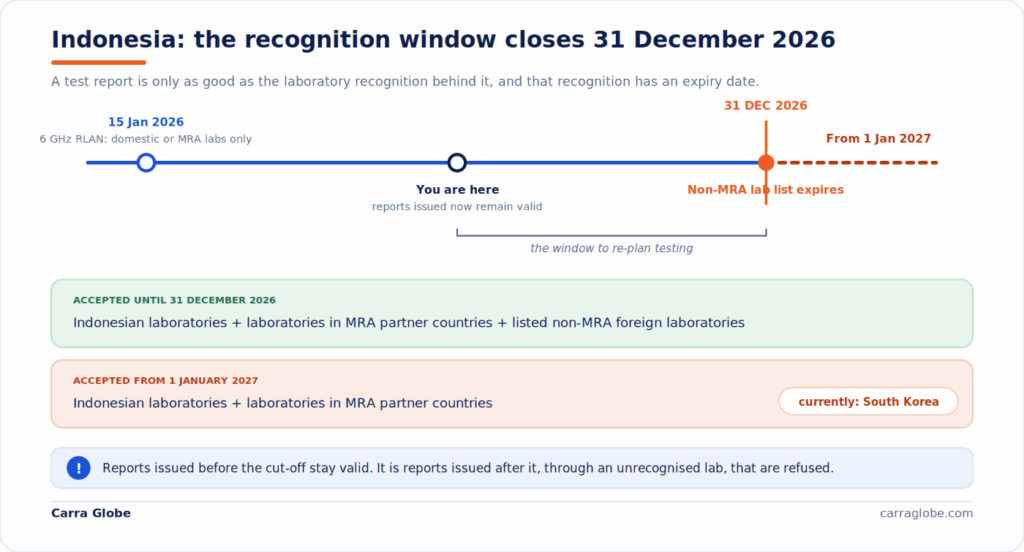
Foreign laboratories can currently support Indonesian type approval through two routes. Some are recognised under a mutual recognition agreement between Indonesia and the laboratory’s home country. Others were recognised unilaterally, without any such agreement, under a decree that lists them by name. That decree, KEPMEN KOMDIGI No. 13 of 2025, is expressly effective from 1 January 2025 to 31 December 2026.
Under the framework established by PERMEN KOMINFO No. 5 of 2024, unilateral recognition ends when that list expires. The published position is that from 1 January 2027, only reports from mutual recognition agreement laboratories will be accepted for certification. Indonesia has one such agreement, with South Korea, in force since May 2025, under which Korean laboratories including Nemko Korea and DT&C Korea have been designated, each with its own validity period and scope.
One caveat belongs here, because it affects how you plan rather than whether you plan. The current decree itself replaced an earlier list that expired at the end of 2024, so a successor instrument is possible. What is not in doubt is the direction. In June 2025 the ministry announced plans to move the majority of telecommunications device testing to domestic facilities by the end of 2026. The policy is stated, not inferred.
Read those two facts together and the position for 2027 becomes clear enough to plan around. Unless the agreement network expands considerably in the next five months, a manufacturer who tests in the United States or Europe and expects to use that report for Indonesian approval will need either a Korean laboratory or an Indonesian one.
The direction has already been demonstrated on a specific product class. Following DJID Circular B-63/DJID.3/SP.04.06/01/2026 of 13 January 2026, and the expiry of transitional provisions under KEPMEN KOMDIGI No. 12 of 2025, test reports for RLAN devices in the 5925 to 6425 MHz band have been accepted since 15 January 2026 only from authorised Indonesian laboratories or from laboratories in agreement partner countries holding an explicit recognised scope for 6 GHz RLAN. Reports issued before that date remain valid. Reports issued after it, through any other channel, do not.
Two further details matter to anyone planning around this. Accreditation alone is not sufficient, because the accreditation body itself must hold a recognised arrangement with Indonesia’s national accreditation committee. And where specific absorption rate testing is required, it is performed in Indonesia regardless of which route the rest of the application takes. Our guide to acting as importer of record in Indonesia covers the wider entry position.tely.
Brazil: The Report Can Be Void Before the Testing Starts
Brazil approaches the question from a different direction, and produces the most counterintuitive failure in this article.
Conformity assessment runs through a designated certification body, known as an OCD, and the position on foreign testing is more conditional than it is often reported. ANATEL’s own guidance is that testing performed abroad can be recognised, provided the results are consistent with Brazilian requirements and the laboratory is genuinely capable of testing against them. Responsibility for assessing that laboratory, and for following the priority order, sits with the certification body rather than with you.
ANATEL Resolution 242 sets a priority order for choosing a laboratory, and it is worth reading in order: third-party laboratories in Brazil accredited by the national accreditation coordination, then third-party laboratories evaluated by the certification body, then non-third-party laboratories evaluated by that body, and only then laboratories abroad accredited in their own country and belonging to the international accreditation cooperation. Foreign testing is the last option in a hierarchy, not an equivalent one, and where the priority order cannot be followed, the reason has to be justified and documented rather than simply assumed. The current list of designated certification bodies is published by ANATEL.
The sharper trap sits in the sequence. Under item 6.3.1.5 of ANATEL Act 4083, before testing begins the manufacturer or applicant must formally notify the certification body of the manufacturing unit that produced the sample and the traceability of the sample submitted. Foreign laboratories must be approved by the certification body before they start work. A report produced by a competent laboratory, on the correct sample, against the correct standard, can therefore be unusable because the notification was not made first.
There is a genuine exception worth knowing, and it favours infrastructure buyers. Under Act No. 7280, ANATEL accepts foreign laboratory reports for certain business and industrial products, including non-radio network switches, optical line terminals, digital multiplexers, coaxial cables, certain fibre optic cables and satellite transceivers. Much of what goes into a data hall sits closer to that list than to the consumer wireless products that attract full local testing, so the answer for a mixed shipment is rarely uniform across the bill of materials, and it starts with correct classification of the equipment.
One structural point deserves attention from anyone using an import partner. Brazilian certification is issued to a specific importer rather than to the product. A device already certified for one importer is not thereby certified for another, even where the hardware is identical. Change the entity bringing the goods in and the certification position changes with it, which makes continuity of the the importing entity in Brazil a technical matter rather than an administrative preference.
India: Recognised Is Not the Same as Recognised for This
India runs its laboratory recognition scheme under section 13(4) of the Bureau of Indian Standards Act 2016 and rule 32 of the BIS Rules 2018, and the requirement that catches people is narrower than it first appears.
Samples must be tested at a laboratory that is both accredited by the national accreditation board and recognised by BIS for the specific product category and the specific Indian Standard in question. A laboratory that holds recognition for a neighbouring category is not a substitute. Under the Compulsory Registration Scheme covering much of the electronics sector, testing is carried out in an in-country recognised laboratory, with the report supporting an application made through an Authorised Indian Representative. Where samples are drawn during inspection, they may only be tested in BIS-approved laboratories.
This is why the scope question matters more in India than the recognition question. The instinct is to ask whether a laboratory is BIS-recognised. The operative question is whether it is recognised for the exact standard your product is being certified against, which is a narrower enquiry and one that has to be answered before samples are shipped rather than after the report arrives.
India is unusually transparent about this, and the transparency is worth using. BIS publishes its list of recognised laboratories, and the entries carry a recognition validity date for each laboratory. Some entries also record suspensions and the dates on which suspensions were revoked. A laboratory that was recognised when you last used it may be recognised until a date that falls before your next submission, or may not be operative at all. That is checkable in an afternoon and is almost never checked.
There is also a timing dimension. India is moving several hundred products into mandatory certification through omnibus technical regulations, and a large number of Indian Standards have been revised during 2026. A product certified against a superseded version of a standard is not automatically in the same position as one certified against the current version, so the standard number and its revision year both belong in the file. Our guide to acting as acting as IOR in India sets out the wider certification landscape, and the position for medical devices has moved particularly quickly.
Three Markets, Three Different Ways to Lose a Report
| Market | Whose testing is accepted | The mistake that surprises people | What it costs |
|---|---|---|---|
| Indonesia | Domestic laboratories, or foreign ones under a mutual recognition agreement | Assuming the current list of recognised foreign laboratories continues past its expiry | Retesting in Indonesia or Korea for approvals filed from 2027 |
| Brazil | A priority hierarchy placing Brazilian laboratories first and foreign ones last | Commissioning testing before notifying the certification body | A completed report that cannot be used, and a repeat test |
| India | Laboratories accredited and BIS-recognised for that exact category and standard | Treating recognition as general rather than scope-specific | Rejected application and retesting against the correct standard |
| Malaysia | Testing evidence specified for the type approval category | Assuming a category previously outside scope has stayed outside it | Additional testing before type approval can proceed |
| South Korea | Domestic scheme, and Indonesia’s only current agreement partner | Overlooking it as the practical foreign route into Indonesia | A missed option, rather than a penalty |
Set out that way, the differences look like administrative detail. They are not, and treating them as detail is what makes them expensive. Each column describes a separate way for a technically perfect report to be worth nothing, and none of them can be discovered by reading the report itself. What unites the three markets is not the content of their rules but the direction of travel: a report that moved freely between markets in 2020 will not move freely in 2027.
The Same Movement in Three More Markets
Three further markets are moving in the same direction, each in a way that is easy to file as a minor technical notice and harder to absorb once a shipment is committed.
- Malaysia has extended the test evidence required for type approval of certain non-wireless devices, adding requirements to categories whose owners had not previously treated testing as a gating item. The position for importing into Malaysia is worth confirming per product class rather than per shipment.
- South Korea matters here for two reasons. It operates its own domestic scheme, and it is currently Indonesia’s only mutual recognition partner, which makes Korean testing the practical foreign route into Indonesian approvals once the existing list expires.
- Saudi Arabia has moved conformity documentation upstream, so that certain product classifications now require a ministry declaration before a shipment certificate can issue, and the certificate must be in place before arrival rather than obtained afterwards. Our guidance on importing into Saudi Arabia covers the sequencing.
Different instruments, different agencies, different product scopes. The same underlying instruction: the evidence must come from a source this regulator has approved, in the sequence this regulator has set.
Why This Is the Failure That Cannot Be Papered Over
Import compliance problems usually have a documentary remedy. That is what makes this category unusual and worth separating from the rest of the checklist.
If a classification is wrong it can be corrected. If a certificate is missing it can be applied for. If a declaration is incomplete it can be refiled, sometimes at a cost, usually within days. If a test report was issued by a laboratory the destination does not recognise, none of that applies. The regulator is not questioning the measurement. It is declining to accept the source, and the only cure is to have the measurement taken again by an acceptable source.
That means a physical sample in a laboratory, which is itself a cross-border movement requiring an exporter of record, a booking in a queue, and a timescale set by someone else. On a hardware programme with an installation date, this is the difference between a compliance cost and a schedule failure. It is also, in our experience, the failure most likely to be discovered late, because everyone involved has a valid-looking document in hand and no reason to doubt it until the application is refused.
Shipping certified hardware into markets that are tightening laboratory recognition? The question is not whether your product passes. It is whether the destination accepts the laboratory that says so, on the scope that applies, on the date you file. Carra Globe acts as importer of record across 175+ countries and checks the conformity route alongside the customs position, before samples are shipped and before certificates are relied on.
What to Establish Before Samples Are Shipped
- Confirm the laboratory is recognised by the destination regulator, not merely accredited. Accreditation is a statement about competence. Recognition is a statement about acceptance, and they are issued by different bodies for different purposes.
- Check the recognition scope against your exact standard. India in particular requires recognition for the specific product category and Indian Standard, and a laboratory recognised for an adjacent category will not serve.
- Check the expiry of the recognition, not just its existence. Indonesia’s current list of unilaterally recognised foreign laboratories runs only to 31 December 2026.
- Establish the required sequence before commissioning any testing. Brazil requires notification of the certification body, including the manufacturing unit and sample traceability, before testing begins.
- Split the bill of materials by product class. Brazil’s treatment of non-radio industrial equipment differs from its treatment of consumer wireless products, so one answer rarely covers a mixed shipment.
- Record the standard revision, not just the standard number. Where standards have been revised, certification against a superseded version may not carry forward.
- Confirm who holds the certificate. In Brazil it attaches to the importer rather than the product, so a change of importing entity is a certification event.
None of these questions is answered by the test report. All of them are answered before it is commissioned, which is the awkward part, because the testing decision is usually made by an engineering team and the consequence lands on a logistics team months later. Our guidance on telecom equipment imports covers where those two functions most often fail to meet.
Frequently Asked Questions
Can I use my CE or FCC test report for approval in other markets?
Sometimes, but it depends on the laboratory rather than the report. Markets accept reports from laboratories they recognise, and recognition is granted to specific laboratories for specific scopes, not to accreditation marks in general.
Brazil generally requires local testing for radio equipment, while Indonesia accepts reports only from domestic or agreement-partner laboratories.
What happens to test reports issued before a recognition expires?
Reports issued while a recognition was valid are generally still usable, and Indonesia confirmed this for the 6 GHz change. It is reports issued after the cut-off through an unrecognised channel that are refused.
That makes the issue date of the report a material fact, and worth recording alongside the standard and the scope.
What is a mutual recognition agreement in this context?
An agreement between two governments under which each accepts test reports from designated laboratories in the other. It is narrower than accreditation, because it names laboratories and the scopes they may test within.
Indonesia’s agreement with South Korea, in force since May 2025, is the operative example for anyone planning Indonesian approvals beyond 2026.
Can I reuse one test report for multiple countries?
Partly, and less than before. A single report can still support several markets where each recognises the issuing laboratory for the relevant scope, but the set of markets accepting any given laboratory is narrowing.
Plan testing by which laboratories each destination recognises, rather than assuming one report covers a region.
What is an OCD in Brazilian certification?
A designated certification body appointed by ANATEL. It defines the testing scope, must be notified of the manufacturing unit and sample traceability before testing starts, and issues the certificate of conformity.
No approval is granted without a valid certificate from one, which makes the OCD the gatekeeper rather than the regulator directly.
What does BIS recognition of a laboratory actually mean?
That the Bureau of Indian Standards has approved that laboratory to test against particular Indian Standards. It is granted for defined scopes, so a laboratory can be recognised for one product category and not another.
It sits alongside national accreditation rather than replacing it, and both are usually required.
How do I check whether a laboratory is recognised for my product?
Ask for the recognition instrument rather than the accreditation certificate, then check three things: the issuing regulator, the scope it covers, and the date it expires.
An accreditation certificate answers whether the laboratory is competent. Only the recognition answers whether the destination will accept its work.
Can a rejected test report be fixed without retesting?
Usually not. Where a report is refused because the laboratory is not recognised or lacks the right scope, the regulator is declining the source rather than disputing the measurement, so the product must be tested again.
This is what separates it from most import problems, which can be resolved with a corrected or supplementary filing.
Does changing our importer affect existing certifications?
In some markets, yes. Brazilian certification is issued to a specific importer rather than to the product, so an identical device brought in by a different entity requires its own certification.
Continuity of the importing entity is therefore a compliance consideration, not only a commercial one.
Why are so many markets changing laboratory rules at once?
Regulators are moving conformity assessment closer to home, either into domestic laboratories or into a narrow set of foreign laboratories they have assessed directly. The changes are separate instruments but share a direction.
For multi-market programmes the practical effect is that testing can no longer be planned once and reused indefini