
The short version. Covered GPU servers to or within the five countries now need US authorisation. The exceptions are an available licence exception, or a receiving company (the ultimate consignee or end user) that is US-headquartered, or whose ultimate parent is, provided the exporter, reexporter or transferor relying on the exclusion reports to BIS monthly. That exclusion does not override other controls. Reselling, relocating or repairing a server later can call for a fresh review. Malaysia, and Singapore for goods on its control list, add their own checks when servers leave again.
Carra Globe provides importer of record and exporter of record services, so we have a commercial interest in this topic. The checklist below is usable whether or not you ever work with us.Why the file now outlives the shipment
Reexport controls and record-keeping already applied, but many buyers treated a shipment as finished at customs release. The interim final rule at 91 FR 74970 makes that harder in three ways. The licence requirement now covers in-country transfers, so a new end user inside Malaysia or Singapore can be a controlled event. The US-headquartered exclusion only works while monthly reports keep flowing. And the new data centre control in section 744.24 follows how the equipment is used, not just where it lands. US rules require five years of retention, generally from the latest export, known reexport or in-country transfer, or the end of the transaction, and the rule adds the section 744.24 notice and authorisation records to the list of records to be retained. A server transferred to a new end user in 2029 can keep the 2026 papers live until 2034.The 12-document checklist
Print this and work down it. The status column separates what the law requires, what it requires only in some cases, and what BIS guidance recommends. A missing line should be a decision, not an oversight.| # | Document | Status | Prepared by | Needed |
|---|---|---|---|---|
| 1 | Classification sheet. ECCN to paragraph level (for example 4A090.a, 3A090.a or the applicable .z entry), product name, SKU and Total Processing Performance (TPP) | Classification required, sheet recommended | Seller or manufacturer | Before the order |
| 2 | Party map. Every party and its role, plus the ultimate parents of the ultimate consignee and end user and every parent company’s headquarters, with physical and mailing addresses and phone numbers | Required data where the exclusion is used | Buyer, checked by the exporter | Before the order |
| 3 | Ownership evidence. Group chart or registry extract showing the full chain to the ultimate parent | Recommended | Buyer | Before the order |
| 4 | End-user certification. Intended activity, delivery and installation addresses, items and ECCNs, signed | Recommended | Buyer or end user | Before the order |
| 5 | Data centre due diligence. Customer screening and ownership checks, access arrangements and linked facilities, plus an infrastructure attestation | Due diligence expected where section 744.24 applies, attestation recommended | Data centre provides, exporter evaluates | Before booking |
| 6 | Authorisation record. The basis and evidence, whether licence and conditions, the exclusion, a licence exception and its conditions (ACA normally needs a written purchase order), or No Licence Required | Basis required, record recommended | Exporter | Before booking |
| 7 | Commercial invoice and air waybill. Destination control statement on both, plus the ECCN on the invoice, with 3A090 identified as .a, .b or .c | Required for most controlled items exported from the US | Exporter | At dispatch |
| 8 | US export filing. Electronic Export Information in the Automated Export System | Required for US exports that meet the filing rules | Exporter or its forwarder | Before departure from the US |
| 9 | Recipient notice. The section 744.24(e) warning | Required where its conditions apply | Exporter, reexporter or transferor | With the shipment |
| 10 | Monthly BIS report. Copy of each section 743.10 report | Required where the exclusion is used | Exporter, reexporter or transferor | First business day of next month |
| 11 | Import file. Invoice, packing list, transport document, declaration, value evidence and any product approvals | Depends on destination law | Importer of record | Before arrival |
| 12 | Onward movement file. Malaysian AI Chip Assessment form and any permit, or Singapore strategic goods permit, with supporting papers | Required where local controls apply | Local exporter | Malaysia, at least 30 days ahead where the form applies. Singapore, before moving |
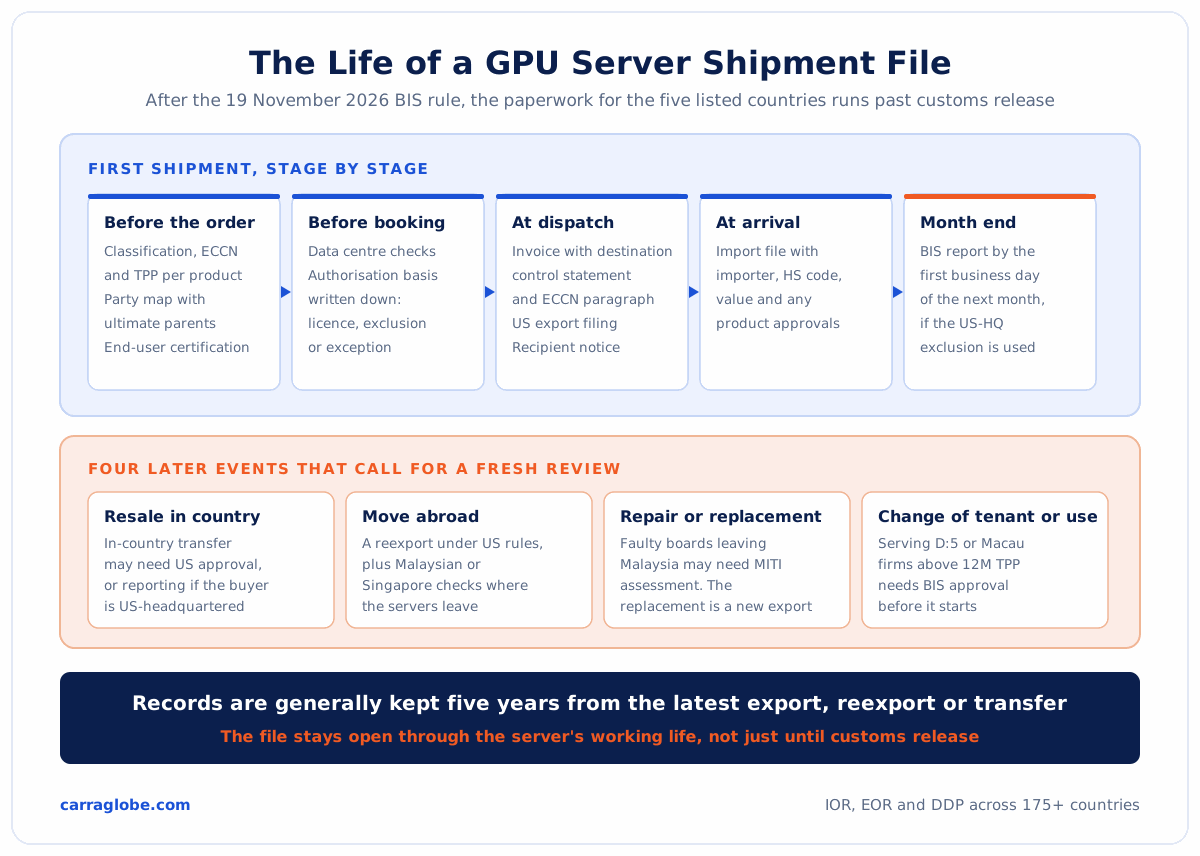
Before the order
Get the classification, with its basis. Everything downstream copies document 1. The five-country requirement covers 3A090 except high-bandwidth memory under 3A090.c, 4A090 and certain .z entries, so the exact entry matters, and a server assembled outside the US can still be caught through its US content or the foreign direct product rules. Where a prohibited data centre use is known, the new rule also limits reliance on the de minimis exclusion. Ask the seller how it reached the classification, not just the answer, and check the HS code for servers separately.
Map the parties. The exclusion turns on where the ultimate consignee or end user, or its ultimate parent, is headquartered. US rules define the ultimate consignee as the principal party receiving the items, not an intermediary, so a local importer on the customs entry does not change who that is. Our guide to importer, consignee and end user roles explains the difference.
Check the data centre, not just its power supply. BIS’s counter-diversion guidance of 13 May 2025 recommends end-user certifications, data centre attestations and business licences for new customers. The new rule expects exporters to get enough information about a foreign data centre’s own customer checks, including ownership links to Macau or D:5. A data centre that cannot provide it is a red flag that presumes knowledge unless resolved.
At booking and dispatch
Write the basis down. Licence Exception ACA does not cover data centre chips meeting 3A090.a or servers containing them, so many shipments of current data centre GPUs, such as H200-class parts, need a licence or the US-headquartered exclusion, depending on the exact ECCN. The rule also removed Licence Exceptions AIA and LPP, so older paperwork citing them needs reassessing. Our guide to GPU servers to Malaysia and Singapore works through the licence decision.
Know the exclusion’s limits. It removes only the five-country requirement. A US-parented buyer can still need a licence if the deal is for a Macau or D:5 headquartered company, or the data centre use is restricted. Separately, items that lost their old eligibility can still move under the savings clause if they were already aboard a carrier on 19 November under actual orders and the movement is completed by 21 December 2026.
Get the invoice right. For exports from the US, sections 732.5 and 758.6 require the destination control statement on the commercial invoice, and on the air waybill or bill of lading, for controlled items, except EAR99 items and shipments under Licence Exceptions BAG or GFT. For advanced computing items like these, the invoice must also list the ECCN, identifying 3A090 chips as .a, .b or .c. A model number and HS code alone are not enough. A later reexport between foreign countries does not need the statement, but still needs an ECCN and authorisation check.
File before departure. Under section 758.1, Electronic Export Information is filed for every US export that needs a licence, whatever its value, and for others by value and destination. A Singapore to Malaysia reexport does not go through the US system.
Send the notice where it applies. If covered items ship without a licence because no prohibited use was known and no other licence applied, section 744.24(e) requires a warning to the recipient. It must say that BIS authorisation is needed before the items serve companies headquartered or ultimately parented in Macau or a D:5 country at a data centre, or linked data centres, giving more than 12,000,000 aggregate TPP, and that the transferor making that change must obtain it and follow BIS know-your-customer guidance. No format is set, so keep a written copy with the invoice.
After the servers arrive
The monthly report. Under the exclusion, a section 743.10 report must reach BIS by the first business day of the month after each transaction, covering the parties and parent chain, the destination, and each product’s paragraph-level ECCN, product name, SKU, TPP, quantity and transaction date. When we checked on 19 November, the submission page named in the rule showed page not found, so sellers should confirm the route with BIS before their first deadline. Buyers should expect to be asked for this data, and should treat a seller who never asks as a warning sign.
The import file. The destination side carries on whatever the US position. Importer registration, the HS code, the value basis and any product approvals sit with the importer of record. Our guides for Malaysia, Singapore, Thailand, Indonesia and Brazil cover the local requirements.
A worked example
- The deal. A US OEM ships 4A090 GPU servers to a Malaysian data centre company whose ultimate parent is US-headquartered.
- Before booking. The OEM records the ECCN, SKU and TPP, collects the party map and ownership chart, and keeps evidence that it reviewed the data centre’s customer screening. Having found no other licence requirement, including under sections 744.23 and 744.24, it relies on the US-headquartered exclusion.
- At dispatch. The invoice carries the destination control statement and 4A090, Electronic Export Information is filed before departure, and the 744.24(e) notice goes to the data centre.
- After shipment. The OEM reports to BIS by the first business day of the next month. A later sale to a locally owned company, or a tenant headquartered in a D:5 country, starts a fresh review.
Four events that call for a fresh review
Most buyers have not planned for these. Each can trigger a new authorisation check, reporting and records.
- A new end user in the country. Selling used servers to another company in one of the five countries can be an in-country transfer where it changes the end user or end use, and may need US authorisation. If the new end user qualifies for the US-headquartered exclusion, the party making the transfer must report. Each later sale or transfer can itself be a controlled event, so whoever makes that movement must run the authorisation and reporting checks again. Our guides to used and refurbished IT equipment and exporting retired AI hardware cover the customs side.
- Moving to another country. Singapore to Malaysia is generally a reexport under US rules. MITI’s industry guideline under Directive No. 1/2025 asks for an AI Chip Assessment form at least 30 days before export, transhipment or transit where items meet its specifications or that is unclear, and MITI decides whether a permit is needed. Its statement of 13 November 2026 confirms that bringing AI chips in needs no permit under these controls, though normal customs rules apply. Singapore’s strategic goods permit applies to listed goods, by individual permit at least five working days before shipment or by bulk permit, with some transit exemptions.
- Repairs and replacements. A faulty GPU board leaving Malaysia for repair can fall under the same Malaysian process, even if it goes back to the US. The replacement is a new export into a listed country with its own authorisation, invoice and, where applicable, report. Our guide to exporting equipment for repair covers the customs mechanics.
- A change of tenant or use. Serving Macau or D:5 headquartered companies above the threshold generally needs authorisation first, with a separate conditional route for qualifying commercial recommender systems that submit the prescribed information to BIS. Data centres already providing that access before the rule must obtain a licence within 90 days, by around 17 February 2027, to continue. That transition does not cover new shipments or new uses.
Who keeps which documents
- Sellers and OEMs. Documents 1, 6, 7, 8 and 9, every monthly report, and the buyer’s documents 2 to 5.
- Buyers and data centres. Copies of 1, 7 and 9, your own 2 to 5, the import file and any onward permits. The reporting duty sits with whoever relies on the exclusion, so ask in the contract if you want a copy. If you transfer or relocate servers, you may become the transferor or reexporter.
- Importers of record. Document 11 and the customs entry. This role does not replace the exporter’s US obligations or the buyer’s end-use duties.
Where files usually break
On the Malaysia lane, the holds we see come from the customs side, not the export file. The usual causes are missing SIRIM or communications approvals where the configuration needs them, the wrong importer named, HS code or value mismatches, and battery papers where batteries are included. Each is avoidable, and our guide to a customs hold on servers explains how they are resolved. For the export side, our guides to export controls on data centre hardware and trade diversion scrutiny give the wider picture.
How Carra Globe handles GPU server files
Five lanes, one review. Our team has handled more than 200 shipments each into Malaysia and Brazil and more than 100 into Indonesia, and we also ship to Singapore and Thailand. Depending on the shipment, we act as importer of record at destination, arrange freight forwarding and delivered duty paid moves, or support the exporter with export paperwork through our exporter of record service. Our trade compliance team reviews each shipment’s file before booking. If a licence, notice or document is missing, we flag it to the exporter before the cargo moves.
Carra Globe works through importer-side registrations and local importing structures appropriate to the goods and destinations it accepts, its own in some markets and established local structures in others. Approvals falling outside the available structure are flagged before a delivery date is agreed.
To start, send the server and GPU model numbers, the seller’s ECCNs, the destination, the end user and your delivery date to info@carraglobe.com or through our contact page.
GPU servers · Shipping documents · Five listed countries
Send us your GPU server file before booking. We will check it line by line and flag anything missing.
Since 19 November 2026, GPU servers to Malaysia, Singapore, Thailand, Indonesia and Brazil need a file that runs from classification to monthly reporting. Share the invoice, the seller's ECCNs, the end user and the destination, and our team will review the file and flag any missing licence or document before the cargo moves.
- Importer of record for AI servers
- IOR for data centre equipment
- SIRIM approvals for IT hardware
- IOR for tech imports into Singapore
- Indonesia TKDN local content rules
- Brazil REDATA data centre incentive
- Exporter of record in the USA
- Exporter of record in Taiwan
- HS code for GPU chips
- Wrong HS code on an invoice
- Delivery documentation for imports
- Lithium battery customs clearance
- AI server import duties in 2026
- Cargo insurance for IT equipment
- What an exporter of record does
Free toolsHS Code FinderVolumetric Weight CalculatorPallet Calculator
Building a GPU server shipment file? Send the invoice and model numbers, and we will reply with what the file still needs.
Review my fileFrequently asked questions
What documents do I need to ship GPU servers to Malaysia?
Typically a classification, party details, the authorisation basis, an invoice with the destination control statement and ECCN, any recipient notice and the import file, plus recommended due diligence records.What must the commercial invoice say for 3A090 GPUs?
On exports from the US, the destination control statement and the ECCN, with 3A090 chips identified as .a, .b or .c. Servers under 4A090 or .z entries also need their ECCN listed.Who files the BIS monthly report?
The exporter, reexporter or transferor relying on the US-headquartered exclusion. Reports are due by the first business day of the month after each transaction.Does the US-headquartered exclusion cover everything?
No. It removes only the five-country licence requirement. Deals for Macau or D:5 headquartered companies, or restricted data centre uses, can still need a licence.Do I need MITI approval to move GPU servers out of Malaysia?
Often. MITI’s guideline asks for an AI Chip Assessment form 30 days before export, transhipment or transit of covered items, and MITI decides whether a permit is needed.How long must GPU export records be kept?
Generally five years from the latest of the export, any known reexport or in-country transfer, or the end of the transaction, under US record-keeping rules. Adjacent ground: importing NVIDIA H200 servers, AI GPU import compliance and NBTC and TISI approvals in Thailand.Sources and verification
This guide is based on the rule as published in the Federal Register, current US regulations, and Malaysian and Singaporean government sources, as available on 20 November 2026. Interim final rules can change after comments close on 19 January 2027, so check the current text before you ship. When we checked, the online eCFR was up to date only to 17 November 2026, so the new sections 743.10 and 744.24 appear only in the Federal Register text for now. The other eCFR sections cited were not changed by the rule.- Bureau of Industry and Security. Interim final rule, Addressing Remote Access to Advanced Semiconductors, 91 FR 74970, 19 November 2026, including sections 742.6, 743.10 and 744.24 and the savings clause, and the counter-diversion guidance of 13 May 2025.
- US regulations. 15 CFR 732.5 and 15 CFR 758.6, destination control statement, 15 CFR 758.1, Electronic Export Information, 15 CFR 762.6, period of retention and 15 CFR 740.8, Licence Exception ACA.
- Malaysia. Directive of the Strategic Trade Controller No. 1/2025, in force since 14 July 2025, version updated 8 December 2025, the MITI industry guideline on the directive and the MITI media statement of 13 November 2026.
- Singapore. Singapore Customs, permit and registration requirements, updated 1 September 2026 and Individual Permit, export, transhipment and transit, updated 8 June 2026.
Disclaimer: This guide is for informational purposes only and does not constitute legal or regulatory advice. Requirements depend on the chips, the server, the parties, the destination and the date of each movement. The position described is as at 20 November 2026. Confirm the current position with BIS, the relevant national authority, export control counsel or a licensed customs broker before acting.