
Most articles about importing enterprise IT hardware in 2026 answer a question you did not ask. They explain that customs is complex and then tell you to hire an importer of record, without ever addressing the decision you are actually trying to make: for this shipment, into this country, do you handle it yourself, hand it to your freight forwarder, or bring in an importer of record?
Those are three genuinely different answers with three different cost and risk profiles, and the honest truth is that no single one of them is right for every situation. Sometimes your forwarder is enough. Sometimes you do not need any third party at all. And sometimes trying to save the cost of an importer of record is the most expensive decision you can make.
This guide is a decision framework, not a sales pitch. It walks through what each of the three options actually does, where each one fits, and the specific questions that tell you which you need for a given enterprise IT hardware shipment. By the end you should be able to place any shipment into the right lane, and know why.
Enterprise IT Hardware Import Compliance: At a Glance
- The three options are not interchangeable: handling it in-house, using a freight forwarder, and using an importer of record solve different parts of the problem, and choosing wrongly is where cost and delay come from.
- A freight forwarder moves the goods; it is usually not the legal importer: forwarding and the importer of record responsibility are different roles, and conflating them is the most common and expensive mistake.
- The deciding factor is usually the entity question: whether you have a properly registered local entity in the destination country, with the right import and product authorisations, is what most often decides the lane.
- Enterprise IT hardware raises its own flags: high value, encryption, wireless certification, and used-versus-new status all push a shipment toward needing specialist handling regardless of who moves the box.
- There is a simple test: the three-question import lane test below places most shipments in the right lane in under a minute.
- See it side by side: the comparison table further down maps all three options against who is legally the importer, who moves the goods, and who carries the compliance liability, so you can match your situation at a glance.
The Three Options, and What Each Actually Does
Before choosing, it helps to be precise about what each option is responsible for, because the three are often blurred together in a way that causes exactly the problems people are trying to avoid.
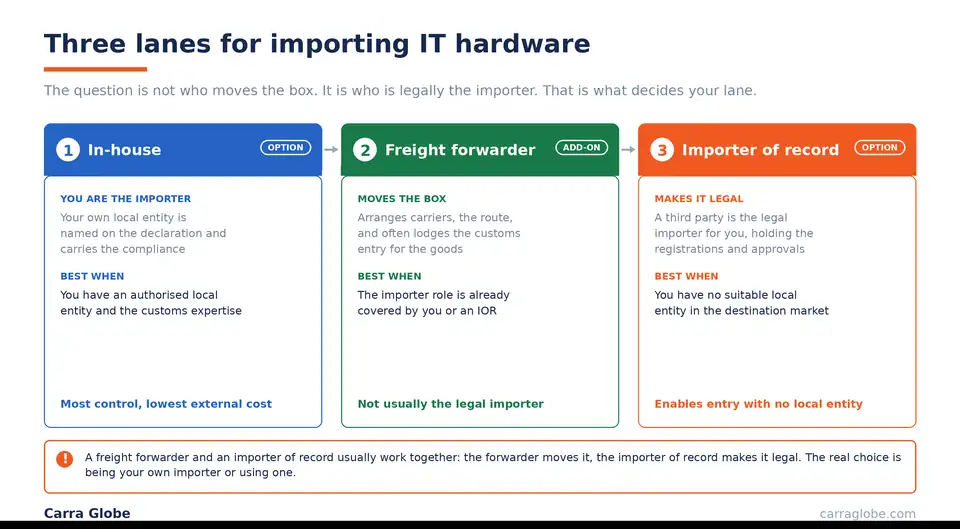
🏢 Option 1: Handle it in-house (you are the importer)
Handling imports in-house means your own company is the importer of record. Your legal entity in the destination country is named on the customs declaration, holds the necessary registrations, pays the duties and taxes, and carries the compliance responsibility. This is the natural choice when you already have a properly established and import-authorised entity in the destination market, and the internal customs expertise to manage the declaration correctly. It gives you the most control and the lowest per-shipment external cost, but it only works where you actually have that local entity and that expertise, and it puts the full legal liability on you.
🚚 Option 2: Use a freight forwarder (moves the box)
A freight forwarder arranges the physical movement of your goods: booking carriers, coordinating the route, handling the logistics of getting the hardware from origin to destination. A good forwarder is invaluable for moving equipment efficiently, and many also offer customs brokerage to lodge the entry. But there is a critical distinction that trips up even experienced teams: arranging transport and brokering an entry is not the same as being the legal importer of record.
In most countries the forwarder moves the box and can file the paperwork, but someone still has to be the legally accountable importer, and that is usually you or a dedicated importer of record, not the forwarder. A forwarder is the right lane when you have the importer role covered and simply need the goods moved and the entry lodged.
🛡️ Option 3: Use an importer of record (makes it legal)
An importer of record is a third party that acts as the legally recognised importer on your behalf, in a country where you do not have a suitable entity of your own. It holds the local registrations, presents and stands behind the documentation, ensures the product certifications are in place, pays the duties and taxes, and carries the legal compliance responsibility for the import.
This is the lane when you need to import into a market where you have no local entity, or no entity with the specific import and product authorisations the goods require. It is not about moving the box, a forwarder still does that, it is about making the import legal in a place where you otherwise could not.move.
Importer of Record · 175+ countries
Importing IT or high-value hardware? We can be your Importer of Record.
Carra Globe acts as your Importer of Record so you can ship into markets where you have no local entity. We carry the legal liability, handle certifications and duties, and give you one itemised quote:
Have a shipment in mind? Send us your lane and goods, we will confirm and quote.
Get a compliance quoteThe Import Lane Test: Three Questions
Here is the framework. For any enterprise IT hardware shipment, three questions place it in the right lane. Work them in order, because the first question is the one that most often decides the answer on its own.
- Do you have a local entity in the destination country with the right import and product authorisations? If no, you are heading for an importer of record, because you cannot legally be the importer yourself. If yes, continue to question two.
- Does that entity have the customs expertise to manage the declaration correctly for this type of hardware? If no, you either build that capability or use an importer of record to carry the compliance. If yes, you can handle the import in-house and continue to question three.
- Do you still need the goods physically moved and the entry lodged? If yes, that is your freight forwarder’s job, running alongside whoever holds the importer role. The forwarder is not an alternative to the importer decision; it sits next to it.
The reason the entity question comes first is that it is usually decisive. Enterprises expanding into new markets very often have no local entity there yet, which sends the shipment straight to the importer of record lane no matter how strong their internal customs team is at home. The forwarder question, by contrast, is almost always “yes, we need one”, it just is not the same question as who imports.
Which Option Fits: A Side-by-Side
| Factor | In-house | Freight forwarder | Importer of record |
|---|---|---|---|
| Legally the importer? | Yes, you are | No, not usually | Yes, on your behalf |
| Moves the goods? | Via a forwarder | Yes | Via a forwarder |
| Needs your local entity? | Yes, essential | Depends on the role | No, that is the point |
| Carries compliance liability? | You do | Limited, for the entry it files | The IOR does |
| Best when | You have an authorised local entity and expertise | The importer role is already covered | You have no suitable entity in the market |
The most useful thing this table shows is that the columns are not mutually exclusive. An importer of record and a freight forwarder usually work together on the same shipment: the forwarder moves it, the importer of record makes it legal. The real choice is between being your own importer and using a third-party importer, and the forwarder sits alongside either way.
Not sure which lane your next IT hardware shipment belongs in? Carra Globe can review your destination markets and tell you honestly where you can import in-house, where a forwarder covers it, and where you genuinely need an importer of record.
What Makes Enterprise IT Hardware a Special Case
The lane test above applies to most imports, but enterprise IT hardware carries specific characteristics that push shipments toward specialist handling more often than general cargo does. These are worth knowing because they can turn what looks like a simple in-house import into one that needs expert compliance, even in a market where you do have a local entity.
- High declared value invites scrutiny. Servers, storage arrays, and networking gear carry high values, and high-value shipments draw closer customs attention on classification, valuation, and documentation. The cost of an incorrect HS code is magnified on expensive hardware.
- Encryption and security features can trigger controls. Hardware with cryptographic capability can fall under export-control regimes, such as the US Export Administration Regulations, and separate import-licensing rules that ordinary goods never touch, adding a documentation layer many teams do not anticipate.
- Wireless components need type approval. Anything with a radio, from a management interface to an embedded wireless module, may require in-country type approval (for example FCC in the US, CE in the EU, or a national radio regulator elsewhere) before it can clear, separately from the customs entry itself.
- Used and refurbished hardware follows different rules. Redeployed or second-hand equipment frequently faces extra restrictions, age limits, or inspection requirements that new hardware does not, which matters for enterprises moving kit between sites.
- Converged devices are hard to classify. A device that is part server, part network appliance, part security tool can be classified several ways, and the duty rate and regulatory treatment differ by classification, so getting it right is both a cost and a compliance question.
When one or more of these applies, the value of specialist handling rises sharply, because the failure modes are exactly the ones that hold high-value hardware at the border. For the deeper technical picture, see our guide to IT hardware and data centre trade compliance.
The Most Expensive Mistake: Assuming the Forwarder Has It Covered
In our experience across enterprise IT hardware shipments, a large share of the customs delays we see, on the order of 40 to 50% of the stalled shipments we are asked to help unblock, come down to a single avoidable cause: the importer of record was never confirmed before the goods moved.
If there is one error that causes more stalled enterprise IT hardware shipments than any other, it is assuming that because a freight forwarder is moving the goods, the importer of record responsibility is handled. It often is not. The forwarder moves the box and may lodge the entry, but in many countries the legal importer still has to be an entity with local standing.
If that is not arranged, the shipment arrives with no one legally able to import it. The goods sit, the deployment slips, and the cost of the delay dwarfs whatever was saved by not arranging an importer of record in advance.
The fix is simple: on every shipment into a market where you lack a local entity, confirm who the legal importer of record is before the goods move, not after they land. Our guide to the difference between a freight forwarder and an importer of record covers this distinction in full.
How Carra Globe Helps
The framework above is deliberately vendor-neutral, because the right answer genuinely varies by shipment. This section is where Carra Globe fits, and it is kept separate.
Carra Globe acts as importer of record and exporter of record for enterprise IT hardware across 175+ countries, with a focus on servers, data centre equipment, networking, and telecoms, exactly the high-value, certification-heavy categories where the import lane decision matters most.
Where you have a local entity and simply need the goods moved and cleared, we will tell you so. Where you have no suitable entity in a market, we hold the importer of record function so your hardware can enter legally, with the certifications and documentation handled. Our global trade compliance team manages the classification, encryption, and type-approval questions that make enterprise IT hardware a special case.
Our delivered duty paid service means the goods arrive with duties and taxes handled rather than becoming a surprise at the border. For the freight side, our guide to the freight forwarder versus importer of record distinction sets out how the roles fit together.
Frequently Asked Questions: Enterprise IT Hardware Import Compliance
What is an importer of record?
An importer of record is the legal entity responsible for ensuring that imported goods comply with the destination country’s customs law, holding the registrations, presenting the documentation, and paying the duties and taxes.
It can be your own company where you have a local entity, or a third party acting on your behalf where you do not. The importer of record carries the legal compliance responsibility for the import.
Do I need an importer of record to import IT hardware?
You need an importer of record only if you lack a local entity in the destination country with the right import and product authorisations.
If you have a properly registered and authorised local entity, you can act as your own importer and use a freight forwarder for physical movement. Enterprises expanding into new markets often lack this, which is when an importer of record becomes essential.
How much does an importer of record cost?
Importer of record pricing varies by destination country, shipment value, product type, and the complexity of the compliance involved, so it is quoted per engagement rather than as a fixed rate.
The more useful comparison is against the cost of a delay: for high-value IT hardware, the depreciation, penalties, and project slippage from a stalled shipment usually dwarf the importer of record fee.
Can my freight forwarder be my importer of record?
Usually not. A freight forwarder moves your goods and may lodge the customs entry, but being the legally accountable importer of record is a separate role that most forwarders do not take on.
Assuming the forwarder covers the importer role is the most common cause of stalled IT hardware shipments. Confirm who the legal importer is before the goods move.
What is the difference between a freight forwarder and an importer of record?
A freight forwarder arranges the physical movement of goods; an importer of record is the legally accountable entity that ensures the import complies with the destination country’s law and holds the required registrations.
The two roles usually work together on the same shipment: the forwarder moves it, the importer of record makes it legal. Moving a box is not the same as legally importing it.
What is the difference between a customs broker and an importer of record?
A customs broker prepares and lodges the customs entry on behalf of the importer; the importer of record is the party legally accountable for the import itself, whose name is on the declaration.
A broker files the paperwork, but the importer of record carries the legal responsibility. In many arrangements the importer of record uses a broker to lodge the entry.
When should I handle IT hardware imports in-house instead of using an IOR?
Handle imports in-house when you have a properly registered and import-authorised local entity in the destination country, plus the internal customs expertise to manage the declaration correctly for that hardware.
That combination gives you the most control and the lowest external cost. Without either the entity or the expertise, an importer of record usually carries the compliance more safely.
Can I be my own importer of record?
Yes, in any country where your company has a properly registered local entity with the customs and product authorisations the goods require, and the expertise to file the declaration correctly.
Where you have no suitable local entity, you generally cannot be your own importer of record, and a third-party importer of record is the route into that market.
Why does enterprise IT hardware face more customs scrutiny than other goods?
Because it combines high declared value with technical features like encryption and wireless components, which can trigger export controls, import licensing, and type-approval requirements that ordinary cargo never encounters.
Customs authorities commonly verify the classification, valuation, and regulatory compliance of high-value technical hardware more closely, which is why accurate documentation matters so much.
What documents are needed to import IT hardware?
Typically a commercial invoice, packing list, transport document, an accurate HS classification, country-of-origin details, and any product certifications or import permits the destination country requires.
For IT hardware specifically, that can also include type-approval certificates for wireless components and export-control documentation where encryption is involved.
Can I import servers into a country without a local office?
Yes. An importer of record can legally import servers and other enterprise IT hardware on your behalf into many countries where you have no local entity, subject to local regulations.
This is one of the main reasons enterprises use an importer of record: it enables market entry and deployment without first establishing a local company in every destination.
Does used or refurbished IT hardware follow the same import rules as new?
Often not. Used and refurbished equipment frequently faces additional restrictions, age limits, inspection requirements, or import bans in some markets that new hardware does not encounter.
This matters for enterprises redeploying kit between sites or countries, so the used-versus-new status should be checked per destination before the goods