
A pallet of three-year-old servers leaves a decommissioned European data centre. They were working when they were pulled from the racks. The buyer in Lagos has paid. The commercial invoice says “refurbished IT equipment,” which everybody involved considers an accurate description.
At the destination, an inspector opens the crate and asks a question nobody prepared for. Not “are these refurbished?” but “can you demonstrate these work?”
Nobody can. And the shipment now has an evidential problem: whether it is genuinely moving as used equipment for reuse, or as waste.
Importing used IT equipment is a large part of what we handle, so Carra Globe has a commercial interest in your answer. What follows is written to be usable whether or not you ever speak to us, including the parts where the honest answer is that a market is closed to you.
Can you import used IT equipment?
It depends on the destination and on what you can evidence. Several markets restrict particular categories of second-hand electronics, some prohibit waste imports entirely, and some require evidence of functionality or intended reuse before release.
Calling equipment refurbished does not establish that it is legally importable. The word appears in some import policies and producer responsibility rules, so it is not meaningless. What it does not do is answer the question an inspector is actually asking.
The first classification question is whether the shipment is moving as usable goods for reuse, or as waste for recovery or disposal. Goods face import rules. Waste faces an entirely different regime, in many cases a prohibition and occasionally a criminal one. Mixed or uncertain consignments can require separate treatment for different items.
Understanding that distinction is worth more than memorising any country list, because the lists change and the question does not.
Goods or waste: how the line is drawn
The international framework is the Basel Convention, which regulates transboundary movements of hazardous and certain other wastes, with national and regional regimes built on top. In the EU, producer obligations sit under the WEEE framework while cross-border movement is controlled by the Waste Shipment Regulation. Two regimes, two different questions.
The practical position is unambiguous from the inspector’s side: a large part of e-waste enforcement deals precisely with whether equipment is a second-hand good or is waste.
Where authorities have indications that a shipment may be waste, they can require the consignor or holder to produce evidence that the equipment is genuinely intended for reuse and meets the applicable conditions. The demonstration is evidential rather than rhetorical.
What raises the risk of waste classification
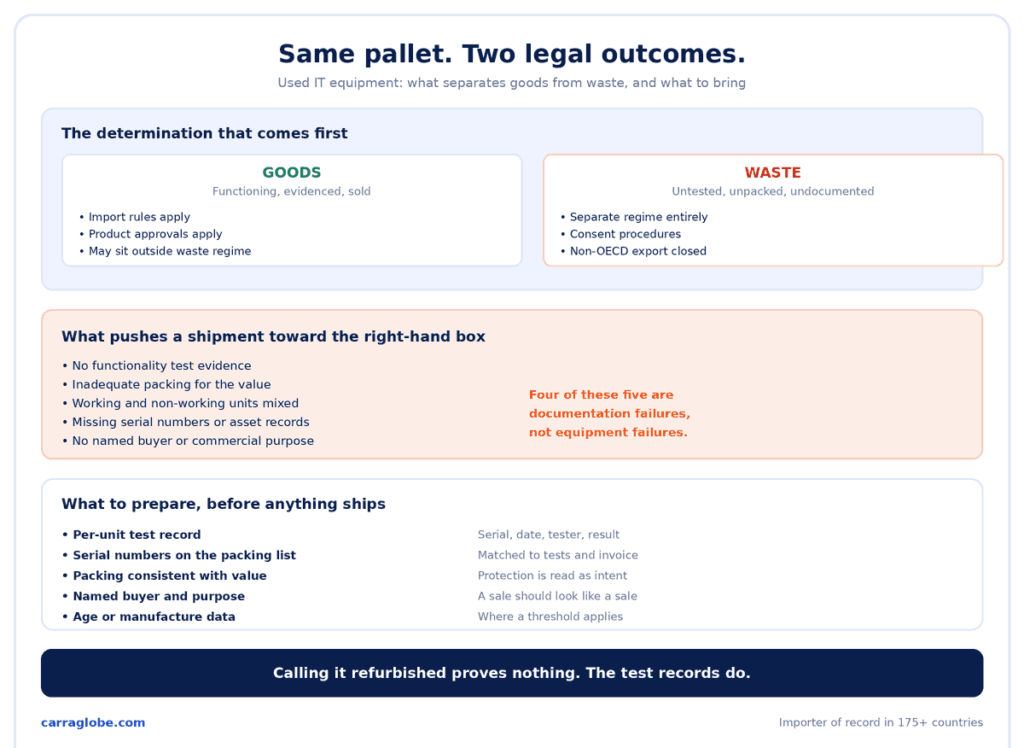
- No evidence of functionality testing. A major evidential weakness where authorities need to determine whether equipment is genuinely shipped for reuse.
- Inadequate packing. Equipment loose in a crate, unprotected, stacked without separation. Inadequate protection weakens the case that goods are being shipped as usable equipment, and protection against transport damage is expressly relevant under EU rules.
- Mixed working and non-working units in one consignment. Do not load tested working units alongside scrap, defective units or parts intended for recovery unless the destination permits it and the paperwork separates the streams. Non-working units raise their own classification question and drag the rest of the pallet into it.
- Missing serial numbers or asset records, making the units untraceable to any prior owner or test.
- No declared buyer or commercial purpose, where the shipment reads as disposal rather than sale.
Notice that four of those five are documentation and preparation failures rather than anything about the equipment itself. Classification depends not only on the hardware but on its condition, intended reuse, documentation and the circumstances of the shipment.
The United States anomaly
Worth understanding if any of your stock originates there.
The United States signed the Basel Convention but never ratified it, which leaves it a non-party. That matters more than it sounds. The Convention restricts parties from trading controlled wastes with non-parties absent a qualifying agreement, so the constraint runs in both directions rather than being a US problem alone. Lawful export from the United States does not establish that the destination can lawfully accept the shipment.
For anyone moving decommissioned US enterprise hardware, that gap is the whole risk. It is entirely possible to do everything correctly at origin and still present a shipment the destination cannot lawfully accept, because the obstacle sits in the receiving country’s treaty obligations rather than in your export paperwork.
Which makes the goods-or-waste determination even more decisive on US-origin stock. Equipment that is genuinely functioning goods is outside the controlled waste entries entirely, and the problem does not arise.
Four restriction patterns, rather than a country list
Country lists date quickly. The structures underneath them are stable, and recognising the pattern predicts most of what a market will require.
| Pattern | How it works | What it means for you |
|---|---|---|
| Restricted category | Used goods sit in a restricted import list requiring a specific licence | Possible, but licence-dependent and often refused for consumer-grade items |
| Environmental clearance | An environmental authority requires a permit, clearance or no-objection decision before import or release | Adds a regulator, and a lead time, ahead of clearance |
| Functionality conditions | Used equipment permitted where it meets prescribed conditions including working order | Evidence is the whole game. Prepare it before shipping |
| Age or lifespan limits | Residual life or manufacture date must be declared and meet a threshold | Older stock can be excluded regardless of condition |
Most difficult markets run two or three at once. India is the clearest example of why the word refurbished settles nothing: its own import policy uses the phrase, and uses it to restrict. Second-hand computers including laptops, and refurbished or reconditioned spares, sit in the restricted category.
Note the boundary. Other refurbished capital goods spares can be treated differently, subject to their own conditions such as a residual life certificate, so the category matters as much as the word. Specified electronics and IT products can also carry compulsory registration requirements, and environmental obligations may apply separately. Screen the shipment against the current DGFT, standards and environmental position for the exact item rather than assuming one clearance covers the rest.
Nigeria illustrates the functionality pattern. E-waste import is prohibited, while certain functional used electrical and electronic equipment may be imported subject to prescribed conditions including functionality and packaging. NESREA also operates a permit specific to used electrical and electronic equipment, so the route involves registration as well as evidence.
Same country, two completely different outcomes, and the difference is what you can prove.
Our note on importing used equipment into Vietnam under Circular 30 covers a market that runs age limits, and the market table below sets out where each pattern shows up.
Where the patterns show up, market by market
High-volume IT destinations, and the question that decides a used shipment in each. This is a starting point for the conversation, not a substitute for checking the current entry.
| Market | Pattern | What actually decides it |
|---|---|---|
| India | Restricted category | Second-hand computers and refurbished or reconditioned spares sit in the restricted list. Registration and environmental obligations can apply separately |
| Nigeria | Functionality conditions | E-waste prohibited. Functional used equipment permitted under prescribed conditions, with a NESREA permit specific to used electrical and electronic equipment |
| Vietnam | Age limits | Residual life and manufacture date thresholds under the used equipment circular. Older stock excluded regardless of condition |
| European Union Germany, Netherlands and other member states |
Waste classification | Classification decides everything. Where equipment falls within the e-waste entries, export to non-OECD destinations is closed and OECD destinations require consent. Where it moves as functioning goods for reuse, neither applies |
| United Kingdom | Waste classification | Operates its own post-Brexit waste shipment regime. Confirm the current UK position rather than assuming the EU rule applies |
| China | Waste classification | Solid waste import controls are strict. The goods-versus-waste classification is fundamental, and product-specific import controls apply alongside it |
| Saudi Arabia and UAE | Conformity first | Product conformity, registration and import controls may apply. Check used equipment separately rather than assuming it follows the same route as new |
| United States | Origin asymmetry | Import of used equipment is generally straightforward. The difficulty is on export, since the US is not a party to Basel |
Two things are worth reading out of that table. The pattern column predicts the shape of the requirement, which is what lets you plan. And the third column is a question in most rows rather than an answer, because used goods entries change more often than new goods entries do.
Our IOR by country index covers the wider position in each market, including whether a third party may act as importer at all.
What the evidence actually looks like
This is the part that separates shipments that clear from shipments that argue, and almost nobody prepares it properly.
- A functionality test record per unit. Not a blanket statement covering the consignment. Serial number, test date, tester, result. One of the strongest practical pieces of evidence supporting treatment as used equipment rather than waste.
- Serial numbers on the packing list, matched to the test records and the invoice. Three documents that agree are worth more than any one alone.
- Packing consistent with value. Anti-static protection, separation, proper crating, covered in our note on packaging standards for IT hardware.
- A stated commercial purpose and an identified buyer. A sale looks like a sale.
- Age or manufacture data where the destination applies a threshold, declared rather than discovered.
- Data sanitisation certification where storage media are present, which matters commercially even if customs never asks.
- Battery information and dangerous goods documentation where applicable. Retired equipment can contain lithium or other cells that create separate transport and handling requirements.
Point one deserves emphasis. A per-unit test record, prepared before shipping, turns an unsupported assertion of functionality into documented evidence authorities can assess. It is cheap at the warehouse and impossible to produce credibly once goods are at a border.
Not every non-working unit is waste
Worth knowing, because it is the exception most people miss.
Equipment moving under a documented business arrangement for warranty repair, refurbishment or root cause analysis can be treated differently from equipment being discarded. The EU framework contains specific provisions along these lines for certain business-to-business transfers of defective equipment.
The treatment is highly conditional, and the conditions are where it goes wrong. Confirm the route, the recipient and the documentation before shipping rather than assuming a repair label carries the consignment. Our note on exporting equipment for repair covers the adjacent ground.
Valuation, and why the low number causes trouble
Importing used IT equipment invites a different valuation problem from new. The instinct is to declare a low value, because the goods genuinely are worth less
A very low declared value can trigger customs valuation questions, particularly where the amount looks inconsistent with the goods or the available evidence. That is a valuation issue and should not be confused with the separate question of whether the equipment is waste. A functioning server can be worth very little and still be goods.
Where customs does not accept the declared transaction value, the destination’s valuation rules determine how an alternative is established.
Declare the value required under the destination’s rules and retain the purchase agreement, payment evidence and condition records that support it. Our guide to calculating landed cost covers the wider picture, and classification still matters as much as it does on new goods, which our overview of HS codes for electronics sets out.
The document set, in full
| Document | What it establishes |
|---|---|
| Commercial invoice | The transaction and the declared value |
| Packing list with serial numbers | Each unit individually identified |
| Functionality test report, per unit | Working condition, tied to serial number |
| Test methodology | What was actually tested, and how |
| Photographs | Condition and packing as despatched |
| Buyer order or contract | Intended reuse and commercial purpose |
| Age or manufacture data | Compliance with any residual life threshold |
| Import authorisation | Where the destination requires one |
| Environmental permit | Where the destination requires one |
| Product conformity evidence | Where registration or certification applies |
| Data sanitisation record | Commercially essential where media are present |
| Waste or goods classification assessment | Where relevant, the reasoning and supporting evidence used |
Not every destination asks for all of it. The point is that assembling it takes an afternoon at the warehouse and cannot be done credibly once goods are at a border.
The direction most people get wrong
Almost everything written about used IT equipment addresses importing it. For enterprise operators, the harder problem usually runs the other way.
You are decommissioning a data centre in a market where you have equipment and no easy route out. The hardware has residual value, a buyer exists somewhere else, and now you need an export that satisfies both the origin country’s waste rules and the destination’s import rules.
For EU-origin equipment the position changed materially, and recently. Regulation (EU) 2024/1157, the revised Waste Shipment Regulation, has applied to most provisions since 21 May 2026, with certain export provisions and transitional arrangements taking effect later.
For waste shipments covered by the revised regime, procedures are moving into the EU’s DIWASS system, and the split matters for IT hardware. Notification and movement documents for shipments under the prior informed consent procedure moved to electronic submission on 21 May 2026.
Green-listed waste destined for recovery sits under transitional arrangements during 2026. There is a second transition running alongside it, specific to e-waste: shipments moving within the EU can continue under the existing green-list entries until 31 December 2026, after which the new e-waste entries and the consent procedure apply.
Two different clocks, both stopping at the end of this year. Worth knowing which one your movement runs on.
For e-waste specifically, new Basel classification entries took effect on 1 January 2025. Since that date, equipment falling within those entries cannot be exported from the EU to non-OECD destinations, and export to OECD destinations requires prior informed consent. The qualification matters: this bites on equipment classified as e-waste, not on everything second-hand. The European Commission publishes the current position.
And the classification question decides whether any of that applies to you. Cross-border transfers of operational equipment for genuine reuse can fall outside the waste shipment regime entirely, which is the strongest argument for getting the evidence right.
Which is why the question is not academic. The same pallet, treated as used goods for reuse, may move. Treated as e-waste and bound for a non-OECD destination, it may not move at all. The regulation’s own stated purpose includes safeguards against waste being passed off as used goods, so the evidential bar is deliberate rather than incidental.
Which makes the export side a question of who is named as exporter of record and what they can evidence.
Three consequences follow for anyone planning a decommissioning, and they are worth knowing before the racks come out.
- Test before you decommission, not after. Equipment tested while still racked and running produces better evidence than equipment tested on a warehouse floor weeks later. The window for cheap evidence closes when the kit is powered down.
- The buyer’s location changes the legal position, not just the freight cost. An OECD destination and a non-OECD destination sit under different rules for the same pallet, which makes the sale a compliance decision as much as a commercial one.
- Storage between removal and sale is a risk window. Long periods in storage without testing, a buyer or a documented reuse plan make the evidential case for intended reuse harder to demonstrate.
Our notes on exporting retired AI hardware and returned goods and reverse logistics cover adjacent ground.
The obligation that outlives the shipment
One more thing, which catches people who solved everything else.
Producer responsibility rules can create obligations for the party that places equipment on a market, and in some regimes that includes the importer. Used and refurbished goods are often in scope rather than exempt, so clearing the import can create a continuing obligation with nothing to do with customs. Definitions vary considerably by jurisdiction.
India’s e-waste rules, for instance, name refurbishers and importers among the categories of obligated entity. Our guide to WEEE producer obligations for importers covers why the importer is so often treated as the producer.
The uncomfortable arithmetic. Used equipment is cheaper to buy and more expensive to import. Licences, environmental clearances, inspection, evidence preparation and producer registrations all cost money that new equipment does not attract. On low-value consignments the compliance cost can exceed the saving, which is a calculation worth doing before the purchase rather than after.
Six questions before you buy
- Does the destination permit used electronics at all, and under what category?
- Which regulators are involved beyond customs, and what are their lead times?
- Can the seller provide per-unit functionality evidence, or only a general assurance?
- Is there an age or residual life threshold, and does the stock meet it?
- Who will be named as importer, and are they eligible for used goods specifically?
- What producer obligation follows, and who carries it?
Work them in that order. The first four are free and take an afternoon. The last two cost money, and running them out of sequence is the difference between a decision and a write-off.
Question three most often ends the conversation. A seller who cannot produce per-unit test records is selling you a documentation problem alongside the hardware.
Importer of record for used IT equipment
The boundary first, because importing used IT equipment is one of the areas where the honest answer is often no. We cannot create an import route where the destination prohibits the goods, and neither can any legitimate provider. What we do is establish which situation you are actually in, before money moves
- Screening the destination for used goods specifically, because a market that welcomes new hardware may treat the same equipment quite differently second-hand.
- Acting as importer of record across 175+ countries where used equipment is permitted and we are eligible to hold the role.
- Acting as exporter of record on the decommissioning side, which is the direction more enterprise operators actually need.
- Handling the rest of the movement, from freight through staging to delivery where the equipment goes back into a rack.
- Telling you when the compliance cost exceeds the saving, which on smaller consignments it frequently does.
Where a market is closed to your stock, we will say so rather than sell you a structure that does not solve it.
Underneath it sits global trade compliance, and our case studies cover comparable movements.
Which brings us back to the pallet in Lagos. Those servers were working when they came out of the racks. Nothing about the hardware was wrong.
What was missing was an afternoon at the warehouse: power each unit, record the serial, note the result, photograph the packing. The equipment would have been identical. The outcome would not.
Moving used or decommissioned hardware? Send the equipment list, the age of the stock, the origin and the destination. We will tell you whether it can go, and what it needs.
Importer and Exporter of Record · 175+ countries
Decommissioning kit, or buying used? The classification decides everything.
We handle both directions: used equipment coming in where the market permits it, and retired hardware going out where the waste rules decide the route. Where a destination is closed to your stock, we will say so rather than sell you a structure that does not solve it.
- Importer of Record services
- Exporter of Record services
- Returns and reverse logistics
- Exporting retired AI hardware
- WEEE producer obligations
- IOR by country
Free tools HS Code Finder Volumetric Weight Calculator Pallet Calculator
Moving used or decommissioned hardware? Send the equipment list, the age of the stock, the origin and the destination. We will tell you whether it can go, what evidence it needs, and where the compliance cost outruns the saving.
Check your used equipment routeFrequently asked questions
Is refurbished equipment treated differently from used?
Not necessarily. Some regimes expressly use the terms refurbished or reconditioned, while others focus on whether the goods are used, waste, or subject to separate import controls.
India’s policy, for instance, names refurbished and reconditioned spares alongside second-hand computers in the same restricted category. The word does not buy you a different treatment.
Which countries ban used IT equipment imports?
Several restrict rather than ban outright, placing used goods in a licensed category or requiring environmental clearance. Many prohibitions target waste, though some markets restrict particular categories of used equipment regardless of condition.
Lists change frequently, so confirm the current position for the specific destination rather than relying on a published list.
What proof of functionality is required?
Requirements vary, but per-unit test records tied to serial numbers are the strongest position. A general statement covering a whole consignment is considerably weaker.
Prepare it at the warehouse before shipping. It cannot be produced credibly once goods are at a border.
Does US-origin used equipment face extra difficulty?
It can. The United States has not ratified the Basel Convention, so an export lawful at origin may still be unacceptable to a destination that is a party to it.
Assess the destination’s position independently of the export position.
Can an importer of record solve a used goods restriction?
Only where the goods are permitted and the restriction relates to importer eligibility. Where a market prohibits used electronics, no import structure changes that.
Treat any provider implying otherwise with caution.
Is decommissioned equipment automatically waste?
No. Classification depends on factors such as whether further use is certain, whether the equipment can fulfil its intended function, whether reuse is lawful, and whether functionality has been demonstrated.
Decommissioning alone does not make equipment waste. The absence of evidence around those factors is what creates the problem.
Sources and verification
- International framework: the Basel Convention on transboundary movements of hazardous wastes. The 2022 e-waste amendments took effect on 1 January 2025, introducing entry A1181 for hazardous e-waste and Y49 for other e-waste within the prior informed consent framework, and deleting the former entries. The United States signed but has not ratified it.
- European Union: Regulation (EU) 2024/1157, the revised Waste Shipment Regulation, applying from 21 May 2026 with electronic submission through DIWASS, subject to transitional arrangements running to 31 December 2026 for green-listed waste. Since 1 January 2025, equipment falling within the e-waste entries cannot be exported from the EU to non-OECD destinations, and export to OECD destinations requires prior informed consent. Shipments within the EU may continue under the existing green-list entries until 31 December 2026. Equipment genuinely moving as non-waste for reuse sits outside that, subject to the evidence and conditions applying. Current position published by the European Commission. The WEEE Directive governs producer obligations separately.
- India: the DGFT import policy for second-hand goods treats second-hand computers including laptops, and refurbished or reconditioned spares, as restricted. Compulsory registration requirements apply to specified electronics under the Bureau of Indian Standards scheme, and e-waste rules impose obligations on categories including importers and refurbishers. Confirm the current entry for the exact product.
- Nigeria: NESREA prohibits e-waste import while permitting certain functional used electrical and electronic equipment under prescribed conditions, and operates a permit specific to used electrical and electronic equipment.
- Positions change. Restricted lists, thresholds, waste codes and clearance procedures are national and revised frequently. Confirm the current position for your destination and product before committing to a purchase.
Disclaimer: This guide is for informational purposes only and does not constitute legal, environmental or customs advice. Waste classification, import restrictions, licensing requirements and producer obligations vary by country and by product, and change over time. This article reflects publicly available information as at 16 September 2026. Always confirm the position for your equipment, origin and destination with a qualified adviser or the relevant authority before shipping.