
A rack of accelerated servers sits in an EU warehouse, sold to a customer outside the Union. The freight is booked and the export declaration is drafted.
Whether it can lawfully leave depends on the EU dual-use control list, and on a question most shipments never stop to ask: who, in law, is the exporter.
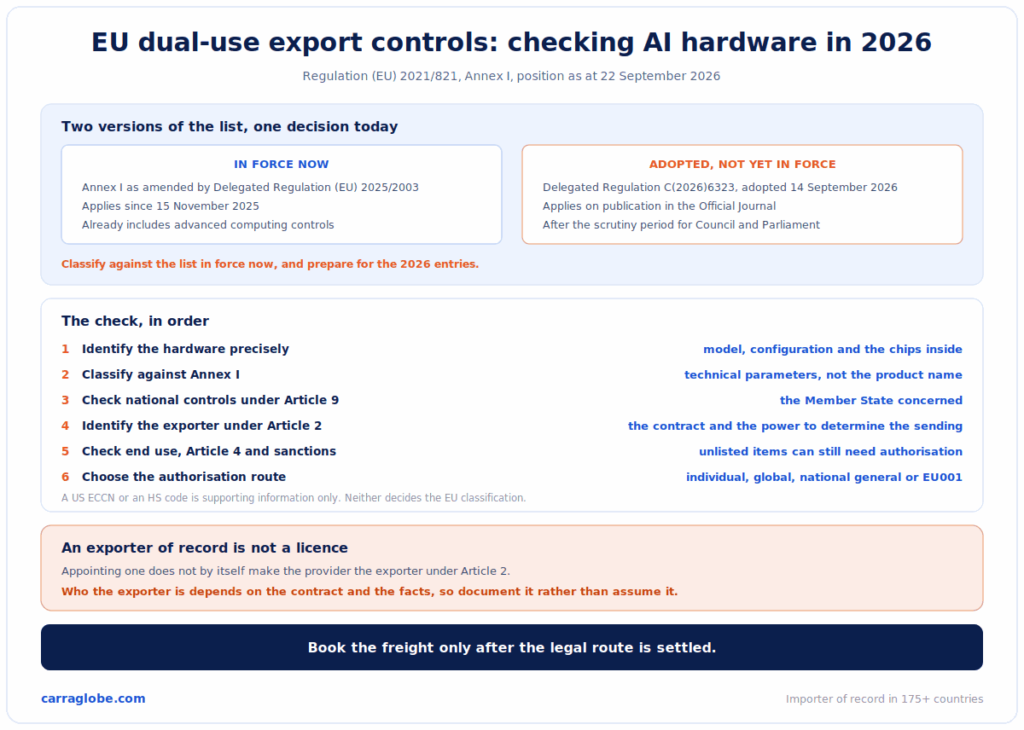
On 14 September 2026 the European Commission adopted an update to Annex I of Regulation (EU) 2021/821, the EU dual-use control list. It adds further advanced computing integrated circuits and electronic assemblies, such as those incorporating digital processing units, and more semiconductor manufacturing and testing equipment. As of 22 September 2026 it is not yet in force. That is not the same as uncontrolled: the list already in force includes advanced computing controls added in 2025, so some hardware may need authorisation today.
Carra Globe provides exporter of record services, so we have a commercial interest in your answer. What follows is written to be usable whether or not you ever speak to us.
What the Commission adopted on 14 September 2026
The Commission adopted Delegated Regulation C(2026)6323 updating the dual-use list. It brings the list in line with decisions taken in 2025 within the Wassenaar Arrangement, the Australia Group and the Nuclear Suppliers Group, and adds items that Member States have committed, as Wassenaar members, to control uniformly. For context, the regulation defines dual-use items as items, including software and technology, that can be used for both civil and military purposes.
Does the 2026 update apply to my AI hardware yet? Not yet, but that does not mean your hardware is uncontrolled. The 2026 changes enter into force on publication in the Official Journal, after the usual two-month scrutiny period. Until then, the list in force since November 2025 applies, and it already contains advanced computing controls. Classify against that list now, and review the 2026 changes so you are ready when they apply.
The additions the Commission lists that matter most for IT and data centre hardware:
- Advanced computing integrated circuits, and electronic assemblies such as those incorporating one or more digital processing units
- Semiconductor manufacturing and testing equipment and materials, including atomic layer deposition equipment for molybdenum and ruthenium, equipment for developing and inspecting extreme ultraviolet masks and reticles, and single wafer cleaning equipment
- Changes to certain control parameters, technical definitions and descriptions across the list
This builds on last year’s change. The 2025 update, Delegated Regulation (EU) 2025/2003, was published in the Official Journal on 14 November 2025 and entered into force on 15 November 2025. It was a broad update, adding controls on quantum technology, semiconductor manufacturing equipment and additive manufacturing, among other areas. For AI hardware, the relevant change was new controls on advanced computing integrated circuits and electronic assemblies, which the Commission describes as including field programmable logic devices and systems. The 2026 update adds further items in the same area, so the question for AI hardware is not only what is coming but what already applies.
The update also covers items outside IT, including ceramic matrix composites, inductive rotary encoders, additive manufacturing equipment for energetic materials and gas turbine compressor technology.
This does not make every AI server a controlled item. Whether a particular server, GPU system or accelerator is controlled depends on the applicable Annex I entry and its technical parameters, together with any catch-all or national control. The Commission’s announcement identifies new categories. The actual item still has to be classified against the list that legally applies.
What is not in force yet
The adopted text is public: the Commission links the delegated regulation and a change note summary, so exporters can start preparing now. It is not yet binding, though. The amended Annex I becomes legally operative only on publication in the Official Journal, so this article does not restate the new parameters as current law and will be updated with the published entries.
The EU control list is typically amended at least once each year. Our guide to export controls for data centre hardware sets out how the EU list sits alongside the Wassenaar, UK and US regimes, and this article focuses on what the 2026 update means in practice.
Who needs to check
- EU manufacturers and distributors exporting servers, accelerators, network equipment or electronic assemblies
- Non-EU vendors holding stock in an EU warehouse and selling it to customers outside the Union
- Data centre operators moving or redeploying hardware from an EU site to a third country
- Resellers and IT asset disposal companies selling on used AI hardware
- Suppliers of semiconductor manufacturing and test equipment and materials
- Anyone using an exporter of record for shipments leaving the EU
Why “it’s just a server” is not an export control analysis
Annex I controls items by technical parameters, not by product name. A server, a GPU card, an accelerator module and a network appliance can each fall inside or outside an entry depending on what the chips inside it can do. Calling something “standard IT equipment” is a description, not a classification.
Three shortcuts regularly stand in for a real classification, and none of them is one.
| Shortcut | Why it does not answer the question |
|---|---|
| The HS code | An HS code is a customs classification used for tariff and statistical purposes. On its own it does not determine whether an item is subject to dual-use controls. See HS code 8542 for GPU chips and HS code 8471 for servers |
| A US ECCN on the datasheet | The EU and US lists share multilateral roots but are not identical. An EU classification has to be established against Annex I itself |
| “We imported it without a licence” | The fact that hardware was lawfully imported into the EU does not by itself determine whether its export requires authorisation |
What to collect before classifying
- Manufacturer, exact model and part number
- The chip or accelerator model, and how many are fitted
- The relevant technical specifications and the datasheet
- Board or module configuration, and any firmware or software supplied with it
- Destination, end user and end use
- Country of origin, and any US-origin content or technology
- Any existing EU or US classification, and previous authorisation history
A US ECCN can be useful supporting information, but it is not a substitute for determining the EU classification.
The 2026 update makes this sharper for two kinds of hardware. Electronic assemblies are also addressed, so boards or modules containing the relevant digital processing architecture may need to be assessed against the new entries once they enter into force. Until then, do not treat them as uncontrolled: they may already be caught by an existing entry, Article 4, Article 9 or another applicable measure. Semiconductor manufacturing and test tools gain new entries, which matters for companies moving semiconductor manufacturing or testing equipment that may fall within them, as covered in importer of record for semiconductor manufacturing equipment.
Who is the exporter under the EU dual-use regulation?
Article 3 subjects exports of items listed in Annex I to an authorisation requirement. Separate requirements can also arise for certain unlisted items under Article 4, or from Member State measures under Article 9. Article 12 says individual and global authorisations are granted by the competent authority of the Member State where the exporter is resident or established. Where the exporter is not resident or established in the Union, an individual authorisation is granted by the Member State where the items are located. Other authorisation routes have their own eligibility and registration conditions. So before anyone can apply, the exporter has to be identified correctly.
Article 2 defines the exporter as the person who, when the export declaration is accepted, holds the contract with the consignee in the third country and has the power to determine the sending of the items out of the Union. Where there is no export contract, or the contract holder is not acting on its own behalf, it is the person with that power to determine. In practice, the legal exporter is not automatically the shipper, the customs filer or the exporter of record.
One sentence in that definition catches non-EU vendors. Where the right to dispose of the item belongs to a person outside the Union under the contract on which the export is based, the exporter is the contracting party resident or established inside the Union. A non-EU company selling goods held in EU stock therefore does not automatically become the exporter. Where the right to dispose conditions apply, the contracting party established in the EU is treated as the exporter, and carries the obligations. That conclusion depends on the contract and the facts, so document it rather than assume it.
An exporter of record is not a licence. Appointing one does not itself create or remove an authorisation requirement. Where Annex I captures the item, the exporter under Article 2 has to establish the applicable authorisation route, which may be individual, global, national general or Union general. Who the exporter is turns on the Article 2 definition and the underlying contractual and factual circumstances, not simply on whose name appears on the customs declaration.
| Situation | Who is the exporter | The question to settle |
|---|---|---|
| An EU company exporting goods it has sold | Usually that company, as the contract holder with power to determine the sending | Does the item need authorisation, and which route applies? |
| A non-EU seller shipping from EU stock | Depends on the contract. Where the right to dispose sits outside the EU, the EU contracting party | Who is the contracting party established in the EU? |
| An exporter of record is appointed | Depends on the contractual and factual structure | Does the arrangement make the exporter of record the exporter under Article 2? |
| The item is captured by Annex I | The exporter as defined in Article 2 | Which authorisation route applies, and in which Member State? |
A commercial exporter of record appointment does not by itself make the provider the exporter under Article 2. The party handling the formalities and the party the law holds responsible can be different, so the structure has to be settled before the goods move. Our guide to what an exporter of record does explains the role, and IOR versus EOR sets out where each one sits.
The check, in order
For an EU export of IT or AI hardware, this is the order that avoids the expensive mistakes. Logistics comes last on purpose.
- Identify the hardware precisely. Model, configuration and the chips inside it, not the marketing name.
- Classify against Annex I. Use the list currently in force, then check the 2026 entries once they are published.
- Check national lists. Article 9 permits Member States, in specified circumstances, to impose authorisation requirements on certain items not listed in Annex I, including for public security or human rights reasons. Check the current national list or guidance of the Member State concerned.
- Identify the exporter. Apply the Article 2 test, including the rule for non-EU sellers.
- Check destination, end user, end use and sanctions. Article 4 can require authorisation even for unlisted items, and an exporter who is aware that the items are intended for one of the uses covered by Article 4 must notify the competent authority. EU restrictive measures can also apply to dual-use exports, so a no-licence conclusion under Annex I does not by itself clear the shipment.
- Choose the authorisation route. Individual, global, national general or Union general authorisation.
- Only then book the freight. Carrier, routing and handling come after the legal route is settled.
Article 2 defines export broadly. It covers re-export and outward processing as well as transmitting software or technology electronically to a destination outside the Union. Controlled software or technology sent by email or made available online therefore also needs assessing before it leaves the Union. The regulation separately controls brokering, technical assistance and transit of dual-use items.
What to keep on file
The Commission lists record-keeping and registers among the compliance measures the regulation requires of exporters. Regular exporters usually hold this within an internal compliance programme (ICP), which Article 2 defines, and an exporter using a global authorisation must implement one unless the competent authority considers it unnecessary. In practice, each shipment should leave a file that shows how each step above was answered:
- A classification memo naming the Annex I entry considered, the list version used and the pending 2026 changes reviewed
- End user, end use and destination screening, including sanctions and embargo checks
- The Article 4 and Article 9 assessment
- The Article 2 analysis of who the exporter is
- Any US-origin or EAR analysis
- The authorisation obtained, or the reasoned no-licence decision, with internal sign-off
- The software and technology transfer assessment
- The commercial invoice, packing list and export declaration
EU dual-use export authorisations, and where EU001 fits
The regulation speaks of export authorisations, which is what most exporters mean when they search for an EU export licence. Article 12 provides four types. Which one applies depends on the item, the destination and how often you export.
| Authorisation | What it covers | Who grants it |
|---|---|---|
| Individual | One exporter, one end user or consignee in a third country, one or more items | Competent authority of the Member State where the exporter is resident or established, or where the items are located if the exporter is outside the Union |
| Global | One exporter, a type or category of items, one or more specified end users or third countries | Competent authority of the exporter’s Member State |
| National general | Defined by national legislation within the limits the regulation sets | The Member State concerned |
| Union general (EU001 to EU008) | Available to all exporters who meet the conditions in Annex II, for exports to certain destinations | Set in the regulation itself, used subject to national registration and notification conditions |
The regulation also defines a large project authorisation, which is an individual or global authorisation granted for a specified large-scale project.
For exports to allied destinations, check whether the item and transaction meet the conditions of EU001. It is not a blanket authorisation for AI hardware. It covers exports to Australia, Canada, Iceland, Japan, New Zealand, Norway, Switzerland, including Liechtenstein, the United Kingdom and the United States. It excludes the items listed in Section I of Annex II, and it cannot be used where the conditions in Annex II prevent its use, including specified weapons of mass destruction uses, military use in embargoed countries and components for unauthorised military exports.
Using a Union general authorisation is not automatic. The regulation applies directly in every Member State, but national competent authorities administer it and their procedures differ. Member States attach registration and notification conditions. Ireland, for example, requires exporters to register and to notify first use within 30 days. Check the conditions of the Member State where the exporter is established before relying on it.
EU and US: why one check is not enough
An AI server leaving Germany or the Netherlands can raise questions under two regimes at once. The EU list governs the export from the Union. The US Export Administration Regulations can also apply independently, to US-origin items and, in specified circumstances, to certain foreign-made or foreign-produced items under the EAR’s scope rules in 15 CFR 734.3 and related provisions. The analysis depends on the item, its origin and the transaction.
One check does not cover both regimes. An EU authorisation, or a finding that none is needed, does not settle the US position, and the reverse is equally true. Whether the Export Administration Regulations apply depends on the specific item and transaction.
Our guide to ITAR and EAR compliance for IT hardware shipments covers the US side, and our note on the Chip Security Act and AI hardware covers a related US development.
Retired, redeployed and repaired hardware
The fact that hardware is second-hand does not by itself remove it from export control analysis. A decommissioned cluster sold on, or moved to another group site outside the Union, still has to be assessed against the applicable control entries and parameters. That is covered in more depth in exporting retired AI hardware.
The same applies to units sent out of the EU for repair. The customs treatment of the round trip is set out in exporting equipment for repair, but the export control question has to be answered for the outbound leg on its own terms.
How Carra Globe approaches EU exports of AI hardware
Carra Globe Ltd is a UK company, number 16657216, providing importer of record, exporter of record, DDP and trade compliance services across 175+ countries. Moving IT and data centre hardware is a large part of what we handle, and on controlled items the legal route comes before the logistics.
The classification and authorisation position must be established for the exporter identified under Article 2, under the procedures of the Member State concerned. Where Carra Globe is appointed in an exporter of record structure, we work through that position with the relevant parties, flag where the exporter under Article 2 may differ from the party you expected, and move the shipment once the authorisation position is clear. Our exporter of record service and country pages for Germany and the Netherlands set out the detail, and exporter of record by country covers other origins.
Exporter of Record · EU
We handle EU exports of IT and AI hardware. The legal route comes first.
Being clear about the boundary: appointing an exporter of record does not by itself make us the exporter under Article 2, and it does not create or remove an authorisation requirement. What we do is gather the technical data, work through classification, the exporter question and the authorisation route with you and your advisers, and only then book the freight.
- Exporter of record services
- What an exporter of record does
- Export controls for data centre hardware
- ITAR and EAR for IT hardware
- Exporting retired AI hardware
- HS code 8542 for GPU chips
- Exporter of record in Germany
- Exporter of record in the Netherlands
- EOR by country
Free tools HS Code Finder Volumetric Weight Calculator Pallet Calculator
Exporting servers or accelerators from the EU? Send the model, configuration, destination and end user. We will map the checks before quoting, and say so plainly if the route needs an authorisation first.
Check your EU export routeFrequently asked questions
Is the 2026 EU dual-use update in force?
Not yet. It enters into force on publication in the Official Journal, after a two-month scrutiny period for the Council and the European Parliament.
Until then, the list in force since November 2025 applies, and it already includes advanced computing controls.
Do AI servers need an export licence from the EU?
It depends on the specific hardware and the applicable control entry. An authorisation may be required where the item is listed in Annex I, or where a catch-all or national control applies.
Who is the exporter if a non-EU company sells from EU stock?
Where the right to dispose belongs to a person outside the EU under the contract, the regulation treats the contracting party established in the EU as the exporter.
Can an exporter of record be the exporter?
Potentially, where the contract and the facts make it the exporter under Article 2. Appointment alone does not decide it.
What matters is who holds the contract with the consignee and has the power to determine the sending of the goods out of the Union.
Does EU001 cover exports to the US and UK?
Yes, both are EU001 destinations, but items in Section I of Annex II are excluded and national registration and notification conditions apply.
Does a US ECCN tell me the EU classification?
No. The lists share multilateral roots but are not identical, so the EU classification has to be established against Annex I itself.
Does an HS code show whether an item is controlled?
No. An HS code is a customs classification for tariff and statistical purposes. Export control status comes from the dual-use list and its technical parameters.
Sources and verification
- Primary instrument: Regulation (EU) 2021/821, for the definitions of export and exporter in Article 2, the authorisation requirement in Article 3, the catch-all in Article 4, national lists in Article 9, authorisation types and the granting Member State in Article 12, and penalties in Article 25.
- The 2026 update: European Commission, 2026 update of the EU control list of dual-use items, 14 September 2026, Delegated Regulation C(2026)6323. The scope of the additions and the entry into force mechanism are taken from this notice.
- The 2025 update: Commission Delegated Regulation (EU) 2025/2003, published in the Official Journal on 14 November 2025 and in force from the following day, and the Commission’s 2025 update notice, for the scope of the 2025 additions, including advanced computing, and the annual amendment cycle.
- Compliance measures and sanctions: European Commission, exporting dual-use items, for record-keeping and registers, brokering, technical assistance and transit controls, and the note that EU restrictive measures may also apply.
- Union general export authorisations: Government of Ireland, Union general export authorisation guidance, for the EU001 destinations, the Annex II exclusion and an example of national registration and notification conditions.
- US scope: 15 CFR 734.3, for the items subject to the Export Administration Regulations.
- This is not legal advice. Classification and authorisation are matters for the exporter, its advisers and the competent authority of the Member State concerned.
Disclaimer: This guide is for informational purposes only and does not constitute legal, tax or customs advice. The EU dual-use list, its entry into force, and the conditions attached to authorisations may change, and the 2026 update had not been published in the Official Journal when this article was written. This article reflects publicly available information as at 22 September 2026. Always confirm classification and authorisation requirements with a qualified adviser and the competent authority before exporting.