
A data centre build is not a shipment. It is dozens of consignments, across six or seven classes of equipment, into several countries, all pointing at one commissioning date. The thing that slips the date is almost never the servers. It is the one class nobody checked, held at a border for an approval that had to be applied for weeks earlier.
Carra Globe runs the whole movement for data centre and server infrastructure programmes across 175+ countries. That means importer of record and exporter of record services, global trade compliance, freight forwarding, delivered duty paid where you want landed cost fixed, warehouse logistics for staged release, and white glove delivery into the hall.
Depending on the destination, the equipment and the rules that apply, we act through an appropriate importing structure or work with a local partner, which can remove the need for you to establish your own entity there.
What we have actually moved
64 deployments, 2024 to 2026. We handled 64 data centre and server infrastructure deployments, covering import, clearance and delivery coordination. We count a deployment as a coordinated programme rather than a single movement.
- Europe. United Kingdom, Germany, the Netherlands, Ireland, Belgium, Italy, Spain and Switzerland, plus Poland, Sweden, Norway, Denmark, Finland.
- Americas. United States, Canada, Mexico, Brazil and Colombia, plus Chile.
- Middle East and Africa. the United Arab Emirates, Qatar, Saudi Arabia and South Africa, plus Kenya.
- Asia Pacific. India, China, Hong Kong, Japan, South Korea, Singapore, Malaysia, Indonesia, Thailand, Vietnam and Australia.
- 35 countries in total. Each linked country has its own page covering what the import actually involves there.
- Largest single deployment. 27 consignments across 14 weeks, scheduled against the client’s rollout plan rather than a shipping calendar.
- Longest programme. 18 months, from April 2024 to September 2025, covering recurring imports, clearance and scheduled delivery.
- Typical consignment. Two to eight pallets, roughly 400 to 1,800 kg.
- Largest shipment. 24 pallets, 8,600 kg, around 42 cubic metres.
- Highest declared value on one consignment. Approximately 1.8 million US dollars.
- Administrative onboarding. One to two working days once complete documentation is received. That is not a shipment lead time and not a guarantee of customs release, since eligibility, classification, approvals and destination procedures all sit after it.
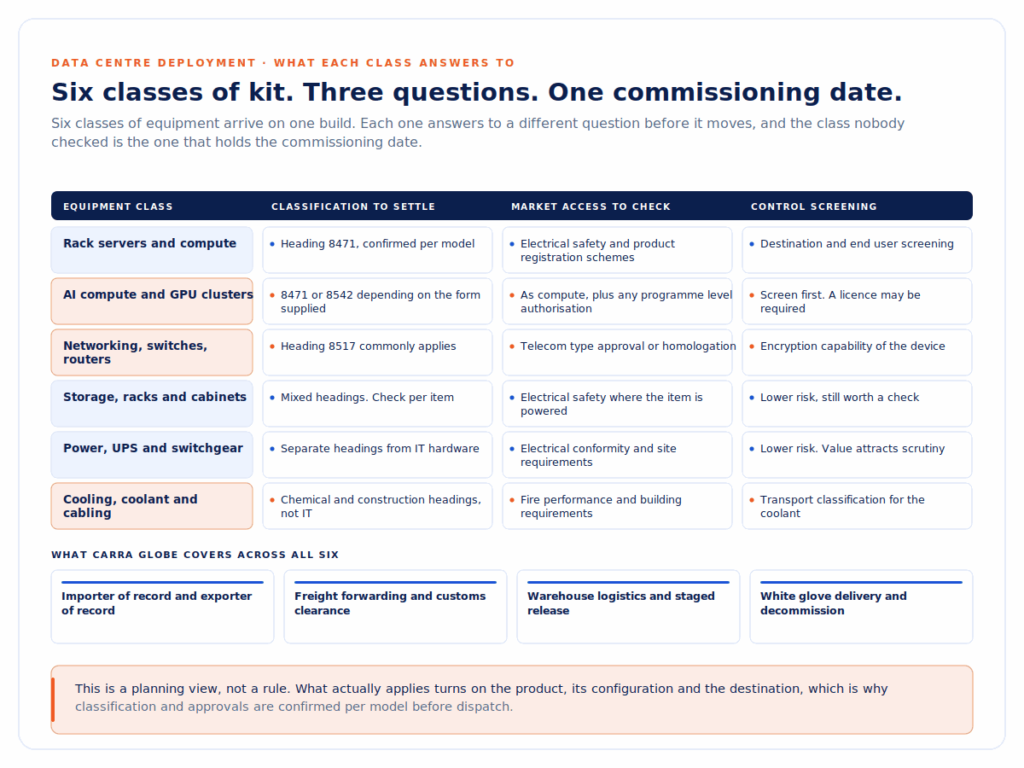
The equipment, and what gates each class
Identical kit is treated differently by class and by country. A managed switch can trigger telecom homologation in a market where a server clears on ordinary handling. This is where builds get held up, so it is where we start.
- Rack servers and compute. Classification usually sits under heading 8471, and the detail matters more than people expect. See HS code 8471 for servers and why servers get held at customs.
- AI compute and GPU clusters. Screen these for export controls early. Whether a licence or further review is needed depends on the specification, the origin, the destination, the end user and the intended end use. See importer of record for AI servers and GPU clusters, shipping AI servers internationally and importing NVIDIA H200 servers.
- Networking, switches and routers. Check whether the destination requires telecom type approval or homologation, and whether the device’s encryption capability triggers an import or export control. Requirements vary by product and by market. See encryption import restrictions on network equipment.
- Storage arrays, racks and cabinets. Often fewer market access hurdles than active electronics, though classification, electrical and safety requirements and site handling constraints still have to be checked. Usually the part that gets scheduled last and then rushed.
- Power, UPS, switchgear and transformers. Long lead times, heavy and high-value cargo, and a fixed energisation date. Electrical conformity is the gate here rather than anything on the IT side, which is covered separately below.
- Cooling and coolant. Liquid cooling needs the coolant’s safety data sheet and transport classification checked before dispatch, because depending on the formulation and the shipment conditions, dangerous goods requirements may apply. Settle it before the cargo is booked rather than when the drums are at the airport. See importing data centre coolant.
- Cabling and containment. Check the fire performance, electrical safety and construction product requirements for the product and the destination. These sit alongside the rules that apply to IT hardware rather than replacing them. See data centre cabling and fire rating and data centre construction freight.
The buyer questions that come up most often across these classes are answered in IT hardware trade compliance for data centre imports.
How the import is actually structured
There is no single way to be the importer. A provider who gives you the same answer for every country is not reading the country. Across those 64 deployments, 15 were imported through our own entity, 15 through a documented local importing structure and 34 through partner led importing arrangements.
Which route your lane takes depends on the goods and the destination, not on which is easiest to sell. That distinction is the one we set out in paper IOR versus operational IOR, and it is worth probing with anyone you are choosing as an importer of record.
Country detail sits in IOR by country and EOR by country, with the regulatory picture in IT hardware import rules by country, and the wider decision set in our enterprise IT hardware import decision guide.
Approvals that have to exist before the goods move
In several of our busiest markets the approval is the schedule, and applying after the kit has shipped is how a commissioning date is lost. We work these through with verified local partners in the destination rather than claiming to hold every registration ourselves. What follows is a planning reference, because what actually applies turns on the product and its configuration.
This section is about who may import and what the IT and telecom side needs. Electrical conformity on the power and cooling plant, meaning CE marking, INMETRO, PSE and the rest, is a separate question with its own answer in our article on importing data centre equipment.
-
- India. You need an authorisation, and the window closes on 15 December 2026. Restricted IT hardware, servers under HSN 8471 included, sits inside the DGFT Import Management System for 2026 under Policy Circular No. 08/2025-26 of 17 December 2025. Applications run through the DGFT portal until that date, and authorisations issued under it are valid to 31 December 2026. BIS registration and TEC’s testing and certification scheme are checked against the specific product rather than assumed. See importing IT equipment into India without a local entity and importer of record in India.
- United Arab Emirates. Approval comes before the customs release permit, shipment by shipment. Telecommunications equipment falls under the TDRA type approval regime. Approval is needed before equipment is offered or sold, and an importer has to hold it before applying for a customs release permit on each commercial shipment. Wireless equipment can need a separate spectrum authorisation.
- Brazil. The route depends on why the goods are coming in. Telecommunications products subject to ANATEL requirements may need certification and homologation before import, sale or use, and the route differs depending on whether the goods are for commercialisation or a qualifying own use. See the ReData data centre tax incentive.
- Saudi Arabia. The shipment certificate is per consignment, not per product. Product level conformity is registered once through the relevant SABER process, but a shipment certificate is raised for each consignment, which is the step a rolling delivery schedule tends to trip over.
- China. Components in the same rack can follow different routes. Check whether the server, the power supply or another component falls inside the China Compulsory Certification catalogue and its implementation rules under SAMR. Not every item in a build follows the same certification route.
- United States. The constraint is not the product, it is who may be the importer. Executive Order 14411, Strengthening Customs Enforcement, signed on 3 June 2026, directs minimum tangible domestic assets or bonding for importers of record, additional ownership and beneficial ownership disclosure, and a good standing test with CBP. For foreign importers of record it directs a prohibition on informal entry, restricts reliance on a continuous bond, and requires CTPAT validation or a CTPAT validated broker. It directs regulations rather than making them, so the detail depends on what Homeland Security issues.
- Other markets where an approval often has to exist first. Telecommunications, radio and electrical safety approvals commonly apply before dispatch in Indonesia, Vietnam, Thailand, Malaysia, South Korea, Japan, Mexico, South Africa and Qatar. Which authority and which route applies turns on the product and its configuration, so we confirm it per model rather than per shipment.
Export controls run in the other direction and catch AI and high performance compute first. That is covered in export controls on data centre hardware.
How a deployment runs with us
-
-
- Classification before dispatch. We read the technical specification, the commercial description and the product documentation per model, so the classification, the duty position and any approval requirement are settled before anything moves rather than at the border.
- Approvals applied for in parallel. Where the destination needs one, the application runs alongside production rather than after it.
- Import under the right structure. Our entity, a local importing structure or a partner acting for the importer, chosen for that lane.
- Staged release. We arrange in-country storage and release against your deployment milestones instead of landing everything at once. Whether that storage is bonded or ordinary depends on the destination.
- Temporary import where it fits. Demonstration, testing and staging equipment can enter under a temporary procedure and leave again, where the destination allows it and the procedure is discharged properly.
- Delivery to the agreed point. Final mile into the data centre or server room. Inside delivery and physical installation are arranged through qualified local partners.
- Decommission. We also move kit out, including collection from site, export documentation and international transport for retired infrastructure.
-
One contact across the whole programme. A multi-country programme is coordinated through one Carra Globe contact, with destination partners handling the local importing and operational detail. One client programme ran this way across seven countries, 19 consignments over five months. The case for consolidating onto a single importer across a build is made in our data centre equipment article, and the operational pattern in multi-country IT equipment deployment.
What we tell you before you commit
Carra Globe works through importer-side registrations and local importing structures appropriate to the goods and destinations it accepts, its own in some markets and established local structures in others. Where an approval falls outside the structure available, we flag it before a delivery date is agreed rather than after.
On price. We quote against the equipment, the destination, the importing structure, the regulatory position and the services involved, and for a multi-shipment deployment we quote the programme rather than each movement. We do not publish a percentage of shipment value, because on its own it tells you nothing about what a deployment costs.
Send us the destination, the equipment list and your commissioning date, and we will come back on which structure fits, what has to be applied for before anything ships, and where the schedule risk sits. Reach us at info@carraglobe.com.
Data Centre Deployment · Importer Of Record
Tell us the destination and the kit. We will tell you who can be the importer.
A build is dozens of consignments across several equipment classes into several countries, pointing at one commissioning date. The class that stops it is rarely the servers. So the useful conversation is which structure carries the entry in each destination, what has to be applied for before the goods move, and which approvals sit outside the structure available. Where one does, you hear that before a delivery date is agreed rather than after the cargo has landed.
- AI server import duties in 2026
- HS code 8542 for GPUs and chips
- Case study, AI servers into India
- Global IOR for technology OEMs
- Exporting retired AI hardware
- Resolving a customs hold
- What an importer of record is
- How to verify an IOR provider
- When the customer will not be IOR
- Importing IT equipment with no entity
- Import VAT and the importer of record
- What an EORI number is
- EU dual-use export controls
- Exporter of record in Germany
- Exporter of record in the Netherlands
Free tools HS Code Finder Volumetric Weight Calculator Pallet Calculator
Planning a data centre build across more than one country? Send the destinations, the equipment list with the technical specification per model, and your commissioning date. We will come back on which structure fits each lane, who answers as importer on it, and where the schedule risk sits.
Check my deploymentFrequently asked questions
Can you import data centre hardware if we have no entity in the country?
Yes. That is what an importer of record arrangement is for. The structure used depends on the destination and the equipment, and we tell you which one carries your entry before you commit.
How many countries have you delivered data centre hardware into?
35, across Europe, the Americas, the Middle East, Africa and Asia Pacific, within 64 data centre and server infrastructure deployments handled between 2024 and 2026.
Do you install the equipment once it arrives?
We deliver to the agreed point at the data centre or server room. Inside delivery and physical installation are arranged through qualified local partners rather than carried out by us.
Can you hold stock and deliver against our build schedule?
Yes. We arrange in-country storage and release against your deployment milestones. Whether that storage is bonded or ordinary warehousing depends on the destination and the plan.
How quickly can a first shipment move?
Administrative onboarding usually takes one to two working days once complete documentation is received. That is not a shipment lead time. Eligibility, classification and any required approval sit after it.
Do you handle GPU and AI compute?
Yes, alongside servers, networking, storage and power equipment. AI compute is the class most likely to raise an export control question, so it is assessed before the shipment is booked.
Who is the importer of record for a data centre deployment?
Whoever is lawfully named on the entry in that country. It can be you, your local entity, or us acting through an appropriate importing structure. We tell you which before the goods move.
Can you import refurbished or used data centre hardware?
Often yes, though several markets restrict used electronics or require extra documentation. It depends on the destination and the equipment, so it is checked before anything is booked.
What documents does a data centre import usually need?
A commercial invoice, packing list, transport document and the technical specification per model, plus any approval, licence or conformity certificate the destination requires for that product.
Is an importer of record cheaper than setting up a local entity?
Usually, for a defined programme. A local entity brings registration, tax filing and ongoing cost, which rarely pays back across a single build. For a permanent presence the calculation changes.
Who pays the duties and taxes on a data centre import?
It depends on the terms agreed. Under delivered duty paid we handle them and fix your landed cost. Otherwise duties and taxes are passed through at cost against the entry.
What happens if a data centre shipment is held at customs?
We deal with the authority directly and work the hold rather than reporting it to you. Most holds trace back to classification, valuation or a missing approval, which is why those are settled before dispatch.
Can you deliver into a colocation facility we do not own?
Yes. Delivery goes to the agreed point at the facility, worked to the site’s access, booking and handling rules. Inside delivery and installation are arranged through local partners.