
When buyers ask us about CIF or DAP, the first question is usually who pays the freight. The question that costs money is who clears the goods at the destination. Under both terms that is the buyer, and we still meet buyers who find out at the port.
This guide covers where risk passes, why CIF is the wrong rule for air freight, and how customs in the UK, the EU and the US values each invoice.
The short version
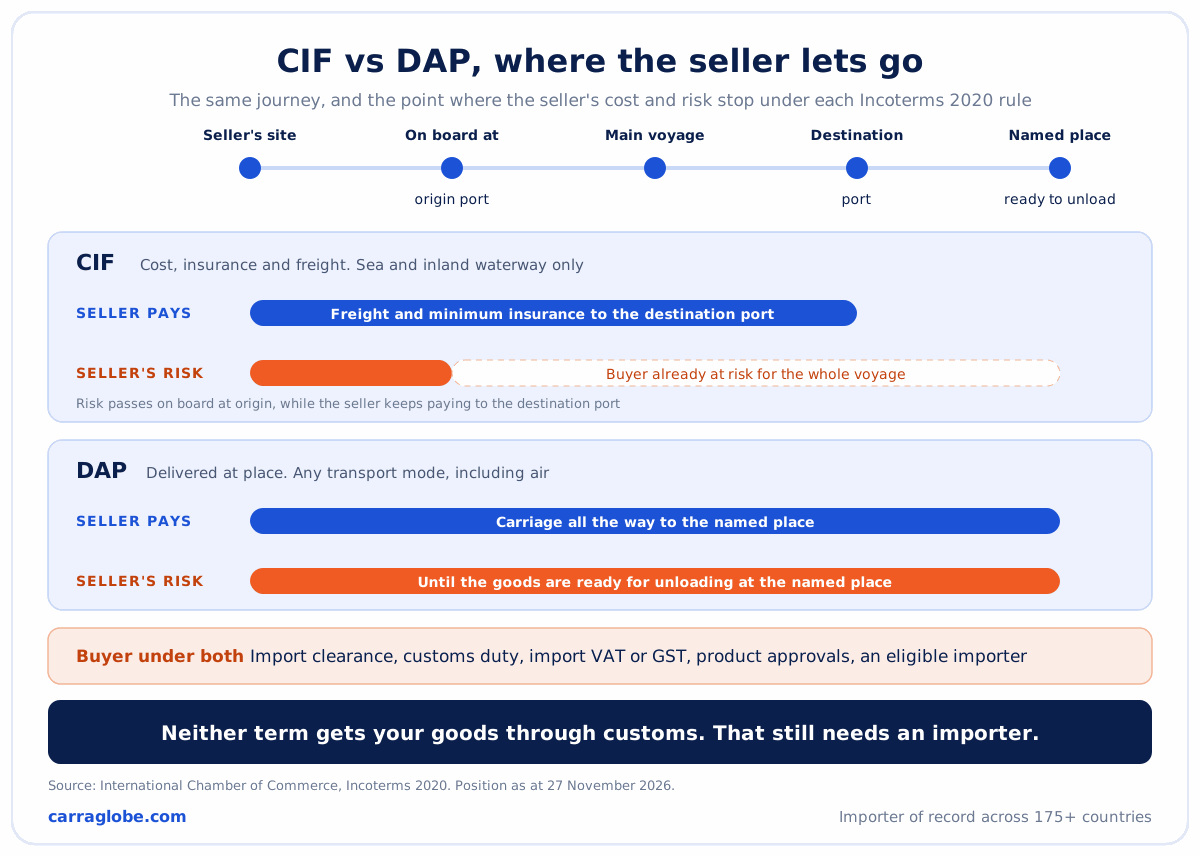
- CIF. The seller pays freight and minimum insurance to the destination port, but risk passes to the buyer once the goods are on board at origin.
- DAP. The seller carries cost and risk to the named place, ready for unloading, with no duty to insure.
- Under both. The buyer arranges import clearance and pays duty and import taxes, through itself or an eligible importer.
- Air freight and terminal handovers. CIF is a sea and inland waterway rule. Where goods fly, or are handed to the carrier at a container terminal before loading, the ICC points to CIP.
Carra Globe provides importer of record, exporter of record and delivered duty paid services, so we have a commercial interest in this topic. The rules quoted below come from the International Chamber of Commerce and official customs texts, listed in the sources.
Where each term stops
Under CIF, risk moves to the buyer long before the seller stops paying. The seller delivers by placing the goods on board the vessel at the port of shipment, and the risk passes there. It still pays the freight to the destination port and insures the goods for the buyer, so the buyer is covered on a voyage it is already at risk for.
The cover is limited. Unless the contract or the trade’s custom says otherwise, CIF requires only Institute Cargo Clauses (C) or similar, at 110 per cent of the contract price. Clauses (C) cover named major casualties, not all risks, so for six-figure server shipments it pays to agree wider cover, as our note on cargo insurance for IT equipment explains.
Under DAP, the seller’s cost and risk both run to the named place. The seller pays for carriage and carries the risk until the goods sit on the arriving vehicle, ready for unloading, which is the buyer’s job. Name the place to the dock door or data centre address, not the city, because that is where the risk changes hands. DAP puts no duty to insure on the seller, so write any cover you want into the contract.
The part neither term covers
Someone has to be the importer. Export clearance is the seller’s job under both terms. Import formalities, duty, import VAT or GST and product approvals are the buyer’s, and they need an importer the destination recognises. Whether that must be a local company depends on the country, since some accept non-resident importers or indirect representation. Where the seller is meant to clear and pay, the standard rule is DDP, compared in our guide to DDP vs DAP.
Without an importer, the goods sit in storage while the buyer arranges an importer of record for goods nobody will import. Much can still be fixed after arrival, as our piece on how late an importer of record can be appointed explains, but the storage bill keeps running.
Under DAP, a clearance failure can move the risk early. “Delivered” does not mean cleared. Under DAP B3(a) and B9(e), a buyer that fails to clear the goods bears the resulting risk of loss or damage and the seller’s extra costs, provided the goods are identified as the contract goods, even before they reach the named place. The ICC’s own note gives the example of goods held at the port.
Why CIF does not fit air freight or terminal handovers
CIF is a sea and inland waterway rule. It ties delivery to goods placed on board a vessel. For air, road, rail or multimodal moves, the ICC’s counterpart is CIP, with delivery on handover to the first carrier unless agreed otherwise, and broader Clauses (A) cover by default.
Early handovers point the same way. The ICC recommends CIP rather than CIF where goods are handed to a carrier at a container terminal before loading, as with many LCL and FCL server shipments. A container alone does not rule CIF out, but under CIF the seller would stay at risk after losing control of the goods at the terminal.
We still see CIF with an airport name on the invoice. Most of our IT freight flies, and nothing makes that wording illegal, but with no vessel to load the risk point is unclear and the insurance may not suit air carriage. Ask for CIP or FCA before the goods move, and check the policy. The air leg itself is covered in our guide to shipping server racks by air freight.
HMRC covers one version of this. Where a CIF contract obliges the seller to switch to air to meet a deadline at its own cost, and the contract is in force when the goods are entered for free circulation, HMRC treats the terms as CIP with the air freight inside the price.
How customs values a CIF or DAP invoice
The UK and EU value goods to the border. The Union Customs Code adds transport and insurance up to EU entry and leaves out transport after it, and its replacement, Regulation (EU) 2026/2108, keeps that rule from 21 September 2027. HMRC applies the same principle and adds inland transport in the exporting country and surcharges such as fuel and security.
A CIF price to the port of entry is therefore a sound starting point, although packing, assists or royalties may still need adding. A DAP price runs past the border, and HMRC lets the importer take out the onward leg when the seller’s invoice shows it separately or the carrier’s invoice or a certified statement backs it. The same applies to a CIF price named to a place beyond the point of entry. In HMRC’s CIF Heathrow example, the UK leg comes out only if the seller confirms it was built into the price.
The US values goods without international freight, if you can prove it. CBP expects the actual amounts paid to the carrier, forwarder or insurer, backed by freight bills, contracts or proof of payment, and accepts the breakdown on an invoice attachment. Foreign inland freight generally also needs a through bill of lading, except in ex-factory sales.
The evidence counts more than the wording. In ruling H335828 of 17 October 2025, CBP refused the deduction on CIF invoices that showed a separate freight and insurance amount, because the importer’s payments could not be matched to the shipments.
An illustration with round numbers
Goods of 100,000, freight and insurance to the border of 4,000, inland delivery of 1,000. In the UK or EU the customs value starts at 104,000 under CIF, at 104,000 under DAP when the inland 1,000 is supported, and at 105,000 when it is not. In the US, it is 100,000 when the 4,000 of international transport is supported by actual cost evidence and the 1,000 of US delivery is shown separately as a post-importation charge. The figures are illustrative and assume no other additions. Customs values the goods, not the Incoterm, so well-supported CIF and DAP invoices can end at the same figure.
Get the breakdown before the goods ship. We regularly meet DAP invoices with freight folded into the unit prices. The same figures drive the landed cost calculation and the import VAT under an importer of record, so it pays to have them right before booking.
A CIF shipment that stopped at the port
The shipment. 39 enterprise servers and 25 network switches worth USD 278,000 left Rotterdam as LCL sea freight on a CIF Nhava Sheva invoice, Incoterms 2020, for a data centre in Pune. The buyer read CIF as cleared and delivered. On arrival it learned that clearance, duty, taxes, the destination handling in this shipment and the road leg to Pune were all its own, and that it had no entity able to import.
The fix. A local importer of record was appointed, the documents and approvals were checked, including India’s DGFT import authorisation and whether BIS registration applied to the servers, and the goods cleared before trucking to Pune. It took eight working days and USD 7,850 the buyer had not budgeted for in storage, extra handling and inland transport, before duty, taxes and importer fees.
What DAP would have changed. The freight and the transit risk to Pune, but not the importer gap. With clearance stalled at Nhava Sheva, DAP would have put the resulting risk and costs back on the buyer. The route through that gap is set out in our guide to importing IT equipment into India without a local entity.
Choosing between CIF and DAP
- Check the transport. If the goods fly, or are handed over at a terminal before loading, use CIP, FCA or DAP rather than CIF.
- Put the insurance in writing. CIF gives Clauses (C) by default, and DAP obliges the seller to buy no cover for the buyer.
- Name the place exactly. A DAP term should give the delivery address, not a city.
- Line up the importer before booking. A buyer that cannot import needs an importer of record agreed before the goods ship.
- Split and evidence the costs. Goods, freight to the border and onward delivery as separate amounts, with the carrier’s invoice kept, as in our list of shipping documents for server consignments.
A buyer that wants nothing to do at the destination needs a DDP or importer of record arrangement instead, and should know how to compare DDP quotes for IT equipment before signing one.
How Carra Globe handles CIF and DAP shipments
We act as the importer the buyer is missing. When goods arrive under CIF or DAP and the buyer cannot import them, we can act as importer of record, clear customs and arrange the final delivery. Our trade compliance team reviews the invoice and the Incoterm before booking, flagging CIF on air freight, missing value splits and approvals the product needs.
Carra Globe works through importer-side registrations and local importing structures appropriate to the goods and destinations it accepts, its own in some markets and established local structures in others. Approvals falling outside the available structure are flagged before a delivery date is agreed.
We also move and install. We arrange freight forwarding by air and sea and white glove delivery where servers need positioning on site. For a quote, send the draft commercial invoice with item names, quantities and unit values, the Incoterm, the total weight and dimensions and the collection and delivery addresses. Add the datasheets and, where batteries are included, their MSDS, and send it all to info@carraglobe.com or through our contact page.
Importer of Record · CIF and DAP shipments
Your Incoterm stops before customs. We pick up from there.
CIF and DAP both leave import clearance, duty and the importer to the buyer. We review the Incoterm and invoice before booking, flag CIF on air freight and missing value splits, and act as importer of record where you have no local entity.
- DDP vs DAP
- Incoterms for tech shipments
- DDP vs importer of record
- Cargo insurance for IT equipment
- How to calculate landed cost
- Importing without a legal entity
- What an importer of record costs
- Server racks by air freight
- IOR by country
Free tools HS Code Finder Volumetric Weight Calculator Pallet Calculator
Shipping on CIF or DAP with no importer at the other end? Send the invoice and Incoterm and we will check the importer, the value split and the approvals before the goods arrive.
Check your IncotermFrequently asked questions
What is the difference between CIF and DAP?
Under CIF the seller pays freight and minimum insurance to the destination port, but risk passes to the buyer once the goods are on board at origin. Under DAP the seller carries both cost and risk to the named place, ready for unloading.
Does CIF include customs clearance?
Only export clearance. Import clearance, duty, import taxes and destination charges outside the seller’s freight contract fall to the buyer.
Who pays import duty under DAP?
The buyer. DAP takes the goods to the named place, but import clearance, duty and taxes stay with the buyer. Where the seller is meant to clear and pay them, the standard rule is DDP.
Can CIF be used for air freight?
Not properly. Under Incoterms 2020, CIF is meant for sea and inland waterway transport. For air, CIP is the matching term and requires Clauses (A) insurance unless otherwise agreed.
Is customs duty calculated on the CIF value?
In the UK and EU, the customs value includes freight and insurance to the border, which matches a CIF price to the port of entry. The US leaves out international freight and insurance when the actual costs are identified and supported.
Who is the importer under CIF or DAP?
The buyer arranges import clearance under both. A buyer that cannot legally act as importer in the destination needs an importer of record agreed before the goods ship.
Adjacent ground: which Incoterm protects tech shipments, freight forwarder vs importer of record and what an importer of record does.
Sources and verification
This guide was checked against the Incoterms rules and official customs texts and guidance on 27 November 2026, the day of publication.
- International Chamber of Commerce. Incoterms 2020, the CIF, CIP and DAP rules with their explanatory notes.
- HM Revenue and Customs. Delivery costs to include in the customs value, updated 15 April 2026.
- European Union. Regulation (EU) No 952/2013, Union Customs Code, Articles 71 and 72, and Regulation (EU) 2026/2108 of 16 September 2026, Articles 176 and 177, applying from 21 September 2027.
- United States Code. 19 U.S.C. 1401a, value.
- US Customs and Border Protection regulations. 19 CFR 152.103, transaction value, and 19 CFR 141.86.
- US Customs and Border Protection. Ruling HQ H335828, dutiability of freight and insurance charges, 17 October 2025.
Disclaimer: This guide is for informational purposes only and does not constitute legal or customs advice. Incoterms allocate cost and risk only as far as the contract adopts them, and customs valuation depends on the destination’s law and the documents presented. The position described is as at 27 November 2026. Confirm your contract terms and the customs value with a qualified adviser or the customs authority before shipping.