
An integrator sells one solution at one price. Customs values goods, not solutions.
That gap is where integration projects come unstuck, and it is almost never in the project plan. The import conversation usually starts with who signs the declaration. It should start earlier, with what the declaration is going to say.
Carra Globe provides importer of record and exporter of record services, so we have a commercial interest in your answer. What follows is written to be usable whether or not you ever speak to us.
Why an integration project breaks the normal import model
Can a system integrator be the importer of record? Only where the integrator, or a structure it appoints, qualifies to act as importer in that destination. Depending on the market that may be the integrator’s own entity, the end customer, or a third-party importer of record. The end customer route is often refused.
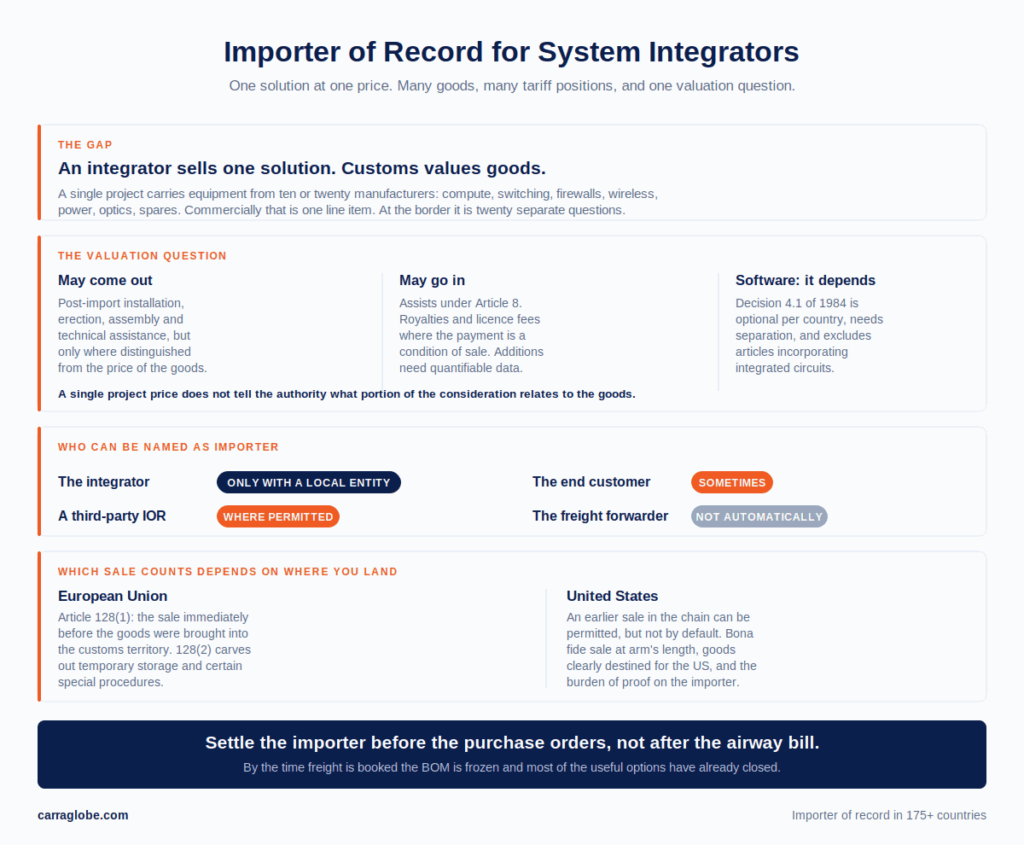
A single infrastructure project can carry equipment from ten or twenty manufacturers: compute, storage, switching, routing, firewalls, wireless access points, power distribution, optics, racks, cabling and spares. Commercially that is one solution. At the border it is twenty separate questions.
The tariff classification can differ per item. So does the regulatory status. A server may move freely while an access point in the same crate needs a radio approval, a firewall carries encryption functionality that triggers a separate control, and a refurbished unit falls under a different regime again. Our note on IT hardware import rules by country sets out how far those paths diverge.
This is the difference between an integrator project and a manufacturer shipping its own product, which we cover separately in importer of record for technology OEMs. An OEM ships one product it designed and certified. An integrator ships a basket it assembled from other people’s products, under a commercial agreement that describes none of them individually.
The System Integration valuation problem nobody prices in
How is a bundled hardware solution valued at customs? Not automatically at the single project price. The starting point is the transaction for the imported goods, adjusted under the destination’s rules. Qualifying post-import installation may be excluded where it is separately identified, while assists, royalties and licence fees may have to be included.
Customs valuation across most of the world runs on the World Trade Organization Valuation Agreement. Article 1 sets the primary method: the customs value is “the price actually paid or payable for the goods when sold for export to the country of importation adjusted in accordance with the provisions of Article 8”.
Read that against an integration project. There is a sale from each vendor to you. There is a sale from you to the end customer, at a bundled price covering hardware, licences, configuration, installation and often support. Neither is automatically the transaction that determines customs value. Which one governs depends on how the deal is structured and on the valuation rules of the destination market.
A services-heavy contract sharpens the point. A design, build and operate agreement may not itself be a sale of the imported goods at all. The analysis has to find the transaction that actually covers the goods crossing the border, then apply whatever additions the destination requires on top of it.
The cost of leaving this late. Before shipment you can still change the contract, split the invoice and choose which transaction you rely on. After arrival you can only explain the one you have, with records to produce and no room to restructure. The work is the same either way. The options are not.
What can be taken out, and the condition attached
The Interpretative Note to Article 1 excludes certain charges from the customs value, and this is the provision an integrator should know by heart. Customs value “shall not include the following charges or costs, provided that they are distinguished from the price actually paid or payable for the imported goods: charges for construction, erection, assembly, maintenance or technical assistance, undertaken after importation on imported goods such as industrial plant, machinery or equipment”.
Two conditions sit inside that sentence and both bite.
- The work must be after importation. Racking, imaging, staging and configuration done at your facility before the goods ship falls outside the exclusion. Installation at the customer site after import may qualify, where it is genuinely post-import, separately distinguished and accepted as such under the destination’s rules.
- The charge must be distinguished from the price paid for the goods. Being able to reconstruct the figure later is not the same as clearly distinguishing it from the price of the imported goods, and the supporting records are what the authority looks at.
The United States implements this in almost the same words. Under 19 U.S.C. 1401a(b)(3), transaction value excludes post-importation construction, erection, assembly, maintenance and technical assistance “if identified separately from the price actually paid or payable”. That is the US statutory treatment of those particular post-importation charges. Documentary expectations differ by market, so check what the destination asks for rather than carrying one country’s practice into another.
Training and support are not named in that list, so treating them as automatically outside the customs value is an assumption rather than a rule. The same caution applies across an integrator’s commercial terms. Software licences, royalties, maintenance and support can each need their own analysis, particularly where the payment is a condition of the sale or relates to the imported goods. Royalties and licence fees meeting that test are an express addition under Article 8, not an exclusion.
What can be added, and what cannot
Article 8 governs additions, and it is a closed list. The one that catches integrators is Article 8.1(b)(iv), which adds the value of “engineering, development, artwork, design work, and plans and sketches undertaken elsewhere than in the country of importation and necessary for the production of the imported goods”, where the buyer supplied them free of charge or at reduced cost.
Solution architecture is not automatically an assist. The test is whether you supplied engineering, design work or plans to the producer free of charge or at reduced cost, and whether that material was necessary to produce the imported goods. Architecture developed for your own downstream deployment, never handed to the manufacturer, is a different fact pattern. The Note to Article 1 supports the distinction: “Activities undertaken by the buyer on the buyer’s own account, other than those for which an adjustment is provided in Article 8, are not considered to be an indirect payment to the seller.”
Two further provisions are worth quoting to anyone who suggests apportioning a project fee across the goods. Article 8.3 requires additions to be made “only on the basis of objective and quantifiable data”. Article 8.4 says “No additions shall be made to the price actually paid or payable in determining the customs value except as provided in this Article”.
Software, and why the usual shortcut fails
Integrators often assume software is outside the customs value. The authority for that belief is Decision 4.1 of the Committee on Customs Valuation, adopted on 24 September 1984, which permits a country to take only the cost or value of the carrier medium into account, excluding the data or instructions, “provided that this is distinguished from the cost or the value of the carrier medium”.
Three things about that decision get overlooked.
- It is optional. The decision says it “would also be consistent with the Agreement for those Parties which wish to do so” to adopt the practice. It is a country-by-country question, never a universal answer.
- It depends on separation. Same condition as everything else in this section. A bundled licence line inside a project price makes that distinction harder to establish, and the treatment has to be worked out per destination.
- It does not cover software embedded in the equipment. The decision states that “carrier medium” does not include “integrated circuits, semiconductors and similar devices or articles incorporating such circuits or devices”. Firmware and pre-loaded software therefore needs its own valuation analysis rather than the carrier medium treatment. That is not the same as saying it is automatically dutiable.
So the licence on media and the operating system inside the appliance can be treated differently, in the same crate, under the same contract. Confirm the position per destination rather than assuming the one you met last time.
Which sale counts depends on where you are landing
An integrator project is a chain of sales, and jurisdictions do not agree on which link to value.
In the European Union, Article 128(1) of the Union Customs Code Implementing Regulation provides that transaction value “shall be determined at the time of acceptance of the customs declaration on the basis of the sale occurring immediately before the goods were brought into that customs territory”.
Article 128(2) carves out a defined exception. Where goods are sold after being brought into the customs territory but while in temporary storage or under a special procedure other than internal transit, end use or outward processing, that sale is the basis instead. So a later sale is not always unavailable in the EU, but the circumstances in which it counts are specified rather than general.
There is a practical trap in this for integrators, and the Commission’s guidance states it plainly: “When the importer does not have access to this invoice, the transaction value method is not applicable.” If the governing sale sits between two parties upstream of you and you cannot obtain that invoice, a correct valuation theory is no use. The declaration falls back to one of the secondary methods.
In the United States, an earlier sale in a multi-tier chain can be permitted, but not as a default. The importer has to show the sale qualifies: a bona fide sale negotiated at arm’s length, goods clearly destined for export to the United States at that point, and the evidence to support both. There is also a declaration requirement, and the burden of proof sits with the importer.
Same project, same vendors, same hardware, different dutiable value. Treating valuation as settled because it was settled once will produce a surprise in the next market. The mechanics of building a defensible figure sit in our guide to calculating landed cost.
Who can actually be the importer
Working out the value is half the exercise. Somebody then has to declare it, and carry the consequences of getting it wrong. That is the importer of record, and on an integration project there are four possible parties with very different legal positions.
| Candidate | Workable? | The catch |
|---|---|---|
| The integrator | Only with a qualifying local entity | An integrator without a qualifying local importing entity cannot take the role, and registering one for a single project may not fit the deployment timeline |
| The end customer | Sometimes | Requires import registrations the customer may not hold, and many refuse the liability outright even when they do |
| A third-party importer of record | Where permitted | The provider must be legally able to act as importer in that destination and operationally equipped to do it, not merely a name on the declaration, as paper IOR versus operational IOR explains |
| The freight forwarder | Not automatically | Arranging clearance and carrying the importer role are different jobs. Whether one entity can do both depends on the destination’s rules and the provider’s own status, as importer of record versus customs broker covers |
There is a commercial reason integrators reach for a third-party importer rather than a local reseller. A reseller can solve the import structure by becoming the local importer and seller, but it also changes the commercial relationship. It sees the pricing, the scope and the customer contacts, and it sells technology for a living. An importer of record performs the import function and has no reason to be in the account next year.
Phased deployment, split origin, and the problems they add
- Split origin. Hardware arriving from several countries means several entries, several origin determinations and potentially several preference positions. One commercial project, several import files.
- Phased delivery. Each phase is assessed under the tariff, valuation and regulatory rules applying to that entry rather than the ones you priced against, subject to any transition or special procedure rules. A change mid-rollout can land on the later phases only.
- Spares and staging stock. Units imported ahead of deployment and held locally raise a different question about who owns them while they sit, and a different one again if they are later moved to another country.
- Returns and replacements. The original import file determines how straightforward the return is. Advance replacement is two customs movements, not one, and our note on exporting equipment for repair covers the mechanics.
- Refurbished items in the basket. One used or refurbished line can raise a separate regulatory or valuation question inside the project. See importing used and refurbished IT equipment.
The order to work in
- Settle the importer before the purchase orders, not after the airway bill. By the time freight is booked the BOM is frozen and most of the useful options have closed.
- Break the commercial price into lines that survive customs. Goods, software, pre-import configuration, post-import installation, training, support. Document the distinction in the contract and the supporting records, because the exclusions depend on qualifying charges being distinguished from the price of the imported goods.
- Classify the basket, not the project. Every line needs its own tariff position. Our HS Code Finder and the guide to HS code 8471 for servers are a starting point.
- Find the regulated items early. Radio, encryption, refurbished and power equipment each carry their own approval path and their own lead time.
- Check the valuation position per destination. Which sale counts, and how software is treated, are country questions.
- Then book the freight.
How Carra Globe handles integrator projects
We provide importer of record and exporter of record services for technology hardware across 175+ countries, alongside DDP customs clearance, freight forwarding, warehousing and white glove delivery to site.
On integration projects the work starts at the bill of materials rather than the shipment. We identify which lines are regulated and where, which entity will be named as importer in each country, how the pricing and transaction structure support the valuation method that applies, and which items carry an approval lead time longer than the deployment date allows. That review is worth more than the clearance itself, because it happens while the project can still absorb the answer.
Carra Globe already holds the importer-side licences, certifications and approvals its local importing structures require for the goods we handle, so your cargo moves without delay at the border. Where a line in your BOM needs an approval outside that scope, we say so before a delivery date is agreed rather than after the goods land. That applies whether this is a first shipment into a new country or one leg of a multi-country deployment.
Importer of Record · System Integration Projects
Send us the bill of materials, not the airway bill.
Being clear about the boundary: nobody can promise you a border outcome, and an article that spends three thousand words explaining how valuation questions surface after arrival should not try. What we can do is review the project while it can still absorb the answer: which lines are regulated and where, which entity can be named as importer in each destination, how the pricing and transaction structure support the valuation method that applies, and which approvals have a lead time longer than your deployment date.
- Importer of record services
- IOR for technology OEMs
- Exporter of record services
- Multi-country deployment
- First shipment into a new country
- DDP customs clearance worldwide
- DDP versus DAP
- Freight forwarding services
- White glove delivery to site
- Global warehouse and logistics
- IOR by country
- How to calculate landed cost
- Paper IOR vs operational IOR
- Who is liable when a reseller imports
- IT hardware import rules by country
Free tools HS Code Finder Volumetric Weight Calculator Pallet Calculator
Have a project BOM and a destination? Send both. We will tell you which lines are regulated in that market, which entity can be named as importer, where your pricing structure will cause a valuation question, and which approvals need starting now rather than after the purchase orders go out.
Review my project BOMFrequently asked questions
Can one importer of record cover equipment from several manufacturers?
Yes. The importer of record is a role in the entry, not a relationship with a vendor. What varies per manufacturer is classification, origin and any product approval, not who may be named as importer.
What is the customs value of a solution sold at one price?
Not automatically the project price. You need to establish which transaction is being valued, what part of the consideration relates to the goods, and which additions or exclusions the destination applies.
Is installation included in the customs value?
Under the WTO framework, qualifying post-importation installation can be excluded where it is distinguished from the price of the goods. Work done before shipment is not, and documentary treatment is destination-specific.
Does software supplied with hardware affect customs value?
It can, and the answer is destination-specific. The 1984 decision permitting exclusion is optional for each country, conditional on separation, and does not cover software embedded in the equipment.
Does the end customer have to be the importer?
Not necessarily. Where permitted in the destination, a third-party importer of record may take the role while you remain the seller under your own contract with the customer.
When should the importer be decided?
Before the purchase orders. The importer decision constrains contract wording, invoice structure and delivery terms, and all three are difficult to change once the hardware has been bought.
Adjacent ground: who is liable when a reseller imports, DDP versus DAP, verifying an importer of record provider and the enterprise hardware import decision guide.
Sources and verification
- Transaction value and the exclusions: the World Trade Organization Analytical Index on the Customs Valuation Agreement, for Article 1, the Interpretative Note to Article 1 on post-importation charges and on activities undertaken on the buyer’s own account, and Article 7 on the residual method.
- Additions: the Analytical Index on Article 8, for the assist provisions at 8.1(b), the objective and quantifiable data requirement at 8.3 and the closed list at 8.4.
- Software: Decision 4.1 on the valuation of carrier media bearing software for data processing equipment, adopted 24 September 1984, read in full, including the carrier medium exclusion for articles incorporating integrated circuits.
- United States: 19 U.S.C. 1401a for transaction value, the separation requirement at (b)(3) and the definition of an assist, with the implementing rules at 19 CFR Part 152 Subpart E.
- European Union: Article 128(1) of Commission Implementing Regulation (EU) 2015/2447, as set out in the European Commission’s customs valuation guidance, for the sale occurring immediately before the goods were brought into the customs territory.
- Verification note. Checked on 30 September 2026. Two things are named rather than quoted. The World Customs Organization Technical Committee publishes instruments directly on point, including a commentary on the treatment of package deals and one on the application of the software decision, but the compendium is a paid publication and we have not reproduced text we could not read. And the United States position on valuing an earlier sale in a multi-tier chain rests on case law and administrative practice rather than on the face of the statute, so it is described in general terms and should be confirmed for a specific structure.
Disclaimer: This guide is for informational purposes only and does not constitute legal, customs or regulatory advice. Customs valuation outcomes depend on the specific contract, transaction structure and destination market, and the position described is as at 30 September 2026. Confirm the current position with the competent authority or a qualified adviser before acting.