
Customs can release a shipment of traction inverters that cannot lawfully be fitted to a single vehicle. Nothing has gone wrong at the border. Clearance and approval are separate systems, run by different authorities, and only one of them is customs.
That gap is where vehicle programmes lose weeks. The parts land, the invoice is settled, and the approval question surfaces once the goods are already in the country and the build slot is booked.
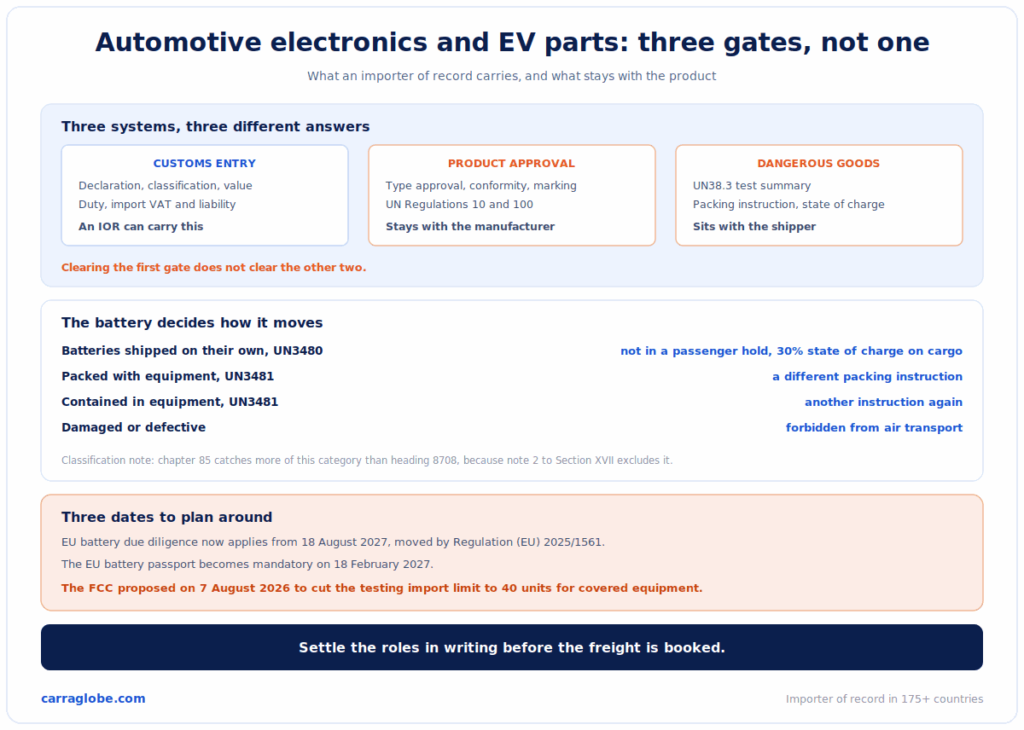
Automotive electronics answer to three control systems at once: customs, product approval and dangerous goods. Each decides something different, and each puts the obligation on a different party. This guide sets out which gate does what, who the law treats as the importer, and where an importer of record genuinely helps.
Carra Globe provides importer of record and exporter of record services, so we have a commercial interest in your answer. What follows is written to be usable whether or not you ever speak to us.
What sits inside automotive electronics and EV components
Can an importer of record bring automotive electronics into a country? For the customs entry, usually yes. An importer of record can be named on the declaration, pay the duty and take on the entry obligations. What it does not do is create a type approval, a battery conformity assessment or a radio authorisation. Those attach to the product and to whoever places it on the market, and they have to exist before the goods are sold or put into service.
The phrase covers products with very different regulatory treatment:
- Electronic control units, domain controllers and gateway modules
- Sensors and camera or radar assemblies for driver assistance
- Traction inverters, DC to DC converters and on-board chargers
- Battery cells, modules and complete packs
- Wiring harnesses, connectors and busbars
- Charging equipment, from cables and wallboxes to DC charging units
- Test, validation and development hardware, including bench supplies and data loggers
They travel in the same programme and are treated differently at the border. A harness may need a certificate where a control unit does not, and one battery module changes how the whole shipment can fly. Treating the pallet as one thing is the first mistake.
Two gates, and only one of them is customs
The first gate is the customs entry: a declaration, a classification, a value, a duty payment and a party liable for all of it. The second is product approval, which decides whether the item may be placed on the market or put into service at all. Clearing the first does not clear the second: goods can be released by customs and still be unlawful to fit or sell.
In the EU, Regulation (EU) 2018/858 says components and separate technical units, “including those intended for the aftermarket”, may only be made available on the market if they comply with the relevant regulatory acts and are marked accordingly.
Approval follows the product, not the paperwork. A type approval attaches to the approved type and to the holder or manufacturer responsible for it under the applicable regime. Approvals can be amended or extended, but only through the approval authority. Naming a different company on the customs declaration does not create, transfer or extend one.
Who the importer is under EU law
Regulation (EU) 2018/858 defines an importer as a person established in the Union who places on the market a vehicle, system, component, separate technical unit, part or equipment manufactured in a third country. Establishment in the Union is part of the definition, which is why a non-EU supplier placing covered products on the EU market generally needs a Union-established operator to hold the role.
The obligations that follow are not clerical. Importers may only place compliant items on the market, must verify that a type-approved item is covered by a valid EU type-approval certificate before placing it, and must put their own name or trade mark and a contact address on the item.
Article 20 goes further. Manufacturer obligations apply to an importer or distributor in two situations: where it supplies the item under its own name or trade mark, or modifies it so that it may no longer comply, and where it relies on a UN type-approval granted to a manufacturer outside the Union with no representative identifiable inside it. That second limb catches a common structure: a non-EU manufacturer appoints nobody in the EU and expects the importing party to simply sign the entry.
Aftermarket programmes feel this first. The regulation covers components and separate technical units intended for the aftermarket on the same terms, and the first limb of Article 20 catches private-label lines directly: put your own brand on a part and you take on manufacturer obligations for it. The cleaner route is for the manufacturer to appoint a representative inside the Union, which is a different appointment from a customs importer of record and cannot be satisfied by one.
| What you need done | Can an importer of record do it | What has to exist anyway |
|---|---|---|
| File the customs entry and pay duty and import VAT | Yes, as the declared importer | Correct classification, value and origin |
| Import parts for testing, validation or a development fleet | Usually, depending on the market and the end use | The end use documented, and any temporary admission conditions met |
| Place a component on the EU market for fitting or sale | Only where the approval and conformity position is in order | A valid type approval, correct marking and the Article 16 checks |
| Create, transfer or extend a type approval | Not by acting as importer of record | An approval held by the manufacturer or its representative, amended through the approval authority |
Two UN regulations come up constantly in this category:
- UN Regulation No. 10: electromagnetic compatibility, covering vehicles and the components and separate technical units fitted to them, on emissions and immunity.
- UN Regulation No. 100: electric power train safety, including the rechargeable electrical energy storage system, for vehicles in categories M and N.
Testing and temporary admission sit differently
A large share of automotive imports never reach a customer: validation samples, bench parts, development fleets, show vehicles. Placing on the market means making an item available for the first time in the Union, and entry into service means its first use for its intended purpose. Where neither happens, the market-placement duties are not yet engaged.
That is a timing difference, not an exemption. The customs regime still has to be chosen and applied correctly, whether that is temporary admission, an ATA Carnet or a normal entry with the goods staying in-house, and the conditions of that regime have to be met and evidenced. Programmes get into trouble when parts brought in for testing quietly move into a saleable build. If this is your first movement into the market, the first shipment into a new country sets out what to line up.
Who the importer is under US law
The United States answers the question differently, and more narrowly. Under 19 U.S.C. 1484, the entry documentation is filed by the owner or purchaser of the merchandise, or by a licensed customs broker when appropriately designated, and the importer of record must be one of those parties. A foreign seller who is neither owner nor purchaser at the time of entry cannot simply elect the role.
Liability then sits with that party:
- Duty liability is a personal debt due from the importer to the United States, a point worth reading alongside who is liable when a reseller imports.
- Paying a broker does not relieve the importer if the duties go unpaid.
- Goods are not released from customs custody until a single entry or continuous bond is filed.
Safety rules reach parts as well as vehicles. Federal law prohibits importing motor vehicle equipment that does not comply with an applicable Federal Motor Vehicle Safety Standard, and the import procedure requires the importer to file a declaration at the time the goods are offered for importation. NHTSA identifies the equipment items that carry standards of their own, including brake hoses, brake fluid, glazing, lighting equipment, seat belt assemblies, tyres and rims.
Most electronics in this category sit outside that list, which is not the same as being unregulated. The declaration still has to be made, and the position for each item established.
Radio authorisation is an import condition
Devices that transmit, such as automotive radar, keyless entry and telematics modules, can meet the Federal Communications Commission before they meet the customer. FCC rules treat importation itself as marketing, and radio frequency devices may be imported only where one of the listed conditions is met, the first of which is a valid equipment authorisation. Which condition applies depends on the device and the rule it falls under.
There is room for development work. The current rule allows 4,000 or fewer units for testing, evaluation or product development, and 400 or fewer for demonstration at trade shows where they will not be sold or marketed.
Treat those figures as current, not permanent. In a further notice of proposed rulemaking published on 7 August 2026, the Commission proposed cutting the testing limit to 40 units for equipment on its covered list, unless the Office of Engineering and Technology approves more. Check the rule in force when you ship.
Batteries decide how the shipment moves
Once a lithium battery is in the box, transport rules drive the schedule. The testing requirement is the UN Manual of Tests and Criteria, Part III, sub-section 38.3, and manufacturers and distributors have to make the test summary available for cells and batteries within its scope. Under the air and sea regimes that obligation took effect on 1 January 2020, for cells made on or after 1 January 2008.
That summary is evidence about the product. It does not settle how a shipment may move, which is decided by the packing instruction, the watt-hour rating, the configuration and the carrier’s acceptance conditions.
How the battery is packed then changes what is possible:
| Configuration | UN number | The practical effect |
|---|---|---|
| Lithium-ion batteries shipped on their own | UN3480 | Forbidden in the hold of passenger aircraft. On cargo aircraft the state of charge must not exceed 30 per cent |
| Batteries packed with equipment | UN3481 | A different packing instruction. The standalone state of charge condition does not carry across unchanged, and that instruction’s own conditions apply |
| Batteries contained in equipment | UN3481 | A further packing instruction again, with its own conditions |
| Damaged or defective batteries | Handled separately | The US regulator states they are forbidden from air transport. Assess the battery under the dangerous goods rules before choosing a route |
By road in Europe, carriage is governed by ADR, which sets the classification, packaging, labelling and certification requirements. Lithium batteries fall in Class 9, miscellaneous dangerous substances. Our guide to HS code 8507 for lithium batteries covers the classification side of the same products, and exporting equipment for repair covers the outbound leg when a part goes back.
Returns are where programmes get caught. A module that failed on a test bench, a pack pulled from a vehicle after an incident, or a unit going back to the supplier for analysis may be a damaged or defective battery for transport purposes. That is not an air freight problem to solve at the airport. It has to be established before anyone promises a date.
Classification drives the duty, and the code is not obvious
There is a common assumption that anything fitted to a car is classified as a vehicle part. It is wrong, and it is expensive. Heading 8708 covers parts and accessories of motor vehicles, but to sit there an item must be suitable for use solely or principally with vehicles, must not be more specifically included elsewhere, and must not be excluded by note 2 to Section XVII, which excludes all articles of chapters 85, 90 and 91.
That exclusion is why so much of this category lands in chapter 85:
- 8507.60: lithium-ion accumulators.
- 8504.40: static converters. HMRC guidance classifies a wireless charging plate within 8504 40.
- 8537: boards and panels equipped with two or more apparatus of heading 8535 or 8536, for electric control or the distribution of electricity.
- 8708: vehicle parts and accessories, only where the conditions above are met.
Charging equipment is the honest grey area. A unit that converts alternating to direct current points towards 8504.40, while a wallbox that only switches and controls a supply points towards 8537, and rulings have not always landed in the same place. For a volume programme, an advance ruling beats an opinion. Our HS Code Finder and the guide to HS codes for electronics are a starting point, and what to do about a wrong HS code covers the clean-up.
The United States tariff position in 2026
Section 232 duties on automobiles and automobile parts remain in force. Proclamation 10908 of 26 March 2025 applied a 25 per cent tariff to listed automobiles from 3 April 2025 and to automobile parts from 3 May 2025, and defines automobile parts as covering engines and engine parts, transmissions and powertrain parts, and electrical components. A Federal Register notice published on 15 May 2026 still describes the measure as a 25 per cent tariff.
For UK exporters a separate treatment applies, subject to conditions. The executive order implementing the US and UK economic prosperity deal set a combined 10 per cent rate for a quota of 100,000 UK automobiles a year, and a total tariff of 10 per cent for UK automotive parts, provided they are products of the United Kingdom and are for use in automobiles that are products of the United Kingdom.
Two operational points follow:
- It turns on your code, not your product name. The covered goods are listed by tariff code in U.S. note 33 to subchapter III of chapter 99.
- The list can change. The Bureau of Industry and Security runs a process for adding parts, with a window that opened on 1 April 2026, so check the current tariff schedule and implementing notices rather than last quarter’s position.
Our note on Section 232 and full customs value covers how the duty is calculated.
Gates in other major markets
The pattern repeats with local variations. What changes is which body holds the gate, and whether the obligation attaches to the product or to the importer.
| Market | The gate | Who it binds |
|---|---|---|
| India | Type approval under the Central Motor Vehicles Rules, against AIS standards, with testing by the specified agencies | Manufacturers and importers of motor vehicles, who submit the prototype for test. Component requirements come through the applicable AIS standards. Some power products, such as adaptors and smaller inverters, need BIS registration |
| Brazil | INMETRO conformity assessment, where the product falls inside a compulsory programme such as the one for automotive components | Manufacturers and importers. The certificate number is a condition of importation, while INMETRO registration is a condition of placing the product on the market |
| Saudi Arabia | The technical regulation for auto spare parts, applying to new parts whether made in the Kingdom or imported, with different certificate routes for original and replacement parts | The supplier, plus Saber registration for importers. The regulation also prohibits importing used or refurbished spare parts, so check any second-hand or remanufactured line |
| Gulf states | The Gulf technical regulation for low voltage electrical equipment, 50 to 1000 volts AC and 75 to 1500 volts DC, where the product falls in scope. Gulf Conformity Marking applies | The importer has its own duties, including drawing up a declaration of conformity, providing safety information in Arabic and keeping records for ten years |
Read the table as a screening guide, not a determination: each row depends on whether your product falls inside the scope of the measure named. Where those routes apply, start them first, because component testing in India and the Saudi certificate and Saber steps run on their own timetable rather than the shipment’s.
None of these gates is opened by appointing an importer of record. What it gives you is a party that can lawfully make the entry and carry the customs obligations once the product position is settled. Country detail sits on the India, Brazil and GCC pages, and the full list sits under IOR by country.
Two EU battery dates worth putting in the plan
Under the EU batteries regulation, importers may only place on the market a battery that complies with the listed conformity requirements. Two dates around it have moved or are approaching, and both matter for programmes being planned now.
- Battery due diligence has been postponed. Regulation (EU) 2025/1561 replaced the 18 August 2025 application date with 18 August 2027. As at September 2026 those obligations are not yet in application.
- The battery passport is coming. The Commission states that the battery passport becomes mandatory on 18 February 2027 for relevant battery categories placed on the EU market, including electric vehicle batteries and industrial batteries.
A programme importing packs into the EU through 2027 is therefore working to a moving requirement, not a fixed one. Our guide to the EU battery regulation for importers goes through the obligations in more detail, and CE marking importer obligations covers the wider conformity duties that come with placing goods on the EU market.
Customs importer and regulatory importer are not the same role
Most confusion in this category comes from one word doing two jobs. “Importer” in a customs sense means the party on the declaration. “Importer” in product legislation means the economic operator who places the goods on the market and carries the conformity duties that come with it. One company can hold both, and often does, but appointing an importer of record does not merge them.
| Role | What it carries |
|---|---|
| Importer of record, the customs role | The declaration, the classification and value declared, duty and import VAT, and the records that follow |
| Importer under product legislation | Conformity checks before the goods are placed on the market, marking and information duties, and manufacturer obligations in the Article 20 cases |
| Manufacturer | Conformity and technical documentation, including the approval or assessment the regime requires, which may involve a technical service or designated body |
| Manufacturer’s representative | Acting for a non-EU manufacturer where the framework requires someone inside the market |
| Shipper for dangerous goods | Classification, packing, marking and documentation for the battery or other regulated item |
Settle in writing, before the goods move, which of these roles your provider takes and which stay with you. Four questions are worth answering in the contract rather than after a hold:
- Who carries the cost and the delay if an approval is refused or turns out to be missing?
- Who is responsible for the radio authorisation, and for evidencing it at import?
- Who holds the UN38.3 test summaries and the dangerous goods documentation, and how fast can they produce them?
- Who bears the liability for an incorrect classification, and who pays the duty difference if it is corrected later? Our note on what an importer of record costs covers how these sit in a quote.
The order to work in
For an automotive or EV shipment, this order avoids the expensive mistakes. The freight commitment comes last on purpose.
- Identify each item, line by line. A pallet is not a product, and the parts on it may sit in different regimes.
- Establish the purpose. Testing, temporary admission, development or placing on the market, because that changes who carries what.
- Classify. The heading drives duty, and chapter 85 catches more of this category than heading 8708 does.
- Check the approval position in the destination market for anything to be fitted or sold.
- Check the battery. Configuration, test summary, state of charge and condition decide the mode before they decide the price.
- Check radio authorisation for anything that transmits.
- Settle the roles in writing: who is the importer of record, and who carries the product obligations.
- Then book the freight.
How Carra Globe handles automotive and EV shipments
We provide importer of record and exporter of record services for technology hardware across 175+ countries, including programmes run by companies with no entity in the destination market, as set out in importing without a local entity. On automotive and EV work we take on the customs and import structure where it sits inside that scope.
Before a date is promised, that means four things: classifying each line rather than the pallet, establishing whether an approval gate applies in the destination, working out the transport position for any battery in the box, and telling you in writing where the answer is no. What it does not replace is a manufacturer’s type approval, a conformity assessment, a radio authorisation or dangerous goods compliance. Where the approval position is not ours to fix, we say so early rather than at the airport.
Importer of Record · Automotive & EV
We carry the customs entry. The approval gate stays where the law puts it.
Being clear about the boundary: appointing an importer of record does not create a type approval, a battery conformity assessment or a radio authorisation. What we do is classify each line rather than the pallet, establish whether an approval gate applies in the destination, work out the transport position for any battery in the box, and tell you in writing where the answer is no.
- What an importer of record does
- IOR for high-tech imports
- Importing without a local entity
- HS code 8507 for lithium batteries
- EU battery regulation for importers
- CE marking importer obligations
- Importer of record in Germany
- Importer of record in India
- IOR by country
Free tools HS Code Finder Volumetric Weight Calculator Pallet Calculator
Shipping ECUs, inverters, packs or charging equipment? Send the part list, the destination and whether the goods are for testing or for sale. We will map the gates before quoting, and say plainly if a battery or an approval changes the timeline.
Check your automotive shipmentFrequently asked questions
Can an importer of record arrange type approval for a component?
Not simply by being appointed. Type approval is a separate process involving the manufacturer, the approval authority and the technical requirements.
An importer of record can coordinate the import structure around it, and can tell you early whether the approval position holds, but the appointment itself creates nothing.
Who counts as the importer of automotive components in the EU?
A person established in the Union who places an item manufactured in a third country on the market. Establishment inside the Union is part of the definition in Regulation (EU) 2018/858.
That is also why a non-EU manufacturer usually needs a party inside the market, rather than a customs agent alone.
Can a foreign company be the importer of record in the United States?
Only if it is the owner or purchaser of the goods at entry. US law limits the role to the owner, the purchaser, or a licensed customs broker who has been appropriately designated.
Do EV battery modules need a UN38.3 test summary?
For air and sea transport, manufacturers and distributors have had to make a test summary available since 1 January 2020, for cells and batteries manufactured on or after 1 January 2008.
Can damaged battery packs be flown back for analysis?
Not as ordinary air cargo. The US regulator states that damaged lithium-ion batteries are forbidden from air transport, so the condition has to be assessed before a return route is chosen.
Are automotive electronics classified under heading 8708?
Often not. Note 2 to Section XVII excludes all articles of chapters 85, 90 and 91, so electrical and electronic items are frequently classified in chapter 85 instead.
Do UK automotive parts still face a 25 per cent US tariff?
The UK treatment sets a total tariff of 10 per cent, subject to origin, use and quota conditions. Where those are not met, check the current tariff schedule and implementing notices.
Sources and verification
- EU vehicle approval: Regulation (EU) 2018/858, for the definition of importer, the importer obligations in Article 16, the cases in Article 20 where manufacturer obligations apply to importers, and the rule in Article 50 on components and separate technical units including those intended for the aftermarket. UN Regulation No. 10 and UN Regulation No. 100 are published by the UNECE World Forum for Harmonization of Vehicle Regulations.
- EU batteries: Regulation (EU) 2023/1542 for the importer obligation in Article 41, with the due diligence date moved to 18 August 2027 by Regulation (EU) 2025/1561, and the European Commission’s battery passport page for the 18 February 2027 date.
- Battery transport: UK Civil Aviation Authority for UN38.3 and the passenger aircraft prohibition. The 30 per cent state of charge condition is taken from the FAA summary of the ICAO packing instructions, the position on damaged batteries from US Department of Transportation guidance, and ADR and Class 9 from gov.uk guidance on moving dangerous goods.
- Classification: the WCO Harmonized System Nomenclature for headings 8504, 8507, 8536, 8537 and 8708, and HMRC guidance on classifying vehicles for the note 2 exclusion of chapters 85, 90 and 91 and on classifying electrical equipment for the wireless charging example.
- US customs and safety: 19 U.S.C. 1484 on who may be the importer of record, with 19 CFR 141.1 on personal liability for duties, 19 CFR 142.4 on the bond, 49 CFR 591.5 on the importer’s declaration and NHTSA importation guidance for the equipment items that carry standards.
- US radio authorisation: 47 CFR 2.1204 for the import conditions and current quantity limits, and the Commission’s further notice of proposed rulemaking of 7 August 2026, which proposes a 40 unit limit for covered equipment.
- US tariffs: Proclamation 10908 for the 25 per cent tariff and the definition of automobile parts, with Executive Order 14309 for the United Kingdom rates and a Federal Register notice of 15 May 2026 confirming the rate still stands.
- Other markets: the Press Information Bureau of India’s Ministry of Road Transport and Highways for the prototype testing requirement, INMETRO’s register of compulsory programmes for Brazil, and the SASO technical regulation on auto spare parts and the GSO low voltage regulation for Saudi Arabia and the Gulf.
- This is not legal advice. Classification, approval and conformity are matters for the importer, its advisers and the authority of the market concerned.
Disclaimer: This guide is for informational purposes only and does not constitute legal, customs or regulatory advice. Requirements change, and the position described is as at 23 September 2026. Confirm the current position with the competent authority or a qualified adviser before acting.