
If you are sending GPU servers to Malaysia, Singapore, Thailand, Indonesia or Brazil for a data centre, the paperwork changed this week. A US rule that took effect on its publication on 19 November 2026 adds those five countries to the list where advanced computing items need a US licence. A server built around a US data centre GPU can be caught, and some deals signed last month may now need one. The exceptions matter as much as the rule, so this guide works through the four questions that decide your shipment.
The short version. The Bureau of Industry and Security (BIS) now requires authorisation to export, reexport or transfer advanced chips and the computers that contain them to or within Indonesia, Malaysia, Singapore, Thailand and Brazil. That new requirement falls away where the ultimate consignee or end user, or its ultimate parent, is headquartered in the United States and the exporter reports monthly to BIS. Some lower-performance items can use a licence exception. Qualifying goods already aboard a carrier on 19 November can finish under the old rules if exported by 21 December 2026. Data centres serving China or Macau headquartered companies face separate controls.
Carra Globe provides importer of record, exporter of record and delivered duty paid services, so we have a commercial interest in your answer. What follows is written to be usable whether or not you ever speak to us.
What changed on 19 November 2026
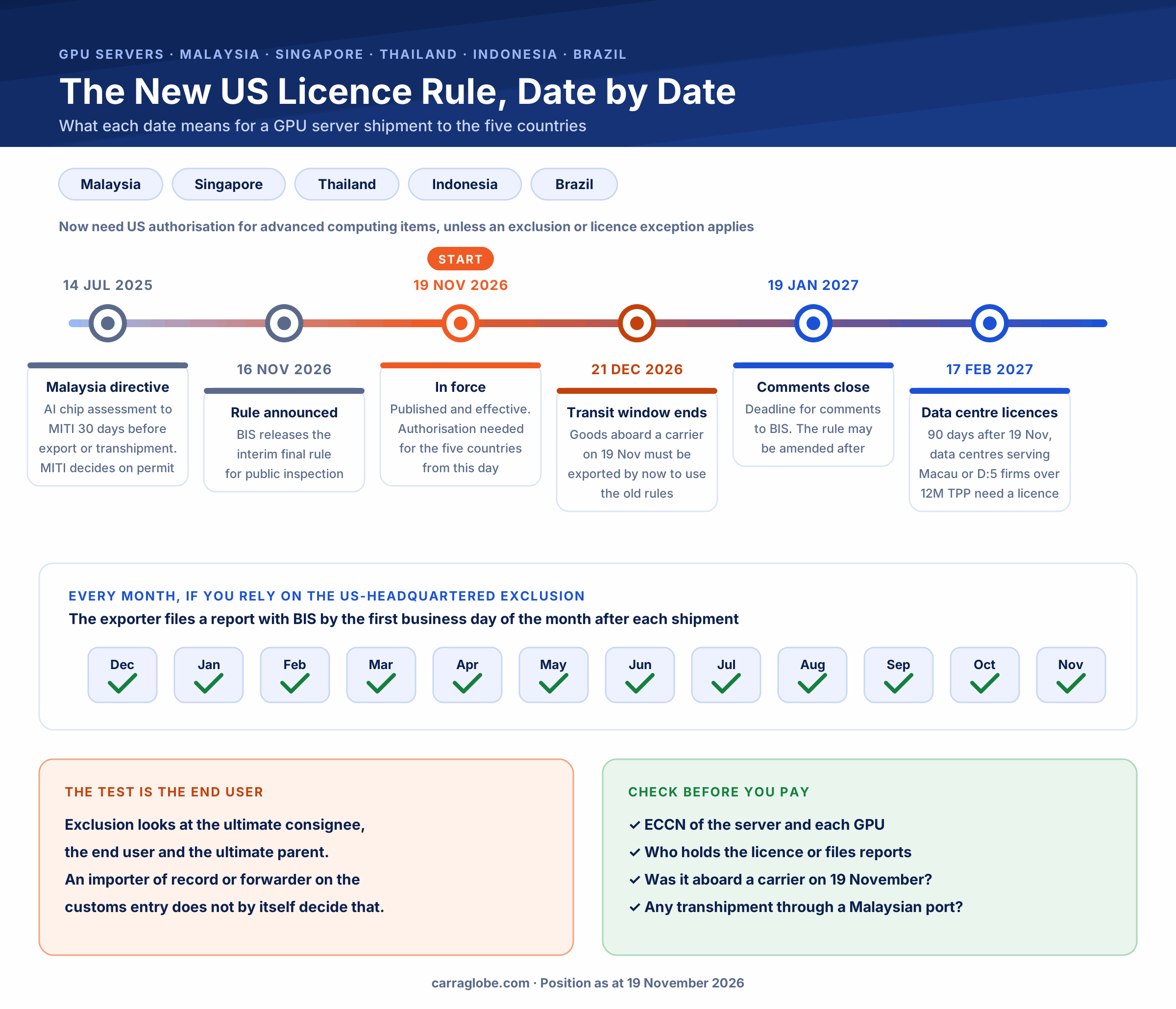
BIS announced an interim final rule, Addressing Remote Access to Advanced Semiconductors, on 16 November 2026. It was published in the Federal Register on 19 November at 91 FR 74970 and took effect the same day, with comments open until 19 January 2027. The rule explains that these five countries present a higher than normal risk of diversion, after concerns that advanced computing items were reaching entities and countries of concern without authorisation.
Licence applications are reviewed case by case, taking account of each destination’s own export controls and its enforcement cooperation with BIS. The same rule formally rescinds the 2025 AI Diffusion Rule, so its country tiers no longer apply, while other EAR controls remain in place.
Question 1. Is the server caught?
The requirement covers chips classified under ECCN 3A090, except high-bandwidth memory under 3A090.c, and computers, assemblies and components under 4A090 that contain a chip meeting 3A090.a or .b, plus related software, technology and certain .z entries. The rule’s preamble gives a GPU board or server as an example, so what matters is the GPU inside, not what the server is called.
The chip thresholds. Entry 3A090.a catches a chip with a Total Processing Performance (TPP) of 4,800 or more, or a TPP of 1,600 or more with a performance density of 5.92 or more. Entry 3A090.b catches a TPP of 2,400 to under 4,800 with a performance density of 1.6 to under 5.92, or a TPP of 1,600 or more with a density of 3.2 to under 5.92. A chip not designed or marketed for data centres, with a TPP below 4,800, falls outside both. The maker’s figures and stated ECCN are strong evidence, but the exporter remains responsible for the classification.
Servers built outside the US. Many GPU servers are assembled outside the US. Whether the finished server is subject to US rules depends on its US content and the de minimis and foreign direct product rules, and for the new data centre control, BIS bars reliance on de minimis for US-origin items built into foreign-made products where a prohibited end use is known. Before you commit to shipping GPU servers to Malaysia or any of the other four countries, ask the seller in writing for the ECCN of each GPU and of the complete server, and on what basis it is subject to US rules.
A licence exception for some items. Licence Exception ACA covers 3A090 and 4A090 items to most destinations, including these five, except chips designed or marketed for data centres that meet 3A090.a, and servers containing them. So a 4A090.b server whose GPUs are all 3A090.b may move without an individual licence, if the exporter holds a written purchase order and meets the exception’s other conditions. Top-end data centre GPUs generally need an individual BIS licence, unless the exclusion below or another BIS authorisation applies.
Question 2. Who receives the server?
This is where most buyers will find their answer. The new five-country requirement does not apply where the ultimate consignee or end user is headquartered in the United States, or its ultimate parent company is. Other EAR controls, such as the end-use rules in Question 4, still apply. A US cloud provider’s Malaysian subsidiary could fall inside that exclusion, while a locally owned data centre in Johor or a Singapore reseller with a non-US parent would not.
The exporter carries the reporting. The exclusion only works if the exporter, reexporter or transferor files reports with BIS under the new section 743.10. Reports are due by the first business day of the month after each transaction and cover, among other details, the parties and their ultimate parents, the destination, and each product’s ECCN, TPP and quantity. If your seller relies on the exclusion, ask who is filing those reports and keep evidence of the end user’s ownership.
The importer on the customs entry is not the test. US rules define the ultimate consignee as the principal party abroad who receives the items, and say it is not a forwarding agent or other intermediary. Appointing a local importer of record structure to clear customs does not by itself decide who the ultimate consignee or end user is. Each party must be named in its actual role, with the final recipient, user and ownership stated accurately.
Question 3. Is the shipment already moving?
Who qualifies. The rule includes a savings clause. Items that lose their licence-free or licence exception eligibility can still go under the old rules if, on the publication date, they were already en route aboard a carrier to a port of export, reexport or transfer, under actual orders. The rule sets the deadline itself, so the export must be completed no later than 21 December 2026.
Who does not. Servers still sitting in a warehouse, awaiting collection or held pending payment on 19 November are unlikely to qualify, because the clause looks at goods already aboard a carrier. If an order was confirmed but not yet moving, assume the new rules apply and check the end user before booking freight.
Question 4. Who will use the compute?
The 12 million TPP test. A second part of the rule applies anywhere in the world, including in the five countries. The new section 744.24 bars exporting, reexporting or transferring covered items without a licence where there is knowledge that they will be used in a data centre providing more than 12,000,000 aggregate TPP to or for companies headquartered in, or ultimately parented in, Macau or a Country Group D:5 destination, such as China. Digitally linked data centres count together towards that figure.
Below the threshold. Staying under 12 million TPP is not a safe harbour. The existing section 744.23 can separately require authorisation for certain advanced computing items supplied to, or on behalf of, an entity headquartered in Macau or a D:5 country, subject to that section’s destination conditions. BIS says that includes deals where such an entity is the purchaser, or uses more than half of the data centre’s compute remotely, although Licence Exception NAC or ACA may cover some of those transactions.
Red flags and existing services. A foreign data centre that declines or cannot provide enough information to verify compliance is treated as a red flag that presumes knowledge, unless it is resolved. Data centres already providing that access before the rule, and wishing to continue, must obtain a licence within 90 days of the effective date.
One narrow exclusion. Access used only for a commercial recommender system, a tool that ranks or suggests products or content, is excluded if the required information is submitted to BIS, but generative AI is not.
If the use changes later. Where covered items ship without a licence, because no prohibited use was known and no other licence applied, section 744.24(e) makes the shipper warn the recipient. BIS authorisation is needed before the equipment serves Macau or D:5 headquartered companies above the threshold, and the party making that change, such as the data centre operator, must obtain it and follow BIS know-your-customer guidance. Expect sellers to ask about your customers before they ship.
Three buyers, three answers
- A US cloud provider’s Malaysian subsidiary. The new five-country requirement falls away if the exporter reports monthly, but the end-use rules still apply if the compute serves companies headquartered in China or Macau.
- A Malaysian-owned data centre buying 4A090.b servers with 3A090.b GPUs. Licence Exception ACA may cover the shipment, if all its conditions are met and no other control applies.
- The same data centre buying servers with top-end data centre GPUs. On these facts neither the US-parent exclusion nor ACA applies, so unless another BIS authorisation is available, the exporter needs an individual licence, reviewed case by case.
What each destination adds on the import side
The US rule is the same for all five countries. What differs is the import and onward-movement side, which carries on regardless of the US position.
| Destination | Local point to check | Our guide |
|---|---|---|
| Malaysia | For any export, transhipment or transit, check whether the chips or servers fall within MITI’s Directive No. 1/2025. If they meet its parameters, or that cannot be determined, an AI Chip Assessment form goes to MITI at least 30 days ahead and MITI advises whether a Strategic Trade Permit is needed. Importing alone needs no permit under this AI chip measure | shipping IT equipment to a Malaysian data centre |
| Singapore | Import permit and goods and services tax, plus a Strategic Goods (Control) Act check if the servers will be re-exported, transhipped or moved in transit. An updated strategic goods list applies from 1 December 2026 | importer of record in Singapore |
| Thailand | Whether NBTC or TISI approvals apply to the server or its wireless parts | NBTC and TISI approvals |
| Indonesia | Which import approvals apply depends on the exact HS code and configuration | Indonesia import rules for tech hardware |
| Brazil | Importer set-up, and Anatel approval only where the equipment falls within its scope | shipping IT hardware to Brazil without a local entity |
MITI confirmed in its statement of 13 November 2026 that bringing AI chips into Malaysia needs no permit, but exporting, transhipping or moving them in transit does. So a qualifying server routed through Port Klang to Singapore may need both US authorisation and Malaysian strategic trade clearance, and both should be checked before the route is confirmed.
Questions to ask your seller before you pay
- What are the ECCNs of the server and of each GPU, and on what data sheet figures?
- Is a US licence required for this destination and end user, and who will hold it?
- If you rely on the US-headquartered exclusion, who files the monthly BIS reports, and what ownership evidence do you need from us?
- Was this order already aboard a carrier on 19 November, and can it be exported by 21 December 2026?
- Will the servers pass through any third country, such as a Malaysian port, on the way?
- What happens to the delivery date and payment terms if a licence is refused or delayed?
Our wider guides to export controls on data centre hardware and EAR compliance for IT hardware shipments cover how the US rules sit alongside other countries’ controls.
How Carra Globe helps with GPU servers to Malaysia and the region
One route from origin to the data hall. Carra Globe serves all five lanes, Malaysia, Singapore, Thailand, Indonesia and Brazil. Depending on the shipment, we act as importer of record at destination, as exporter of record at origin where the route allows, or run the whole move as a delivered duty paid shipment, with the declarations, freight and delivery handled together. Our page on importer of record services for AI servers and GPU clusters explains how that works for data centre deployments.
What we see on the Malaysia lane. Our team has handled more than 200 shipments into Malaysia, including deliveries to Malaysian data centres. In our experience, a complete file usually clears customs the same day, or within one to two days if customs asks for a recheck. Timing still depends on the goods, the documents and any export authorisation, which no forwarder can promise in advance.
Carra Globe works through importer-side registrations and local importing structures appropriate to the goods and destinations it accepts, its own in some markets and established local structures in others. Approvals falling outside the available structure are flagged before a delivery date is agreed.
To start, send the server and GPU model numbers, the seller’s ECCNs, the destination, the end user and the date you need it delivered to info@carraglobe.com or through our contact page.
Malaysia · Singapore · Thailand · Indonesia · Brazil
Tell us the GPUs, the destination and who will use the servers. We will check the import route before anything ships.
From 19 November 2026, advanced GPU servers to these five countries can need a US licence unless the end user is US-headquartered. So the useful conversation starts with the server and GPU models, the seller's ECCNs, the end user and the delivery date. Anything missing on the import side is flagged before a delivery date is agreed.
- Importer of record in Malaysia
- SIRIM approvals for IT hardware
- IOR for tech imports into Singapore
- Thailand customs for IT imports
- Importer of record in Indonesia
- Indonesia TKDN local content rules
- Importer of record in Brazil
- Brazil REDATA data centre incentive
- Exporter of record in the USA
- Exporter of record in Taiwan
- AI server trade flows in 2026
- HS code for GPU chips
- Importing data centre coolant
- Shipping server racks by air
- What an exporter of record does
Free toolsHS Code FinderVolumetric Weight CalculatorPallet Calculator
Shipping GPU servers into Southeast Asia or Brazil? Send the model numbers and end user, and we will reply with the import route for your destination.
Check my shipmentFrequently asked questions
Do I need a US licence to ship GPU servers to Malaysia?
Often yes, from 19 November 2026, if it is subject to US rules and contains a 3A090.a or .b chip. The US-headquartered exclusion or Licence Exception ACA may apply.
Which countries does the new BIS rule add?
Indonesia, Malaysia, Singapore, Thailand and Brazil. Exports, reexports and in-country transfers of covered advanced computing items to or within them now need authorisation.
Is a US-headquartered data centre exempt?
From the new five-country requirement, yes, if it or its ultimate parent is US-headquartered and the exporter reports monthly. Other EAR controls still apply.
What happens to GPU servers already in transit?
Items aboard a carrier to a port of export on 19 November under actual orders can proceed under the old rules if the export is completed by 21 December 2026.
Does the rule cover servers built outside the US?
It can. That depends on US content and the de minimis and foreign direct product rules, so ask the seller for the ECCNs and the basis before booking.
What is the 12 million TPP data centre rule?
A new control needing a licence where covered items serve data centres giving over 12,000,000 TPP to Macau or D:5 headquartered firms. Other controls apply below it.
Adjacent ground: exporting AI servers from Taiwan and importer of record in Thailand.
Sources and verification
This guide is based on the rule as published in the Federal Register, US regulations and Malaysian government statements, as available on 19 November 2026. Interim final rules can be amended after comments, and BIS may publish further guidance, so check the current text before you ship.
- Bureau of Industry and Security. Interim final rule, Addressing Remote Access to Advanced Semiconductors, 91 FR 74970, 19 November 2026 and the BIS press release of 16 November 2026.
- US regulations. 15 CFR 740.8, Licence Exceptions NAC and ACA, 15 CFR 744.23, advanced computing end-use controls and 15 CFR 772.1, definitions.
- Malaysia. Directive of the Strategic Trade Controller No. 1/2025, the MITI industry guideline on advanced AI chips, the MITI press statement of 14 July 2025 and the MITI statement of 13 November 2026.
- Singapore. Singapore Customs, strategic goods control overview.
Disclaimer: This guide is for informational purposes only and does not constitute legal or regulatory advice. Requirements depend on the chips, the server, the parties, the destination and the date of export. The position described is as at 19 November 2026. Confirm the current position with the Bureau of Industry and Security, export control counsel or your exporter of record before shipping.