
An AI server ordered in Taiwan this month may leave under different rules from the ones in force when the contract was signed. Taiwan has said AI servers will join its export control list, but not when. This guide to exporting AI servers from Taiwan follows one order from quote to delivery, with the check due at each stage so a rule change does not strand the shipment.
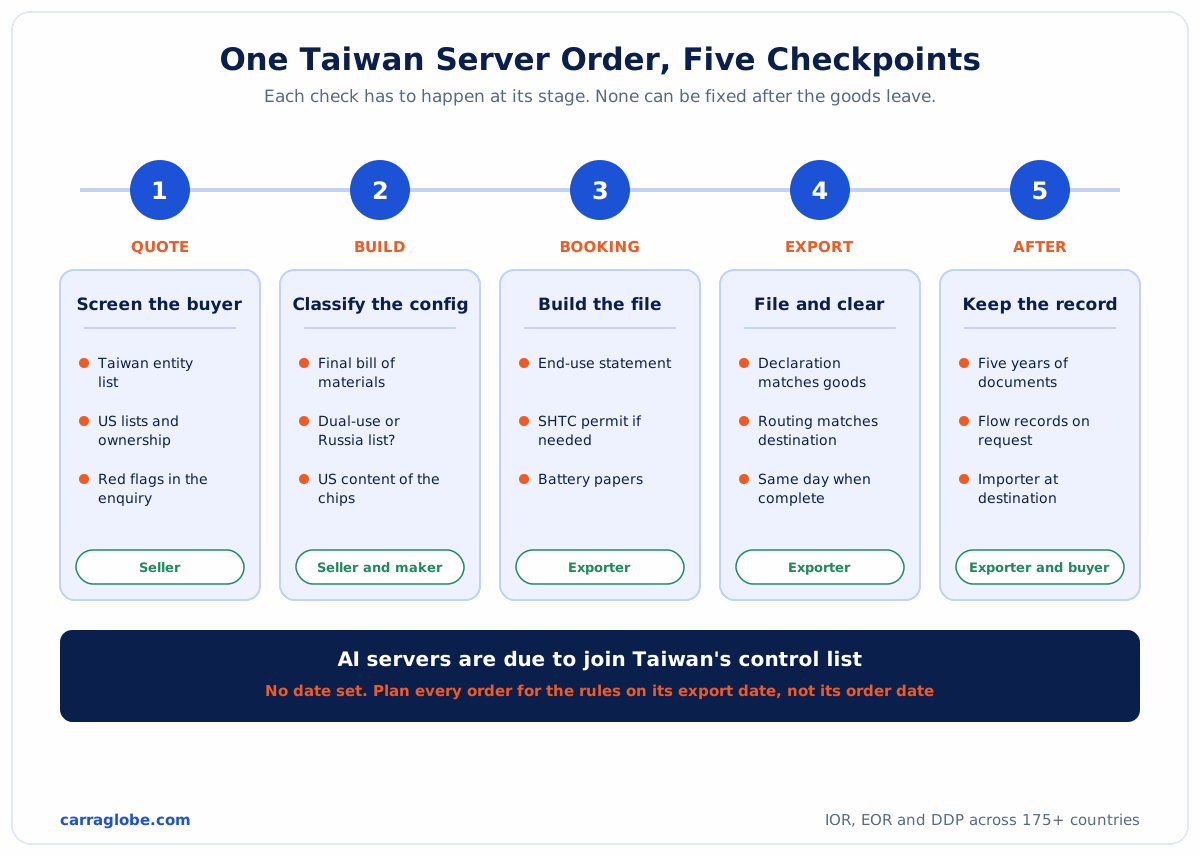
The short version. Taiwan already requires permits for strategic high-tech exports, and a listed buyer or weapons-related end use can bring even an unlisted server into that system. AI servers are due to be added to the list, with no date set. Screen the buyer at quote, classify before the build is locked, build the permit file before booking and keep records for five years.
Carra Globe provides exporter of record, importer of record, delivered duty paid and freight forwarding services, so we have a commercial interest in your answer. What follows is written to be usable whether or not you ever speak to us.
Settled, announced and still unknown
Settled law. Under Article 13 of the Foreign Trade Act, strategic high-tech commodities (SHTC) need a permit before export, and the exporter must declare the end use and end user truthfully. The International Trade Administration of the Ministry of Economic Affairs (TITA) runs the system and updated its export entity list on 22 October.
Announced, not in force. In mid-October, the minister said AI servers and advanced semiconductors would join the control list, and that unauthorised shipments of restricted AI hardware to China could then be prosecuted as a crime. No item list or effective date has been published. Separately, lawmakers held a public hearing on 2 November on a bill amending Articles 13-2 and 27-3 of the Foreign Trade Act to tighten chip exports to China. Neither is in force.
Still unknown. Which servers will be caught, by what performance test, from when, for which destinations, and whether orders already in production get a transition period. Nobody outside government can answer these yet, so the stages below matter more than any prediction.
Stage 1. Before you quote
Screen the buyer before the price goes out. TITA says exports to a party on its export entity list need an SHTC permit before shipment, and customs will stop an unlicensed one. Separately, an unlisted item can fall into the SHTC system through its end user or end use. The list held more than 11,660 entities and individuals after the 22 October update, which added 343 and removed 90. Check the US lists too, and look at who owns the buyer, not just its name.
Ownership matters because the US affiliates rule is due back on 10 November 2026, with no further amendment published by 5 November, under its suspension notice. For items subject to US export rules, it extends Entity List restrictions to companies at least 50% owned, directly or indirectly, by listed parties.
Read the enquiry for red flags. TITA’s SHTC guidance lists warning signs of a possible weapons-related end use. A single flag does not make a server controlled, but it should pause the order until checked, because an unlisted item with such an end use needs a permit.
- The buyer or its agent will not explain the end use or end user.
- The specification does not fit the buyer’s business or the destination’s technical level.
- Price, trade terms or payment look unusual.
- The buyer refuses routine installation, training or maintenance.
- Delivery dates are vague, the delivery point differs from the destination, or a forwarder is named as final consignee.
- Packaging, marking or routing is odd without a reason.
Stage 2. Before the build is locked
Classify the configuration, not the product family. Taiwan’s dual-use list has entries for electronics, computers, telecommunications and information security, but a server is controlled only where its actual specifications meet an entry’s technical parameters. Do not assume every GPU or encryption-capable system is caught. The separate list for Russia and Belarus names tariff lines including 8471.50, 8471.80, 8517.62 and 8542.31. A change of GPU, network card or security module can change the answer, so classify the final bill of materials.
Ask for a ruling if in doubt. TITA will issue a formal SHTC identification, confirming whether an item is controlled, for NT$2,000 per item. A tariff code identifies the goods for customs but does not decide whether the server is SHTC. Settle it at the same time using our guide to the HS code for servers.
Map the US position. Building a server in Taiwan does not take it outside US export controls. Whether it is subject to US rules depends on its US-origin parts and technology, the de minimis and foreign direct product rules, and the destination and end user. Ask the manufacturer for its export classification and licensing position for the exact configuration. Our guides to advanced AI accelerator servers and the Chip Security Act cover the US side.
Stage 3. Before you book
If a permit is needed, the file rests on end-use evidence. Under the SHTC export and import regulations, the exporter applies with transaction documents and either an import certificate, end-use certificate or guarantee from the importing government, or an end-use guarantee issued by the foreign importer or end user.
A standard permit lasts six months and can cover split shipments. Under Article 15, exporters may apply for a two-year permit for countries in all four multilateral control regimes, or for an unrestricted country or area where they have regularly exported SHTC to the same importer at least five times in the past six months. Exporters with an internal control programme approved by TITA may apply for three-year permits.
Two routes are lighter. For the US or Japan, Article 15 lets the authority waive the permit, at its discretion, where the exporter has checked that the buyer is not on the entity list or a party the authority has specifically notified, and either the controlled item is worth under NT$300,000 FOB or the exporter runs an approved internal control programme. Temporary exports to unrestricted destinations for exhibition, repair or testing still need a permit application under Article 18, but with fewer documents and a closing step once the goods return, which suits equipment sent abroad for repair.
Do the battery papers now. Lithium cells are a carrier and dangerous goods matter, not an export control one, but missing papers still stop the shipment. See our guide to lithium battery customs clearance.
Stage 4. At export
A complete file moves fast. Carra Globe and its team have handled more than 100 Taiwan shipments to the US, Europe and the UK, Asia-Pacific, the Middle East and beyond. In our experience, once any permit is issued and the file is complete, the declaration usually clears the same day. When it does not, the cause is usually one of four holds.
- End-user questions, where the buyer, consignee or final user cannot be confirmed.
- Licence or control list queries on whether the configuration is SHTC.
- Invoice mismatches, where model numbers or tariff codes do not match the goods.
- Battery and dangerous goods papers that are missing or incomplete.
The exporter must be able to file in Taiwan. Businesses trading in imports and exports register with TITA under Article 9 of the Foreign Trade Act, Article 10 covers specified exports by other bodies and individuals, and the SHTC permit goes to the exporter that declares the end use. A foreign company without a Taiwan entity usually exports through its supplier, its own entity or an exporter of record in Taiwan service.
Routing counts as well as destination. Specified SHTC heading to a restricted area need a permit even to transit a Taiwan port, transship or enter a bonded zone.
Stage 5. After it leaves
Close the permit, then keep the file. Unless the permit was applied for electronically, return its reconciliation copy within one month of clearance, or of the final shipment if split. Keep the SHTC documents for five years, and expect TITA to ask where the goods went. Re-exports of imported controlled goods may also need the original exporting government’s consent.
The other end has to work too. A clean export can still stall on arrival if nobody can import it properly. Our guides to importer of record for AI servers and GPU clusters and shipping AI servers internationally cover the destination side.
If the rules change while an order is in production
China is where the change lands hardest. Article 13 requires a permit for any SHTC, whatever the destination. The destination changes the penalty. Unlicensed exports to a restricted area are a crime under Article 27, with up to five years in prison and a fine of up to NT$3 million, and Article 27-1 adds suspension or loss of trading registration. Elsewhere, Article 27-2 provides for fines of NT$60,000 to NT$3 million, suspension of exports, imports or both for one month to one year, or revocation of the exporter or importer registration.
Mainland China is a restricted area only for 12 classes of wafer fabrication equipment, so an unlicensed AI server export there does not fall under the Article 27 crime by destination alone. The permit requirement and buyer checks still apply if the server is SHTC. Forgery or fraud can still bring separate charges, so diversion is far from low risk.
A live example. In August 2026, the Keelung District Prosecutors Office indicted nine people over 74 high-end AI servers allegedly delivered to Chinese customers, directly or via Indonesia, or via Japan and Hong Kong. Prosecutors say forged end-user statements and a forged permit application were used, and another 56 servers were stopped when customs required a permit. The charges remain allegations, not convictions, but the lesson for exporters is to check the end user, site and onward route, not just the paperwork.
Plan for the order, not the announcement. Controls are normally assessed at the time of export, so unless the new rules say otherwise, assume an order signed today will be judged by the rules on its export date.
- Collect end-use evidence now, even where no permit is needed today, so a permit file can be built quickly later.
- Add contract terms covering export licences, end use and resale, and what happens to dates if a permit becomes necessary.
- Avoid shipping on the edge of a likely change, since a permit cannot be fixed once the goods have left.
- Watch TITA’s announcements, since list changes can take effect on the day they are published, as its amendment of 5 November to the North Korea and Iran lists showed.
US easing does not carry over. The Commerce Department’s rule of 15 January 2026 moved licence review for certain advanced chips to China and Macau to case by case, but only for exports from the US. Re-exports and exports from abroad to Macau or Country Group D:5 destinations, which include China, stay at a presumption of denial.
Servers bound for the US also need a separate tariff check. Proclamation 11002 adds a 25% duty only to articles under 8471.50, 8471.80 or 8473.30 containing a logic chip in one of two narrow performance bands, and exempts several end uses, including repair, R&D and qualifying US data centres. A data centre qualifies only if it needs more than 100 MW of new load dedicated to AI, so a buyer saying “data centre” is not enough. Check the classification, chip data and intended use before pricing the duty in.
Taiwan has tied its plans to the reciprocal trade agreement signed with the US on 12 February 2026, which had not entered into force as of the US notice of 28 May 2026.
How Carra Globe handles Taiwan server exports
We run the stages before the goods move. Carra Globe arranges exporter of record services for servers and GPU systems leaving Taiwan, through different structures depending on the shipment. We screen the parties, review classification and end-use papers, and coordinate the import at destination through our importer of record service, including importer of record in the USA and importer of record in Japan.
Carra Globe works through importer-side registrations and local importing structures appropriate to the goods and destinations it accepts, its own in some markets and established local structures in others. Approvals falling outside the available structure are flagged before a delivery date is agreed.
The file we ask for on a Taiwan server export.
- Draft commercial invoice with models, quantities and values.
- Final bill of materials, including GPUs, network cards and security modules.
- Chip specifications and the manufacturer’s US content position.
- Buyer, end user and end-use statement.
- Battery details, total weight and dimensions, and the delivery address.
Our EOR by country and IOR by country pages cover 175+ countries. Reach us at info@carraglobe.com.
Taiwan · AI Servers · Export Controls
Send the model list, buyer and destination. We will tell you what the export controls ask for and who should file the export before anything ships.
Taiwan already controls strategic high-tech exports, and AI servers are due to join the list. So the useful conversation is how the server classifies, who the buyer really is, what end-use evidence you hold and who stands as exporter of record. Where something sits outside the structure available, you hear that before a delivery date is agreed.
- Importer of record in Taiwan
- What an exporter of record does
- ITAR and EAR on IT hardware shipments
- AI GPU import compliance
- AI server trade flows in 2026
- HS code for GPU chips
- HS code for routers and switches
- Do you need both EOR and IOR?
- Importer of record in Singapore
- Importer of record in the UAE
- Hong Kong as an IT equipment hub
- Exporting retired AI hardware
- When servers are held at customs
- Data centre trade compliance
- Reducing import duty in Taiwan
Free tools HS Code Finder Volumetric Weight Calculator Pallet Calculator
Shipping servers or GPU systems out of Taiwan? Send the draft invoice with models, quantities and values, datasheets, chip and network card specifications, battery details, the buyer and end user, weights and dimensions, and the delivery address. We will come back on the controls, the exporter, the importer at destination and timing.
Check my Taiwan server exportFrequently asked questions
Do I need an export permit to ship AI servers from Taiwan?
Only where the server is a listed SHTC item or the deal falls within end-use or end-user controls. A warning sign calls for checks but does not make a server controlled by itself.
Can AI servers be exported from Taiwan to China?
Taiwan’s rules do not yet ban them outright, but SHTC permits, entity list checks and US rules can apply. The government plans tighter controls, and a separate bill is not yet law.
Is Taiwan adding AI servers to its export control list?
The Minister of Economic Affairs said in October that it will, but no list amendment or effective date had been published as at 5 November 2026. A related bill is still only a proposal.
Who can be the exporter of record in Taiwan for a foreign company?
Usually the Taiwan supplier, the company’s own Taiwan entity or an exporter of record service able to file declarations and any SHTC permit in Taiwan.
Do US export rules apply to servers built in Taiwan?
They can, depending on the US chips and content inside and the destination. Check with the manufacturer and screen buyers against US lists as well as Taiwan’s.
How long does Taiwan export clearance take for servers?
For Carra Globe, usually the same day once the file is complete. Permit applications, end-user questions or document mismatches can add time.
Adjacent ground: export controls on data centre hardware and EU dual-use controls on IT and AI hardware.
Sources and verification
Shipment counts, destinations, clearance times and hold causes are Carra Globe’s own, covering Taiwan shipments handled by Carra Globe and its team. Regulatory points were checked against official publications on 5 November 2026.
- Foreign Trade Act. The Foreign Trade Act, Articles 9, 10, 13, 27 and 27-2, on exporter registration, SHTC permits and penalties.
- SHTC regulations. The regulations governing the export and import of SHTC, Articles 15 to 21, and the fee standard for SHTC classification rulings.
- Control lists, red flags and restricted areas. TITA’s SHTC guidance and list documents, including the announcement of SHTC types and export restricted areas and the Russia and Belarus high-tech list.
- Entity list. TITA’s release of 22 October 2026 on the export entity list update.
- Sensitive goods lists. TITA’s announcement of 5 November 2026 amending the North Korea and Iran lists.
- Enforcement case. The Keelung District Prosecutors Office press release of 24 August 2026 on the high-end server export indictments.
- Planned controls. Statements by the Minister of Economic Affairs in October 2026 and by the Ministry on 2 November 2026, and the Legislative Yuan’s economics committee hearing of 2 November 2026 on Articles 13-2 and 27-3.
- US rules. The Commerce Department’s rule of 15 January 2026 on advanced computing licence review, the affiliates rule of 30 September 2025 and its one-year suspension, and Proclamation 11002 on the US semiconductor tariff.
- Verification note. Taiwan’s and the US’s export controls are changing quickly, and treatment depends on the exact server, its chips, the buyer and the destination. Check the current position for your shipment before relying on this guide. This guide is general information, not advice on your shipment.
Disclaimer: This guide is for informational purposes only and does not constitute legal, customs or export control advice. Requirements depend on the specific equipment, its classification, value, origin and end use, and the parties involved. The position described is as at 5 November 2026. Confirm the current position with the International Trade Administration or your exporter of record before shipping.