
Yes. When you export GPU servers from the UK, a server can need an export licence even when it looks ordinary, because the control follows the chips inside it. From 1 December 2026, Great Britain extends that control to a band of less powerful data centre chips and withdraws General Export Authorisation No 001, which many exporters to the US, Japan and other allies relied on. Three questions decide your route. Which chips are inside, where is the server going, and which licence covers that destination?
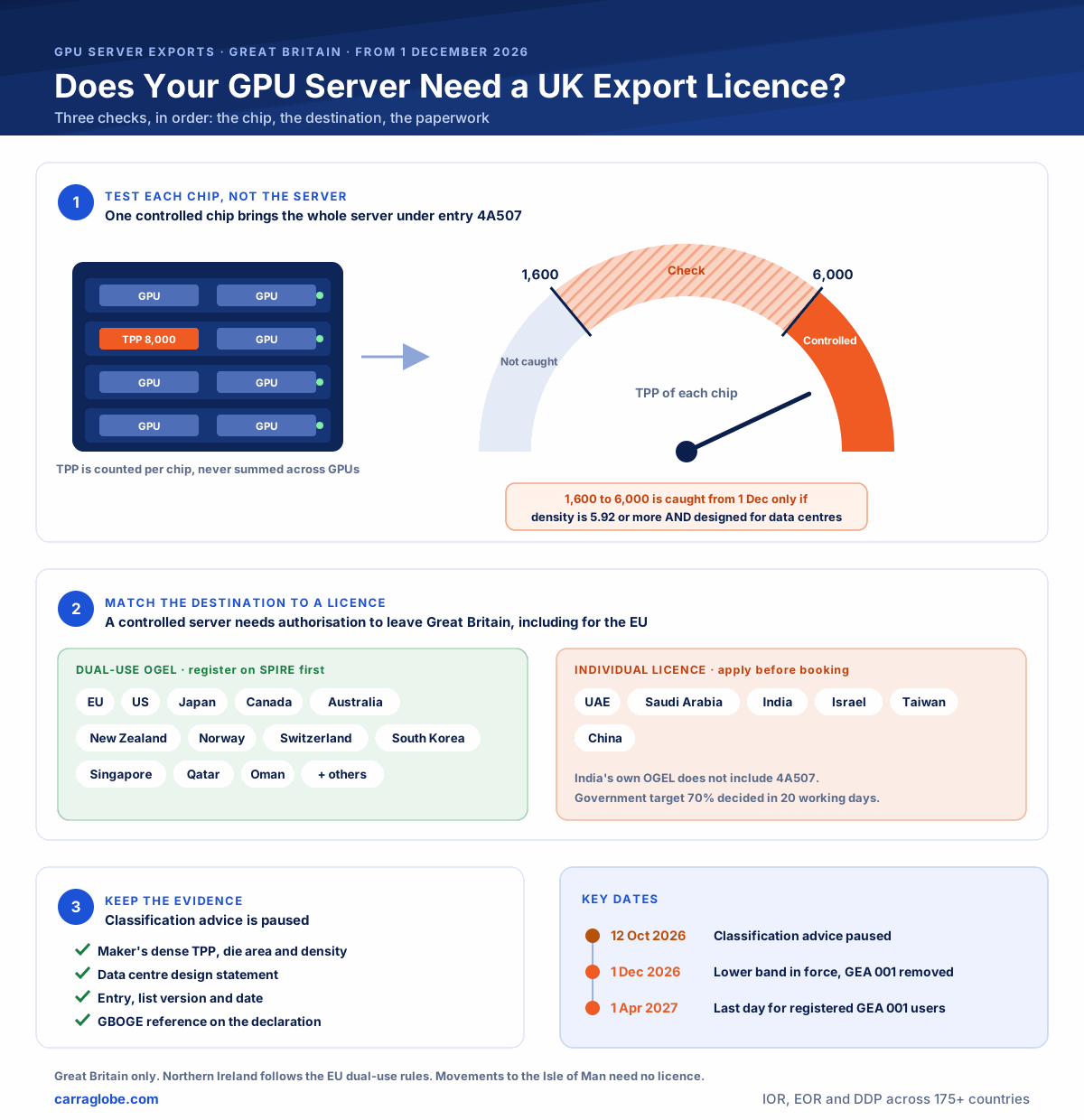
The short version. Servers containing a chip with a Total Processing Performance (TPP) of 6,000 or more have been controlled under entry 4A507 since 16 December 2025. From 1 December 2026, data centre chips with a TPP from 1,600 to under 6,000 and a performance density of 5.92 or more join them. To export GPU servers controlled this way, you need authorisation to leave Great Britain, including for the EU. The dual-use open general export licence covers listed allied destinations, and other destinations generally need an individual licence.
Carra Globe provides exporter of record, freight forwarding and trade compliance services, so we have a commercial interest in your answer. What follows is written to be usable whether or not you ever speak to us.
Great Britain, not Northern Ireland. In this guide, exports from the UK means exports from Great Britain, where the 1 December changes apply. Northern Ireland stays under the EU dual-use framework, so its exports to EU member states need no export licence and the dual-use OGEL does not cover them.
Why the GPU matters to server classification
Entry 3A501.a.16 of the UK dual-use list controls advanced integrated circuits. Entry 4A507 then controls any computer, electronic assembly or component that contains one of those chips, and from 1 December its technical note covers digital, hybrid and analogue computers. So a rack server, a GPU node or an accelerator card can inherit the control from a single chip. Other list entries, end-use controls and sanctions can still apply, so screen the whole server, not only its GPUs.
These entries came into force on 16 December 2025, when the government moved former national controls into the 500 series of the dual-use list. The Export Control (Amendment) Regulations 2026, made on 29 October and laid before Parliament on 3 November, change the chip test from 1 December 2026, subject to parliamentary procedure.
| Chip | Until 30 November 2026 | From 1 December 2026 |
|---|---|---|
| TPP 6,000 or more | Controlled | Controlled |
| TPP 1,600 to under 6,000, performance density 5.92 or more, designed for data centres | Not caught by 3A501.a.16 | Controlled |
| TPP 1,600 to under 6,000, not designed for data centres | Not caught by 3A501.a.16 | Not caught by 3A501.a.16 |
| TPP under 1,600 | Not caught by 3A501.a.16 | Not caught by 3A501.a.16 |
How to test the chip
Total Processing Performance. The technical notes define TPP as 2 multiplied by the chip’s MacTOPS, multiplied by the bit length of the operation, which is the largest bit length of the inputs to the multiply. The rate is the highest the maker claims in a manual or brochure, and the processing units on the one chip are added together. From 1 December, the official example reads that 6,000 equals 750 trillion integer operations per second at 8 bits, or 375 trillion floating point operations per second at 16 bits, correcting an earlier figure of 300.
Four traps.
- Use dense performance figures, not sparse ones, because the technical notes base TPP on dense matrices
- The formula counts one multiply-accumulate as two operations, so if the maker’s figure already counts both, do not apply the factor of two again
- Count each chip on its own, because the figures for eight GPUs in one server are not added together
- Check every precision the chip supports and use the highest result
Three quick examples, using makers’ dense figures
- 1,000 trillion operations per second at 8 bits. TPP is 8,000, so the chip is controlled whatever it was designed for.
- 250 trillion floating point operations per second at 16 bits. TPP is 4,000, so from 1 December the chip is controlled only if its performance density is 5.92 or more and it is designed for data centres.
- Eight chips at a TPP of 1,000 each. No single chip reaches 1,600, so the server is not caught by these entries on that basis.
Performance density. This is TPP divided by the applicable die area in square millimetres, counting the logic dies made on a process node with non-planar transistors. Data sheets rarely give it, so ask the maker in writing for the logic die area, the process basis, the calculated density and its reasoning for 3A501.a.16.
Designed for data centres. The lower band applies only to chips designed for data centres, which the regulation defines as structures dedicated to housing, interconnecting and running IT and network equipment, with their power and cooling. The test looks at how the chip itself was designed, not where it ends up, so ask the maker for its evidence rather than judging from the server or card.
Where you export GPU servers to decides the licence
A controlled server needs authorisation to leave Great Britain for any destination, including the EU, apart from movements to the Isle of Man. The open general export licence (export of dual-use items) covers dual-use list items to its listed destinations, except the entries in Annex IIg of the dual-use regulation and a short list excluded for certain destinations. Neither 3A501 nor 4A507 is among them, so a 4A507 server can use it, provided no other entry that applies to it is excluded and the conditions are met.
| Destination | Route for a controlled GPU server | What to do |
|---|---|---|
| EU member states, the US, Japan, Canada, Australia, New Zealand, Norway, Iceland, Switzerland, Liechtenstein | Dual-use OGEL | Register on SPIRE before first use and follow the checklist below |
| Other listed OGEL destinations, such as South Korea, Singapore, Qatar and Oman | Dual-use OGEL. Its extra exclusions for these destinations do not include 4A507 | Register on SPIRE before first use and follow the checklist below |
| Destinations not on the OGEL list, such as the UAE, Saudi Arabia, India, Israel, Taiwan and China. India’s own OGEL does not include 4A507 | Standard individual export licence (SIEL), or an open individual licence for repeat flows | Apply before you book, with the documents listed below |
Before you rely on the OGEL. A listed destination does not make every export eligible, so check these each time you export GPU servers under it.
- SPIRE registration is in place before the first export
- The export documents carry the prescribed OGEL wording or your SPIRE reference
- The customs declaration carries your licence reference in the format GBOGE 20XX/XXXXX
- The goods are not going to a customs free zone, or on to an unlisted country, unless an exception in paragraph 4 applies
- Nothing suggests a weapons of mass destruction use, or a military use in a country under an arms embargo
- Your entitlement to use the OGEL has not been suspended or revoked
- Any Wassenaar Sensitive or Very Sensitive List item going permanently to a non-Wassenaar destination, such as Singapore, Qatar or Oman, is notified with its destination, entry, date and quantity
- Records are kept for at least four years after the end of the export year, and any pre-audit questionnaire is returned in full by its deadline
Applying for an individual licence. The application needs the following.
- The technical specification of the items
- Quantities, values, the consignee and the end user
- Normally a signed end-user and stockist undertaking, which some government customers can replace with a purchase order or contract
The government aims to decide 70% of applications within 20 working days, but that is a target, and sensitive cases can take longer. Our wider guide to export controls on data centre hardware covers how other countries treat the same equipment.
Already using GEA 001?
Regulation 18 of the 2026 Regulations removes General Export Authorisation No 001 in Great Britain. Under regulation 19, an exporter registered to use it immediately before 1 December 2026 can keep using it until 1 April 2027. The government says the dual-use OGEL supersedes it and covers its destinations, and its notice to exporters asks existing users to move across before that date.
The government also plans to revoke the separate OGEL for dual-use exports to EU member states, and says its users can keep using it until 1 April 2027.
Classification advice is paused, so build your own file
The Export Control Joint Unit paused its Control List Classification service on 12 October 2026 to focus on licence applications. It is still answering earlier requests but not taking new ones, and it reminds exporters that classification is their own responsibility. While the pause lasts, anyone who needs to export GPU servers should keep a file for each server model with the following.
- The chip model, its TPP and how it was calculated, with the maker’s source
- For a TPP from 1,600 to under 6,000, the die area, the performance density and the maker’s data centre design statement
- The entry you classified the server under, the list version and the date
- The licence or OGEL used for each shipment, and its reference
Other checks before the server leaves
End users. Unusual end users, resellers with no clear customer or routes through third countries deserve a closer look, whichever licence you use.
Encryption. Many commercial servers fall outside entry 5A002 through the Cryptography Note, as government guidance on the Cryptography Note explains, but that depends on the server’s actual functions, and it does not lift a separate 4A507 control. Our guide to encryption rules for network equipment covers the import side.
US rules. Check whether the GPUs or the server are subject to US export rules, including when the server was built outside the US, because a UK licence does not replace any US authorisation. The same question arises when you export AI servers from Taiwan or another manufacturing hub.
Customs. The goods still need a correct commodity code, value and export declaration, as our guide to the HS code for servers explains.
Returns, repairs and demo kit. Every export of a controlled server needs authorisation, including for repair, replacement or demonstration. Dedicated open licences exist for repair or replacement under warranty, after repair and after exhibition, with differing scope and registration rules. The after-exhibition licence covers items previously brought into the UK temporarily for exhibition, not UK kit sent abroad. Our guides to exporting equipment for repair and exporting retired AI hardware cover the customs side.
How Carra Globe helps you export GPU servers from the UK
One route from the UK to the site. Carra Globe helps you move GPU and AI servers out of the UK and into their destination. Depending on the shipment, we act as exporter of record in the UK, provide importer of record services at destination, or run the whole move as a delivered duty paid shipment, with the export declaration, freight and delivery handled together.
Carra Globe works through importer-side registrations and local importing structures appropriate to the goods and destinations it accepts, its own in some markets and established local structures in others. Approvals falling outside the available structure are flagged before a delivery date is agreed.
To start, send the server and chip model numbers, the maker’s data sheets, the destination, the end user and the date you need it delivered to info@carraglobe.com or through our contact page.
United Kingdom · Export Controls · GPU and AI Servers
Tell us the chips and where the servers are going. We will check the classification and the licence route before anything ships.
From 1 December 2026, Great Britain controls more data centre chips and withdraws GEA 001. So the useful conversation starts with the chip models, their TPP, the destination and the end user. Where a licence or OGEL registration is needed, you hear that before a collection date is agreed.
- What an exporter of record does
- Do you need both an EOR and an IOR?
- Exporter of record in the US
- Importer of record for AI servers and GPU clusters
- AI GPU import compliance
- Importing high-end GPU servers
- HS code for GPU chips
- Chip security rules for AI hardware importers
- Shipping servers to the UAE
- Importer of record in Saudi Arabia
- Importing IT equipment into India without an entity
- Importer of record in Japan
- Shipping server racks by air freight
- AI server import duties in 2026
- What an EORI number is
Free tools HS Code Finder Volumetric Weight Calculator Pallet Calculator
Exporting GPU servers from the UK? Send the server and chip model numbers, the maker's data sheets, any licence or OGEL reference you hold, the destination and end user, weights and dimensions, and the collection and delivery addresses. We will come back on classification, the licence route, freight and timing.
Check my UK exportFrequently asked questions
Do I need an export licence to ship GPU servers from the UK?
Generally yes, if a chip inside is controlled under 3A501.a.16. The server then falls under 4A507 and needs an OGEL or individual licence to leave Great Britain, including for the EU.
What changes in UK export controls on 1 December 2026?
The chip entry adds data centre chips with a TPP from 1,600 to under 6,000 and a performance density of 5.92 or more, and GEA 001 is withdrawn in Great Britain.
What replaces GEA 001?
The open general export licence for dual-use items. Exporters registered for GEA 001 before 1 December 2026 can keep using it until 1 April 2027.
How do I calculate TPP for a GPU?
Multiply the chip’s dense peak trillion operations per second by the bit length, for each precision, and use the highest result. Count each chip separately, not the whole server.
Can I use the dual-use OGEL for GPU servers?
Yes, for listed destinations such as the EU and the US, because 4A507 is not excluded. Register on SPIRE first and meet its conditions. Other destinations generally need an individual licence.
Is UK export classification advice available?
The Control List Classification service has been paused since 12 October 2026 for new requests, so exporters must classify their own items and keep the evidence.
Adjacent ground: EU dual-use controls on AI hardware and shipping AI servers internationally.
Sources and verification
This guide is based on UK legislation and Department for Business and Trade notices, as available on 18 November 2026. The 2026 Regulations were laid before Parliament subject to its procedure, so confirm the position with the Export Control Joint Unit before you ship. After 1 December 2026, check the consolidated UK strategic export control list and the current OGEL text before relying on 3A501.a.16 or 4A507 coverage.
- Legislation. The Export Control (Amendment) Regulations 2026, SI 2026/1150, regulations 11, 18 and 19 and The Export Control (Amendment) (No. 2) Regulations 2025, SI 2025/1197, inserting 3A501 and 4A507.
- Export Control Joint Unit. Notice to exporters 2026/24, updated 11 November 2026, Notice to exporters 2026/22, 12 October 2026, Notice to exporters 2025/30 and the dual-use OGEL text, in force 14 October 2026.
Disclaimer: This guide is for informational purposes only and does not constitute legal or regulatory advice. Requirements depend on the chips, the server, the destination, the end user and the date of export. The position described is as at 18 November 2026. Confirm the current position with the Export Control Joint Unit, a licensed customs agent or your exporter of record before shipping.