
Ask an office manager what a CPU is and they will point at the box under the desk. Ask a component buyer and they will hand you a chip in a blister pack. On a commercial invoice the customs officer has no way of knowing which one was meant, and a chip, a tower and a bare motherboard each take a different code.
This guide is for IT teams, technology resellers and system integrators moving computers and parts across borders, and it covers the codes, the traps and the 2026 destination checks.
The short version
- Laptops. 8471.30, for portable machines up to 10 kg with a processor, keyboard and display.
- All-in-ones. 8471.41, where the processor, input and output share one housing.
- Desktop systems. 8471.49, when the tower travels with its keyboard and monitor as a system.
- Towers and mini PCs on their own. 8471.50, as processing units.
- Processor chips. Usually heading 8542, not 8471.
Carra Globe provides importer of record, exporter of record and delivered duty paid services for IT equipment, so we have a commercial interest in this topic. The tariff texts and rulings below are public and listed in the sources.
The same computer can take four different codes
Every ordinary PC is a data-processing machine. Note 6(A) to Chapter 84 asks whether a machine can store and run its program, be freely programmed and make its own logical decisions, and desktops and laptops pass easily. The harder choice is the six-digit subheading, which depends on what is presented to customs. Those six digits are shared worldwide, and each country adds its own digits for the full declaration code. The next edition of the nomenclature is covered in our guide to the HS 2028 update.
A laptop goes to 8471.30. The subheading covers portable machines of no more than 10 kg with at least a processor, a keyboard and a display.
An all-in-one goes to 8471.41. If the machine is not a portable of 8471.30 and its processor shares one enclosure with at least one input and one output unit, this is the line, whatever it weighs. The EU guidance puts touch-screen, luggable and industrial computers here too when they work as general-purpose computers.
A desktop shipped as a system goes to 8471.49. Subheading Note 2 to Chapter 84 defines a system as a processing unit with at least one input and one output unit meeting the conditions of Note 6(C). Its examples include a scanner and a printer as well as a keyboard and display. Sharing a pallet is not enough. The units have to be presented together as one working set, even if they arrive in several cartons.
A tower or mini PC on its own goes to 8471.50. Without its keyboard and monitor, the box is a processing unit, even with one or two storage, input or output units in the same housing. Business desktop orders often land here when the monitors come from another supplier or travel separately. Servers sit on the same line, as our HS code for servers under 8471 explains from the data centre side.
What “CPU” means on an invoice
A boxed processor is an integrated circuit. Section XVI Note 2 sends a part that has its own heading to that heading, and processors are named in subheading 8542.31, “processors and controllers”. The US tariff even gives central processing units their own statistical line, 8542.31.00.45. The rest of the heading is set out in HS codes for chips under 8542.
The EU guidance approaches CPUs as assemblies. The European Commission’s guide describes CPUs as two or more integrated circuits and places them under 8473 30 20, the electronic assemblies line. A processor that meets the Chapter 85 definition of an integrated circuit still belongs in 8542, so the construction of the actual part decides it. For repeat processor imports into the EU, a Binding Tariff Information decision removes the doubt.
A “CPU” that is really a tower goes to 8471.50. Office slang calls the desktop box a CPU, and invoices sometimes follow. Write “desktop computer” with the model number instead.
What is fitted to a motherboard changes everything. The EU guidance treats a motherboard carrying its processor and memory as a base unit under 8471.50, while one without them is a part under 8473.30.
A barebone kit is usually a part. CBP ruling NY N325863 of 11 May 2022 classified an enclosure with a motherboard and graphics board, sold for the buyer to fit the processor later, under 8473.30 because without a processor it could not run. The same ruling notes that incomplete machines imported with their processor have been treated as computers. The EU guidance lists barebone units of a case, motherboard and power supply under 8473 30 80. A product sold as a “mini PC” therefore does not qualify for 8471.50 by name alone.
A machine with a computer inside may not be a computer. Note 6(E) sends machines that work with a data-processing machine but perform another specific function to the heading for that function. A general-purpose industrial PC and a control unit built for one machine can share a processor and still take different codes.
Parts and peripherals each have their own line
Shipped loose rather than as part of a system, most items need their own line.
- Keyboards and mice. 8471.60, still inside heading 8471.
- Monitors. 8528.52 for monitors that connect directly to, and are designed for use with, a computer. An HDMI or USB-C port alone does not settle it, and Note 6(D) keeps separately presented monitors out of 8471.
- Memory modules and part-built motherboards. 8473.30, where the memory is designed mainly for computers. Loose memory chips go to 8542.32, and the EU sends memory for other apparatus elsewhere.
- Power supply units. 8504.40, as static converters.
- Processor coolers. A combined CPU fan and heatsink for a personal computer goes to 8414.59, while the EU puts a heatsink alone under 8473.30.
- Graphics and expansion cards. The EU guidance lists expansion cards under 8471.80, while in Atlas Power LLC v United States the US court classified NVIDIA CMP 170HX crypto-mining boards as parts under 8473.30.1180. The goods differ, so check how the destination treats the specific card.
- Loose batteries. A separate classification with its own transport rules, covered in our HS code guide for lithium batteries.
When the shipment is mixed
Laptop-only consignments give us the fewest classification problems, though a wrong code on the supplier’s invoice can still stop them. Most trouble starts when monitors, docks, spare chargers and loose memory ride on one invoice line under one code. Keep 8471.49 for towers that genuinely travel as matched systems.
What changes by destination in 2026
The duty is usually nil. As at 26 November 2026, the UK tariff shows 0 per cent third-country duty across heading 8471, and the US general rate for every 8471 line is free.
Import VAT still applies in the UK and EU. Postponed or deferred accounting can change when it is paid, and who pays import VAT under an importer of record depends on how the import is structured. The US has no VAT, and state sales or use tax sits outside customs. Our guide to calculating landed cost shows how the figures stack up.
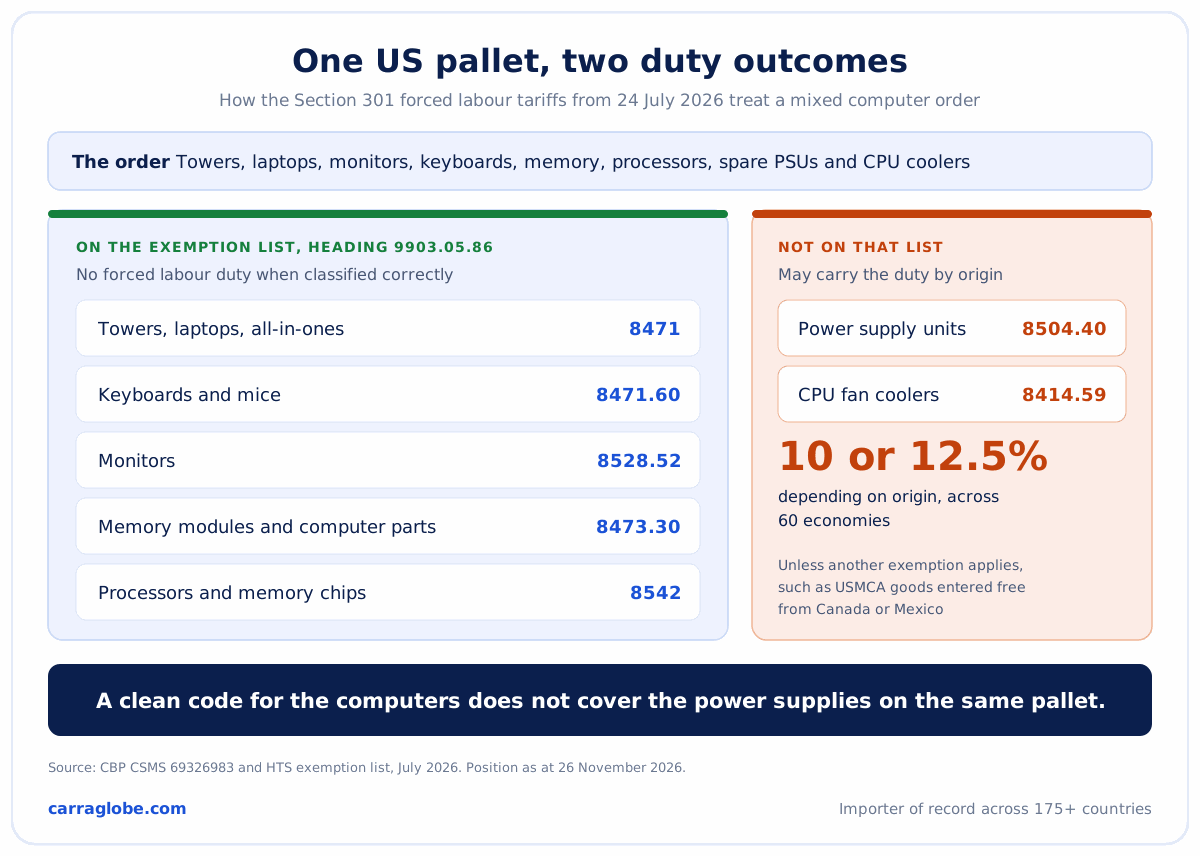
The US forced labour tariffs split a mixed order. Since 24 July 2026, Section 301 duties of 10 or 12.5 per cent apply to goods from 60 economies by origin, working as a floor with the ordinary duty for the EU, Japan, South Korea, Switzerland and Taiwan. CBP’s exemption list under 9903.05.86 covers computers of 8471, keyboards and mice included, parts of 8473.30, monitors of 8528.52 and chips of 8542.
Power supplies of 8504.40 and fan coolers of 8414.59 are not on that list, so on the same pallet they may carry the duty unless another exemption applies. Canadian and Mexican goods entered free under the USMCA are exempt, a status worth watching through the USMCA annual review.
A correct code does not win an exclusion on its own. In Atlas Power, decided on 27 January 2026, the court accepted the mining boards as computer parts, yet the importer still owed the China Section 301 duties because the boards did not match the wording of the exclusions claimed. The lesson is to read the exclusion text against the product, not only the tariff line. China-origin duties change often, and our overview of the Section 301 electronics exemption tracks how they have moved.
The US now asks a question about every 8471.50 unit. Since 15 January 2026, Section 232 has applied a 25 per cent duty to advanced chips, and goods containing them, under 8471.50, 8471.80 or 8473.30. It targets two narrow bands of processing performance and DRAM bandwidth, beyond most office desktops, with end-use exemptions, so the chip’s datasheet decides it.
Even when no duty is due, the entry needs a Chapter 99 line, such as 9903.79.02 for chips outside the bands or 9903.79.07 for consumer and personal computing, and the broker must establish which applies. Data centre hardware is covered in our guide to US chip tariffs on servers.
India restricts several of these lines. Laptops, tablets, all-in-ones, ultra small form factor computers and servers need an Import Management System authorisation for ordinary commercial imports. Under DGFT Policy Circular 08/2025-26, applications for 2026 close on 15 December 2026 and authorisations are valid until 31 December 2026, so a late-year shipment should be checked against both dates. How to apply is covered in India’s IT hardware import authorisation.
Used computers raise other questions. A refurbished tower usually takes the same code as a new one, but many countries restrict second-hand IT equipment separately, as our guide to importing used and refurbished IT equipment explains.
What we see on computer shipments
We ship the full range. Desktops and workstations, laptop orders running to hundreds of units, loose processors and parts, and refurbished machines are all regular work for our team. Laptops alone account for more than 130 of our shipments into EU countries, and our guide to shipping laptops to Europe covers that lane.
One laptop shipment that still got held. For an IT equipment import into India, we moved 89 business laptops from a globally known brand, with their power adapters, by air from Frankfurt to Bengaluru for a rollout at a multinational’s Indian office, worth USD 121,129. The supplier had declared them under 8471.50 instead of 8471.30. Indian customs also found, during the documentary check, that the model reference on the invoice did not exactly match the model on the manufacturer’s BIS registration, which India requires for laptops under its BIS registration rules.
The supplier issued a corrected invoice the next day, backed by datasheets, serial number records, label photographs and the BIS registration, and the broker amended the declaration to 8471.30. Customs released the goods on day three, and our guide to resolving a customs hold on IT shipments walks through the same steps. The laptops were fine. The paperwork was not, and the paperwork is what customs reads. A check before dispatch would have saved three days.
The other holds we see most. A tower declared as parts, or a processor declared as a computer, is the classic wrong HS code on an invoice. Missing radio approvals for wireless models and battery paperwork come next, then queries over declared value or origin, where our certificate of origin guide for US IT hardware imports sets out what to hold.
Before you write the invoice
- Look at what ships, not what was ordered. Note whether each tower travels with its own keyboard and monitor.
- Name the machine properly. “Desktop computer”, “laptop computer” or “processor”, never “CPU” alone, because customs reads the word literally and it can mean either a chip or a tower.
- Give every item type its own line, with model number, quantity, unit value and country of origin.
- Check what is fitted. A board or barebone kit without its processor will generally be a part.
- Match the registrations. The model on the invoice should match India’s BIS registration, any radio approval and the battery documents exactly.
- Get a ruling for volume. A binding ruling pays for itself on repeat processor or component imports.
- Photograph the cartons before sealing. If customs questions what was packed, the photos are quick evidence that costs nothing.
Our free HS Code Finder is a quick first check before you send the invoice for review.
How Carra Globe handles computer imports
We review the invoice before the shipment is booked. Our trade compliance team checks each line against what is actually in the cartons, splits mixed shipments into the right headings and then acts as importer of record where you have no local entity.
Carra Globe works through importer-side registrations and local importing structures appropriate to the goods and destinations it accepts, its own in some markets and established local structures in others. Approvals falling outside the available structure are flagged before a delivery date is agreed.
From collection to desk. We arrange freight forwarding for bulk laptop and desktop orders and white glove delivery where machines need unpacking on site. For a quote, send the draft commercial invoice with item names, quantities and unit values, the total weight and dimensions, the collection and delivery addresses and the datasheets. Where batteries are included, add their chemistry, watt-hour rating and test summary, and send it all to info@carraglobe.com or through our contact page.
Importer of Record · Computers and IT hardware
Every line on the invoice checked against what is in the cartons.
A code is only as good as the description behind it. We review each invoice line for desktops, laptops, processors and parts before booking, split mixed shipments into the right headings and flag destination checks such as India's import authorisation and BIS registration, or US Chapter 99 reporting, before a delivery date is agreed.
- HS code for servers (8471)
- HS code for GPU chips (8542)
- HS codes for electronics
- Wrong HS code on an invoice
- Shipping laptops to Europe
- India IT hardware authorisation
- Used and refurbished IT equipment
- How to calculate landed cost
- IOR by country
Free tools HS Code Finder Volumetric Weight Calculator Pallet Calculator
Shipping computers or parts across a border? Send the draft invoice and we will check every code and licence before you book.
Check your invoice codesFrequently asked questions
What is the HS code for a desktop computer?
It depends on what ships. A tower presented with its keyboard and monitor as a system is 8471.49, a tower or mini PC on its own is 8471.50, and an all-in-one is 8471.41.
What is the HS code for a laptop?
8471.30, for portable data-processing machines weighing no more than 10 kg with at least a processor, a keyboard and a display.
Is a CPU classified under 8471 or 8542?
A boxed processor chip is usually classified under 8542.31 as a processor, and the US tariff has a specific CPU line, 8542.31.00.45. A desktop box described as a CPU is a computer under 8471.50. EU guidance places certain CPU assemblies under 8473.30, but a processor that meets the legal definition of an integrated circuit stays in 8542.
What HS code is a computer monitor?
A computer monitor shipped on its own generally falls under 8528.52, not 8471, provided it connects directly to and is designed for use with a computer.
Our order has towers, monitors and spare power supplies. Is that one code?
No. In a mixed shipment of computers and accessories, each item type takes its own line, such as towers under 8471.50, monitors under 8528.52 and power supplies under 8504.40, unless the units travel together as complete 8471.49 systems.
Do computers pay import duty?
Often not. The UK applies 0 per cent across heading 8471 and the US general rate is free, but import VAT applies in the UK and EU, and some countries add licences or measures by origin.
Adjacent ground: HS codes for electronics and tech equipment, IT hardware import regulations by country and what an importer of record does.
Sources and verification
This guide was checked against official tariff texts, guidance and rulings on 26 November 2026, the day of publication.
- World Customs Organization nomenclature, as published in the UK tariff. Heading 8471 with Note 6 and Subheading Note 2 to Chapter 84, and heading 8542.
- European Commission. Classifying computers and software, Access2Markets.
- US Customs and Border Protection. CSMS 69326983, Section 301 forced labor import duties, July 2026, with its HTS exemption list and the USTR final action notice of 23 July 2026.
- US Customs and Border Protection. Ruling NY N325863, barebone system classified under 8473.30, 11 May 2022.
- US Customs and Border Protection. CSMS 67400472, Section 232 import duties on semiconductors and their derivative products, 14 January 2026.
- US Court of International Trade. Atlas Power LLC v United States, Slip Op. 26-4, 27 January 2026.
- United States International Trade Commission. Harmonized Tariff Schedule, headings 8471 and 8542.31, and guidance on taxes and fees levied on imports.
- Bureau of Indian Standards. Compulsory Registration Scheme product list, laptops, notebooks and tablets.
- Directorate General of Foreign Trade, India. Policy Circular 08/2025-26, Import Management System for restricted IT hardware, 17 December 2025.
Disclaimer: This guide is for informational purposes only and does not constitute legal or customs advice. Classification depends on the exact goods, how they are presented and the destination’s tariff and practice. The position described is as at 26 November 2026. Confirm the classification with the customs authority or a binding ruling before shipping.