
A rack-mounted server with no wireless may need one Thai product approval. Add a wireless management module and the regulatory route can change entirely. Ship equipment that will later be re-exported and a separate trade-control question can arise. The hardware barely changes. The path to market does.
The NBTC vs TISI question gets asked constantly, and most guidance treats the two as interchangeable Thai red tape. They are not. They are separate regulators with separate scopes, separate processes and separate lead times, and confusing the two is how a shipment ends up sitting at Suvarnabhumi while somebody starts an approval that should have begun two months earlier.
This guide is written from the customs side and answers the question that comes first: for this specific SKU, which approval actually applies? It also covers the requirement that catches most overseas vendors, which is that the paperwork cannot sit in your own name. If you have no Thai entity, our note on importing without a local legal entity covers the wider routes.
Quick answer
The answer is not always NBTC or TISI. Depending on the product it can be NBTC, TISI, both, or neither.
| Question | Short answer (confirm for your exact product) |
|---|---|
| What does NBTC cover? | Radio and telecommunications equipment. WiFi, Bluetooth, cellular and other radio functions can bring equipment within NBTC requirements, subject to the technology and applicable rules |
| What does TISI cover? | Products falling within specific Thai Industrial Standards. Mandatory certification applies only where the exact product is covered by a compulsory standard |
| Can a product need both? | Yes. A product can fall within NBTC requirements for its radio function and separately within a compulsory TISI standard |
| Does every server need TISI? | No. The exact product, applicable TIS standard and current compulsory scope have to be checked |
| Can an overseas manufacturer apply directly? | Not necessarily. The applicable NBTC and TISI route determines the required Thai applicant, certificate holder or representative structure |
| Is DFT another import approval? | Not generally. Dual-use controls are a separate trade-control question, most relevant to controlled exports and re-exports from Thailand |
| When to start | Before freight is booked. Testing, documentation, factory assessment and local-entity requirements all affect the schedule |
NBTC vs TISI: two distinct product-approval questions
The first thing to get right is that NBTC and TISI are not alternatives you choose between. They are scopes your product either falls inside or outside, independently of each other. The dual-use question sits apart from both, and is a trade-control matter rather than a product approval.
| Authority | What it regulates | How to assess it |
|---|---|---|
| NBTC | Radio and telecommunications equipment | Check whether the exact radio function falls within an NBTC technical requirement, and which conformity route applies |
| TISI | Products covered by specific Thai Industrial Standards | Check the exact product, category and HS code against the current compulsory standards list |
| DFT | Dual-use trade controls | A separate question, most relevant where goods will be exported or re-exported from Thailand |
So one consignment can need nothing, one approval or two. Do not classify a shipment as “servers”, “network equipment” or “IT equipment”. The regulatory position is set by exact manufacturer, model and configuration.
Does your product need NBTC approval?
The trigger is radio functionality. WiFi, Bluetooth, cellular and other RF functions bring equipment within NBTC’s remit, with the route set by the technology, band and power. It catches a lot of equipment nobody thinks of as telecoms.
The trap is embedded radios. A server whose baseboard management controller includes WiFi, a storage appliance with a Bluetooth service interface, a KVM with a wireless dongle in the box. Each carries a radio, and a radio brings the finished product into NBTC’s remit even though it is sold as compute or storage. Our page on the importer of record for telecom equipment covers the wider category.
Where NBTC conformity assessment is required, the applicable route is determined by the equipment category and technical requirements rather than chosen. The main routes are Class A registration, Class B certification and SDoC for eligible equipment, and which one applies changes the timeline substantially.
| Route | What it involves | Practical effect |
|---|---|---|
| Class A | Registration route: conformity demonstrated through an NBTC-recognised assessment route, then registration with NBTC | Testing must come from a recognised laboratory. NBTC does not accept manufacturer self-testing |
| Class B | Approval certification, where test evidence to international standards from an accredited laboratory may be accepted | Can be faster where existing test evidence meets NBTC’s acceptance requirements |
| SDoC | Supplier’s declaration of conformity, for products eligible for the self-declaration route | The lightest route where the product qualifies |
The question worth asking first. If your product already holds RF and EMC test evidence from an accredited laboratory, ask whether it qualifies for Class B before anyone books new testing. Where existing evidence meets NBTC’s acceptance requirements, avoiding repeat testing is usually the single biggest lever on a Thai approval timeline. Note that a CE marking or EU declaration of conformity is not itself a test report.
Three further points on NBTC. Where the applicable route requires a certification or registration mark, the prescribed NBTC marking and electronic labelling requirements must be followed. NBTC ended authorisation for import and conformity assessment of equipment using 2G or 3G-only technologies from 30 June 2025, which matters for legacy machine-to-machine hardware still in circulation. And while an existing NBTC approval can be valuable, check it against the exact model, technical configuration, applicable standard and current NBTC requirements before relying on it for a new shipment.
Does your product need TISI certification?
TISI administers Thai Industrial Standards through mandatory and voluntary certification marks. It works product by product rather than by category, and the applicable standard may cover safety, EMC, energy efficiency or other requirements. According to the US Department of Commerce country guide, Thailand requires compulsory certification for 129 products across eighteen sectors, including electrical appliances and accessories. Everything outside that falls under the voluntary scheme.
The test is not whether a product is electrical or ICT. It is whether that exact product falls within a compulsory Thai Industrial Standard. The mandatory categories do reach into ICT more than most importers expect, and goods such as laptops, monitors, power supplies, modems and networking equipment appear among them, but the existence of a standard covering a product type does not by itself make certification mandatory for your model. Check the current compulsory standards list at category and HS code level.
Where mandatory certification does apply, the process is heavier than a paperwork exercise. Four elements drive the timeline.
- The applicable TIS standard. Testing and conformity assessment follow the requirements of that specific standard and the TISI certification procedure.
- Accepted laboratories. These vary by product and scheme, so foreign test reports cannot be assumed to transfer.
- Existing test evidence. IEC-aligned evidence may reduce the scope of testing required, though it rarely removes it.
- Factory assessment. Where this forms part of certification, your manufacturer’s site and quality-control arrangements join the approval timeline, not just your compliance team’s workload.
If your test reports were issued elsewhere, read our notes on foreign test report recognition and what to do when an accredited laboratory report is rejected before assuming they will be accepted.
One shipment, three answers
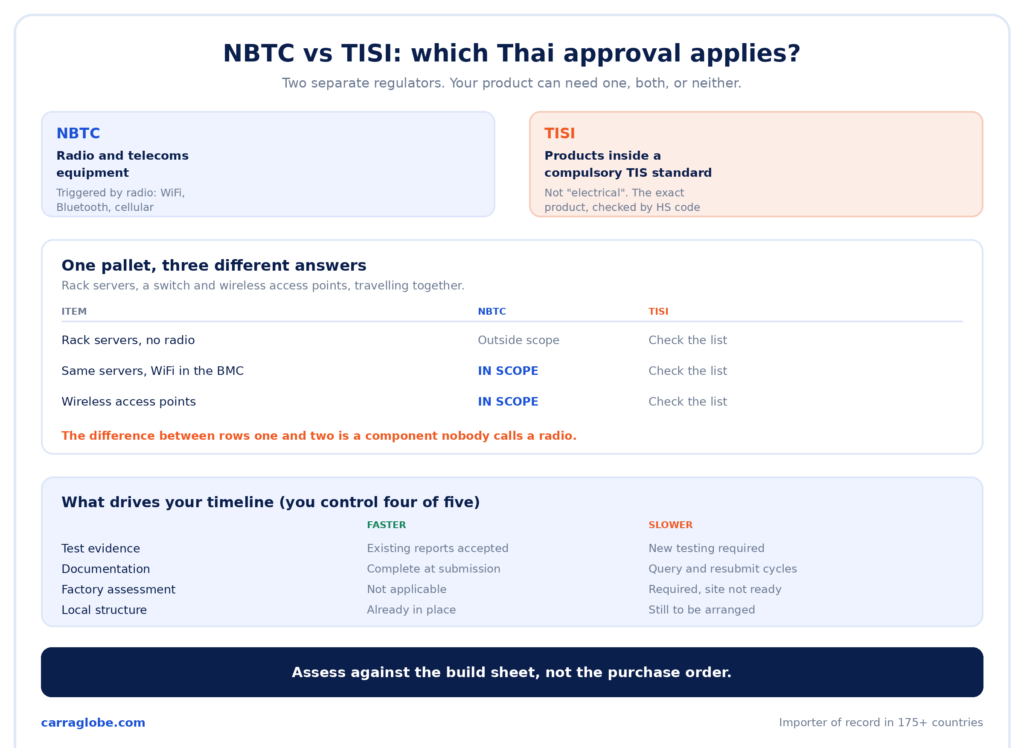
Take a single pallet going to a Bangkok data centre: rack servers, a top-of-rack switch, and a handful of wireless access points for the facility. One purchase order, one consignment, three different regulatory positions.
| Item | NBTC | TISI | What decides it |
|---|---|---|---|
| Rack servers, no radio | Outside scope | Check the compulsory list | Whether the exact model falls within a compulsory TIS standard |
| Same servers, WiFi in the management controller | In scope | Check the compulsory list | The embedded radio, which the purchase order will not mention |
| Wireless access points | In scope, route depends on the radio | Check the compulsory list | Radio technology, band and power, then the applicable route |
Two things follow. The servers and the access points may take completely different paths despite travelling together, so the pallet is only as ready as its slowest item. And the difference between rows one and two is a component nobody in procurement thinks of as a radio, which is why the assessment has to be done against the build sheet rather than the order.
This is also why “we ship IT equipment to Thailand regularly” is not evidence that the next shipment is covered. A different model, a different management controller or a newly added wireless option can move an item from one row of that table to another.
A separate question: dual-use trade controls
This one should not be presented as a general third approval gate for importing into Thailand. The Department of Foreign Trade administers Thailand’s controls on items related to the proliferation of weapons of mass destruction, under legislation dating from 2019, through the e-TCWMD system. It is a trade-control classification regime rather than a product certification scheme, and it is primarily relevant to controlled exports and re-exports.
It matters to technology companies for one practical reason: if the same equipment will later be exported or re-exported from Thailand, its dual-use classification needs checking separately. Products that may warrant particular attention include certain encryption and decryption-capable equipment, cybersecurity-related products and surveillance or monitoring equipment, though classification has to be determined against the applicable Thai control lists rather than assumed from the product type. Our guide to encryption import restrictions on network equipment covers the wider pattern across markets.
There is a live development here. Thailand has introduced additional controls affecting Category 0 dual-use goods through the e-TCWMD framework, with further categories expected to follow. If equipment will be exported or re-exported from Thailand, check the current Department of Foreign Trade requirements before shipment rather than working from a previous position.
Importer of Record · 175+ countries
Shipping IT equipment into Thailand? Find out which approvals apply before the freight is booked.
Send us the SKU list with part numbers and we will screen it against NBTC, TISI and dual-use scope, then act as your importer of record where you have no Thai entity. Explore how we help:
Free tools: HS Code Finder|Volumetric Weight Calculator|Pallet Calculator
Planning a Thai deployment? Send the part numbers and we will tell you which gates you are facing before anything moves.
Screen my SKU listThe requirement that stops most overseas vendors
Here is the part that turns a compliance question into a structural one, and it is the reason many Thai projects stall at the planning stage rather than at the border.
You will need a Thai party on the paperwork. For imported products subject to mandatory TISI certification, the application and licence structure normally involves a Thai-registered importer or licensee, while the foreign manufacturer may need to be registered or assessed as part of the process. TISI maintains a list of registered foreign manufacturers, so the factory itself can hold formal registration. NBTC applications likewise require the appropriate local applicant or representative structure.
That leaves three practical routes, and the right one depends on the product and the applicable certification route. Establish a Thai subsidiary or branch, which is slow and rarely justified for a single deployment. Use a Thai importer, distributor or authorised representative as certificate holder, which works commercially but ties the approval to that relationship and can complicate a change of partner. Or appoint a specialist that already holds relevant approvals and can act as importer of record.
The third route is why this needs resolving before logistics is booked: the regulatory applicant, the importer and the commercial structure have to work together. It is also worth checking whether existing approvals already cover your categories, because an approval that exists is worth considerably more than one that can be applied for.
What actually drives your timeline
Published processing times for Thai approvals vary widely and none of them is reliable for planning a shipment. The useful question is not “how long does it take” but “which of these five applies to me”, because four of the five are within your control.
| Driver | Fast case | Slow case |
|---|---|---|
| Test evidence | Existing accepted reports cover the product | New testing required at a recognised laboratory |
| Documentation | Complete technical file at submission | Queries and resubmission cycles |
| Factory assessment | Not applicable, or site already assessed | Assessment required and the site is not ready |
| Local structure | Applicant and certificate holder already in place | Entity or representative still to be arranged |
| Authority workload | Outside your control either way | Outside your control either way |
Read down the slow column. Every row except the last is something a project can fix before it becomes a delay, and the two that cost the most time, new testing and an unprepared factory, are the two most often discovered late.
Sequence the project around the slowest gate
Approvals are queues, not transactions. Nothing about a delivery commitment shortens them, so the plan has to run backwards from whichever gate takes longest for your product mix.
- Build the SKU list first, at part-number level. Not “network equipment” but the exact models, including anything with an embedded radio, because that is what decides which gates apply. Our HS Code Finder helps pin the customs heading at the same time.
- Screen each SKU against all three scopes. NBTC for radio, TISI for the mandatory categories, DFT where encryption or surveillance functions are present.
- Establish the NBTC route. Confirm whether the product qualifies for Class B on existing test reports, or whether the regulator’s own testing applies.
- Check factory readiness for TISI. Where factory inspection is part of the assessment, your manufacturer’s availability becomes part of your timeline.
- Settle who will hold the approvals and act as importer. This determines everything downstream and cannot be resolved after the goods ship.
- Only then commit to dates. Processing time depends on the route, the product, the documentation, the testing evidence and current workload at the authority. Do not commit a shipment date until the applicable route and document set are confirmed.
Thailand is not unusual in this respect. Malaysia runs a comparable pattern through SIRIM, covered in our note on SIRIM compliance for IT hardware, and the broader picture sits in our IT hardware import regulations by country guide.
How Carra Globe helps
The problem we solve here is structural rather than technical. Your engineering team can produce the test data. What is harder is having a party in Thailand able to hold the approvals and put its name on the entry.
- Assessing your SKU list against all three scopes before freight is booked, so the gates are known rather than discovered.
- Checking whether an existing approval or an eligible approval route can cover your products, and coordinating NBTC approval and local representation where these are required.
- Acting as importer of record in Thailand and across 175+ countries, so the local-entity requirement is not a blocker to your deployment. Full detail sits on our Thailand importer of record page.
Where a product genuinely needs new testing or certification, we say so rather than implying it can be shipped around. Moving manufacturing can also reset approvals, covered in our note on product certification when manufacturing moves. The value is in knowing which of those you are facing before the schedule is set.
Shipping IT equipment into Thailand and unsure which approvals apply? Send us the SKU list with part numbers and we will tell you which gates you are facing before anything moves.
Ask us to screen your SKU list →
Frequently asked questions
What is the difference between NBTC and TISI?
NBTC regulates telecommunications and radio equipment under Thailand’s applicable technical requirements. TISI administers Thai Industrial Standards, some of which are mandatory for specific product categories. Separate scopes, not alternatives.
A product can fall inside one, both or neither, which is why assessment happens at part-number level.
Does my server need NBTC approval?
If it incorporates radio functionality, it may fall within NBTC requirements. A server with no wireless generally sits outside NBTC scope, but the exact configuration and applicable technical requirements should be checked.
Check the management controller and any bundled accessories, because that is where radios are most often overlooked.
Can a foreign manufacturer obtain TISI certification?
The foreign manufacturer can take part and may be registered with TISI, but the licence structure for an imported product must be established with TISI and normally involves a Thai-registered party.
Do not assume a foreign manufacturer can obtain and use a TISI import licence without the required Thai-side structure. The usual routes are a Thai subsidiary of your own, a Thai importer, distributor or authorised representative, or a specialist that acts as importer of record.
Will my FCC or CE test reports be accepted?
Existing FCC, ETSI or EN test evidence may be usable where it meets NBTC’s acceptance requirements. A CE marking is not itself a test report and should not be treated as proof of acceptance.
TISI is stricter on this point: testing is generally accepted only from laboratories it accredits or recognises. Establishing which route applies is the highest-value question to answer early.
How long does Thai approval take?
Published figures vary widely and none is reliable for planning. What you can estimate is your own position, because five things drive the timeline and you control four of them.
Whether you already hold accepted test evidence, whether your documentation is complete at submission, whether factory assessment applies, and whether the local applicant structure is in place. Only the authority’s workload is outside your control. Do not commit to dates before the route and document set are confirmed.
Do encryption or cybersecurity appliances face extra requirements?
Potentially, though as a trade-control question rather than an extra import approval. Encryption-enabled devices, cybersecurity appliances and surveillance systems may fall within Thailand’s dual-use classification.
It matters most where goods will be exported or re-exported from Thailand, and it sits alongside NBTC and TISI rather than replacing either.
Sources and verification
- NBTC: the National Broadcasting and Telecommunications Commission regulates radio and telecommunications equipment through Class A registration, Class B approval certification and supplier declaration routes, with marking and electronic labelling where the applicable route requires it. A local representative is required, and NBTC ended authorisation for 2G and 3G-only equipment from 30 June 2025.
- TISI: the Thai Industrial Standards Institute, which also publishes a list of registered foreign manufacturers, operates mandatory and voluntary certification schemes based on specific Thai Industrial Standards. Mandatory certification applies where the exact product falls within a compulsory standard, so confirm status at category and HS code level. Testing is generally accepted only from TISI-accredited or nationally recognised laboratories, and a Thai-registered company acts as certificate holder.
- DFT: Thailand’s controls on items related to the proliferation of weapons of mass destruction, administered through the e-TCWMD system. This is a trade-control classification regime rather than an import approval scheme. Ministry of Commerce notifications of June 2026 introduced Category 0 dual-use export and re-export licensing effective 30 July 2026, with further categories expected.
- Scope of compulsory certification: the US Department of Commerce Thailand country commercial guide records compulsory certification for 129 products across eighteen sectors, with certification of other products on a voluntary basis.
- Verify before shipping. Scope lists, routes, marking rules and lead times change. Confirm the position for your exact product with the relevant Thai authority or a qualified adviser before committing to dates.
Disclaimer: This guide is for informational purposes only and does not constitute legal, customs or regulatory advice. Approval scopes, classification routes, marking requirements and processing times vary by product and change over time, and the requirements applying to a specific consignment depend on its exact technical characteristics. This article reflects publicly available information as at 26 August 2026. Always confirm current requirements with the relevant Thai authority or qualified counsel before importing.