
On 20 January 2027 the EU rulebook for machinery changes, and the part that matters most to anyone shipping robots is easy to miss. The importer stops being a bystander and gets an article of its own.
Under Machinery Directive 2006/42/EC, conformity responsibilities sit with the manufacturer or its authorised representative. Regulation (EU) 2023/1230 adds standalone duties for the party placing machinery from a third country on the Union market: verify the conformity assessment, check the documentation, put its own details on the machine, keep a copy of the EU declaration of conformity for ten years, and ensure the technical documentation can be made available on request. For anyone using an importer of record for robotics shipments, that turns the appointment into a compliance question, not an administrative one.
That is one of several compliance gates a robot may pass: customs, machinery conformity, radio requirements where they apply, dangerous goods where a battery travels with it, and other product-specific regimes. This guide sets out who carries each, what an importer of record can and cannot take on, and the classification question that decides the duty.
Carra Globe provides importer of record and exporter of record services, so we have a commercial interest in your answer. What follows is written to be usable whether or not you ever speak to us.
What actually changes on 20 January 2027
Can an importer of record bring industrial robots into a country? For the customs entry, an importer of record can usually handle the formalities. The customs importer and the importer under product legislation are not automatically the same party. What it does not do is create a CE conformity assessment, a notified body certificate or a radio authorisation. Those attach to the product and to whoever places it on the market. From 20 January 2027 in the EU, the party that places machinery on the market carries obligations of its own, which is why the role has to be settled before the goods move rather than after.
Regulation (EU) 2023/1230 replaces Machinery Directive 2006/42/EC. The Commission states that it “applies on a mandatory basis as of 20 January 2027”, and machinery placed on the EU market before then must comply with the current directive. Treat that as the main application date, subject to the transitional provisions.
The scope covers what this sector ships: industrial robots and cells, cobots, autonomous mobile robots and AGVs, conveyors, warehouse automation and the safety components that go with them, much of it moving on the same routes as data centre equipment and other high-tech imports. Partly completed machinery, which is how many robot arms arrive before integration, carries its own parallel duties.
| Date | What changes |
|---|---|
| Now | Machinery Directive 2006/42/EC is the operative EU machinery regime |
| 20 January 2027 | Regulation (EU) 2023/1230 applies, subject to its transitional provisions, and the EU Regulation applies in Northern Ireland |
| 2 December 2027 | High-risk obligations for the AI Act’s Annex III systems |
| 2 August 2028 | High-risk obligations for AI embedded in products covered by the listed product legislation, including machinery, with the delegated acts for machinery due to apply by the same date |
The importer’s own obligations, in plain terms
The Regulation defines an importer as a person “established within the Union who places a product within the scope of this Regulation from a third country on the Union market”. Placing on the market means making the machine available in the Union for the first time, a different act from clearing it through customs. Establishment inside the Union is part of the definition, so a non-EU supplier cannot nominate itself. Our page on importer of record in Germany covers the largest machinery market.
Three things on that table are still moving: the US Section 232 file, the AI delegated acts, and the detail following the January 2027 date. We review this page against those three.
Article 13 then sets out what that party has to do once it places machinery on the Union market. The duties worth knowing before you agree to hold the role:
- Place only compliant machinery on the market. The opening obligation, which the rest supports.
- Verify before placing. That the manufacturer did the right conformity assessment, drew up the technical documentation, affixed the CE marking and supplied the documents.
- Put your details on the machine. Name or trade mark, postal address, and a website, email or other digital contact.
- Supply the instructions for use and the required information.
- Protect conformity in storage and transport while the machine is your responsibility.
- Act on non-conformity. Bring it into conformity, withdraw or recall, and inform the national authorities where there is a risk.
- Keep a copy of the EU declaration of conformity for ten years after the machine is placed on the market or put into service, at the disposal of market surveillance authorities, and ensure the technical documentation can be made available to them on request.
The source code clause deserves a read. Where relevant, source code or programming logic in the technical documentation must be made available to national authorities on a reasoned request, where needed to check compliance with the essential health and safety requirements. The documentation is the manufacturer’s to produce. The importer’s problem is making sure the manufacturer can support that request before the machine reaches the market.
Importer of record and product-law importer
One word does two jobs here, and most of the confusion in this sector starts there.
| Role | What it carries |
|---|---|
| Customs importer, the importer of record | The declaration, the classification and value declared, duty and import VAT, and the records that follow |
| Importer under product legislation | The Article 13 duties: verification before placing on the market, marking and information, corrective action, and ten-year retention |
| Manufacturer | The conformity assessment, the technical documentation, the EU declaration of conformity and CE marking, with a notified body where the procedure requires one |
The same company can hold more than one, and often does. They are not interchangeable, so write down which ones your provider takes before the machine ships rather than assuming from the invoice.
When self-learning safety functions need third-party assessment
Most machinery is self-certified against the essential health and safety requirements. Certain categories are not, and two are written for this sector. On the European Parliament’s summary of the Regulation, the categories requiring third-party conformity assessment include safety components with fully or partially self-evolving behaviour using machine learning ensuring safety functions, and machinery with such systems embedded.
Read the wording before assuming it catches your product. Two conditions travel together: the behaviour must be fully or partially self-evolving, and the function must be a safety function. A model trained, frozen and shipped, or an AI feature unrelated to safety, is a different proposition from a safety function that keeps learning in the field. Settle it early, because it decides the assessment route.
The AI Act timing moved in 2026
The AI Act became generally applicable on 2 August 2026, but the high-risk obligations are not all live. Regulation (EU) 2026/1744, the Digital Omnibus on AI of 8 July 2026, amends the AI Act and the machinery Regulation together. High-risk rules for AI embedded in listed products apply from 2 August 2028, with Annex III systems from 2 December 2027.
The amendment narrows the overlap rather than stacking two regimes: machinery moves to a sectoral approach, with only certain AI Act articles applying directly and the substantive requirements carried into the machinery Regulation’s own annex by delegated acts applying by 2 August 2028. So for machinery on that route, the machinery Regulation comes first in January 2027 and the high-risk AI obligations follow in August 2028. That is not a universal deadline for every AI-equipped robot.
Machinery is rarely the only regime
A robot cell usually meets three or four sets of rules at once, and each applicable regime can add its own conformity and importer obligations:
- Low Voltage Directive 2014/35/EU. Applies to equipment rated between 50 and 1000 V alternating current, or 75 to 1500 V direct current. Importer obligations sit in Article 8.
- EMC Directive 2014/30/EU. Electromagnetic compatibility, with importer obligations in Article 9.
- Radio Equipment Directive 2014/53/EU. Importer obligations in Article 12. It covers equipment that intentionally emits or receives radio waves for communication or radiodetermination, so it can cover certain radiodetermination functions and not just the Wi-Fi module.
- Batteries, where the robot carries one. Covered below.
Connected machines can also bring in cyber security duties, which we cover in our guide to the EU Cyber Resilience Act for importers, and the general conformity position sits in CE marking importer obligations.
The United States works differently
The United States has no single European-style machinery conformity regime at the federal import border. Requirements arise under separate federal and workplace regimes, and two matter here.
| Requirement | When it bites | Who carries it |
|---|---|---|
| FCC equipment authorisation and import rules | At import, where the machine incorporates a radio frequency device subject to FCC rules | Radio frequency devices may be imported only where a listed condition is met, and the ultimate consignee must document which condition applies |
| OSHA and NRTL listing | In the workplace, not at the border | The employer, whose electrical equipment must be approved as defined in the OSHA rules |
| Section 232 on robotics | Pending | An investigation into imports of robotics and industrial machinery was initiated on 2 September 2025. The Bureau of Industry and Security still lists it as an investigation, and no robotics tariff proclamation appears in the official materials checked on 23 September 2026 |
Two details belong in any quote:
- The FCC documentation duty falls on the ultimate consignee, usually your US customer or importing entity, not the overseas manufacturer.
- OSHA’s definition of acceptable equipment has a limb for custom-made equipment built for a particular customer and judged safe on the manufacturer’s test data, so a bespoke cell may fall there rather than in the listing regime.
Watch the Section 232 file rather than assume it. It covers robots, programmable computer-controlled mechanical systems, machine tools and related equipment. The reporting timetable has passed and the investigation is still listed, so a programme committing to US delivery through 2027 should keep checking rather than assume no action follows.
Great Britain and Northern Ireland took different routes
Great Britain still accepts CE marking for machinery, with no end date announced. Government guidance confirms that businesses can choose UKCA or CE marking to place goods on the GB market, and that legislation came into force on 1 October 2024 to continue recognition of the CE marking.
The 2026 instrument matters more than most have noticed. The Supply of Machinery (Safety) (Amendment etc.) and the EU Machinery Regulation (Enforcement etc. in Northern Ireland) Regulations 2026 do two things: they amend GB law so machinery meeting the new EU requirements can still be placed on the GB market, and they build the enforcement framework for the EU Regulation in Northern Ireland from 20 January 2027.
The stated purpose for Great Britain was to avoid a cliff edge where products meeting the new EU requirements would not be accepted in GB. For a manufacturer selling into both markets, that is the difference between one build specification and two.
One trap for EU builders selling into Britain: a mandated authorised representative for the GB market can be based in GB or Northern Ireland, not outside the UK. An EU representative does not cover you, and GB importers must give their details on the product or its documentation.
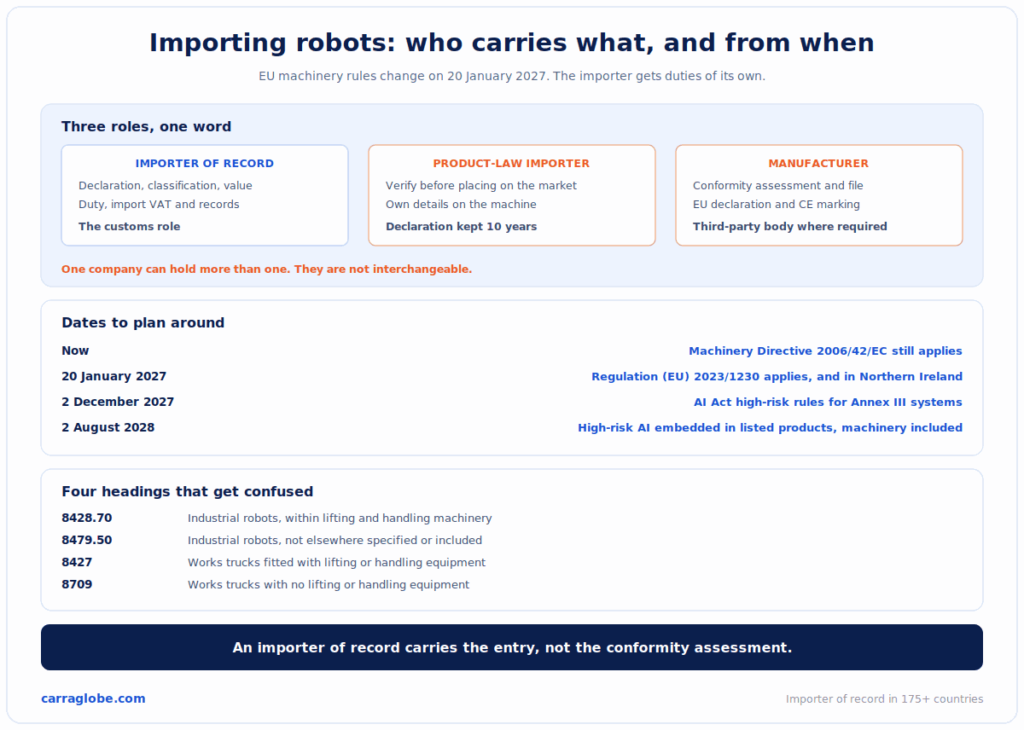
Classification: four headings that get confused
This is where robotics importers lose money quietly. There is more than one industrial robot subheading, and the one everybody quotes is the residual one.
| Heading | What it covers | The test |
|---|---|---|
| 8428.70 | Industrial robots, inside the heading for lifting, handling, loading or unloading machinery | Where the machine falls in heading 8428 on its objective characteristics |
| 8479.50 | Industrial robots, not elsewhere specified or included | Residual, so not for a machine specifically covered elsewhere in chapter 84 |
| 8427 | Fork-lift trucks and other works trucks fitted with lifting or handling equipment | Check the truck characteristics and the lifting or handling equipment |
| 8709 | Works trucks, self-propelled, not fitted with lifting or handling equipment, of the type used in factories and warehouses | Check whether it is the type of works truck the heading covers |
These are headings, not a universal answer: the code depends on the machine’s objective characteristics, its function, and the general interpretative rules and Section XVI notes. Because 8479.50 is residual, it should not be used where the machine is specifically covered elsewhere. The EU has ruled on a mobile robot directly. Commission Implementing Regulation (EU) 2019/1811 classified a self-propelled telepresence robot under CN code 8428 90 90, on the basis that an article performing several functions takes the heading of its principal function, which here was to transport and lift or lower the tablet it carried.
Note where it landed: the residual code within that heading, not the industrial robot subheading. The label on the product does not pick the code.
Two common shipments show how far apart they land. A fixed welding or assembly arm, which works on a part rather than moving goods, may fall under 8479.50 where it is an industrial robot not otherwise specified or included. A self-propelled unit that only carries totes raises the works truck question in 8709, and the same unit with a lift mast raises 8427 instead. These are the questions the legal texts ask, not determinations for a given machine.
Two notes decide the harder cases. Composite machines take the heading of the component performing the principal function, and where interconnected components contribute to one clearly defined function, the whole takes the heading for that function, which is how a robot cell with a controller, conveyor and safety system is treated. Our HS Code Finder and the guide to HS codes for electronics are a starting point, and what to do about a wrong HS code covers the clean-up.
Batteries change the routing, and the paperwork
An AMR or AGV traction battery will commonly fall in the industrial battery category under the EU batteries regulation rather than the light means of transport category, though confirm it against the battery’s design and intended use.
The residual limb turns on weight: any battery over 5 kg that is not an electric vehicle, light means of transport or starting battery. The LMT category covers batteries designed to provide traction for qualifying wheeled vehicles powered by an electric motor alone or by a combination of motor and human power. E-bikes and e-scooters are the familiar examples, but the definition turns on the vehicle’s characteristics rather than the label. The industrial category covers batteries specifically designed for industrial uses with no weight threshold, and otherwise any battery over 5 kg that is not an EV, LMT or starting battery.
Capacity also matters. Rechargeable industrial batteries above 2 kWh trigger further requirements, including carbon footprint, recycled content and performance and durability. Those requirements do not all switch on at the same time, so check the specific obligation and its date rather than treating 2 kWh as one deadline. Many AMR and AGV traction batteries sit above that line.
How the battery travels then changes what is possible. Batteries contained in or packed with equipment take UN3481 for lithium ion, while batteries shipped alone take UN3480. Under the applicable air provisions, standalone lithium-ion batteries are not accepted as cargo on passenger aircraft and are limited to a 30 per cent state of charge on cargo aircraft, subject to the packing instruction, watt-hour rating and carrier conditions.
So settle battery configuration before routing: a battery installed in the robot follows different provisions from spares shipped loose. Our guide to the EU battery regulation for importers covers the market-placement side.
Integration, modification and the day you become the manufacturer
Robotics is an integration business, and integration is where roles move. The Regulation defines a substantial modification as one made by physical or digital means after the machine was placed on the market, unforeseen by the manufacturer, affecting safety by creating a new hazard or increasing an existing risk in ways needing added guards or protective measures.
Moving production between sites raises the same question, covered in product certification when manufacturing moves. Note the phrase “by physical or digital means”: on the facts, a firmware change or a reprogrammed safety envelope can be a modification as much as a new gripper. Where a modification crosses that line, or a company supplies machinery under its own name, the compliance position changes and should be documented. Have that conversation with your integrator before the machine ships.
Demonstrations and trade fairs
Machinery that does not yet comply can still be shown. Member States must not prevent display at trade fairs and demonstrations, provided a visible sign states that it does not comply and will not be made available until brought into conformity, with adequate protective measures during demonstrations.
That is product law, not customs law. The goods still need a customs treatment, whether temporary admission, a carnet or a normal entry, with its conditions met and evidenced. Two systems, two answers, both have to be right.
The order to work in
For a robotics shipment, this sequence avoids the expensive mistakes. The freight commitment comes last on purpose.
- Define what is shipping. Complete machinery, partly completed machinery, or a cell assembled on site. The regime differs.
- Establish the purpose. Sale, integration, demonstration or testing.
- Classify for customs. Establish the function, configuration, self-propelled status and any lifting or handling equipment before selecting the code.
- Check the conformity position in the destination, including whether third-party assessment applies.
- Check the radio and battery position. Both change what moves, and how.
- Settle the roles in writing. Who is the importer of record, and who carries the product obligations, which who is liable when a reseller imports covers further.
- Then book the freight.
How Carra Globe handles robotics and automation shipments
We provide importer of record and exporter of record services for technology hardware across 175+ countries, including for companies with no entity in the destination market, as set out in importing without a local entity. Machine builders usually come to us with a delivery date and a customer waiting, often for a first shipment into a new country. Weighing this against your forwarder? Freight forwarder versus importer of record sets out the difference.
Before a date is promised, that means four things: classifying the shipment line by line, establishing whether a conformity gate applies in the destination, working out the transport position for any battery or radio module, and telling you in writing where the answer is no. What it does not replace is a manufacturer’s conformity assessment, a third-party certificate or a radio authorisation.
Importer of Record · Robotics & Automation
We carry the customs entry. Conformity stays with the manufacturer.
Being clear about the boundary: appointing an importer of record does not create a conformity assessment, a third-party certificate or a radio authorisation. What we do is classify the shipment line by line, establish whether a conformity gate applies in the destination, work out the transport position for any battery or radio module, and tell you in writing where the answer is no.
- Importer of record services
- Exporter of record services
- Importing without a local entity
- CE marking importer obligations
- EU battery regulation for importers
- EU Cyber Resilience Act for importers
- Importer of record in Germany
- Forwarder versus importer of record
- IOR by country
Free tools HS Code Finder Volumetric Weight Calculator Pallet Calculator
Shipping robots, cells or AMRs into a new market? Send the machine list, the destination and whether it is for sale, integration or testing. We will map the gates before quoting, and say plainly if a battery or a conformity step changes the date.
Check your robotics shipmentFrequently asked questions
When does the new EU machinery regulation apply?
From 20 January 2027. Machinery placed on the EU market before that date must comply with Machinery Directive 2006/42/EC, which the Regulation replaces.
Who counts as the importer of machinery in the EU?
A person established within the Union who places machinery from a third country on the Union market. Establishment inside the Union is part of the definition, so a non-EU supplier cannot hold the role itself.
Can an importer of record provide CE conformity?
No. The manufacturer carries out or arranges the conformity assessment and draws up the technical documentation. An importer of record carries the customs entry and the import obligations around it.
What HS code applies to an industrial robot?
It depends on function. Handling robots point to 8428.70, while 8479.50 covers industrial robots not specified elsewhere. Works trucks fall under 8427 or 8709 depending on lifting equipment.
Do warehouse robots need a notified body?
Only where they fall in a listed category, such as machinery with self-evolving machine learning ensuring safety functions. Most machinery is self-certified against the essential health and safety requirements.
Is there a US tariff on imported robots?
A Section 232 investigation into robotics and industrial machinery was initiated on 2 September 2025. No tariff or proclamation had been issued as at 24 September 2026, so check the current position before quoting.
Does Great Britain still accept CE marked machinery?
Yes. Government guidance confirms businesses may use UKCA or CE marking for the GB market, and a 2026 instrument keeps machinery meeting the new EU requirements acceptable in GB.
Sources and verification
- EU machinery: Regulation (EU) 2023/1230, for the Article 3 definitions, the Article 13 importer obligations including ten-year retention and source code, substantial modification and the trade fair provision. The European Commission machinery page gives the 20 January 2027 date. Directive 2006/42/EC applies until then.
- Third-party assessment categories: the European Parliament legislative summary, for the categories including safety components and machinery with self-evolving machine learning ensuring safety functions.
- AI timing: Regulation (EU) 2026/1744, the Digital Omnibus on AI of 8 July 2026, amending the AI Act and the machinery Regulation, with 2 August 2028 for high-risk AI embedded in listed products.
- United Kingdom: The Supply of Machinery (Safety) (Amendment etc.) and the EU Machinery Regulation (Enforcement etc. in Northern Ireland) Regulations 2026, with the purpose described in the Commons debate of 30 June 2026, and gov.uk product marking guidance for the UKCA and CE position.
- United States: the Federal Register notice on the Section 232 robotics investigation, 47 CFR 2.1204 for radio import conditions, and OSHA at 29 CFR 1910.303, 1910.399 and 1910.7.
- Classification and batteries: Commission Implementing Regulation (EU) 2019/1811 on the telepresence robot, with heading texts and Section XVI notes from the World Customs Organization nomenclature, and Regulation (EU) 2023/1542 for the battery categories and thresholds, with transport from US Department of Transportation and UK Civil Aviation Authority guidance.
- This is not legal advice. Conformity, classification and market placement are matters for the importer, its advisers and the authority concerned.
Disclaimer: This guide is for informational purposes only and does not constitute legal, customs or regulatory advice. Requirements change, and the position described is as at 25 September 2026. Confirm the current position with the competent authority or a qualified adviser before acting.