
Brexit did not change the duty on the core IT codes entering Great Britain. Servers, network kit and laptops still carry a 0% rate in the UK Global Tariff. What changed is who can stand as importer and how the VAT gets paid. When shipping IT equipment to the UK, those two questions decide whether the goods clear on arrival or wait. Across more than 300 UK shipments handled by Carra Globe and its team since 2020, clearance from arrival to customs release has taken the same day to one working day when the importer, values and paperwork were settled first.
This guide covers Great Britain, meaning England, Scotland and Wales. Northern Ireland works differently and has its own short section below.
The short version. Servers, network kit and laptops enter Great Britain at 0% duty, but 20% import VAT applies. Without UK premises you cannot usually get a GB EORI, and you can only import through an indirect representative, so most overseas sellers use their customer, a UK company or an importer of record. Eligible VAT-registered importers can postpone the VAT to their VAT return. CE marking is still recognised for most IT equipment. Northern Ireland works differently.
Carra Globe provides importer of record, exporter of record, delivered duty paid and freight forwarding services, so we have a commercial interest in your answer. What follows is written to be usable whether or not you ever speak to us.
What we see on UK IT shipments
Same day to one working day, when the importer is settled first. Our UK shipments cover servers and storage, routers, switches and access points, laptops and end-user devices, and data centre infrastructure. They also include electronic equipment for automotive, medical and aerospace clients. That clearance time is our experience, not an HMRC service standard, and a customs check or query can still add time.
Four recurring issues cause most of the delays we see. Each is covered below, with how to avoid it.
UK IT imports at a glance
Three of these points were updated in 2026. The government refreshed its CE and UKCA guidance in August, HMRC updated its Northern Ireland guidance in July, and the low-value import reform timetable was confirmed on 28 October.
| Point | Position as at October 2026 |
|---|---|
| Customs duty | 0% third-country duty on laptops (8471 30), servers (8471 50) and network equipment (8517 62), subject to the exact commodity code |
| Import VAT | 20% standard rate, separate from duty |
| Postponed VAT accounting | Available to eligible UK VAT-registered importers, with no approval needed |
| GB EORI | Usually needs UK premises |
| Overseas importer | Can only use a representative acting indirectly |
| Product marking | CE still recognised in Great Britain for most electrical and radio equipment |
| Low-value sales | Seller usually charges VAT at checkout on direct sales of £135 or less, with exceptions below |
| Clearance on our shipments | Same day to one working day when documents are complete |
Who can be the importer
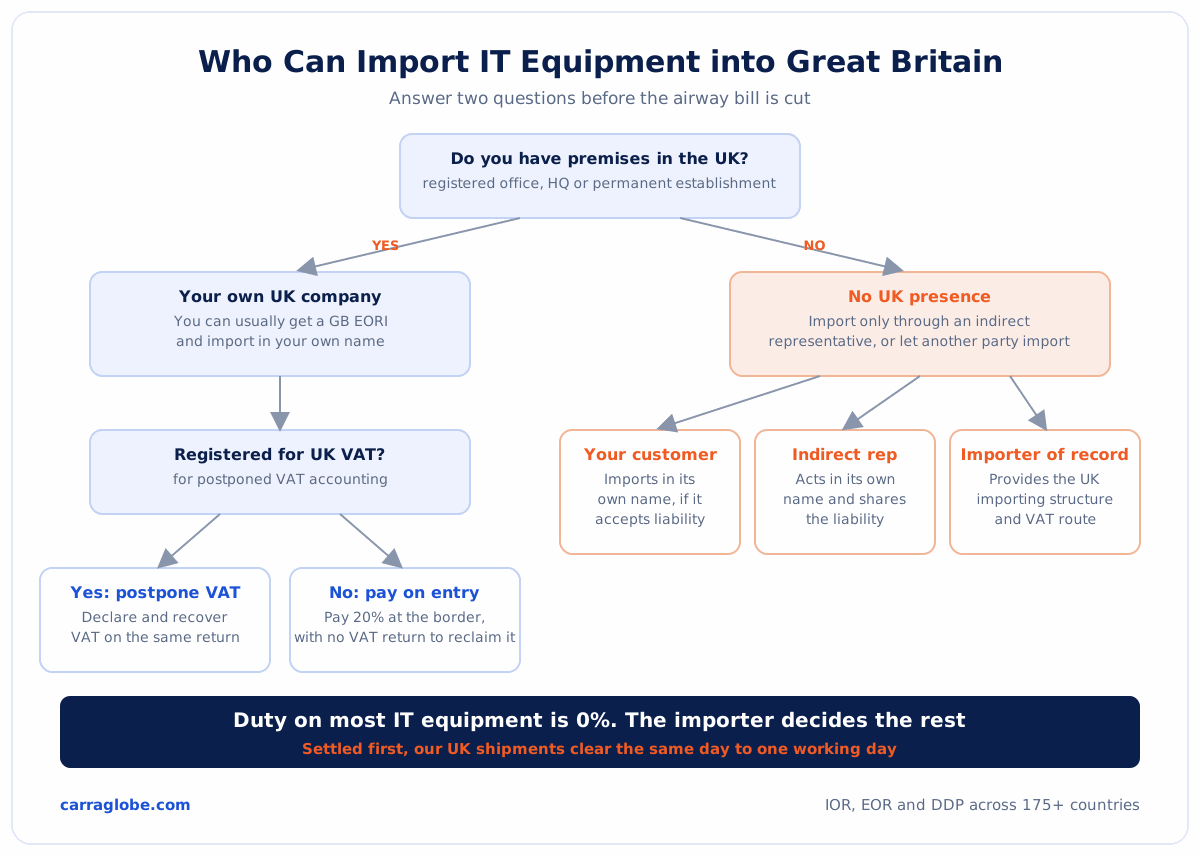
A GB EORI usually needs premises in the UK. HMRC’s guidance says a business usually needs a registered office, central headquarters or permanent business establishment in the UK, which HMRC calls being established, to get a GB EORI number. Without one, HMRC lists only specific cases for getting an EORI, such as transit or temporary admission. HMRC also says that if you are not established in the UK and import into Great Britain, you can only ask someone to act indirectly for you. That leaves a choice of who imports, and then a separate choice of how the declaration is made.
- Your customer. The buyer imports in its own name. Customers often resist taking on import liability for kit they have not fully paid for, as our guide on when the customer will not be the importer of record explains.
- Your own UK company. A UK entity with a GB EORI and VAT registration can import and use postponed VAT accounting.
- You, through an indirect representative. A UK-established agent acts in its own name on your behalf and can be jointly and severally liable for the customs duty or import VAT, so many decline or set conditions for unknown clients.
- An importer of record. Where none of these fits, an importer of record service provides the UK importing structure. The set-up decides who appears on the declaration, who carries the customs obligations and how the VAT is handled.
These routes are not interchangeable. Before dispatch, confirm who is named on the declaration, whose EORI and VAT details are used, who has the right to dispose of the goods, and who carries the customs and tax liabilities.
Agents must be UK-established and instructed in writing. HMRC says the freight forwarders, brokers and express operators you hire need to be established in the UK, and the written instructions must show whether they act directly or indirectly. If you want to use postponed VAT accounting, the agent also needs that in writing. For the wider picture, see what an importer of record does and our page on importer of record in the UK.
Duty is zero for most IT equipment
The UK Global Tariff sets 0% on the core codes. HMRC’s online tariff shows a 0% third-country duty on portable computers under 8471 30, processing units such as servers under 8471 50, and switching and routing equipment under 8517 62. Cables, racks, power units and some peripherals classify elsewhere and can carry their own rates, so check every line. Our guides to the HS code for servers and the HS code for routers and switches explain how these headings work.
Import VAT, and three ways to handle it
Import VAT is 20%, even when duty is 0%. HMRC’s tariff states that import VAT is separate from customs duty and may still be due when the duty rate is zero. On a server shipment, it is usually the largest border charge. How it is handled depends on the importer.
- Paid at the border. The importer pays the VAT on entry and, if VAT-registered, reclaims it later under the normal input-tax rules.
- Postponed VAT accounting. A UK VAT-registered importer declares the VAT on its VAT return instead of paying upfront. No approval is needed, but the goods must be for business use, the importer must have the right to dispose of them, and its VAT number must be on the declaration. Normal input-tax rules apply to recovery.
- Charged at the point of sale. For goods located outside the UK and sold directly to UK consumers in consignments of £135 or less, the seller charges UK VAT at checkout. Business buyers who give a UK VAT number, online marketplaces and Northern Ireland follow other rules.
The £135 customs duty relief is scheduled to end. The government’s policy paper, updated on 28 October 2026, says the new rules will start on a day set by regulations made by October 2028 at the latest. HM Treasury’s July 2026 response adds that duty will be due at UK Global Tariff rates and that an extra fee is still being designed. Most business IT shipments sit above £135, but online sellers should plan for it. Our guide to import VAT and the importer of record explains the VAT side.
Four issues that delay UK IT shipments
No UK importer or GB EORI. This is the most common delay on shipments from overseas sellers. The goods arrive and wait while someone is found to import them, so settle one of the routes above before the airway bill is cut.
A wrong or missing commodity code. Invoices that describe kit loosely, such as “IT equipment” or “spare parts”, leave the declarant guessing, and a wrong code on a line with a positive rate creates a duty debt even when the main units are 0%. Give each line a code and a description that matches the datasheet. Our guide to documentation errors that trigger UK customs audits covers what HMRC looks for.
Value or invoice problems. Loaned, replacement and used equipment often travels with no sale behind it, and a pro forma marked “no commercial value” invites questions. Customs needs a value it can support, which our guides to an importer of record when there is no sale and importing used and refurbished IT equipment explain.
Battery refusals by couriers. Laptops, servers and storage often carry lithium-ion cells, and air carriers apply IATA’s dangerous goods rules plus their own limits. Confirm the battery configuration with the carrier before booking, and see our guide to lithium battery customs clearance.
Shipping servers, network kit or laptops into the UK? Send Carra Globe the model list, values and delivery address, and we will confirm the importer, commodity codes and VAT route before anything is booked. Request a UK shipment check.
CE or UKCA marking
CE marking is still recognised in Great Britain for most IT equipment. The government’s guidance, last updated in August 2026, says the UK continues to recognise CE marking alongside or instead of UKCA under the Product Safety and Metrology (Amendment) Regulations 2024. Its list covers electrical equipment safety, electromagnetic compatibility, hazardous substances and radio equipment, with an exception for radio equipment where designated standards do not exist or have not been applied in full. Recognition does not remove the product requirements themselves or the need for conformity documents.
Selling the kit brings product duties. A business placing equipment on the GB market must work out which product-safety rules apply and meet the duties of its role, which can include checking the marking, documentation, manufacturer details and traceability information. Producer-responsibility duties for waste electrical equipment depend on its role and the scheme rules. Our guides cover CE marking obligations for importers and WEEE producer obligations. Medical and aerospace electronics follow their own sector approvals, covered on our pages for medical devices and aerospace and defence.
Great Britain is not Northern Ireland
Northern Ireland has its own framework. HMRC’s guidance, updated in July 2026, says EU VAT rules continue to apply to goods in Northern Ireland under the Windsor Framework, and the requirements depend on where the goods come from and who moves them. Goods arriving there from outside the UK and EU need declarations and any tariffs due, and businesses may need an EORI starting XI. A plan built for Great Britain should not be reused for Northern Ireland, so check HMRC’s Northern Ireland guidance listed in the sources first.
A six-point check before you book
- Name the UK importer, meaning your customer, your UK company, you through an indirect representative, or an importer of record.
- Confirm the GB EORI and VAT details that will appear on the declaration.
- Classify every line, including cables, racks and power units, not just the main units.
- Give each item a supportable value, especially loaned or used equipment.
- Choose the VAT route, paid at the border or postponed on the VAT return.
- Check batteries and marking with the carrier and the manufacturer before dispatch.
How Carra Globe handles UK IT shipments
We settle the importer and VAT route before the goods move. Carra Globe acts as importer of record for IT equipment entering the UK, working with established UK importing partners for some shipments and through the client’s own UK entity for others, depending on the goods and the client. We also handle onsite delivery through white glove delivery and larger projects through our importer of record for data centre equipment service.
Carra Globe works through importer-side registrations and local importing structures appropriate to the goods and destinations it accepts, its own in some markets and established local structures in others. Approvals falling outside the available structure are flagged before a delivery date is agreed.
When equipment later leaves the UK, we can act as exporter of record, and our IOR by country page covers 175+ countries. For a quote, send your draft commercial invoice with models, quantities and values, datasheets, battery details, total weight and dimensions, and the delivery address. Reach us at info@carraglobe.com.
United Kingdom · IT Equipment · Importer Of Record
Send the model list and delivery address. We will tell you who can import and how the VAT is handled before anything ships.
Most IT equipment enters Great Britain at 0% duty, but the importer, commodity codes and VAT route decide whether it clears the same day or waits. So the useful conversation is who stands as importer, whether postponed VAT accounting is available, and which lines need checking. Where something sits outside the structure available, you hear that before a delivery date is agreed.
- IT imports without a local entity
- Importer of record in Ireland
- Importer of record in the Netherlands
- Importer of record in Germany
- DDP versus importer of record
- What an importer of record costs
- How to calculate landed cost
- The cost of incorrect HS codes
- HS code for lithium batteries
- ATA carnet or temporary import bond
- Returned goods and reverse logistics
- Comparing DDP quotes for IT kit
- Which Incoterm protects tech shipments
- Protecting high-value cargo
- Global IOR for technology OEMs
Free tools HS Code Finder Volumetric Weight Calculator Pallet Calculator
Shipping servers, network kit or laptops into the UK? Send the draft invoice with models, quantities and values, datasheets, battery details, weights and dimensions, and the delivery address. We will come back on the importer, codes, VAT route and timing.
Check my UK shipmentFrequently asked questions
Is there import duty on servers in the UK?
Servers under 8471 50 carry 0% third-country duty in the UK Global Tariff. Import VAT at 20% still applies, and racks, cables and power units may have their own rates.
Can a non-UK company import into the UK?
Yes, into Great Britain, but only through a representative acting indirectly, who can be jointly liable. Many use their customer, a UK entity or an importer of record instead.
How does postponed VAT accounting work?
A UK VAT-registered importer declares import VAT on its VAT return instead of paying at the border, if the goods meet HMRC’s conditions. Recovery follows normal input-tax rules, and no approval is needed.
Is CE marking accepted in Great Britain?
For most electrical and radio equipment, yes. The UK continues to recognise CE alongside UKCA, with exceptions set out in government guidance.
How long does UK customs clearance take for IT equipment?
On our shipments, the same day to one working day when the importer and documents are settled first. That is our experience, not a guarantee.
Do the same rules apply in Northern Ireland?
No. Under the Windsor Framework, EU VAT rules apply to goods in Northern Ireland, and imports there have their own declaration and EORI requirements.
Adjacent ground: reducing import duty in the UK and exporter of record in the UK.
Sources and verification
Shipment counts, goods types, clearance times and the causes of holds are Carra Globe’s own, covering UK shipments handled by Carra Globe and its team. Regulatory points were checked against official publications on 29 October 2026.
- Duty and VAT rates. The UK Integrated Online Tariff for commodity code 8471 30 00 00, commodity code 8471 50 00 00 and commodity code 8517 62 00 00.
- EORI. HMRC on who needs an EORI number and the establishment test.
- Customs agents. HMRC on getting someone to deal with customs for you and what to consider first, including the indirect-only rule for importers not established in the UK.
- Postponed VAT. HMRC on accounting for import VAT on your VAT return.
- Low-value goods. HMRC on VAT and overseas goods sold directly to customers in the UK, the government’s policy paper on reforming the customs treatment of low value imports, updated 28 October 2026, and HM Treasury’s July 2026 response on reforming the customs treatment of low value imports.
- Product marking. The government’s guidance on placing UKCA or CE marked products on the market in Great Britain, last updated August 2026.
- Northern Ireland. HMRC on trading and moving goods in and out of Northern Ireland, last updated July 2026.
- Verification note. UK customs and VAT rules change, and the treatment depends on the exact goods, the importer and the destination. Check the current position for your shipment before relying on this guide. Nothing here is advice on your shipments.
Disclaimer: This guide is for informational purposes only and does not constitute legal, customs, tax or product compliance advice. Requirements depend on the specific equipment, its classification and value, the destination and the parties involved. The position described is as at 30 October 2026. Confirm the current position with HMRC or your importer of record before shipping.