
Shipping servers to the UAE is rarely held up by the flight. It is held up by the name on the import declaration and by paperwork that does not match the hardware. Across more than 500 UAE shipments handled by Carra Globe and its team, the pattern has been consistent. When the importer, certificates and documents are settled before the goods leave, servers clear in one to two working days. When they are not, the delay depends entirely on what is missing.
The short version. UAE customs generally expects a UAE-licensed importer with a customs code, so a foreign company without a local entity usually ships through an importer of record. IT hardware covered by the WTO’s Information Technology Agreement may enter duty-free, depending on the exact tariff line, and import VAT applies on goods entering the mainland. Decide early whether the servers go to a mainland data centre, a free zone or onward to another country. For advanced GPU servers, check the US export licence position too.
Carra Globe provides importer of record, exporter of record, delivered duty paid and freight forwarding services, so we have a commercial interest in your answer. What follows is written to be usable whether or not you ever speak to us.
What a clean UAE server clearance looks like
One to two working days, when everything is in before arrival. That is what we see on servers, storage and networking kit going into Dubai and Abu Dhabi data centres when every certificate is complete and submitted and no inspection intervenes. It is our experience, not a customs service standard. Declarations are filed electronically, through Mirsal 2 in Dubai and the Advanced Trade and Logistics Platform in Abu Dhabi. Filing documents before arrival can shorten clearance, though document review and inspection still set the pace.
The holds come from shipments that started somewhere else. Shipments that run with us from the start rarely miss anything, because the compliance check happens before booking. The ones that arrive stuck mid-shipment usually already have a mix of gaps. A missing radio approval, an invoice that does not match the HS code, an unattested certificate of origin and incomplete battery papers are the four we see most. Our guide to a customs hold on servers covers what happens once a shipment is stopped.
A real case from our records. A server shipment for a Dubai data centre reached us after it had already left the origin country. When we checked the papers, the model numbers on the commercial invoice did not match the packing list. Customs compares the two, so the declaration could not safely go ahead.
We worked with the shipper and the consignee to get a corrected invoice, matched every model number and quantity to the packing list, and passed the clean set to the party handling clearance. The corrected papers took at least two working days to arrive, and customs released the servers three working days after that.
That is five working days or more, against the one to two we usually see. A document check before the goods left would have avoided most of that wait. Client details are withheld.
UAE server imports at a glance
Three of these points changed or took effect in 2026. They are the TDRA policy, the US export rule and the FTA’s free zone clarification, each covered below.
| Point | Position as at October 2026 |
|---|---|
| Clearance on our shipments | One to two working days when documents are complete |
| Customs duty | 5% general rate. Lines covered by the WTO ITA may be 0%, so check the exact code |
| Import VAT | 5% on goods entering the mainland |
| Invoice attestation | Mandatory from Dh10,000. Fee of AED 150 per invoice or certificate of origin |
| Attestation deadline | 14 days from the bill-of-entry date. Late penalty of AED 500 per invoice, on top of the fee |
| TDRA type approval | Policy version 4.0, in force since 1 May 2026 |
| RoHS conformity (ECAS) | Cabinet Resolution No. 10 of 2017, listed IT equipment in scope |
| US export rule for the UAE | Effective 10 July 2026. 3A090 and 4A090 items still need a licence unless every recipient is approved |
| Free zone VAT | FTA clarification TAXP010, 2 October 2026 |
Who can import servers into the UAE
The importer needs a UAE licence and a customs code. Dubai Customs’ own policies say every person dealing with the customs administration must register for a customs code and present a valid licence from a competent authority. US government guidance on UAE imports says the same thing in practice, that importers need the correct trade licence. A foreign company with no UAE entity therefore cannot usually appear as importer in its own name.
That leaves three routes. You can set up a UAE company, ask your customer to import, or use an importer of record in the UAE. Customers may prefer not to take on the import liability for equipment they did not buy outright, which our guide to when the customer will not be the importer of record covers. For a wider view, see how to import IT equipment without a local entity.
Duty and VAT on servers entering the UAE
The headline 5% may not apply to IT hardware. UAE customs applies a general duty of 5% on goods from abroad, with rates varying by tariff line. The UAE also participates in the WTO’s Information Technology Agreement, which covers most servers, storage and network equipment. Products covered by that agreement may enter at zero duty where the UAE’s tariff commitment provides it, so confirm the rate for the exact code, starting with the HS code for servers or the HS code for routers and switches.
Import VAT is the cost to plan for. Goods entering the mainland generally attract VAT at the standard 5% rate. Who accounts for it depends on the import structure, and recovery follows the normal input-tax rules, so an importer of record does not by itself make the VAT recoverable. Our guide to import VAT and the importer of record explains how that works, and reducing import duty in the UAE covers the duty side.
Mainland, free zone or onward to another country
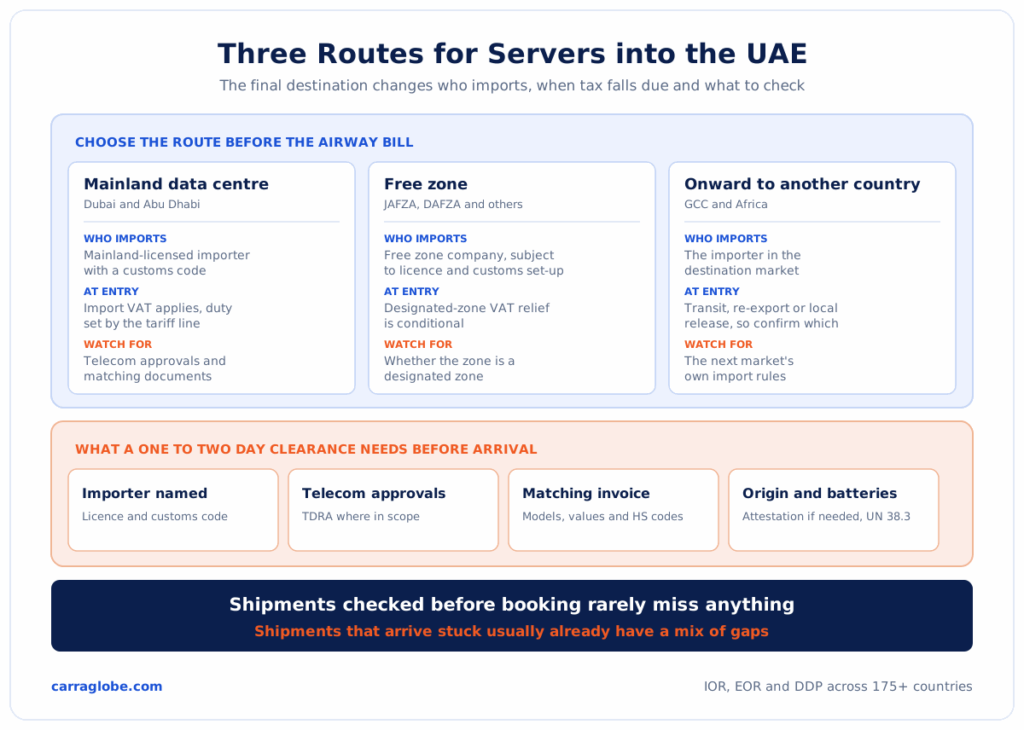
The final destination decides the route. Our UAE server shipments split across four destinations, mainland Dubai data centres, Abu Dhabi data centres, free zones such as JAFZA and DAFZA, and re-export to other GCC or African markets. Each one changes who can stand as importer and when tax falls due, so settle it before the airway bill is issued, not after the goods land.
- Mainland data centre. A mainland-licensed importer clears the goods, and import VAT applies on entry.
- Free zone. A free zone company may import into its zone under its licence and customs arrangements, so confirm its permitted activities and customs registration first. Moving the goods on into the mainland counts as an import.
- Onward to another country. Sharjah Customs excludes goods in transit to GCC countries from the 5% duty, but transit, re-export and release into the local market are different customs procedures, so confirm which applies before arrival. The onward market has its own rules, such as those in Saudi Arabia or across the wider GCC.
Not every free zone is a designated zone. Under the FTA’s guidance, qualifying supplies and movements of goods within a designated zone may be treated as outside the UAE for VAT, subject to conditions. A free zone that is not designated is treated like any other part of the UAE. Check the status of your delivery address, because it changes the VAT position even behind a free zone gate.
Five checks that decide how fast UAE servers clear
TDRA approval for telecom functions. Most servers have no radio, but switches, access points and servers with wireless modules do. Telecom equipment within TDRA’s scope, wired or wireless, may need type approval, and suppliers of covered equipment must register with TDRA. Under Type Approval Policy version 4.0, in force since 1 May 2026, an approval stays with its original holder but can be delegated to another UAE company through an arrangement registered with TDRA. Confirm the approval covers the exact model and that your importer can rely on it. Our certification lead times by country show how long a new UAE approval has taken us.
RoHS conformity under ECAS. The UAE’s RoHS regulation, Cabinet Resolution No. 10 of 2017, covers IT equipment, naming centralised data processing equipment, mainframes and minicomputers, and limits hazardous substances in them. The Ministry of Industry and Advanced Technology issues conformity certificates for it under the ECAS scheme, asking for a RoHS declaration and a test report from an ISO 17025 accredited laboratory. The resolution itself bars non-conforming products from display or sale without setting out a customs check, so confirm with the manufacturer and your importer whether a certificate is needed for your models and their use.
An invoice that matches the hardware. Model numbers, quantities, values and HS codes on the commercial invoice need to agree with the packing list and the goods. A mismatch is one of the fastest ways to turn a one-day clearance into a week, which our guide on a wrong HS code on the invoice explains.
Attested origin and invoice documents. Since 1 February 2023, the Ministry of Foreign Affairs has required electronic attestation through eDAS for imported goods valued at Dh10,000 and above. It can follow the bill of entry, but must be completed within 14 days of the bill-of-entry date, or a penalty of AED 500 per invoice applies on top of the attestation fee. Gaps in origin documents still slow the shipments that reach us already stuck, so have the invoice and certificate of origin ready before dispatch.
Battery transport rules for air cargo. Servers and storage often carry lithium cells for memory backup or RAID controllers. The requirements depend on the battery chemistry, watt-hour rating, configuration, packing instruction and any operator or state variations, so confirm them with the carrier before booking. Where UN 38.3 applies, keep the test summary available, though it does not have to travel with every shipment, and see our guide to lithium battery customs clearance.
Shipping servers into a UAE data centre, free zone or onward to the GCC? Send Carra Globe the model list, delivery address and arrival date, and we will check the importer, approvals and documents before anything is booked. Request a UAE shipment check.
GPU and AI servers face two sets of rules
The US side changed on 10 July 2026, but not into a blanket exemption. A Commerce Department rule moved the UAE into Country Group A:5 and out of D:3 and D:4, while keeping licence controls on advanced-computing items under ECCN 3A090.a and .b, 4A090.a and .b and related .z items.
Any exception depends on the item and the recipient. Supplement No. 8 lists three groups of approved recipients, each with a set scope. They are UAE government agencies, a short list of UAE companies, and named US-headquartered AI companies with their subsidiaries. The two UAE companies approved in July lose that status on 6 April 2027 unless BIS says otherwise. Before shipping, check the classification, the licence or exception, the ultimate consignee and every end user, because approval does not override end-use restrictions.
The UAE side has its own controls. Federal Decree-Law No. 43 of 2021 on non-proliferation applies across the whole state, free zones included. It covers import, export, re-export and transit, requires permits for listed goods and can reach unlisted items where end-use or end-user concerns arise. Whether a GPU server needs a UAE permit depends on its specification and end use. See our guides to importer of record for AI servers and GPU clusters and export controls on data centre hardware.
A six-point check before you book
- Fix the final destination, mainland, free zone or onward, and the delivery address.
- Name the UAE importer that holds the licence and customs code for that route.
- Confirm the HS code and duty rate for each model, and budget for import VAT.
- Check approvals, meaning TDRA type approval for telecom functions, wired or wireless, and, where it applies to your models, RoHS conformity under ECAS.
- Prepare the documents, meaning the invoice, packing list, certificate of origin and transport documents, with attestation for goods valued at Dh10,000 or more and battery paperwork confirmed with the carrier.
- Clear export controls on GPU servers at both the US and UAE ends before the goods move.
How Carra Globe handles UAE server shipments
We run the compliance check before the goods move. Carra Globe acts as importer of record for servers, storage and network equipment entering the UAE, using its own registration for some shipments and established local partners for others, depending on the goods and destination. We also handle onward delivery into the data hall through white glove delivery in the UAE, and wider projects through our importer of record for data centre equipment service.
Carra Globe works through importer-side registrations and local importing structures appropriate to the goods and destinations it accepts, its own in some markets and established local structures in others. Approvals falling outside the available structure are flagged before a delivery date is agreed.
When equipment later leaves the UAE, Carra Globe can act as exporter of record, and our IOR by country page covers 175+ countries. If you are weighing providers, see comparing DDP quotes. For a UAE quote, send us your draft commercial invoice, datasheets, total weight and dimensions, the delivery address and the date the servers need to arrive. Reach us at info@carraglobe.com.
United Arab Emirates · Servers · Importer Of Record
Send the model list and delivery address. We will tell you how your servers clear in the UAE before they ship.
Servers going into the UAE clear in one to two working days on our shipments when the importer, approvals and documents are settled first. So the useful conversation is whether the goods go to the mainland, a free zone or onward, who stands as importer, and which approvals and attested documents each model needs. Where something sits outside the structure available, you hear that before a delivery date is agreed.
- Importer of record in Qatar
- Importer of record in Oman
- Importer of record in Kuwait
- Importer of record in Bahrain
- Saudi free zone rules for tech imports
- Bahrain free zone rules for tech kit
- Kuwait telecom import rules
- Importing liquid cooling and coolant
- Importing data centre cabling
- Importing diesel generators
- HS code for GPU chips
- Importing high-end GPU servers
- Emergency spare parts clearance
- What an importer of record costs
- ATA carnet or temporary import bond
Free tools HS Code Finder Volumetric Weight Calculator Pallet Calculator
Shipping servers, storage or networking kit into the UAE? Send the draft invoice, datasheets, weights and dimensions, delivery address and arrival date. We will come back on the importer, approvals, documents and timing.
Check my UAE shipmentFrequently asked questions
How long does customs clearance take for servers in the UAE?
On our shipments, one to two working days when documents and approvals were complete and submitted in advance. That is our experience, not a guarantee, as inspections and customs queries can add time.
Can a foreign company import servers into the UAE?
Not usually in its own name. UAE customs expects a licensed importer with a customs code, so foreign companies typically use a local entity, their customer or an importer of record.
Is there customs duty on servers in the UAE?
The general rate is 5%, but IT hardware covered by the WTO Information Technology Agreement may enter duty-free. Confirm the rate for the exact tariff line.
Do servers need TDRA approval?
Equipment with radio or telecom functions may need TDRA type approval and a registered supplier. Check each model’s wireless and telecom functions against TDRA’s policy.
Do I need a US export licence to ship AI servers to the UAE?
It depends on the item’s classification. For servers with chips under ECCN 3A090 or 4A090, a licence is needed unless every recipient is approved under the July 2026 rule. End-use restrictions still apply.
Is shipping to a UAE free zone different from the mainland?
Yes. A free zone company may import under its licence and customs arrangements, designated-zone VAT treatment is conditional, and moving goods into the mainland counts as an import.
Adjacent ground: what an importer of record does, the GCC single customs window, how to calculate landed cost and shipping AI servers internationally.
Sources and verification
Clearance times, shipment counts and the causes of holds are Carra Globe’s own, covering shipments handled by Carra Globe and its team till 2026. Regulatory points and source links were checked against official publications on 25 October 2026.
- Who imports. The Dubai Customs policies booklet on client registration and customs codes, and the US International Trade Administration guide to UAE import requirements.
- Duty. Sharjah Customs on the UAE customs tariff and the WTO Information Technology Agreement schedules.
- VAT and free zones. The Federal Tax Authority’s public clarification TAXP010 on free zones and designated zones of 2 October 2026.
- Attestation. The Ministry of Foreign Affairs eDAS attestation service, the MOFA FAQs on the Dh10,000 threshold and 1 February 2023 start, and the eDAS 2.0 guidance on the 14-day window and AED 500 fine.
- Radio equipment. TDRA telecom supplier registration and the TDRA FAQs on Type Approval Policy version 4.0, which give its 1 May 2026 start date.
- RoHS and ECAS. Cabinet Resolution No. 10 of 2017 on the UAE RoHS regulation and the Ministry of Industry and Advanced Technology ECAS conformity certificate service, with its list of technical requirements for regulated products.
- US export rules. The Bureau of Industry and Security announcement and the Federal Register rule of 14 July 2026, effective 10 July 2026, and the current list of approved recipients in Supplement No. 8 to Part 740 of the Export Administration Regulations.
- UAE controls. Federal Decree-Law No. 43 of 2021 on goods subject to non-proliferation and its executive regulation, Cabinet Resolution No. 97 of 2024.
- Customs systems. Dubai Customs on Mirsal 2 and the Abu Dhabi Media Office on ATLP.
- Batteries. The IATA DGR 66 addendum listing current UAE state variations.
- Verification note. UAE customs, tax and export control rules change, and duty depends on the exact tariff line. Check the current position for your shipment before relying on this guide. Nothing here is advice on your shipments.
Disclaimer: This guide is for informational purposes only and does not constitute legal, customs, tax or export control advice. Requirements depend on the specific equipment, its classification, destination and end use, and the parties involved. The position described is as at 28 October 2026. Confirm the current position with the relevant UAE authority or your importer of record before shipping.