
Brazil RoHS puts the importer’s signature on the line. CONAMA Resolution 516, dated 8 July 2026 and published on 10 July 2026, sets Brazil’s first limits on hazardous substances in IT, telecom and other electronic equipment. The importer that declares conformity, and the legal representative or attorney who submits the declaration, can answer administratively and criminally for its accuracy. The first limits already apply and mercury follows from 6 January 2027, so expect your importer to ask for evidence first.
The short version. CONAMA 516 limits ten substances in electronic equipment sold in Brazil, with deadlines running from July 2026 to July 2030. Importers will register each model or product family in a national registry, issue a self-declaration and keep Portuguese technical documentation until five years after the product is discontinued. The registry is not live yet, so build the evidence file now.
Carra Globe provides importer of record, exporter of record, delivered duty paid and freight forwarding services, so we have a commercial interest in your answer. What follows is written to be usable whether or not you ever speak to us.
What CONAMA 516 covers
Electrical and electronic equipment up to 1,000 V AC or 1,500 V DC. IT and telecom equipment are named, and wires, cables and spare parts for repair, reuse, upgrades or added capacity are covered too, so servers, laptops, routers and switches all sit within its reach.
Some categories are excluded. Among others, Article 3 leaves out batteries, which follow their own rules such as lithium battery customs clearance, defence and space equipment, large-scale fixed installations, large fixed industrial equipment, and equipment designed only for research and development and supplied between businesses or institutions.
Is a data centre a large-scale fixed installation? The resolution defines it as a large-scale combination of several types of apparatus, assembled, installed and dismantled by professionals for permanent use in a set place, and lists it separately from large fixed industrial equipment. Servers, switches and storage are still imported as separate products, so do not assume a data centre project escapes the limits. Get a written view on your equipment before you rely on the exclusion.
Brazil RoHS substance limits and deadlines
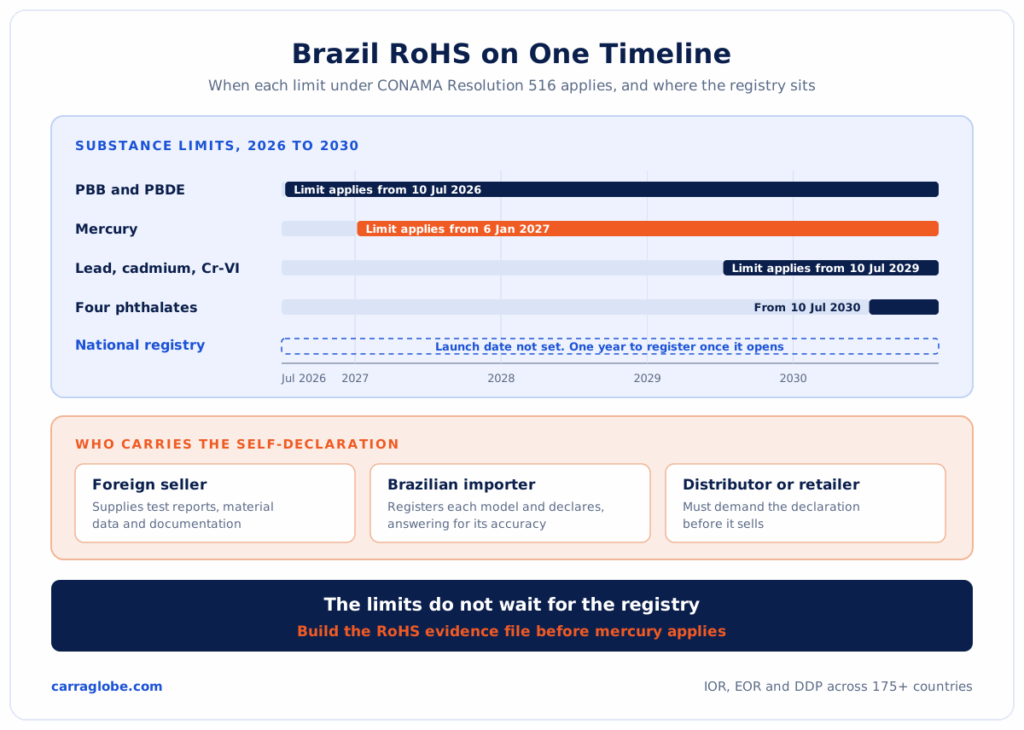
The limits are set by mass of homogeneous material, as in other RoHS regimes. Article 4 staggers them by substance, counting from publication on 10 July 2026, which was also the date of entry into force.
| Substances | Maximum concentration | Applies from |
|---|---|---|
| PBB and PBDE flame retardants | 0.1% | 10 July 2026, on entry into force |
| Mercury | 0.1%, or stricter limits under Decree No. 9,470 of 2018 | 180 days after entry into force, which by our count is 6 January 2027 |
| Lead and hexavalent chromium | 0.1% | 3 years after publication, 10 July 2029 |
| Cadmium | 0.01% | 3 years after publication, 10 July 2029 |
| Phthalates DEHP, BBP, DBP and DIBP | 0.1% | 4 years after publication, 10 July 2030 |
Older stock and repair parts get some room. The limits do not apply to equipment, cables or spare parts for repairing or reusing equipment already on the market that was designed and made before the relevant deadline. Check this if you ship used or refurbished IT equipment. Article 5 also allows temporary exemptions where substitution is not feasible, and Article 27 requires the Ministry to publish an initial list of exempt equipment and applications, with validity periods, within 180 days of publication.
What the importer must do
Article 13 gives importers the same core duties as manufacturers. For each model it imports, the importer must
- ensure it was designed and made to meet the limits and deadlines
- register each model or product family in the national registry and keep the entry up to date
- issue a self-declaration of conformity for each one and make it available
- require Portuguese technical documentation from the foreign manufacturer and keep it, from the date the declaration is issued (Article 26)
- keep the declaration and documentation for five years after the product is discontinued
- keep traceability records for five years after import and hand them to the environmental authority on request
The declaration travels with the product. It goes in the packaging, in full or by QR code, and online. If it cannot go in the packaging, it must be supplied within five working days of a request. Distributors and retailers must demand it before selling, so once declarations exist, a missing one can block the sale.
Labels change too. Once the declaration is issued, equipment must carry durable identification in Portuguese, covering the model, batch or serial number or other identifying details, a trade name or registered brand with one contact address in Brazil, and the importer’s identity. This can be given through a QR code or similar link. Where reverse logistics applies, the crossed-out bin symbol follows two years later.
The national registry and its one-year window
Registration will be mandatory, but the launch date matters. Article 7 creates the National Registry of Electrical and Electronic Equipment with Restrictions on Hazardous Substances and makes registration a precondition for import, subject to Article 11, which allows one year from the day the system goes live. The Ministry of the Environment is responsible for setting it up, and as at 22 October 2026 we found no announcement that it is live, so do not assume you can register yet or that the year has started.
The substance limits do not wait for the registry. Flame retardant limits already apply and mercury applies from 6 January 2027 either way. The Ministry must define the minimum technical documentation within 180 days of publication, so expect that by early January 2027.
Shipping servers, laptops or network kit into Brazil? Send Carra Globe your model list and the RoHS evidence you hold, and we will tell you what the importer will need before it signs a declaration. Request a Brazil import check.
Why foreign sellers feel this first
The person signing carries the risk, so expect them to ask for proof. An importer exposed to liability for an inaccurate declaration will want test reports, material declarations and Portuguese documentation from you first. If you sell into Brazil without a local entity, that evidence becomes part of the deal.
Own-brand and modified goods shift the burden. Under Article 16, an importer selling under its own brand, or altering equipment in a way that could affect compliance, takes on the manufacturer’s obligations. So does a distributor or retailer that sells without demanding the declaration. The resolution defines an importer as bringing goods in for distribution or sale, so confirm how imports for your own use are treated.
Enforcement can involve testing. The federal environmental authority may sample any batch, order tests at labs accredited under ILAC or IAAC agreements, and charge testing, seizure, storage and destruction costs to the party in breach. Federal public buyers may also demand compliance before the deadlines, which matters for tech firms supplying Brazilian projects.
A five-step Brazil RoHS check
- List every model and product family you ship to Brazil, including spare parts and cables.
- Collect RoHS evidence such as test reports and material declarations, and check mercury content first, since that limit arrives on 6 January 2027.
- Prepare Portuguese technical documentation for the importer once the Ministry defines the minimum content.
- Plan the labels, with model, serial or batch, brand, a Brazilian contact address and the importer’s identity in Portuguese.
- Agree who signs the declaration and who registers the models, and build that into your landed cost and lead times.
How Carra Globe handles Brazil shipments
We have shipped hardware into Brazil, and we check the compliance file before accepting a shipment. Carra Globe acts as importer of record for IT, data centre and network hardware entering Brazil, and we will tell you what RoHS evidence the importer needs for each model. See our importer of record in Brazil page and our guide to reducing import duty in Brazil.
When equipment later leaves, Carra Globe can act as exporter of record, as our exporter of record in Brazil page explains, with wider coverage on our IOR by country page.
Carra Globe works through importer-side registrations and local importing structures appropriate to the goods and destinations it accepts, its own in some markets and established local structures in others. Approvals falling outside the available structure are flagged before a delivery date is agreed.
For a Brazil quote, send us your draft commercial invoice, datasheets, delivery address and the date the goods need to arrive. Reach us at info@carraglobe.com.
Brazil · RoHS · Importer Of Record
Send the model list. We will tell you what the importer needs before it declares conformity.
CONAMA Resolution 516 puts the self-declaration on the importer, and its legal representative can answer for the accuracy of what is declared. So the useful conversation is which models need RoHS evidence, what Portuguese documentation the importer will ask for, and who registers each model once the national registry opens. Where something sits outside the structure available, you hear that before a delivery date is agreed.
- IOR for system integrators
- Global IOR for technology OEMs
- When the customer will not be IOR
- How to verify an IOR provider
- What an importer of record costs
- DDP or importer of record
- How to compare DDP quotes
- Data centre equipment IOR
- AI servers and GPU clusters
- Data centre cabling fire ratings
- EU Battery Regulation for importers
- Importer of record in Mexico
- NOM certification in Mexico
- Importer of record in Colombia
- Cambodia Qualified Agent certificate
Free tools HS Code Finder Volumetric Weight Calculator Pallet Calculator
Shipping servers, laptops or network kit into Brazil? Send the model numbers with HS codes and any RoHS test reports or material declarations, the delivery address and your arrival date. We will come back on the evidence the importer needs and how the shipment enters.
Check my Brazil shipmentFrequently asked questions
What is Brazil RoHS?
CONAMA Resolution 516, published on 10 July 2026, which limits ten hazardous substances in electrical and electronic equipment sold in Brazil and requires registration and a self-declaration of conformity.
When does Brazil RoHS apply to mercury?
From 6 January 2027 by our count, which is 180 days after the resolution entered into force on 10 July 2026. The stricter limits under Decree No. 9,470 of 2018 apply where relevant.
Who signs the Brazil RoHS self-declaration?
For imported equipment, the Brazilian importer registers the model or product family and issues the declaration through the national registry. The declarant and its legal representative answer for the accuracy of the information.
Does Brazil RoHS cover servers and network equipment?
Yes, the resolution names IT and telecom equipment within its scope, including parts, cables and spare parts, unless an Article 3 exclusion applies.
Is the Brazil RoHS registry open yet?
We found no announcement that it is live as at 22 October 2026. Once it opens, importers have one year to register models and issue declarations.
Does Brazil RoHS apply to spare parts?
Yes, spare parts for repair, reuse, upgrades or added capacity are covered. Parts for repairing or reusing equipment already on the market, designed and made before the relevant deadline, are outside the limits.
Adjacent ground: what an importer of record does, whether you need an import licence in Brazil, the Brazil Section 301 tariff question, and the EU equivalents in CE marking importer obligations and WEEE producer obligations.
Sources and verification
Checked against the full text of CONAMA Resolution 516 as published in the Diário Oficial da União, on 22 October 2026.
- The resolution. CONAMA Resolution No. 516 of 8 July 2026 in the Diário Oficial da União, published on 10 July 2026, covering scope and definitions (Arts. 1 to 3), limits and deadlines (Art. 4), exemptions (Arts. 5 and 6), the registry and self-declaration (Arts. 7 to 11), importer obligations (Arts. 13 to 17), labelling (Arts. 18 to 20), enforcement (Arts. 21 to 23) and transitional rules (Arts. 26 to 31).
- The official copy. The resolution as published by the National Environment Council (CONAMA).
- Mercury. Decree No. 9,470 of 14 August 2018, cited in Article 4 for mercury concentrations and restrictions.
- Verification note. The Ministry of the Environment still has to launch the registry and publish exemptions and technical documentation rules, so check the current position before relying on this guide. Nothing here is advice on your shipments.
Disclaimer: This guide is for informational purposes only and does not constitute legal, customs or environmental compliance advice. Brazil RoHS obligations depend on the equipment, the parties involved and rules the Ministry of the Environment has yet to publish. The position described is as at 22 October 2026. Confirm the current position with the Ministry of the Environment and Climate Change or your importer of record before shipping.