
China checks IT equipment on the way in and on the way out, and the rules are strict on both sides. Shipping IT equipment to China means fixing the consignee, the tariff line, any US-origin tariffs, CCC and radio approval before the goods leave. Across more than 150 China shipments handled by Carra Globe and its team, clearance has usually taken one to two working days when the compliance file was complete before arrival.
The short version. You need a consignee registered with Chinese customs, usually your customer, a local entity or an importer of record. Core IT lines carry 0% MFN duty, but US-origin goods can face additional tariffs, and import VAT is 13%. Servers and computers need CCC, Wi-Fi equipment generally needs SRRC approval, and used kit is judged case by case.
Carra Globe provides importer of record, exporter of record, delivered duty paid and freight forwarding services, so we have a commercial interest in your answer. What follows is written to be usable whether or not you ever speak to us.
What we see on China IT shipments
One to two working days, when the compliance file is complete. Our China shipments cover servers and storage, network equipment, laptops and data centre infrastructure. That timing is our experience, not an official standard or a guarantee.
In our experience, holds usually come from compliance gaps, not from faults in the goods. Checking before dispatch helps prevent them, although inspections and customs queries can still occur. The common ones are covered further down.
China IT imports at a glance
What changed in 2026. Two updates matter for IT shipments this year.
- 1 January. The VAT Law of the People’s Republic of China replaced the old provisional VAT regulations, keeping 13% for most goods.
- September. China and the US agreed to extend their Kuala Lumpur trade arrangements to 10 January 2027.
| Point | Position as at November 2026 |
|---|---|
| Importer | A consignee registered with Chinese customs |
| MFN customs duty | 0% on laptops, servers and switches under the ITA, by exact line |
| US-origin goods | 10% additional tariff retained, a further 24% suspended for one year to 10 November 2026, so recheck the latest measure |
| Import VAT | 13% for computers, servers and network equipment |
| CCC | Required for catalogue items such as servers, computers and power supplies, unless an exemption certificate is granted |
| Radio approval | SRRC type approval for most radio transmitters, such as Wi-Fi access points |
| Used equipment | Not banned outright for computers, but high risk and decided case by case |
| Clearance on our shipments | One to two working days when the file is complete |
Who can be the importer
The consignee must be registered with Chinese customs. China cancelled the separate foreign trade operator registration on 30 December 2022, but consignees still file with customs under GACC Order 253. That needs an eligible entity in China, such as a Chinese company or a registered branch of a foreign company, so an overseas seller without one normally uses one of these routes.
- Your customer. The buyer imports in its own name, which works when it accepts the liability and the certification duties. Many decline, as our guide on when the customer will not be the importer of record explains.
- Your own Chinese entity. A local company registered with customs can import, though certification and radio approval still apply product by product.
- An importer of record. Where neither fits, an importer of record service arranges an eligible local importing structure. The Chinese entity registered with customs is named as consignee and takes on the importer obligations under the agreed arrangement.
Confirm the consignee before dispatch. Seller, buyer and consignee can be different parties, but each role must be clear on the invoice, the transport documents and the declaration. See what an importer of record does and our page on importer of record in China.
Duty, US-origin tariffs and VAT
Core IT lines generally carry 0% most-favoured-nation (MFN) customs duty. Under the WTO Information Technology Agreement, the MFN rate is 0% on laptops (8471 30), servers and other processing units (8471 50) and switches and routers (8517 62). Cables, racks and power units classify elsewhere. See our guides to the HS code for servers and the HS code for routers and switches.
US-origin equipment can face additional tariffs. From 10 November 2025, China kept a 10% additional tariff on US-origin imports and suspended a further 24% for one year, a period ending on 10 November 2026. In September 2026, the Ministry of Commerce said both sides would extend their wider Kuala Lumpur arrangement to 10 January 2027.
Check the 24% layer at shipment. The Ministry did not name the 24% suspension as separately extended, so do not assume it continues past 10 November 2026 without a further Chinese announcement. Check it, the tariff line and any exclusions before quoting.
Import VAT is 13%, even when duty is zero. The VAT Law in force since 1 January 2026 sets 13% for computers, servers and network equipment, on the customs dutiable value plus duty and any consumption tax. Recovery depends on the importer’s own VAT position. See our guides to import VAT and the importer of record and calculating landed cost.
CCC, radio approval and encryption
Servers and computers sit in the CCC catalogue. China Compulsory Certification lists microcomputers, portable computers, displays, printers, servers and power supplies, each with its own scope. Routers and switches are not in these categories, though some security appliances are, so check each model. Customs checks CCC certificates and marks, and goods that fail can be held.
An exemption is possible, but never automatic. Under Article 42 of the CCC provisions, the importer applies to the local market regulator, and the goods can only be imported once the exemption certificate is granted. Do not assume an ATA carnet or a bonded-zone move removes the requirement. Exemptions cover purposes such as these.
- Research and testing.
- End-user repairs.
- Commercial display, not sale.
- Temporary imports that are re-exported.
Wi-Fi equipment generally needs SRRC approval. Radio transmitters made or imported for sale or use in China need type approval from the Ministry of Industry and Information Technology, unless they are on its current list of exempt micro-power devices. Equipment connecting to the public telecom network can also need a Network Access Licence, mobile phones being the classic case. See our importer of record for telecom equipment service.
Most encryption does not need an import licence. Only four categories do, namely encrypted telephones, encrypted fax machines, high-performance cipher machines and cards, and high-performance encrypted VPN equipment. Mass-market consumer products are excluded, so check the actual specifications. See our guide to encryption import restrictions on network equipment.
Used and refurbished equipment
Used computers are not banned outright, but they are high risk. China’s prohibited list of used electromechanical products includes used monitors, but not used computers or servers. Worn-out or scrap-like kit, however, can count as solid waste, which China has banned since 1 January 2021. Used goods also face inspection and, where listed, CCC. See our guide to importing used and refurbished IT equipment.
Moving through Hong Kong or a bonded zone
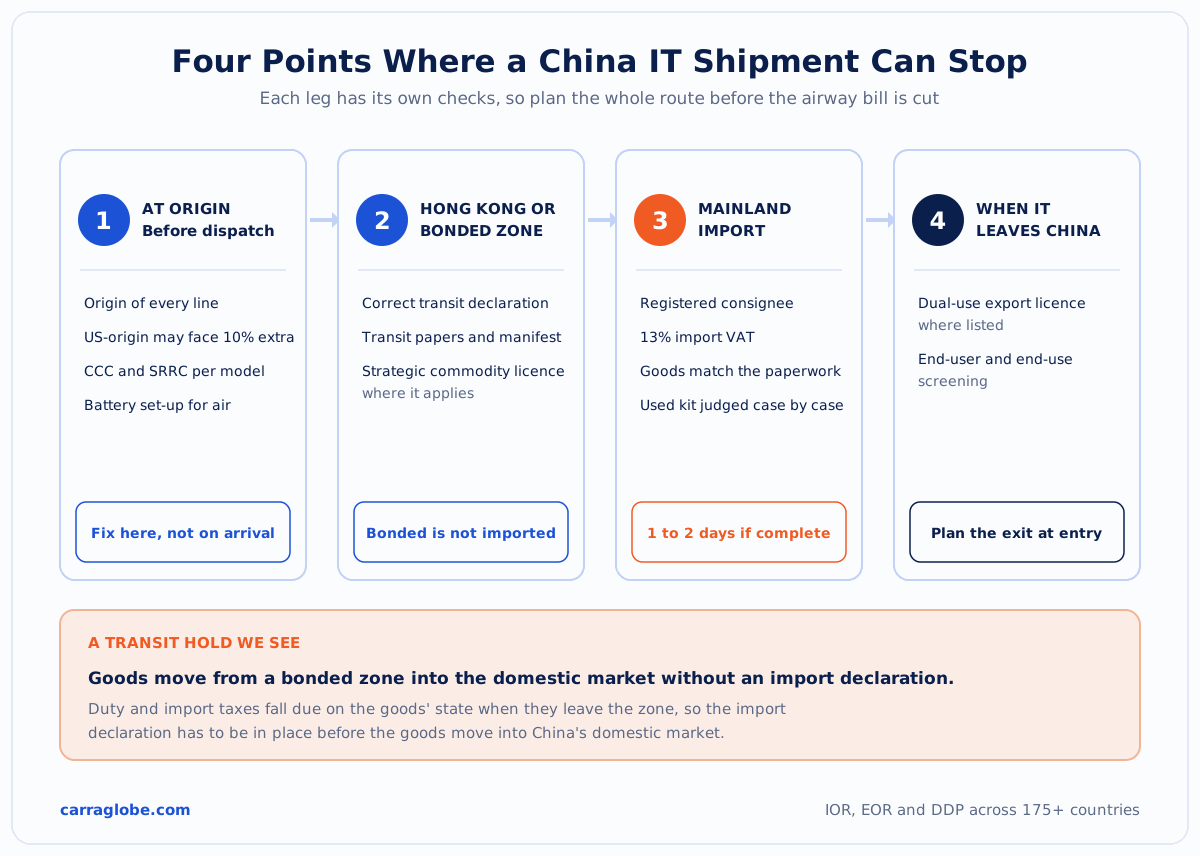
Bonded is not the same as imported. Goods in a mainland comprehensive bonded zone stay bonded. Moving them into the domestic market needs an import declaration, with duty and taxes based on their state when they leave the zone. Goods entering domestic circulation without that clearance is a hold we see.
Hong Kong is a separate customs territory. Strategic commodities moving through Hong Kong can need import and export licences, with conditional exemptions for some air transhipment cargo. Transit holds we see come from wrong transit declarations, missing transit papers, manifest errors and goods that differ from the paperwork. See our guides to Hong Kong as an IOR hub for IT equipment and importer of record in Hong Kong.
When the equipment later leaves China
Plan the exit as carefully as the entry. Since 1 December 2024, exporting listed dual-use items from China needs a Ministry of Commerce licence, and a catch-all rule can reach unlisted items. End-user and end-use screening, destination and classification all matter. See our guide to export controls on data centre hardware and our page on exporter of record in China.
Four issues that delay China IT shipments
Certification gaps. A missing CCC certificate or SRRC approval cannot be arranged quickly once goods have landed. Confirm both for every model before the airway bill is cut.
Classification and value queries. Loose invoice descriptions and values that do not match the datasheet invite questions. Give each line its code and a precise description, and see what to do about a wrong HS code on an invoice.
Documents that disagree. Model numbers, quantities and serials must match across the invoice, packing list and declaration. Loaned or replacement equipment with no sale behind it needs a supportable value, as our guide to an importer of record when there is no sale explains.
Battery holds. Air carriers apply IATA dangerous goods rules to the lithium-ion cells in laptops, servers and storage. Since 1 August 2024, lithium-ion cells and packs for portable electronics, and power banks, also need CCC, so they can be held at customs too. Not every server battery is in scope, so check each one, and see our guide to lithium battery customs clearance.
Shipping servers, network kit or laptops into China? Send Carra Globe the model list, values, origin and delivery address, and we will confirm the consignee, certifications and charges before anything is booked. Request a China shipment check.
A six-point check before you book
- Name the Chinese consignee, meaning your customer, your local entity or an importer of record.
- Classify every line, including cables and power units.
- Confirm the origin of each line, since US-origin goods may face additional tariffs.
- Check CCC and SRRC for every model, or the exemption route that applies.
- Flag any used or refurbished item before it is packed.
- Plan the route, including any Hong Kong or bonded-zone stage, and the eventual exit.
How Carra Globe handles China IT shipments
We settle the consignee and certifications before the goods move. Carra Globe arranges importer of record services for IT equipment entering China, usually through an established local importing partner. Before dispatch, we confirm the legal entity named as consignee on the declaration and the responsibilities it accepts. We also handle onsite delivery through white glove delivery and larger projects through our importer of record for data centre equipment service.
Carra Globe works through importer-side registrations and local importing structures appropriate to the goods and destinations it accepts, its own in some markets and established local structures in others. Approvals falling outside the available structure are flagged before a delivery date is agreed.
When equipment later leaves China, we can support the export as exporter of record, and our IOR by country page covers 175+ countries. For a quote, send your draft commercial invoice with models, quantities, values and origin, datasheets, battery details, total weight and dimensions, and the delivery address. Reach us at info@carraglobe.com.
China · IT Equipment · Importer Of Record
Send the model list and delivery address. We will tell you who can be the consignee and which certifications apply before anything ships.
Core IT lines enter China at 0% duty, but the consignee, the origin of every line, CCC, SRRC radio approval and the route through Hong Kong or a bonded zone decide whether goods clear in a day or two or sit waiting. So the useful conversation is who stands as consignee, which models need certification and how the shipment will later leave China. Where something sits outside the structure available, you hear that before a delivery date is agreed.
- IT imports without a local entity
- IOR for AI servers and GPU clusters
- ATA carnet or temporary import bond
- Importer of record in Taiwan
- Reducing import duty in Hong Kong
- ITAR and EAR on IT hardware shipments
- DDP versus importer of record
- What an importer of record costs
- The cost of incorrect HS codes
- HS code for lithium batteries
- Returned goods and reverse logistics
- Comparing DDP quotes for IT kit
- Freight forwarder versus IOR
- Protecting high-value cargo
- Global IOR for technology OEMs
Free tools HS Code Finder Volumetric Weight Calculator Pallet Calculator
Shipping servers, network kit or laptops into China? Send the draft invoice with models, quantities and values, datasheets, battery details, weights and dimensions, and the origin and delivery address. We will come back on the consignee, codes, certifications, charges and timing.
Check my China shipmentFrequently asked questions
Can a foreign company import into China?
Not ordinarily as the directly registered consignee without an eligible Chinese entity or branch. Most overseas sellers use their customer, a local company or an importer of record.
Is there import duty on servers in China?
Servers under 8471 50 carry 0% most-favoured-nation duty. Import VAT at 13% still applies, and US-origin servers can face an extra 10%.
Do US-made servers pay extra tariffs in China?
They can. China kept an extra 10% on US-origin imports and suspended a further 24% for one year, a period ending 10 November 2026. Check the current measure before shipment.
Do servers need CCC certification?
Servers within the CCC catalogue scope need certification unless the importer obtains an exemption certificate, for example for testing or a re-exported temporary import. Check the exact model first.
Can you import used servers into China?
Used computers and servers are not on the prohibited catalogue, but scrap-like equipment can count as banned solid waste. Treat each shipment case by case.
How long does China customs clearance take for IT equipment?
On our shipments, one to two working days when the compliance file is complete. That is our experience, not a guarantee.
Adjacent ground: China’s rare earth export controls in 2026 and supply chain diversification away from China.
Sources and verification
Shipment counts, goods types, clearance times and the causes of holds are Carra Globe’s own, covering China shipments handled by Carra Globe and its team. Regulatory points were checked against official publications on 2 November 2026, and the US-origin tariff position should be rechecked after 10 November 2026.
- Importer registration and customs filing. The government’s notice on cancelling foreign trade operator registration from 30 December 2022, and China Customs’ guide to consignee filing under GACC Order 253, used here for the eligible entity types only, since its reference to foreign trade operator filing predates the 2022 cancellation.
- Import VAT. The State Taxation Administration’s text of the VAT Law of the People’s Republic of China, in force from 1 January 2026.
- Tariffs. The Ministry of Finance’s Customs Tariff Commission announcement on US-origin tariffs, effective 10 November 2025, the Ministry of Commerce’s 28 September 2026 explanation of the eighth round of talks, the government’s 28 September 2026 update, and the 2026 tariff adjustment plan.
- CCC. The State Administration for Market Regulation’s Provisions on Administration of China Compulsory Certification, Article 42 on exemptions, its 2023 announcement bringing lithium-ion batteries and power banks into CCC, CNCA’s 2026 announcement No. 7 on the revised power bank rules from 1 April 2027, and CNCA’s implementation rules for electronic products and safety accessories (CNCA-C09-01:2023), which list microcomputers, portable computers, displays, printers and servers.
- Radio approval. MIIT Order 57, the Radio Transmitting Equipment Management Provisions, in force from 1 July 2023.
- Micro-power radio devices. MIIT Announcement No. 52 of 2019 and its catalogue of exempt devices.
- Network access. The State Council’s rules on telecom equipment network access.
- Encryption. The National Cryptography Administration’s explanation of commercial cryptography import and export licensing and the Commercial Cryptography Administration Regulations, in force from 1 July 2023.
- Used goods. The catalogue of used electromechanical products prohibited from import and the announcement on the full ban on solid waste imports.
- Bonded zones. GACC Order 256 on comprehensive bonded zones.
- Hong Kong transit. Customs and Excise Department guidance on air transhipment cargo.
- Export controls. The Dual-Use Items Export Control Regulations, in force from 1 December 2024.
- Verification note. Chinese import rules, tariffs and catalogues change, and the treatment depends on the exact goods, origin and importer. Check the current position for your shipment before relying on this guide. This guide is general information, not advice on your shipment.
Disclaimer: This guide is for informational purposes only and does not constitute legal, customs, tax or product compliance advice. Requirements depend on the specific equipment, its classification, value and origin, and the parties involved. The position described is as at 3 November 2026. Confirm the current position with the Chinese authorities or your importer of record before shipping.