
In Turkey, the duty on core IT codes is often zero. The paperwork is where shipments stall. Shipping IT equipment to Turkey means settling the importer, the 12-digit tariff line, any additional duty, device checks and product inspection before the goods land. Across more than 150 Turkey shipments handled by Carra Globe and its team, customs release has come on the day of arrival or the next working day when the compliance file was ready before arrival.
Turkey’s official name is Türkiye, and the government uses it in its own publications. This guide uses both.
The short version. You need an importer with a Turkish tax number, usually your customer, a local company or an importer of record. Core IT lines often carry no duty, but some cables and power units attract additional duty by origin. Expect 20% KDV, plus a 4% TRT levy on specified computer and tablet tariff lines. Devices with an IMEI need a check before release, and used or refurbished kit generally needs a permit.
Carra Globe provides importer of record, exporter of record, delivered duty paid and freight forwarding services, so we have a commercial interest in your answer. What follows is written to be usable whether or not you ever speak to us.
What we see on Turkey IT shipments
Same day to one working day, when the compliance file is ready before arrival. Our Turkey shipments cover servers and storage, network equipment, laptops and data centre infrastructure, from the EU, the US, the UK and Asia. That is our experience, not an official standard, and an inspection can still add time.
In our experience, most holds start with a compliance gap, not a customs decision. A missing registration or a small mismatch between near-identical models can stop a shipment worth millions, while storage charges keep running.
What adds time. On our shipments, the extra days usually come from a TAREKS inspection, an IMEI control, a used goods permit, or a GTİP or value question at customs. Checking the requirements before the airway bill is cut anticipates most of them, although inspections and customs queries cannot always be avoided.
Turkey IT imports at a glance
What changed in 2026. Four updates matter for IT shipments this year.
- 1 January. New import communiqués took effect, including 2026/7 on IMEI checks and 2026/9 on used goods.
- 1 January. The 2026 product inspection communiqués started, covering radio equipment, CE-marked products and batteries.
- 11 July. The additional customs duty annex was last amended, by Decision 11508.
- 5 October. The Ministry of Trade updated its list of product groups inspected at import.
| Point | Position as at November 2026 |
|---|---|
| Importer | Any person with a Turkish tax number, under the Import Regime Decree |
| Tariff line | 12-digit GTİP code on the declaration |
| Customs duty | Often 0% on core IT lines under the ITA, by exact line |
| Additional customs duty | None on 8471, 8473 or 8517, but some 8504 and 8544 lines by origin |
| KDV (import VAT) | 20% general rate |
| TRT levy | 4% on computers and tablets under 8471 30, 41, 49 and 50 |
| IMEI check | Control letter needed for goods with an IMEI, under Communiqué 2026/7 |
| Used or refurbished goods | Permit generally needed for free circulation |
| Clearance on our shipments | Same day to one working day when the compliance file is ready before arrival |
Who can be the importer
The importer needs a Turkish tax number. Under Article 8 of the Import Regime Decree, individuals and legal entities issued a Turkish tax number under the Tax Procedure Law may import. That provision does not make Turkish incorporation a general condition, but a tax number does not remove product-specific licensing, registration or compliance requirements. Getting a tax number and meeting every duty yourself is slow, so most overseas sellers use one of these routes.
- Your customer. The buyer imports in its own name, which works when it accepts the liability and the registrations. Many push back, as our guide on when the customer will not be the importer of record explains.
- Your own Turkish company. A local entity with a tax number can import, may deduct eligible KDV under the normal rules and hold the registrations itself.
- An importer of record. Where neither fits, an importer of record provides the Turkish importing structure. The set-up decides who appears on the declaration and who carries the obligations.
Keep each party’s role clear on paper. The summary declaration is separate from the import declaration and is lodged before arrival by the person bringing the goods in or an authorised representative, often the carrier. Seller, buyer, consignee and importer need not be the same company, especially with an importer of record, but each role must be correctly identified and backed by the commercial and transport documents. See what an importer of record does and our page on importer of record in Turkey.
Duty and additional customs duty
Many core IT lines carry no customs duty. Türkiye is part of the WTO Information Technology Agreement, so computers, servers and much network equipment can enter duty-free. The exact 12-digit GTİP line decides it, and cables, racks and power units classify separately. See our guides to the HS code for servers and the HS code for routers and switches.
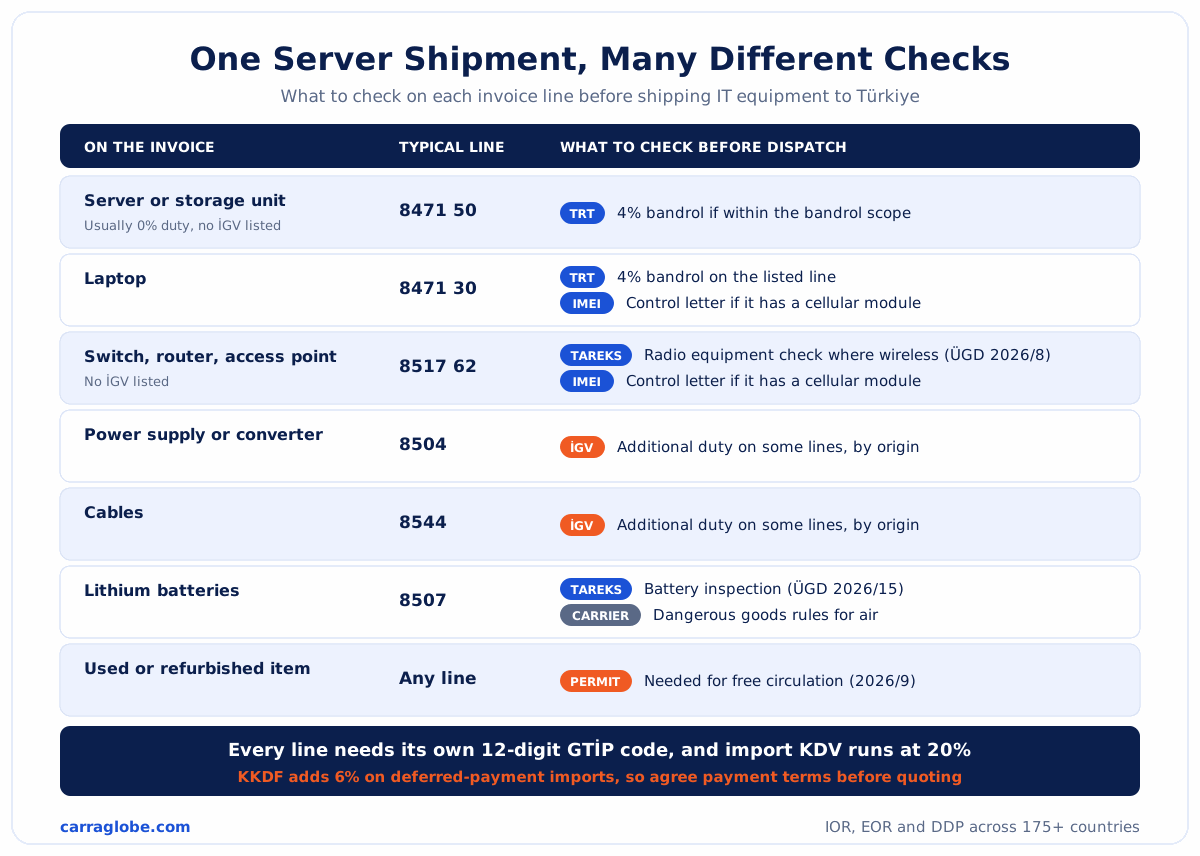
No additional duty on the core server and network codes, but cables and power units can attract it. Decision 3351 adds this duty, known as İGV, on top of the normal rate. The current annex tables have no entries under 8471, 8473 or 8517, while some power equipment under 8504 and cables under 8544 do carry it, at rates set by the exact line and origin. Check every component separately, not just the main unit.
An A.TR shows free circulation, not origin. For industrial goods covered by the EU and Türkiye customs union, the A.TR certificate shows free circulation status, and it is not a certificate of origin. For listed goods made outside the EU and Türkiye, the “Other Countries” additional duty rate can still apply. The exception covers goods from countries in a cross-cumulation system under a Turkish free trade agreement, with preferential origin proven. Check origin and the annex together before quoting.
KDV, the TRT levy and other charges
KDV applies at 20%, even when duty is zero. The rate has been 20% since 10 July 2023, under Presidential Decision 7346. A Turkish importer may be able to deduct import KDV, subject to the VAT rules, documents and restrictions. Decision 7846 makes only the KDV on certain surveillance-related value increases, safeguard duties and anti-dumping or countervailing charges non-deductible, not the KDV on the ordinary import value. KDV General Implementation Communiqué No. 57, published on 31 January 2026, introduced notification or certification requirements for affected importers, depending on the value of the relevant imports. See our guide to import VAT and the importer of record.
The listed computer and tablet lines carry a 4% TRT levy, not 2%. Law 3093 charges a one-off bandrol levy on devices able to receive visual or audio broadcasts, on the import KDV base excluding special consumption tax. The law text still says 2%, but Decision 5610 of May 2022 set 4% for 8471 30, 41, 49 and 50. Some server processing units fall under 8471 50, so confirm both the exact classification and whether the equipment is within the bandrol scope before quoting. A quote built on 2% understates the charge by half. See our guide to calculating landed cost.
Other import charges to check. KKDF, a fund levy, generally adds 6% to imports paid by acceptance credit, deferred letter of credit or open-account payment (mal mukabili). It does not apply where the import price is paid before the customs obligation begins and the payment is properly evidenced to customs. Special consumption tax (ÖTV) applies to some electronics, such as mobile phones, so check each line against the ÖTV lists. Agree the payment method before quoting, since it can change the landed cost.
IMEI checks and product inspection
Devices with an IMEI number need a check first. Import Communiqué 2026/7 applies before free circulation or temporary import. Laptops with cellular modules, cellular tablets and some routers are the usual IT cases.
- Apply through the Single Window System to the Information and Communication Technologies Authority.
- The IMEI is checked against GSMA brand and model records and for lost, stolen or altered numbers.
- An IMEI number control letter is issued, and customs checks it electronically at registration. It does not replace product safety documents.
Product inspection can apply through TAREKS. Three 2026 product safety communiqués (the ÜGD series, numbered separately from import communiqués) matter most for IT kit. Whether a shipment is actually checked depends on its GTİP code and TAREKS risk rules.
- ÜGD 2026/8. Radio and telecom terminal equipment.
- ÜGD 2026/9. Certain CE-marked products, including electrical and electronic devices.
- ÜGD 2026/15. Batteries and accumulators.
Our guides to CE marking obligations for importers and our importer of record for telecom equipment service cover the documents.
Used and refurbished equipment
Used and refurbished kit generally needs a permit for free circulation. Import Communiqué 2026/9 sets two routes, one for listed goods and one for everything else, so the GTİP code decides which applies. The Ministry weighs the importer, the quantity, domestic supply and the equipment’s economic life and efficiency, so approval is not automatic.
The permit is not the only document. Product safety and other rules still apply. See our guide to importing used and refurbished IT equipment.
Temporary storage deadlines and charges in Turkey
Goods have 45 days by sea and 20 days by other modes. Article 46 of the Customs Law sets these limits for giving goods an approved customs treatment. The law counts from the summary declaration, but because that declaration is normally lodged before the goods arrive, Article 77(2) of the Customs Regulation starts the clock on presentation to customs. Miss it and liquidation rules can apply. Storage fees build up meanwhile, so ask for rates before booking, and see our guide to a customs hold on servers.
The clock can pause, but not on its own. Article 76 of the Regulation leaves out time spent on legal or administrative proceedings and on getting documents such as conformity documents, licences, permission letters or analysis reports, and the remaining days resume afterwards. Where customs may not know about the delay, tell the customs office in time and keep proof of the start and end dates.
Extensions must be requested before the deadline. Customs offices can extend the periods on a written application made before the existing deadline runs out, and a request for more than one month must give reasons. Extensions are not automatic and cannot go beyond real need.
Four issues that delay Turkey IT shipments
A missing country-specific check. An IMEI check, a radio equipment check or a used goods permit is slow to arrange after arrival. Confirm which apply to each model before dispatch.
Near-identical items with different specifications. Two lookalike models can sit on different tariff lines, or only one may have a cellular module. Match each line’s GTİP code and description to the datasheet, and see what to do about a wrong HS code on an invoice.
Value or invoice problems. Loaned, replacement and used equipment often travels with no sale behind it, and a pro forma with no supportable value invites questions. Our guide to an importer of record when there is no sale explains the options.
Battery refusals by carriers. Laptops, servers and storage often carry lithium-ion cells, and air carriers apply IATA’s dangerous goods rules plus their own limits. Confirm the battery configuration before booking, and see our guide to lithium battery customs clearance.
Shipping servers, network kit or laptops into Turkey? Send Carra Globe the model list, values and delivery address, and we will confirm the importer, GTİP codes, registrations and charges before anything is booked. Request a Turkey shipment check.
A six-point check before you book
- Name the Turkish importer, meaning your customer, your local company or an importer of record.
- Classify every line to 12 digits, including cables and power units.
- Check the additional duty annex against the origin of each line.
- Confirm the IMEI check for any device with an IMEI number.
- Apply for a permit if any item is used or refurbished.
- Check batteries and inspection with the carrier and against the 2026 communiqués.
How Carra Globe handles Turkey IT shipments
We settle the importer and registrations before the goods move. Carra Globe arranges importer of record services for IT equipment entering Turkey, through an importing structure suited to each shipment. Before dispatch, we confirm the legal entity that will be named as importer on the customs declaration and the responsibilities it accepts. We also handle onsite delivery through white glove delivery and larger projects through our importer of record for data centre equipment service.
Carra Globe works through importer-side registrations and local importing structures appropriate to the goods and destinations it accepts, its own in some markets and established local structures in others. Approvals falling outside the available structure are flagged before a delivery date is agreed.
When equipment later leaves Turkey, we can act as exporter of record, and our IOR by country page covers 175+ countries. For a quote, send your draft commercial invoice with models, quantities and values, datasheets, battery details, total weight and dimensions, and the delivery address. Reach us at info@carraglobe.com.
Turkey · IT Equipment · Importer Of Record
Send the model list and delivery address. We will tell you who can import and which registrations apply before anything ships.
Core IT lines often enter Turkey without customs duty, but the importer, the 12-digit GTİP code, IMEI checks and any additional duty decide whether goods clear the same day or wait in storage. So the useful conversation is who stands as importer, which lines need checking and which approvals apply. Where something sits outside the structure available, you hear that before a delivery date is agreed.
- IT imports without a local entity
- Importer of record in Germany
- Importer of record in the Netherlands
- DDP versus importer of record
- What an importer of record costs
- The cost of incorrect HS codes
- HS codes for electronics and tech
- HS code for lithium batteries
- ATA carnet or temporary import bond
- Returned goods and reverse logistics
- Comparing DDP quotes for IT kit
- Avoiding customs delays
- Freight forwarder versus IOR
- Protecting high-value cargo
- Global IOR for technology OEMs
Free tools HS Code Finder Volumetric Weight Calculator Pallet Calculator
Shipping servers, network kit or laptops into Turkey? Send the draft invoice with models, quantities and values, datasheets, battery details, weights and dimensions, and the delivery address. We will come back on the importer, codes, registrations, charges and timing.
Check my Turkey shipmentFrequently asked questions
Can a foreign company import into Turkey?
The importer needs a Turkish tax number. A foreign company can look at obtaining one, but most overseas sellers use their customer, a local company or an importer of record.
Is there import duty on servers in Turkey?
Core IT lines are often duty-free because Türkiye is an ITA participant. KDV at 20% still applies, and some cables and power units carry additional duty.
What is additional customs duty in Turkey?
It is an extra duty under Decision 3351, set by tariff line and country of origin. Check the Ministry of Trade’s consolidated annex for each line.
Do laptops need an IMEI check in Turkey?
Only if they carry an IMEI number, usually through a cellular module. Those laptops need an IMEI number control letter under Import Communiqué 2026/7 before free circulation or temporary import.
Can you import refurbished servers into Turkey?
For release for free circulation, generally only with a permit under Import Communiqué 2026/9. The GTİP code decides the permit route, and approval is not automatic.
How long can goods stay in Turkish customs storage?
The Customs Law sets 45 days for sea arrivals and 20 days for other modes. Where the summary declaration is lodged before presentation, the period starts when goods are presented to customs.
Adjacent ground: IT hardware import regulations by country and a paper IOR compared with an operational one.
Sources and verification
Shipment counts, goods types, origins, clearance times and the causes of holds are Carra Globe’s own, covering Turkey shipments handled by Carra Globe and its team. Regulatory points were checked against official publications on 30 October 2026.
- Importer and storage. The Ministry of Trade’s frequently asked questions on imports, covering the tax number rule, the 12-digit GTİP code and the summary declaration, dated 5 June 2026.
- Additional customs duty. The Ministry of Trade’s consolidated Decision 3351 and annexes, with annex tables Ek-1 to Ek-3 checked at full GTİP level, current to Decision 11508 of 11 July 2026.
- Import communiqués. The Official Gazette texts of Import Communiqué 2026/7 on goods with an electronic identity and Import Communiqué 2026/9 on used or refurbished goods, listed on the Ministry’s 2026 import communiqués page.
- Used goods guidance. Import Communiqué 2026/9 above is the main legal reference, as this Ministry of Trade page on importing used or refurbished goods still cites the 2025 communiqué.
- A.TR and origin. The Ministry of Trade on A.TR, EUR.1 and certificates of origin.
- Storage deadlines. Customs Law 4458, Articles 46 to 48, including extensions under Article 46(3), and the Customs Regulation, Article 76 on pausing the periods and Article 77(2), which starts them at presentation where the summary declaration comes first.
- Summary declaration. The Ministry of Trade on who lodges the summary declaration.
- Product inspection. The Ministry of Trade’s list of product groups inspected at import, covering ÜGD 2026/8, 2026/9 and 2026/15, updated 5 October 2026.
- KKDF. Decree 88/12944 on the Resource Utilisation Support Fund and Article 2 of KKDF Communiqué No. 6, with the Revenue Administration’s opinion letter of 2 June 2023 on proving payment before the customs obligation.
- Non-deductible import KDV. Presidential Decision 7846 in the Official Gazette of 24 November 2023.
- KDV reporting. KDV General Implementation Communiqué No. 57 in the Official Gazette of 31 January 2026, which sets the six-monthly notification or certified report.
- KDV rate. Presidential Decision 7346 in the Official Gazette of 7 July 2023.
- TRT levy rate. Presidential Decision 5610 in the Official Gazette of 26 May 2022, and TRT’s own page on Decision 5610 listing the 8471 lines at 4%.
- TRT levy. Law 3093 on TRT revenues, Articles 3 and 4.
- ITA. The WTO’s page on ITA schedules of concessions, which lists Türkiye.
- Verification note. Turkish import rules, rates and annexes change often, and the treatment depends on the exact goods, origin and importer. Check the current position for your shipment before relying on this guide. This guide is general information, not advice on your shipment.
Disclaimer: This guide is for informational purposes only and does not constitute legal, customs, tax or product compliance advice. Requirements depend on the specific equipment, its classification and value, its origin and the parties involved. The position described is as at 2 November 2026. Confirm the current position with the Turkish authorities or your importer of record before shipping.